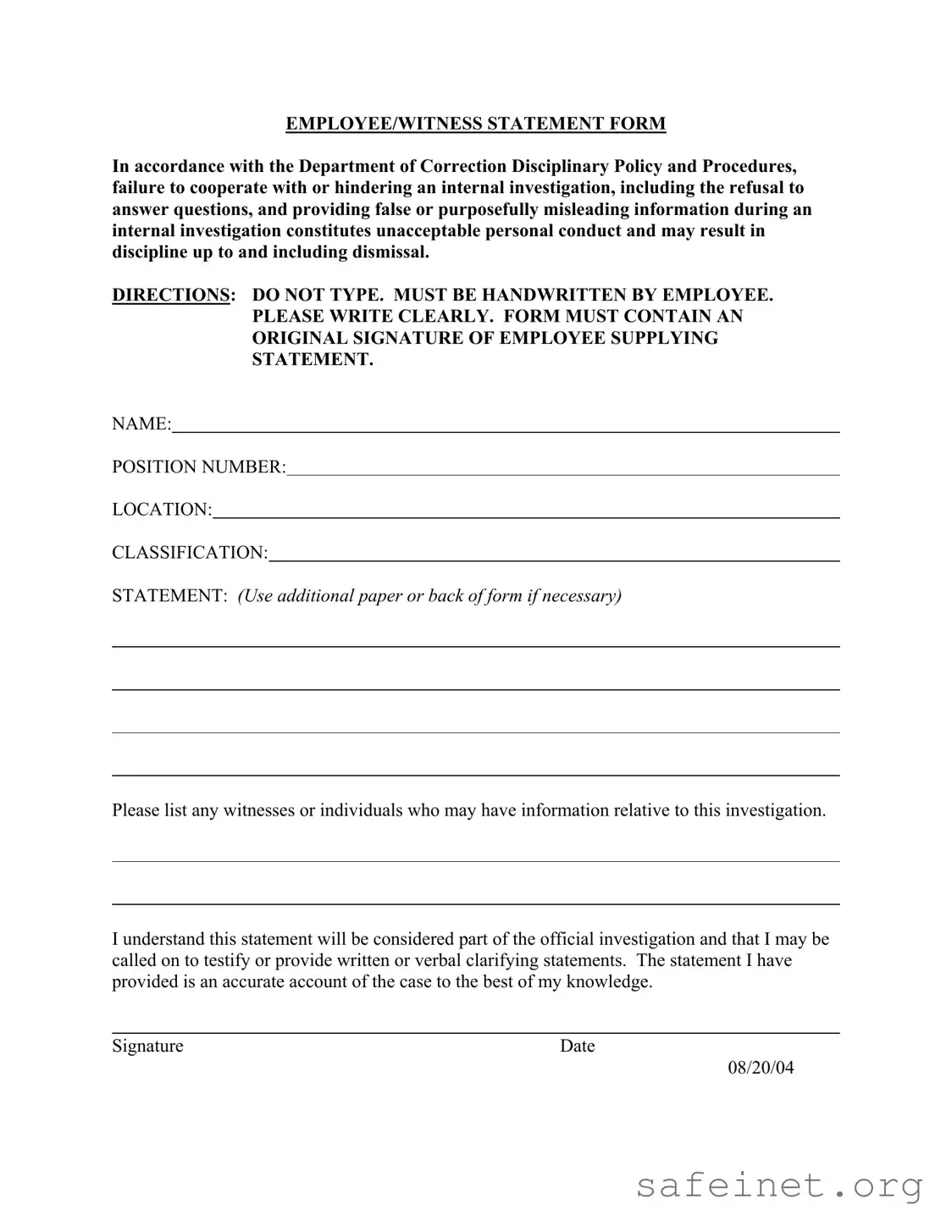
The Employee Statement form plays a crucial role in maintaining integrity and accountability within the workplace, particularly in the context of internal investigations. Designed to gather firsthand accounts from employees or witnesses, this form ensures that the information collected is both accurate and reliable. It emphasizes the importance of cooperation during an investigation, clearly stating that failure to comply can lead to serious consequences, including potential dismissal. Employees are instructed to fill out the form by hand, ensuring that their statements are original and personal. Essential details such as name, position number, location, and classification must be provided, along with a comprehensive statement of events. Additionally, the form encourages individuals to identify any witnesses who may contribute valuable insights into the matter at hand. By signing the form, employees affirm that their account is truthful to the best of their knowledge, reinforcing the weight of their testimony in the investigation process. This form not only serves as a tool for documentation but also as a reminder of the responsibilities that come with being part of an organization committed to ethical conduct.

| Fact Name | Description |
|---|---|
| Purpose | The Employee Statement form is used to gather information during an internal investigation related to the Department of Correction's Disciplinary Policy and Procedures. |
| Handwritten Requirement | The form must be completed by hand. Typing is not permitted. |
| Signature Requirement | An original signature of the employee providing the statement is required for the form to be valid. |
| Witness Information | Employees are encouraged to list any witnesses or individuals who may have relevant information regarding the investigation. |
| Consequences of Non-Compliance | Failure to cooperate with the investigation or providing false information may lead to disciplinary action, which can include dismissal. |
Once you have the Employee Statement form in front of you, it's important to complete it accurately and clearly. This form is a key part of the internal investigation process, and your honest input is crucial. Follow the steps below to ensure you fill it out correctly.
Make sure your handwriting is clear, as this will help in accurately conveying your statement. Once completed, submit the form as instructed to ensure it becomes part of the official investigation process.
What is the purpose of the Employee Statement form?
The Employee Statement form is used to gather detailed accounts from employees or witnesses regarding incidents that may be under investigation by the Department of Correction. It ensures that all relevant information is documented and can be reviewed during the investigation process.
Who is required to fill out the Employee Statement form?
Any employee or witness who has information pertinent to an internal investigation is required to complete the Employee Statement form. This includes individuals who may have witnessed the incident or have knowledge related to the matter being investigated.
What are the consequences of not filling out the form?
Failure to cooperate with the internal investigation, including not completing the Employee Statement form, can be considered unacceptable personal conduct. This may lead to disciplinary actions, including potential dismissal from employment.
How should the form be completed?
The form must be filled out by hand, not typed. Employees should write clearly to ensure that the information is legible. It is crucial to include an original signature on the form to validate the statement provided.
What should be included in the statement section?
In the statement section, employees should provide a clear and accurate account of the events related to the investigation. If more space is needed, additional paper can be used. It is essential to be honest and thorough in detailing the information.
Are witnesses required to be listed on the form?
Yes, employees should list any witnesses or individuals who may have relevant information regarding the investigation. This helps ensure that all potential sources of information are considered during the inquiry.
What happens to the information provided in the form?
The information included in the Employee Statement form becomes part of the official investigation record. Employees may be called upon to testify or provide further clarifying statements based on what they submitted.
What is the importance of the signature on the form?
The original signature is crucial as it confirms that the employee stands by the statement made. It signifies that the information provided is accurate to the best of their knowledge, and it holds the employee accountable for the content of the statement.
Not Following Instructions: Many individuals overlook the specific requirement that the form must be handwritten. Typing the statement can lead to immediate rejection of the form.
Illegible Handwriting: Writing clearly is crucial. If the handwriting is difficult to read, it may cause confusion and misinterpretation of the statement.
Missing Original Signature: The form requires an original signature. Submitting a form without this can result in delays or the need to resubmit.
Inaccurate Information: Providing false or misleading information can have serious consequences. Always ensure that the information given is truthful and accurate.
Failure to List Witnesses: Not including witnesses or individuals who may have relevant information can weaken the statement. It's important to identify anyone who might help clarify the situation.
Neglecting to Date the Statement: Forgetting to include the date on the statement can create confusion about when the information was provided. Always ensure the date is clearly written.
When dealing with internal investigations, various forms and documents are essential for ensuring a thorough and fair process. The Employee Statement form is just one component of this larger framework. Below is a list of other commonly used documents that often accompany the Employee Statement form, each serving a unique purpose in the investigation.
Each of these documents plays a critical role in the investigation process, contributing to a fair and comprehensive understanding of the situation at hand. Together, they help ensure that all relevant information is gathered and considered, ultimately supporting the organization's commitment to maintaining a respectful and compliant workplace.
The Incident Report form serves a similar purpose to the Employee Statement form by documenting specific events or situations that require investigation. Like the Employee Statement, it is often used in workplace settings to provide a detailed account of an incident, including the who, what, when, and where. Both documents aim to gather accurate information that may be used in disciplinary proceedings or other evaluations. The Incident Report form typically requires signatures and may also include sections for witness information, reinforcing the importance of corroborating accounts.
The Witness Statement form is another document that parallels the Employee Statement form. It is utilized to collect firsthand accounts from individuals who have witnessed an event relevant to an investigation. The Witness Statement form may ask for similar details, such as the witness's name, contact information, and a narrative of what they observed. Both forms emphasize the need for clarity and accuracy, as the information provided can significantly impact the outcome of an investigation.
The Grievance Form is comparable to the Employee Statement form in that it allows employees to formally express concerns or complaints regarding workplace issues. While the Employee Statement focuses on providing information about a specific incident, the Grievance Form is broader and may address ongoing issues or disputes. Both documents require the employee's signature, indicating their acknowledgment of the content and the seriousness of the claims being made.
The Performance Review form shares similarities with the Employee Statement form in that it documents employee behavior and performance. While the Employee Statement is often reactive, addressing specific incidents, the Performance Review is typically proactive and evaluates an employee's overall contributions over a period. Both forms may involve input from supervisors and require signatures to confirm that the information has been reviewed and discussed.
The Affidavit is another document akin to the Employee Statement form, as it provides a written statement of facts that can be used in legal proceedings. Like the Employee Statement, an Affidavit must be signed and often notarized to verify its authenticity. Both documents are intended to convey truthful information, and the penalties for providing false statements apply to both. The Affidavit may, however, be more formal and used in legal contexts beyond workplace investigations.
The Exit Interview form is similar to the Employee Statement form in that it collects feedback from employees about their experiences within the organization. While the Employee Statement focuses on specific incidents, the Exit Interview seeks to understand broader issues related to employee satisfaction and organizational culture. Both forms require the employee's signature, affirming that the information provided is accurate and reflective of their experiences.
When filling out the Employee Statement form, it's essential to follow specific guidelines to ensure clarity and compliance. Below are eight things to do and avoid.
Following these guidelines will help ensure that your statement is taken seriously and contributes positively to the investigation process.
Misconceptions about the Employee Statement form can lead to confusion and potentially hinder the investigation process. Here are five common misconceptions:
Understanding these misconceptions can help ensure compliance with the requirements and facilitate a smoother investigation process.
When filling out the Employee Statement form, it is essential to follow specific guidelines to ensure clarity and compliance. Here are some key takeaways:
By adhering to these guidelines, you can contribute positively to the investigation process and protect your rights within the organization.