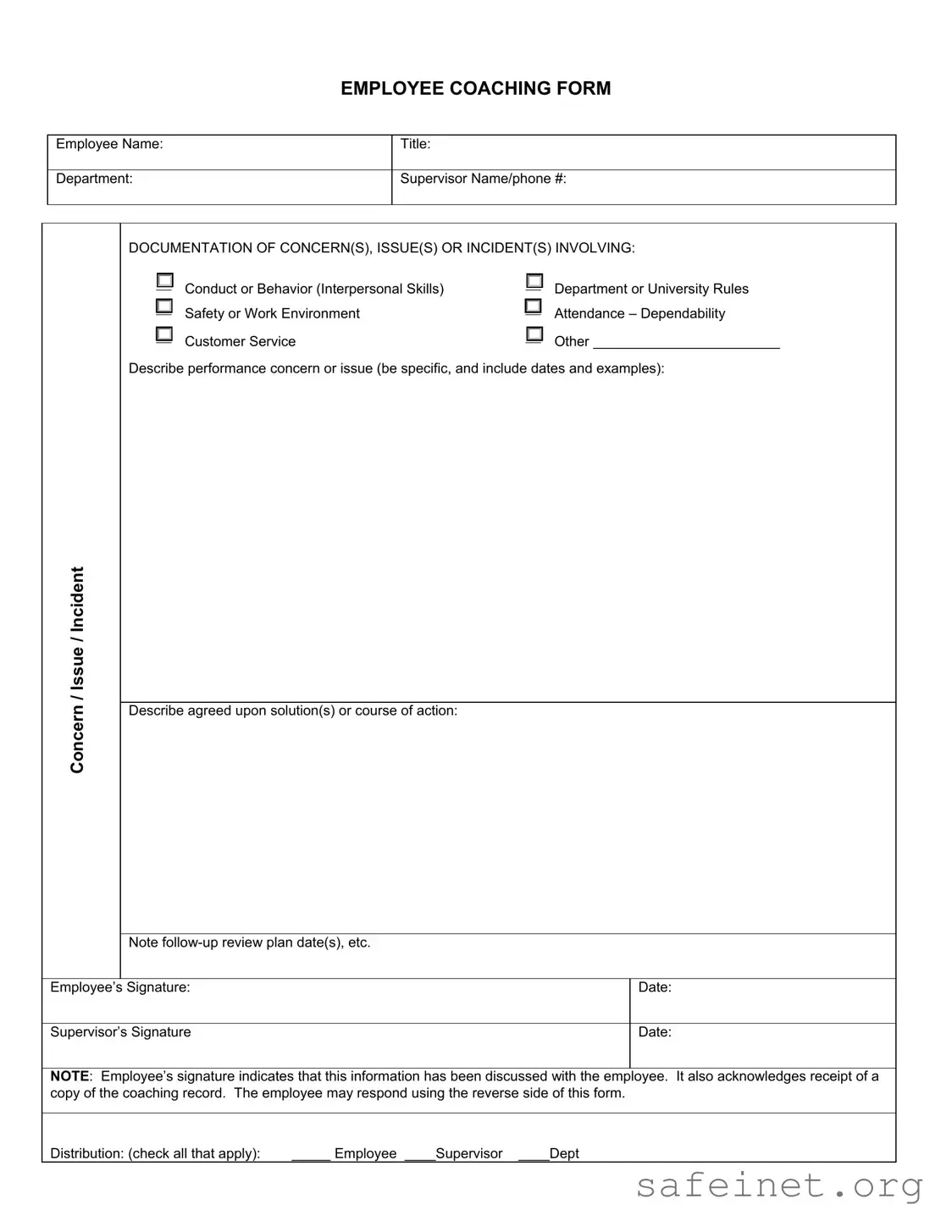
In the realm of employee development, the Employee Coaching Form serves as a vital tool for fostering communication and addressing performance issues. This structured document captures essential information, including the employee's name, department, title, and supervisor's contact details. It allows supervisors to document specific concerns related to conduct, attendance, safety, and customer service, ensuring clarity in identifying the issues at hand. The form encourages detailed descriptions of performance concerns, including dates and examples, which helps create a comprehensive understanding of the situation. Furthermore, it outlines agreed-upon solutions and action plans, promoting accountability and collaboration between the employee and supervisor. A follow-up review plan is also included, reinforcing the commitment to ongoing improvement. Importantly, the form requires signatures from both the employee and supervisor, signifying that the discussion has taken place and that the employee has received a copy of the coaching record. This process not only supports the employee's growth but also strengthens the overall work environment.
| Fact Name | Details |
|---|---|
| Purpose | The Employee Coaching Form is designed to document performance concerns and outline agreed-upon solutions. |
| Key Sections | It includes sections for employee details, documentation of issues, solutions, and signatures from both the employee and supervisor. |
| Employee Acknowledgment | The employee's signature indicates that the issues have been discussed and a copy of the coaching record has been received. |
| Follow-Up | A follow-up review plan is included to ensure that progress is monitored and solutions are implemented effectively. |
| Distribution | The form can be distributed to the employee, supervisor, and department, ensuring all relevant parties are informed. |
Completing the Employee Coaching form is an important step in addressing performance concerns. This form helps facilitate a constructive conversation between the employee and supervisor, ensuring that everyone is on the same page regarding issues and solutions. Follow these steps to fill it out correctly.
What is the purpose of the Employee Coaching Form?
The Employee Coaching Form is designed to document performance concerns, issues, or incidents involving an employee. It serves as a tool for supervisors to address specific behaviors or performance gaps, ensuring that both the employee and supervisor are on the same page. By outlining the concerns and agreed-upon solutions, it promotes accountability and encourages improvement in the workplace.
What information do I need to provide on the form?
When filling out the Employee Coaching Form, you will need to provide the employee's name, department, title, and the supervisor's contact information. Additionally, you should detail the specific concern, issue, or incident, including relevant dates and examples. It's also important to outline the agreed-upon solutions or actions to be taken, as well as any follow-up review dates. This comprehensive approach ensures clarity and sets clear expectations moving forward.
What happens after the form is completed?
Once the Employee Coaching Form is completed and signed by both the employee and supervisor, it serves as a record of the discussion. The employee's signature indicates that they have been informed of the concerns and have received a copy of the coaching record. The supervisor will distribute copies to the employee and any relevant department personnel. Follow-up reviews will be scheduled as outlined in the form to assess progress and make any necessary adjustments.
Can the employee respond to the coaching record?
Yes, the employee has the opportunity to respond to the coaching record. There is space provided on the reverse side of the form for the employee to share their thoughts or concerns regarding the documented issues or the agreed-upon actions. This allows for open communication and gives the employee a voice in the process, fostering a collaborative environment for improvement.
Failing to provide the employee's name clearly at the top of the form. This can lead to confusion regarding who the coaching is intended for.
Not specifying the department or title of the employee. This information is crucial for proper record-keeping and context.
Omitting the supervisor's name and phone number. This detail is important for follow-up and communication purposes.
Using vague language when describing the concern or issue. Specific examples and dates should be included to provide clarity.
Neglecting to outline the agreed-upon solutions or course of action. Clear steps should be documented to ensure accountability.
Forgetting to include a follow-up review plan with specific dates. This helps in tracking progress and ensuring that issues are addressed.
Not obtaining the employee's signature on the form. The signature indicates that the employee has discussed the information and acknowledges receipt.
Failing to check the appropriate distribution boxes. This can result in important parties not receiving the necessary documentation.
Leaving the reverse side of the form blank. Employees should be encouraged to provide their responses or additional comments.
The Employee Coaching form is an important document used to address performance issues and outline agreed-upon solutions. Several other forms and documents often accompany it to ensure a comprehensive approach to employee development and performance management. Below is a list of these documents, each serving a specific purpose.
These forms and documents work together to create a structured approach to employee coaching and performance management. They help ensure that both the employee and supervisor are aligned on expectations and progress.
The Performance Improvement Plan (PIP) is a document that outlines specific areas where an employee's performance does not meet expectations. Similar to the Employee Coaching form, it identifies concerns, sets goals, and establishes a timeline for improvement. The PIP includes measurable objectives and often requires regular check-ins to assess progress. Both documents aim to enhance employee performance through structured feedback and collaborative solutions.
The Incident Report serves to document specific occurrences of misconduct or policy violations. Like the Employee Coaching form, it provides a detailed account of the issue, including dates and descriptions. However, the Incident Report is typically more formal and may be used for disciplinary action. Both documents emphasize the importance of clear communication and documentation in addressing employee behavior.
The Employee Evaluation form assesses an employee's overall performance over a designated period. This form, like the Employee Coaching form, highlights strengths and areas for improvement. Evaluations often incorporate feedback from multiple sources, whereas coaching forms focus on specific incidents or behaviors. Both documents aim to foster professional growth and development.
The Counseling Form is used to address behavioral or performance issues in a more informal setting. Similar to the Employee Coaching form, it documents discussions between the supervisor and employee regarding concerns. The Counseling Form may offer a less structured approach, focusing on dialogue and understanding rather than formal action plans. Both documents seek to resolve issues collaboratively.
The Development Plan outlines a strategy for an employee's professional growth. This document shares similarities with the Employee Coaching form in that it identifies areas for improvement and sets actionable goals. However, the Development Plan is typically broader in scope, focusing on long-term career aspirations rather than immediate concerns. Both documents encourage ongoing communication and support.
The Disciplinary Action Form is used when an employee's behavior requires formal corrective measures. Like the Employee Coaching form, it details specific issues and provides a record of discussions held with the employee. However, the Disciplinary Action Form often leads to more serious consequences, whereas the coaching form aims to facilitate improvement without immediate punitive action. Both documents serve as important tools for maintaining workplace standards.
When filling out the Employee Coaching form, consider the following guidelines to ensure clarity and effectiveness:
Misconception 1: The Employee Coaching form is only for disciplinary actions.
This is not true. While the form can document issues that may lead to disciplinary actions, it is also a tool for positive reinforcement and development. It helps supervisors guide employees toward better performance and growth.
Misconception 2: Employees must sign the form to agree with the contents.
Signing the form does not mean the employee agrees with the concerns raised. Instead, it indicates that the discussion has taken place and the employee has received a copy of the record. This distinction is important for maintaining open communication.
Misconception 3: The form is only relevant for poor performance.
In reality, the Employee Coaching form can be used to recognize and document positive behaviors as well. It serves as a comprehensive tool for addressing both strengths and areas needing improvement.
Misconception 4: Once the form is filled out, there is no room for employee input.
This is a misunderstanding. Employees have the opportunity to respond on the reverse side of the form. This allows them to express their views or provide additional context regarding the issues discussed.
Misconception 5: The coaching process is a one-time event.
Coaching is an ongoing process. The form includes a follow-up review plan, which ensures that supervisors and employees revisit the discussed concerns and solutions. This continuous dialogue fosters improvement and accountability.
When using the Employee Coaching form, it's essential to keep a few key points in mind. This form serves as a vital tool for addressing performance issues and fostering communication between employees and supervisors.
By following these takeaways, you can effectively utilize the Employee Coaching form to enhance communication and performance management within your organization.