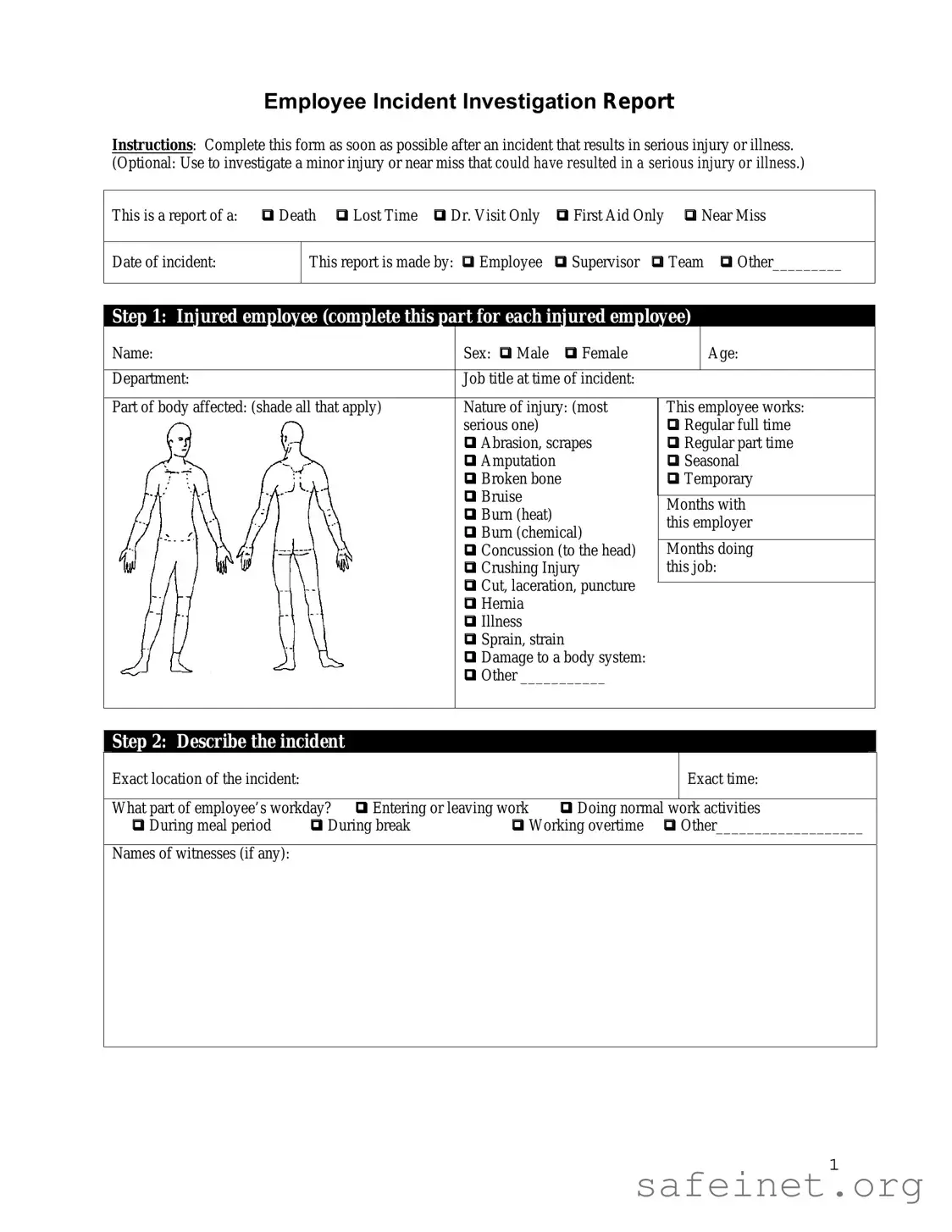
When an employee is injured on the job, the subsequent documentation is crucial for both the individual and the employer. The Employee Accident Report form serves as a vital tool in this process, capturing essential details surrounding the incident. This form typically includes sections for the employee's personal information, a description of the accident, and the nature of the injuries sustained. Additionally, it may require information about witnesses, the circumstances leading up to the accident, and any immediate actions taken post-incident. Properly completed, this report not only aids in the assessment of workplace safety but also plays a key role in processing workers' compensation claims and ensuring compliance with legal obligations. By documenting these events accurately and thoroughly, employers can better understand the risks present in their workplace and take necessary steps to prevent future occurrences.

| Fact Name | Description |
|---|---|
| Purpose | The Employee Accident Report form is used to document workplace injuries and accidents. |
| Who Completes It | Typically, the injured employee or a supervisor completes the form. |
| Information Required | The form requires details such as the date, time, location, and nature of the accident. |
| Submission Timeline | Employees should submit the report as soon as possible after the incident. |
| State-Specific Forms | Some states have specific forms, such as California, governed by California Labor Code Section 6409. |
| Confidentiality | Information on the form is generally kept confidential and shared only with authorized personnel. |
| Follow-Up Actions | After submission, employers may conduct an investigation based on the report's findings. |
| Impact on Workers' Compensation | Accurate reporting is crucial for processing workers' compensation claims. |
When an accident occurs at work, it’s important to document the details accurately. This helps ensure that everyone involved is supported properly. Follow these steps to fill out the Employee Accident Report form correctly.
After completing the form, submit it to your supervisor or the designated safety officer. They will take the next steps to ensure that the situation is addressed properly.
What is the purpose of the Employee Accident Report form?
The Employee Accident Report form is designed to document any incidents that occur in the workplace resulting in injury or potential injury to an employee. This form helps ensure that all necessary details are recorded, which can aid in addressing safety concerns, preventing future accidents, and complying with legal requirements.
Who should fill out the Employee Accident Report form?
The form should be completed by the employee involved in the accident as soon as possible after the incident occurs. If the employee is unable to do so, a supervisor or manager may fill out the form on their behalf, ensuring that all relevant information is accurately captured.
What information is required on the form?
The form typically requires details such as the date and time of the accident, location, a description of what happened, any witnesses present, and the nature of the injuries sustained. Additionally, employees may need to provide their contact information and any medical treatment received as a result of the accident.
How is the information on the form used?
The information collected on the Employee Accident Report form is used for several purposes. It helps the employer investigate the incident, identify any safety hazards, and implement measures to prevent similar accidents in the future. The report may also be used for insurance claims and to comply with workplace safety regulations.
What should I do if I witness an accident?
If you witness an accident, it is important to assist the injured employee if it is safe to do so. After ensuring their safety, report the incident to a supervisor immediately. You may also be asked to provide a statement or fill out a witness section on the Employee Accident Report form to document what you observed.
What happens if the form is not filled out?
Failing to complete the Employee Accident Report form can lead to complications. Without proper documentation, it may be difficult to address the incident, and the employee may miss out on necessary medical treatment or workers' compensation benefits. Additionally, the lack of a report can hinder the employer's ability to improve workplace safety and comply with legal requirements.
Incomplete Information: Failing to provide all required details can lead to delays in processing. Ensure that every section is filled out completely.
Vague Descriptions: Using unclear language or general terms when describing the accident can cause misunderstandings. Be specific about what happened.
Omitting Witnesses: Not including the names and contact information of witnesses can weaken the report. Always list anyone who saw the incident.
Neglecting Dates and Times: Forgetting to include the date and time of the accident can create confusion. Always document when the incident occurred.
Failure to Sign: Submitting the report without a signature can invalidate it. Always sign and date the form before submission.
Ignoring Company Policies: Not adhering to specific company guidelines for filling out the report can lead to complications. Review your employer's instructions carefully.
When an employee experiences an accident at work, several forms and documents are typically required to ensure proper reporting and follow-up. Below is a list of five important documents that are often used alongside the Employee Accident Report form.
Each of these documents plays a vital role in managing workplace accidents effectively. Proper completion and submission of these forms can help ensure employee safety and compliance with workplace regulations.
The Incident Report is a document that serves a similar purpose to the Employee Accident Report. It captures details about any event that results in injury, damage, or disruption within the workplace. Like the Employee Accident Report, it includes information about the individuals involved, the time and location of the incident, and a description of what occurred. The Incident Report is often used for a broader range of occurrences, not limited to accidents, making it a versatile tool for employers to track workplace safety and compliance.
The Workers' Compensation Claim form is another document that aligns closely with the Employee Accident Report. This form is used by employees to formally request compensation for injuries sustained while on the job. It requires detailed information about the incident, similar to what is found in the Employee Accident Report. Both documents aim to ensure that employees receive appropriate medical care and financial support following an accident, emphasizing the employer's responsibility for workplace safety.
The Safety Inspection Report is also comparable to the Employee Accident Report. While the latter focuses on documenting specific incidents, the Safety Inspection Report assesses overall workplace conditions. It identifies potential hazards and ensures compliance with safety regulations. Both documents contribute to a safer work environment by highlighting areas for improvement and documenting incidents that require attention.
The Near Miss Report is another relevant document. This report captures incidents that could have resulted in injury or damage but did not. Similar to the Employee Accident Report, it emphasizes the importance of documenting events to prevent future occurrences. By analyzing near misses, employers can implement safety measures and training programs that may reduce the likelihood of actual accidents.
The First Aid Report is also noteworthy. This document records instances where first aid was administered to an employee following an accident or injury. Like the Employee Accident Report, it details the nature of the injury, the treatment provided, and any follow-up care needed. Both reports serve to ensure that employees receive timely medical attention and help track the frequency and types of injuries occurring in the workplace.
The Claim for Disability Benefits form is another document that bears similarity to the Employee Accident Report. This form is used by employees who are unable to work due to an injury sustained on the job. It requires detailed information about the incident, much like the Employee Accident Report, to establish the connection between the workplace accident and the employee's inability to work. Both documents play a crucial role in the process of securing benefits for injured workers.
Lastly, the Return-to-Work form is relevant in this context. This document is used when an employee is ready to resume work after an injury. It often requires input from medical professionals and may reference the Employee Accident Report to ensure that the employee is fit to return. Both forms focus on the employee's recovery and the importance of a safe transition back to work, highlighting the employer's commitment to supporting injured workers.
When filling out the Employee Accident Report form, it’s important to be thorough and accurate. Here are some key points to keep in mind:
Following these guidelines will help ensure that your report is clear and effective. It’s essential to take your time and be precise. Your attention to detail can make a significant difference in how the situation is handled.
Understanding the Employee Accident Report form is crucial for both employers and employees. However, several misconceptions can lead to confusion and mismanagement. Here are eight common misconceptions:
Addressing these misconceptions can lead to better safety practices and a more informed workplace.
When filling out and using the Employee Accident Report form, keep the following key takeaways in mind: