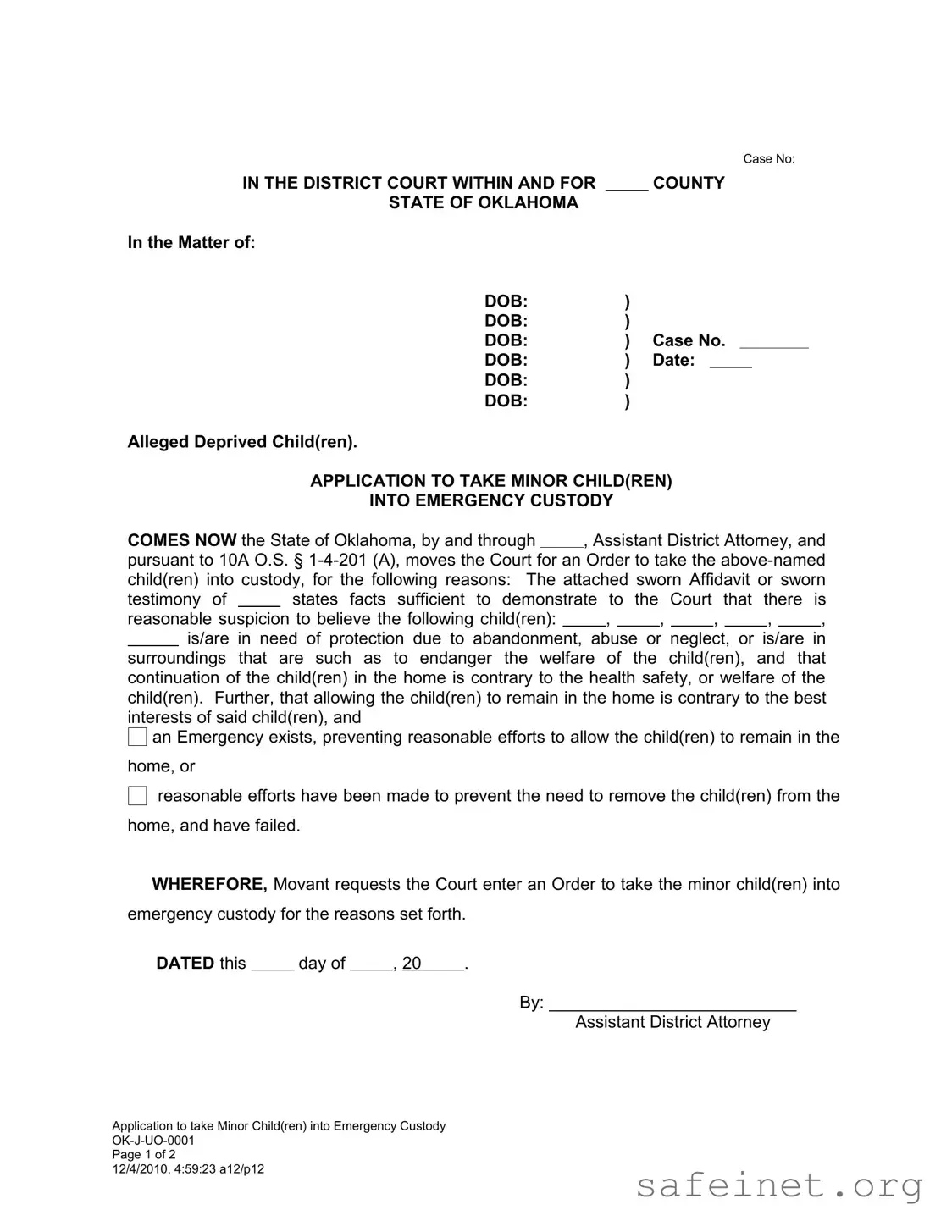
The Emergency Custody Oklahoma form serves as a crucial tool for ensuring the safety and well-being of children who may be at risk due to abandonment, abuse, or neglect. This form is utilized by the State of Oklahoma, specifically by an Assistant District Attorney, to request the court's permission to take a minor child or children into emergency custody. It includes essential information such as the case number, the names and dates of birth of the affected children, and the reasons for the emergency request. The application is supported by a sworn affidavit or testimony that outlines the facts leading to the belief that the child or children are in dangerous surroundings. It emphasizes that keeping the child in their current home would be contrary to their health and welfare. The form articulates that an emergency situation exists, which prevents reasonable efforts to keep the child in the home or that previous attempts to do so have failed. Ultimately, the form seeks a court order to act swiftly in the best interests of the child or children involved.


| Fact Name | Details |
|---|---|
| Governing Law | The Emergency Custody form in Oklahoma is governed by 10A O.S. § 1-4-201 (A). |
| Purpose | This form is used to request the court to take a minor child or children into emergency custody. |
| Allegations | The application must demonstrate reasonable suspicion of abandonment, abuse, or neglect. |
| Best Interests | It must be shown that the child’s continued presence in the home is contrary to their health, safety, or welfare. |
| Affidavit Requirement | A sworn affidavit or testimony must accompany the application, outlining the facts of the case. |
Filling out the Emergency Custody form in Oklahoma is an important step in seeking immediate protection for a child. After completing this form, it will be submitted to the court for review. The court will then consider the request and determine the appropriate course of action regarding the child's safety and welfare.
What is the purpose of the Emergency Custody Oklahoma form?
The Emergency Custody Oklahoma form serves as a legal document that allows the state to take immediate custody of a child or children when there is a pressing concern for their safety. This form is typically utilized in situations where a child may be facing abandonment, abuse, or neglect. By filing this application, the Assistant District Attorney seeks a court order to protect the child(ren) from potentially harmful environments, ensuring their welfare is prioritized above all else.
Who can file for emergency custody using this form?
The application can be filed by the State of Oklahoma, specifically through an Assistant District Attorney. This legal representative is tasked with advocating for the child's best interests and presenting evidence that supports the need for emergency custody. The form requires the submission of a sworn affidavit or testimony, which outlines the specific concerns and justifications for taking the child(ren) into custody.
What criteria must be met for emergency custody to be granted?
For the court to grant emergency custody, there must be reasonable suspicion that the child(ren) is in danger due to various factors, such as abuse, neglect, or unsafe living conditions. The application must demonstrate that allowing the child(ren) to remain in their current environment poses a threat to their health, safety, or overall welfare. Additionally, the form must indicate that efforts to keep the child(ren) in the home have either been attempted and failed or that circumstances prevent such efforts from being made.
What happens after the emergency custody application is filed?
Once the application is filed, the court will review the information presented. A hearing may be scheduled to evaluate the merits of the case, allowing the Assistant District Attorney to provide evidence and arguments supporting the need for emergency custody. If the court finds sufficient grounds for concern, it will issue an order for the child(ren) to be taken into custody. This process is designed to ensure that children at risk receive the protection they urgently need while also providing a legal framework for their care and future placement.
Incomplete Information: Failing to provide all required details about the child or children involved can delay the process or lead to rejection of the application.
Incorrect Case Number: Not including the correct case number can create confusion and may result in the application being misfiled.
Missing Signatures: Omitting necessary signatures, particularly from the Assistant District Attorney, can invalidate the application.
Vague Allegations: Using unclear or vague language to describe the reasons for seeking emergency custody can undermine the application’s effectiveness.
Failure to Attach Supporting Documents: Not including the required affidavit or sworn testimony can weaken the case and may lead to denial.
Ignoring Timeliness: Submitting the application after significant delays can affect the urgency of the situation and the court's response.
Neglecting to Provide Contact Information: Failing to include contact information for the applicant can hinder communication and follow-up.
Inaccurate Dates: Entering incorrect dates, especially the date of the application or the child's date of birth, can lead to complications in processing the form.
When dealing with emergency custody situations in Oklahoma, several important documents often accompany the Emergency Custody form. Each of these documents serves a specific purpose in the process of ensuring the safety and well-being of the child or children involved. Understanding these forms can make the situation clearer and more manageable.
Each of these documents plays a critical role in the legal process surrounding emergency custody. Being familiar with them can help individuals navigate this challenging time with greater confidence and clarity.
The Temporary Custody Order is a document that allows a court to place a child in the temporary care of a designated individual or agency. Similar to the Emergency Custody Oklahoma form, it addresses immediate concerns for a child's safety and welfare. This order is often issued in situations where a child is at risk but does not yet warrant permanent removal from their home. Both documents require evidence of potential harm to the child and involve a court's review and approval to ensure the child's best interests are prioritized.
The Child Protective Services (CPS) Referral Form is another document that shares similarities with the Emergency Custody Oklahoma form. This form is used to report suspected child abuse or neglect to the appropriate authorities. Like the emergency custody application, it highlights concerns for a child's safety and requires detailed information about the situation. Both documents aim to protect children from harm, but the CPS Referral Form is more focused on initiating an investigation rather than seeking immediate custody.
The Petition for Guardianship is a legal document that allows a person to seek custody of a child when the parents are unable to care for them. This document is similar to the Emergency Custody Oklahoma form in that it addresses the need for a child’s protection. However, while the emergency custody form is used for immediate situations, the guardianship petition typically outlines a longer-term arrangement. Both documents require evidence of the child’s need for protection, but the guardianship petition involves a more extended legal process.
The Motion for Change of Custody is another document that parallels the Emergency Custody Oklahoma form. This motion is filed when a party seeks to alter an existing custody arrangement due to concerns about a child's well-being. Like the emergency custody application, it requires a demonstration of circumstances that may endanger the child. However, the Motion for Change of Custody is generally used in ongoing cases, while the emergency custody form is for urgent situations that require immediate intervention.
The Affidavit of Support for Emergency Custody is a sworn statement that supports the claims made in the Emergency Custody Oklahoma form. This affidavit must detail the specific reasons why the child is in danger and why immediate custody is necessary. Both documents work in tandem to provide the court with the necessary information to make an informed decision regarding the child's safety. The affidavit strengthens the emergency custody application by providing a personal account of the situation.
Finally, the Family Court Order for Emergency Custody is a judicial order that grants temporary custody of a child to a designated individual or agency. This document is similar to the Emergency Custody Oklahoma form as it is issued in response to an immediate threat to a child's safety. Both documents require a thorough examination of the circumstances surrounding the child's welfare. However, the Family Court Order is the result of the court's decision based on the information provided in the emergency custody application and supporting documents.
When filling out the Emergency Custody Oklahoma form, consider the following guidelines to ensure accuracy and compliance.
Understanding the Emergency Custody Oklahoma form can be challenging, and several misconceptions often arise. Here are five common misunderstandings that people may have:
Addressing these misconceptions can help clarify the purpose and process of the Emergency Custody Oklahoma form, ensuring that individuals understand their rights and responsibilities in such situations.
When dealing with the Emergency Custody Oklahoma form, it’s essential to understand its purpose and the process involved. Here are some key takeaways to keep in mind:
Filling out the Emergency Custody Oklahoma form is a serious matter that requires careful attention to detail. By keeping these key points in mind, you can ensure that the process is handled as smoothly as possible.