Homepage > Blank Elder Care Agreement 85 Template
Article Structure

The Elder Care Agreement 85 form is an essential document designed to outline the responsibilities and expectations between an older adult and their caregiver. This agreement establishes a clear framework for the care and support that the caregiver will provide, ensuring that both parties understand their roles. It covers various aspects, including daily living assistance, nutrition, cleaning, and personal care needs. The caregiver commits to preparing balanced meals, performing housekeeping duties, and offering companionship, among other services. Additionally, the form addresses compensation, specifying payment terms that can be tailored to fit the needs of both the caregiver and the older adult. It also emphasizes the importance of maintaining a clean and orderly home environment while ensuring that the older adult receives the necessary medical attention and transportation. By signing this agreement, both parties affirm their understanding and commitment to the terms, creating a legally binding contract that protects their interests.


Form Sample

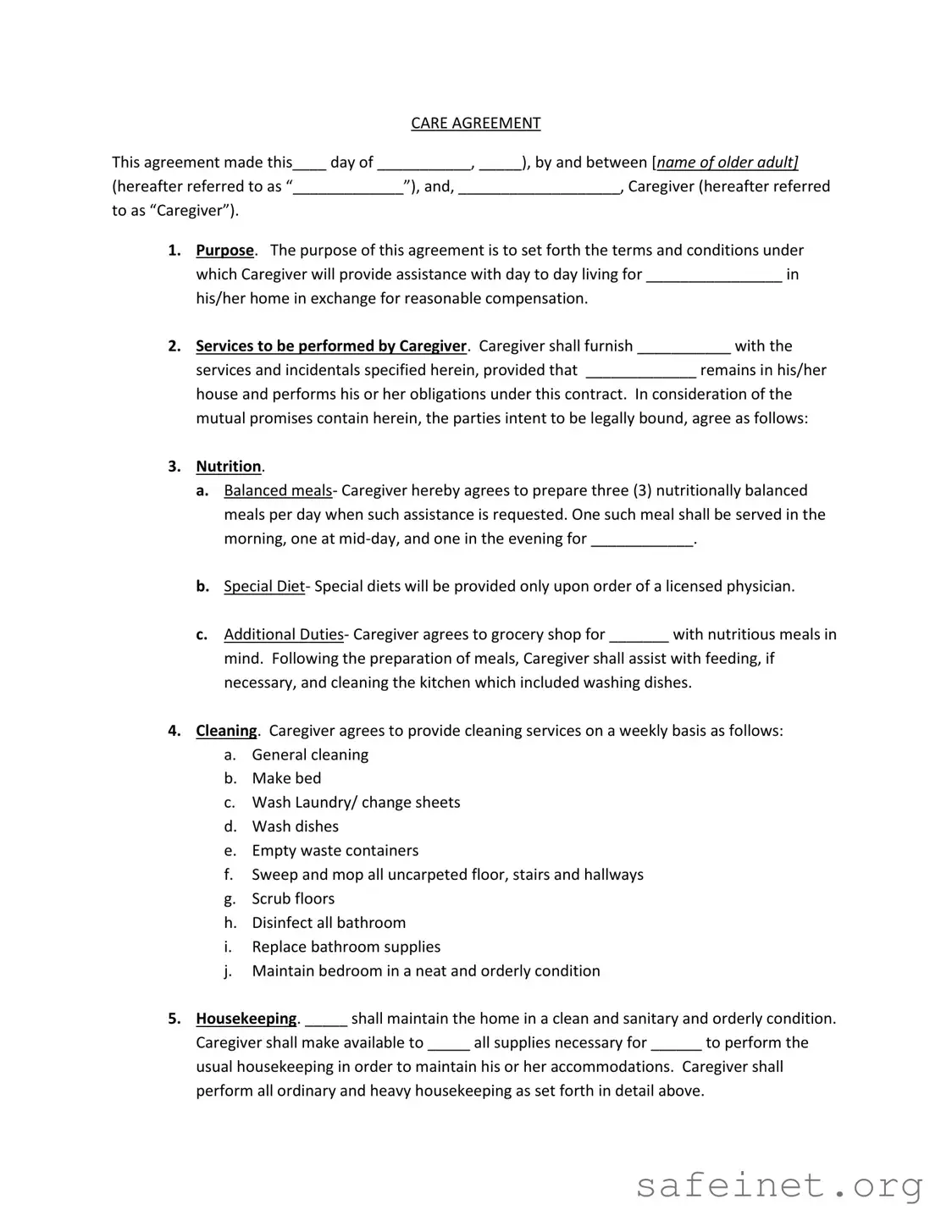
CARE AGREEMENT
This agreement made this____ day of ___________, _____), by and between [name of older adult]
(hereafter referred to as “_____________”), and, ___________________, Caregiver (hereafter referred
to as “Caregiver”).
1. Purpose. The purpose of this agreement is to set forth the terms and conditions under
which Caregiver will provide assistance with day to day living for ________________ in
his/her home in exchange for reasonable compensation.
2. Services to be performed by Caregiver. Caregiver shall furnish ___________ with the
services and incidentals specified herein, provided that _____________ remains in his/her
house and performs his or her obligations under this contract. In consideration of the
mutual promises contain herein, the parties intent to be legally bound, agree as follows:
3. Nutrition.
a. Balanced meals- Caregiver hereby agrees to prepare three (3) nutritionally balanced
meals per day when such assistance is requested. One such meal shall be served in the
morning, one at mid-day, and one in the evening for ____________.
b. Special Diet- Special diets will be provided only upon order of a licensed physician.
c. Additional Duties- Caregiver agrees to grocery shop for _______ with nutritious meals in
mind. Following the preparation of meals, Caregiver shall assist with feeding, if
necessary, and cleaning the kitchen which included washing dishes.
4. Cleaning. Caregiver agrees to provide cleaning services on a weekly basis as follows:
a. General cleaning
b. Make bed
c. Wash Laundry/ change sheets
d. Wash dishes
e. Empty waste containers
f. Sweep and mop all uncarpeted floor, stairs and hallways
g. Scrub floors
h. Disinfect all bathroom
i. Replace bathroom supplies
j. Maintain bedroom in a neat and orderly condition
5. Housekeeping. _____ shall maintain the home in a clean and sanitary and orderly condition.
Caregiver shall make available to _____ all supplies necessary for ______ to perform the
usual housekeeping in order to maintain his or her accommodations. Caregiver shall
perform all ordinary and heavy housekeeping as set forth in detail above.
6. Assistance outside the Home. Caregiver shall run daily errands for______. These may
include but are not limited to, picking up dry cleaning, grocery shopping, shopping for
necessities and, if applicable, maintaining ___’s car.
7. Personal Care Needs. Caregiver shall observe ______’s physical and mental states on a
regular basis, and shall make arrangements, as necessary, to meet health needs by
arranging transportation to the physician of _______’s choice. Caregiver shall provide
assistance to ________ in carrying out the instructions of physicians including storing,
distributing and reminding ______ to take prescribing medications.
Caregiver shall also provide _______ with personal assistance with bathing, dressing,
toileting, hair care, shaving, eating, care of clothing, personal shopping and incidental
services, as needed.
8. Transportation. Caregiver shall assist with transportation needs by arranging for public
transportation or help with specially provided elderly transportation.
9. Companionship and Entertainment. Caregiver shall provide companionship and support
for ______.
10. Compensation. ______________ shall pay Caregiver:
___________ Weekly ___________ Monthly
On each ___ of the week/month $________ per hour.
11. Governing Law, Entirety of Agreement and Severability. This agreement shall be governed
by the laws of state of ______. It constitutes the entire agreement between the parties
regarding its subject matter. If any provision in this contract is held by any court to be
invalid, void or unenforceable, the remaining provisions shall nevertheless continue in full
force and effect.
THIS IS A LEGALLY BINDING CONTRACT. EACH PARTY HAS READ THE ABOVE AGREEMENT BEFORE
SIGNING IT. EACH PARTY UNDERSTANDS THE AGREEMENT THAT HE OR SHE IS MAKING.
We, __________ and Caregiver having read this agreement, agree to its terms and sign it as our free act
on the ____ Day of __________, _________.
__________________________________ _______________________________
[name of older adult] Caregiver
Witness
_______________________________ ___________________________________
Signature Address

Document Specifications

Fact Name Details
Purpose of Agreement The Elder Care Agreement 85 form outlines the terms under which a caregiver provides daily living assistance to an older adult in exchange for compensation.
Services Provided Caregivers agree to deliver specific services, including meal preparation, cleaning, and personal care, as detailed in the contract.
Compensation Structure The form allows for flexibility in payment, specifying either a weekly or monthly payment schedule for the caregiver's services.
Governing Law This agreement is governed by the laws of the state in which it is executed, ensuring compliance with local regulations.
Legally Binding Both parties must read and understand the agreement, making it a legally binding contract upon signing.

Steps to Filling Out Elder Care Agreement 85

Completing the Elder Care Agreement 85 form is essential for establishing clear expectations between the older adult and the caregiver. This document outlines the services to be provided, compensation details, and other important terms. Follow these steps carefully to ensure all necessary information is accurately recorded.

  1. Begin by entering the date at the top of the form in the format: day, month, year.
  2. Fill in the name of the older adult in the first blank space and designate a reference name (e.g., "Client").
  3. In the second blank space, write the name of the caregiver.
  4. Specify the purpose of the agreement by restating that the caregiver will assist the older adult with day-to-day living in exchange for compensation.
  5. Detail the services to be performed by the caregiver, ensuring to include all relevant tasks listed in the form, such as meal preparation and cleaning duties.
  6. Outline nutrition-related responsibilities, including the preparation of balanced meals and any special dietary requirements.
  7. List the cleaning tasks the caregiver will perform weekly, ensuring each item is checked off as applicable.
  8. Describe housekeeping responsibilities, emphasizing that the older adult will maintain a clean and sanitary home with the caregiver providing necessary supplies.
  9. Enumerate the errands the caregiver will run outside the home, including grocery shopping and picking up dry cleaning.
  10. Specify the personal care needs that the caregiver will address, such as assistance with bathing and medication reminders.
  11. Indicate how transportation needs will be met, whether through public transport or specialized services.
  12. Clarify the companionship and entertainment services the caregiver will provide.
  13. State the compensation details, including the payment frequency (weekly or monthly) and the amount per hour.
  14. Fill in the governing law by specifying the state applicable to the agreement.
  15. Both parties must read the agreement carefully and sign it, including the date of signing.
  16. Finally, ensure the witness signs and provides their address as required.

More About Elder Care Agreement 85

What is the purpose of the Elder Care Agreement 85 form?

The Elder Care Agreement 85 form serves to outline the terms and conditions under which a caregiver will provide assistance to an older adult in their home. This agreement clarifies the expectations and responsibilities of both parties, ensuring that the caregiver’s services are compensated appropriately and that the older adult receives the necessary support for daily living activities.

What types of services does the caregiver provide under this agreement?

The caregiver is responsible for a variety of services, including preparing balanced meals, grocery shopping, cleaning, and assisting with personal care needs. Specific tasks may include laundry, maintaining a clean living environment, running errands, and providing companionship. The agreement ensures that these services are tailored to the individual needs of the older adult.

How is compensation determined in the Elder Care Agreement?

Compensation for the caregiver is specified within the agreement. The older adult will pay the caregiver a predetermined amount, which can be structured as a weekly or monthly payment. The agreement may also detail an hourly rate for services rendered, allowing for flexibility based on the level of care required.

What provisions are included regarding personal care needs?

The agreement outlines that the caregiver will observe the older adult's physical and mental health regularly. It includes responsibilities such as arranging transportation to medical appointments, assisting with medication management, and providing personal assistance with activities like bathing, dressing, and grooming. This comprehensive approach aims to ensure the older adult's well-being and health are prioritized.

What happens if a provision of the agreement is found to be invalid?

The agreement contains a severability clause, which means that if any part of the contract is deemed invalid or unenforceable by a court, the remaining provisions will still be in effect. This ensures that the overall intent of the agreement remains intact, even if specific terms are challenged legally.

Is the Elder Care Agreement legally binding?

Yes, the Elder Care Agreement 85 form is a legally binding contract. Both the older adult and the caregiver must read and understand the agreement before signing it. By signing, both parties acknowledge their commitment to the terms laid out in the document, which is enforceable under the governing laws of the relevant state.

Common mistakes

  1. Incomplete Information: Failing to fill in all required fields can lead to confusion or disputes later. Ensure that both the name of the older adult and the caregiver are clearly stated, along with the date of the agreement.

  2. Vague Service Descriptions: Not specifying the services to be provided can create misunderstandings. Clearly outline the tasks the caregiver is expected to perform, such as meal preparation, cleaning, and personal care.

  3. Ignoring Compensation Details: Omitting payment terms can lead to financial disagreements. Clearly state how much the caregiver will be paid, the payment frequency, and the method of payment.

  4. Neglecting Legal Requirements: Not including governing law and severability clauses can make the agreement less enforceable. Specify which state laws will govern the agreement and ensure it includes a clause about the validity of the remaining provisions if one is found invalid.

  5. Not Having a Witness: Failing to have a witness sign the agreement can weaken its legal standing. It is advisable to have a neutral third party present during the signing to validate the agreement.

Documents used along the form

When creating an Elder Care Agreement, several other forms and documents can complement it. These documents help clarify responsibilities, protect rights, and ensure that all parties are on the same page. Here’s a list of commonly used forms alongside the Elder Care Agreement 85:

  • Power of Attorney (POA): This document allows an individual to designate someone else to make decisions on their behalf, especially regarding financial or medical matters. It’s crucial for ensuring that the elder's wishes are respected when they can no longer communicate them.
  • Health Care Proxy: Similar to a POA, a health care proxy specifically grants someone the authority to make medical decisions for another person. This is important for managing health care choices when the elder cannot do so themselves.
  • Living Will: This document outlines a person’s wishes regarding medical treatment in situations where they are unable to communicate their preferences. It helps caregivers and medical professionals understand the elder's desires about life-sustaining treatments.
  • Care Plan: A detailed care plan specifies the types of services needed, the frequency of care, and specific goals for the elder’s health and well-being. It serves as a roadmap for caregivers to follow in providing appropriate support.
  • Medical Release Form: This form allows caregivers or family members to access the elder’s medical records. It ensures that caregivers can make informed decisions regarding the elder’s health care and treatment.
  • Service Agreement: This document outlines the specific services the caregiver will provide, including payment terms and conditions. It clarifies expectations and helps prevent misunderstandings between the caregiver and the elder.
  • Emergency Contact Form: This form lists important contacts for emergencies, including family members, doctors, and other key individuals. It ensures that caregivers know whom to reach out to in case of urgent situations.

Each of these documents plays a vital role in creating a comprehensive framework for elder care. They help protect the elder's rights and ensure that caregivers have the necessary authority and information to provide the best possible care.

Similar forms

The Caregiver Agreement is similar to a Personal Care Agreement, which outlines the responsibilities of a caregiver in providing personal care services to an individual. Like the Elder Care Agreement, this document specifies the types of assistance to be provided, such as help with daily activities, personal hygiene, and companionship. Both agreements aim to ensure clarity regarding the caregiver's duties and the compensation structure, fostering a mutual understanding between the caregiver and the individual receiving care.

Another document that shares similarities is the Service Agreement for Home Health Care. This agreement typically details the services offered by a home health care provider, including medical and non-medical assistance. Similar to the Elder Care Agreement, it emphasizes the importance of outlining the scope of services, such as meal preparation, housekeeping, and personal care. Both documents serve to protect the rights of the parties involved and ensure that the care recipient receives the necessary support in a structured manner.

The Companion Care Agreement is also akin to the Elder Care Agreement. This document focuses on companionship services, providing emotional support and social interaction for seniors. Like the Elder Care Agreement, it specifies the caregiver's role in enhancing the quality of life for the individual. Both agreements emphasize the importance of companionship and social engagement, recognizing that emotional well-being is a crucial aspect of elder care.

A similar document is the Respite Care Agreement, which is designed for caregivers who need temporary relief from their caregiving duties. This agreement outlines the terms under which a temporary caregiver will provide care for a specific period. Much like the Elder Care Agreement, it includes details about the services to be provided and the compensation for those services. Both agreements aim to ensure continuity of care while addressing the needs of both the caregiver and the care recipient.

Lastly, the Adult Day Care Agreement shares similarities with the Elder Care Agreement. This document outlines the services provided by adult day care facilities, including supervision, meals, and activities for seniors during the day. Like the Elder Care Agreement, it emphasizes the importance of clear communication regarding the services offered and the expectations for care. Both agreements focus on providing a safe and supportive environment for seniors, ensuring their needs are met while allowing family caregivers some respite.

Dos and Don'ts

When filling out the Elder Care Agreement 85 form, there are important dos and don'ts to keep in mind. Here’s a straightforward list to help you navigate the process.

  • Do ensure all names are clearly written, including the older adult and caregiver.
  • Do specify the services the caregiver will provide in detail.
  • Do outline the payment terms clearly, including frequency and amount.
  • Do include any special dietary requirements as prescribed by a physician.
  • Don't leave any sections blank; fill out every part of the form.
  • Don't forget to review the agreement with both parties before signing.
  • Don't overlook the importance of having a witness sign the document.

By following these guidelines, you can help ensure that the Elder Care Agreement is completed accurately and effectively.

Misconceptions

When it comes to the Elder Care Agreement 85 form, several misconceptions often arise. Understanding the facts can help clarify its purpose and function. Here are four common misconceptions:

  • The Elder Care Agreement 85 form is only for low-income individuals. This is not true. The form can be beneficial for anyone seeking structured care for an older adult, regardless of their financial situation. It serves to clarify expectations and responsibilities between the caregiver and the older adult.
  • Signing the agreement means the caregiver is now legally responsible for all health decisions. While the agreement outlines the caregiver's responsibilities, it does not transfer decision-making authority regarding health matters. The older adult retains the right to make their own choices unless otherwise legally designated.
  • The Elder Care Agreement 85 form is only necessary if the caregiver is being paid. This is a misconception. Even if the caregiver is a family member or friend providing unpaid assistance, having a written agreement can help establish clear expectations and prevent misunderstandings.
  • The form is too complicated to understand. Many people believe that legal documents are inherently complex. In reality, the Elder Care Agreement 85 form is designed to be straightforward, outlining specific services and responsibilities in plain language. This accessibility helps ensure that both parties understand their commitments.

By addressing these misconceptions, individuals can better navigate the process of setting up elder care agreements and ensure that the needs of older adults are met effectively.

Key takeaways

Here are some key takeaways about filling out and using the Elder Care Agreement 85 form:

  • Understand the Purpose: This agreement outlines the terms for the caregiver's assistance with daily living for the older adult.
  • Identify the Parties: Clearly state the names of both the older adult and the caregiver at the beginning of the form.
  • Detail the Services: Specify the services the caregiver will provide, ensuring both parties agree on the expectations.
  • Nutrition Responsibilities: The caregiver is responsible for preparing balanced meals and may assist with feeding and kitchen cleanup.
  • Cleaning Duties: The caregiver will perform regular cleaning tasks, including laundry and maintaining a tidy home environment.
  • Housekeeping Supplies: Ensure the caregiver provides necessary supplies for the older adult to maintain their living space.
  • Errands and Transportation: The caregiver may run errands and assist with transportation needs, which should be clearly listed.
  • Personal Care Needs: The caregiver should assist with personal care tasks, including bathing and medication reminders.
  • Companionship: Companionship is an important aspect of care; the caregiver should provide emotional support.
  • Compensation Agreement: Clearly outline how and when the caregiver will be compensated for their services.
  • Legal Binding: Both parties must read and understand the agreement before signing, as it is legally binding.

By following these key points, both the older adult and caregiver can ensure a clear and effective agreement that meets their needs.