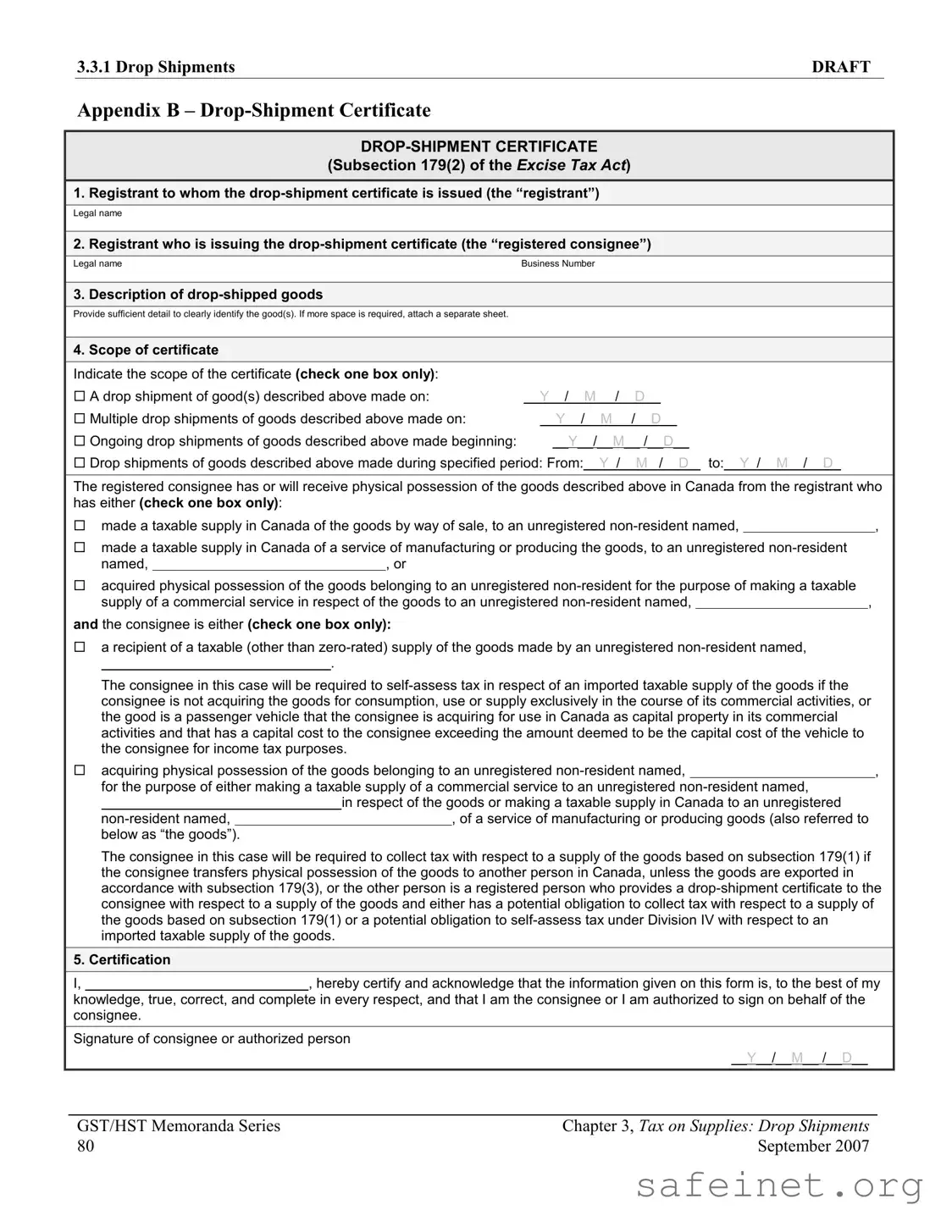
The Drop Shipment Certificate form serves as a crucial document in the realm of taxation and commerce, specifically under the Excise Tax Act. This form facilitates the process of drop shipments, where goods are shipped directly from a supplier to a buyer, bypassing the intermediary. Essential components of the form include the identification of both the registrant and the registered consignee, ensuring clarity in the transaction. Detailed descriptions of the goods being drop-shipped must be provided, allowing for accurate tracking and compliance. The form also outlines the scope of the certificate, with options for single or multiple shipments and specific timeframes. Importantly, it addresses the responsibilities of the consignee regarding tax assessments and collections, particularly when dealing with unregistered non-residents. The certification section requires a signature, affirming the accuracy of the information presented. Overall, the Drop Shipment Certificate is not just a procedural formality; it plays a vital role in ensuring that all parties involved adhere to tax obligations while facilitating smooth business operations.

| Fact Name | Details |
|---|---|
| Purpose | The Drop Shipment Certificate is used to document the details of goods being drop-shipped from a registrant to a consignee. |
| Legal Basis | This form is governed by Subsection 179(2) of the Excise Tax Act in Canada. |
| Parties Involved | It involves two main parties: the registrant (the seller) and the registered consignee (the buyer). |
| Goods Description | It requires a detailed description of the drop-shipped goods to ensure clear identification. |
| Scope of Certificate | The certificate allows for different scopes, including single, multiple, ongoing, or specified period drop shipments. |
| Tax Responsibilities | The consignee may need to self-assess or collect tax depending on their activities related to the goods. |
| Certification Requirement | The form must be signed by the consignee or an authorized person, certifying the accuracy of the information provided. |
Once you have gathered the necessary information, you can proceed to fill out the Drop Shipment Certificate form. This document is essential for ensuring compliance with tax regulations related to drop shipments. Follow the steps carefully to complete the form accurately.
What is a Drop Shipment Certificate?
A Drop Shipment Certificate is a document used in Canada to facilitate the tax treatment of goods that are shipped directly from a supplier to a customer, bypassing the registered consignee. It serves to confirm that the consignee is involved in the transaction and provides necessary details about the goods being shipped. This certificate helps ensure that the correct tax obligations are met under the Excise Tax Act.
Who needs to complete a Drop Shipment Certificate?
The Drop Shipment Certificate must be completed by the registered consignee, who is the individual or business receiving the goods. This form is typically used when the consignee does not take physical possession of the goods before they are delivered to the final customer. The registrant, or the supplier, must also be identified in the certificate.
What information is required on the Drop Shipment Certificate?
The certificate requires several key pieces of information. This includes the legal names of both the registrant and the consignee, a detailed description of the goods, and the scope of the certificate (whether it pertains to a single shipment, multiple shipments, or ongoing shipments). Additionally, the form must indicate how the consignee will receive the goods and whether they are making a taxable supply.
How does the Drop Shipment Certificate affect tax obligations?
The Drop Shipment Certificate plays a crucial role in determining tax obligations. Depending on the nature of the transaction, the consignee may be required to self-assess tax on the goods if they are not for consumption exclusively in commercial activities. In some cases, the consignee must collect tax when transferring possession of the goods to another person in Canada, unless certain conditions are met.
What happens if the Drop Shipment Certificate is not completed correctly?
If the Drop Shipment Certificate is not completed accurately, it may lead to tax compliance issues. The Canada Revenue Agency (CRA) may question the legitimacy of the transaction, which could result in penalties or additional tax liabilities. It is essential to ensure that all information is correct and complete to avoid complications.
How should the Drop Shipment Certificate be submitted?
The Drop Shipment Certificate should be retained by the consignee as part of their records. It does not need to be submitted to the CRA at the time of the transaction, but it must be available for review if requested. Keeping accurate records is vital for compliance and to support the tax treatment of the drop shipment.
Incorrect Registrant Information: Failing to accurately provide the legal name of the registrant can lead to confusion and potential issues with tax compliance. Ensure that the name matches the official business registration.
Missing Business Number: The business number of the registered consignee is crucial. Omitting this information can cause delays in processing the certificate.
Insufficient Description of Goods: Providing vague or incomplete details about the drop-shipped goods can lead to misunderstandings. It's essential to describe the goods clearly to avoid complications.
Incorrect Scope Selection: Selecting more than one box for the scope of the certificate is a common mistake. Only one option should be checked, so be sure to choose the correct timeframe for the drop shipments.
Inaccurate Tax Status Information: Misunderstanding the tax obligations related to the goods can result in compliance issues. Ensure that the correct boxes are checked regarding the consignee's tax status and obligations.
Missing Signature: Forgetting to sign the form is a simple yet critical mistake. Without a signature, the certificate is not valid, so double-check that it has been signed and dated appropriately.
The Drop Shipment Certificate form is an important document in the context of drop shipments. However, it is often used alongside other forms and documents that help clarify the transaction and ensure compliance with tax regulations. Below are a few of these related documents.
Each of these documents plays a key role in the drop shipment process. They help ensure clarity and compliance for all parties involved. Understanding these documents can facilitate smoother transactions and help avoid potential issues related to tax and delivery.
The Drop Shipment Certificate form shares similarities with the Bill of Lading, a document used in the shipping industry. Both documents serve to confirm the transfer of goods from one party to another. While the Drop Shipment Certificate details the specifics of the drop shipment, including the parties involved and the goods being shipped, the Bill of Lading provides evidence of the contract of carriage. It outlines the responsibilities of the shipper and the carrier, ensuring that the goods are delivered as agreed. This makes both documents essential for tracking shipments and ensuring compliance with tax regulations.
Another document comparable to the Drop Shipment Certificate is the Purchase Order. A Purchase Order is issued by a buyer to a seller, indicating the types and quantities of goods being ordered. Like the Drop Shipment Certificate, it establishes a formal agreement between the parties involved. The Purchase Order helps in managing inventory and ensures that both parties are clear about the transaction details, including the description of goods and delivery terms. This clarity is vital for smooth business operations and tax compliance.
The Commercial Invoice is also similar to the Drop Shipment Certificate. This document serves as a bill for the goods sold and includes details such as the seller's and buyer's information, the description of goods, and payment terms. Both documents are used for record-keeping and tax purposes. The Commercial Invoice is particularly important for customs clearance when goods cross international borders, while the Drop Shipment Certificate focuses more on the specifics of the drop shipment process.
Next, the Certificate of Origin is another document that resembles the Drop Shipment Certificate. This certificate verifies the country in which the goods were produced or manufactured. Like the Drop Shipment Certificate, it plays a crucial role in international trade by determining the applicable tariffs and ensuring compliance with trade agreements. Both documents require accurate information about the goods and the parties involved to facilitate smooth transactions.
The Sales Agreement is also akin to the Drop Shipment Certificate. This legal document outlines the terms and conditions of a sale between a buyer and a seller. Similar to the Drop Shipment Certificate, it includes details about the goods, pricing, and delivery terms. Both documents are essential for establishing clear expectations and responsibilities, thereby reducing the likelihood of disputes during the transaction process.
Another related document is the Delivery Receipt. This document serves as proof of delivery for goods shipped from one party to another. Like the Drop Shipment Certificate, it confirms that the goods have been received by the consignee. The Delivery Receipt typically includes information about the shipment, such as the date of delivery and the condition of the goods upon arrival, which is crucial for both record-keeping and tax purposes.
The Export Declaration is also similar to the Drop Shipment Certificate. This document is required for shipments leaving the country and provides information about the goods being exported. Both documents help ensure compliance with tax laws and regulations. The Export Declaration is particularly important for customs purposes, while the Drop Shipment Certificate focuses on the specifics of the drop shipment transaction.
Additionally, the Tax Exempt Certificate is comparable to the Drop Shipment Certificate. This document allows buyers to purchase goods without paying sales tax, provided they meet certain criteria. Both documents require accurate information about the parties involved and the goods being exchanged. They serve to ensure compliance with tax regulations and help businesses manage their tax liabilities effectively.
Lastly, the Return Authorization form shares similarities with the Drop Shipment Certificate. This document is used when a buyer wants to return purchased goods to the seller. Like the Drop Shipment Certificate, it outlines the details of the goods and the parties involved. Both documents are important for maintaining accurate records and ensuring that transactions are properly documented for tax and compliance purposes.
When filling out the Drop Shipment Certificate form, it is important to follow certain guidelines to ensure accuracy and compliance. Here’s a list of what you should and shouldn’t do:
By adhering to these guidelines, you can help ensure that your Drop Shipment Certificate form is filled out correctly and efficiently.
Misconceptions about the Drop Shipment Certificate form can lead to confusion and errors in compliance. Below are ten common misconceptions along with clarifications.
Understanding these misconceptions can help ensure that businesses comply with tax regulations related to drop shipments. Proper use of the Drop Shipment Certificate is essential for maintaining compliance and avoiding potential issues.
Understanding the Drop Shipment Certificate form is essential for businesses engaged in drop shipments. Here are some key takeaways to keep in mind when filling out and using this form: