Homepage > Blank Driver Time Record Template
Article Structure

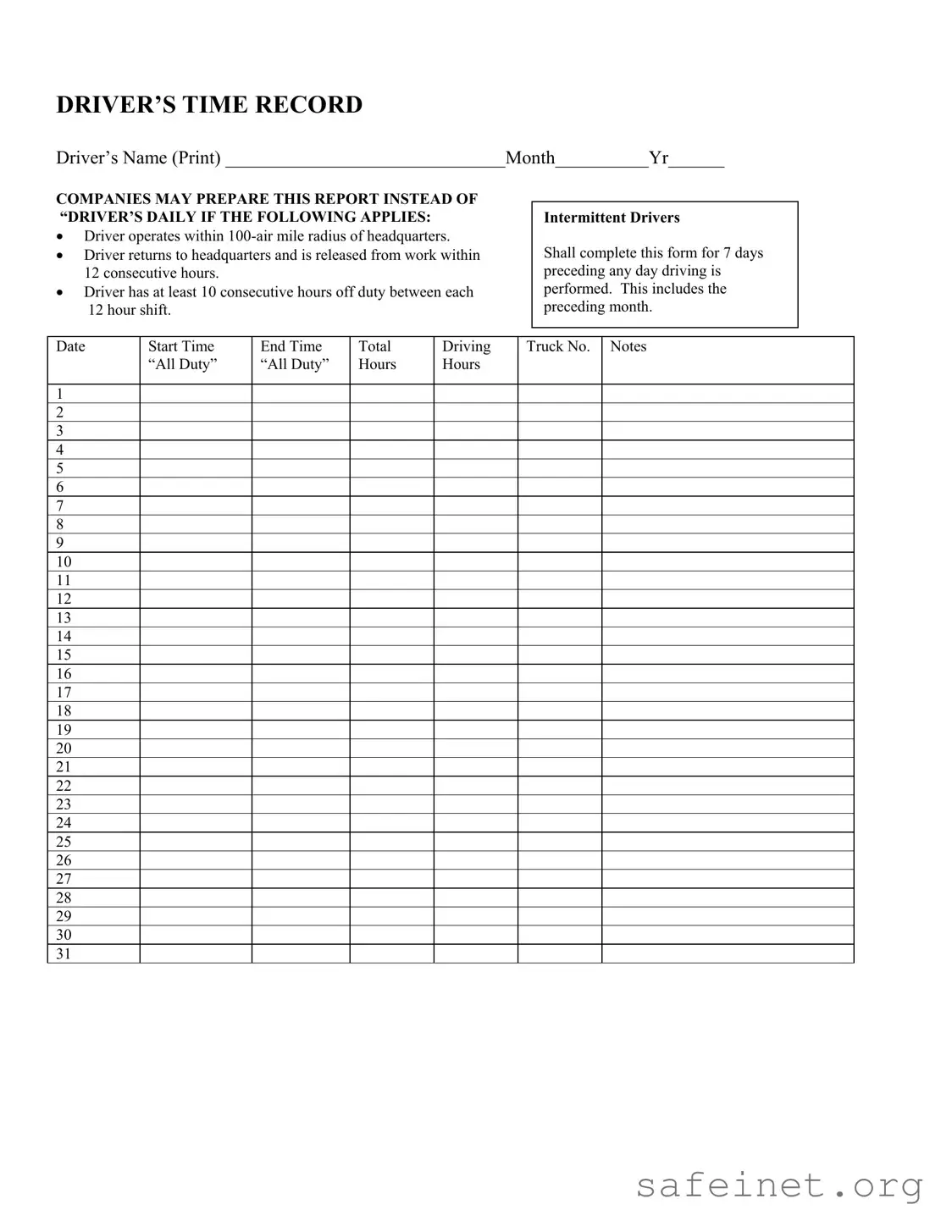
The Driver Time Record form is an essential document for tracking a driver's hours and ensuring compliance with regulations. It is designed for drivers who operate within a 100-air mile radius of their headquarters, allowing them to report their work hours efficiently. To qualify for this simplified reporting, drivers must return to their headquarters and be released from work within 12 consecutive hours, as well as have at least 10 consecutive hours off duty between each 12-hour shift. This form is particularly useful for intermittent drivers, who are required to complete it for the seven days preceding any day they perform driving duties. The form includes sections for the driver's name, the month and year, and a detailed log for each day, capturing the start time, end time, total driving hours, truck number, and any relevant notes. By providing a clear structure for recording this information, the Driver Time Record form helps maintain accountability and supports safe driving practices.

Form Sample

DRIVER’S TIME RECORD
Driver’s Name (Print) ______________________________Month__________Yr______
COMPANIES MAY PREPARE THIS REPORT INSTEAD OF
“DRIVER’S DAILY IF THE FOLLOWING APPLIES:
Driver operates within 100-air mile radius of headquarters.
Driver returns to headquarters and is released from work within
12 consecutive hours.
Driver has at least 10 consecutive hours off duty between each
12 hour shift.
Date Start Time
“All Duty”
End Time
“All Duty”
Total
Hours
Driving
Hours
Truck No. Notes
1
2
3
4
5
6
7
8
9
10
11
12
13
14
15
16
17
18
19
20
21
22
23
24
25
26
27
28
29
30
31
Intermittent Drivers
Shall complete this form for 7 days
preceding any day driving is
performed. This includes the
preceding month.

Document Specifications

Fact Name Description
Driver's Name Requirement The form requires the driver's name to be printed clearly at the top, ensuring accurate identification.
Monthly Record Drivers must complete this record for each month they operate under the specified conditions.
100-Air Mile Radius This form can be used only if the driver operates within a 100-air mile radius of their headquarters.
12-Hour Work Limit Drivers must return to headquarters and be released from work within 12 consecutive hours to qualify for this form.
10-Hour Off Duty Requirement Drivers are required to have at least 10 consecutive hours off duty between each 12-hour shift.
Intermittent Drivers Intermittent drivers must complete this form for the 7 days preceding any day they perform driving duties.
Governing Law This form is governed by the Federal Motor Carrier Safety Administration (FMCSA) regulations under 49 CFR Part 395.

Steps to Filling Out Driver Time Record

Completing the Driver Time Record form is essential for accurately tracking your driving hours. Follow these steps carefully to ensure all necessary information is provided correctly. This will help maintain compliance with regulations and ensure proper record-keeping.

  1. Begin by printing your name clearly in the designated space for the Driver’s Name.
  2. Fill in the month and year at the top of the form.
  3. Check if your company prepares this report instead of the Driver’s Daily log. Ensure you meet the criteria listed on the form.
  4. If you are an intermittent driver, confirm that you are completing this form for the 7 days preceding any day you perform driving duties.
  5. In the table provided, enter the date for each day you drove in the appropriate column.
  6. For each day, record your start time and end time in the respective columns.
  7. Calculate the total driving hours for each day and enter that information in the Total Driving Hours column.
  8. Document the truck number used for each driving session in the Truck No. column.
  9. Use the Notes section to add any relevant information or comments regarding your driving hours or conditions.

More About Driver Time Record

What is the Driver Time Record form used for?

The Driver Time Record form is designed to help drivers keep track of their driving hours and ensure compliance with regulations. It’s particularly useful for those who operate within a 100-air mile radius of their headquarters and return home within a 12-hour workday.

Who needs to fill out the Driver Time Record form?

This form must be completed by drivers who meet specific criteria. If you operate within the 100-air mile radius, return to your headquarters within 12 consecutive hours, and have at least 10 consecutive hours off duty between shifts, you will need to use this form.

What information is required on the form?

You will need to provide your name, the month and year, and details for each driving day. This includes the date, start and end times, total driving hours, truck number, and any notes relevant to your driving activities.

How do intermittent drivers use this form?

If you are an intermittent driver, you should complete the Driver Time Record for the seven days leading up to any day you perform driving duties. This includes documenting your driving activities from the previous month as well.

What happens if I don’t fill out the form correctly?

Failing to fill out the form accurately can lead to compliance issues. It’s important to double-check your entries to ensure that all information is correct and complete. Mistakes may result in penalties or complications with your employer.

Is there a specific format for recording times?

Yes, you should record your start and end times in a clear and consistent format. Make sure to calculate your total driving hours accurately for each day, as this is crucial for compliance with driving regulations.

Can companies create their own version of the Driver Time Record form?

Yes, companies are allowed to prepare their own version of the Driver Time Record form as long as it meets the required criteria and includes all necessary information. This can help streamline the process for their drivers.

What should I do if I have additional notes to include?

There is a designated section for notes on the form. Use this space to include any relevant information that may affect your driving record, such as delays, breaks, or unusual circumstances during your shifts.

How long do I need to keep the Driver Time Record form?

It’s advisable to keep your completed forms for a minimum of six months. This way, you have documentation ready in case of any audits or inquiries regarding your driving hours.

Common mistakes

  1. Incomplete Driver Information: Failing to fill in the driver's name, month, and year can lead to confusion and delays in processing.

  2. Incorrect Time Entries: Entering the wrong start or end times can result in inaccurate records of driving hours.

  3. Missing Total Driving Hours: Not calculating or recording total driving hours can create discrepancies in compliance.

  4. Truck Number Omission: Forgetting to include the truck number makes it difficult to track vehicle usage and accountability.

  5. Notes Section Ignored: Neglecting to add important notes about the trip can lead to misunderstandings or lack of context.

  6. Not Following Intermittent Driver Guidelines: Intermittent drivers must complete the form for the 7 days preceding any driving day, which is often overlooked.

  7. Failure to Adhere to 100-Air Mile Radius Rules: Not understanding the eligibility criteria for using this form can lead to improper submissions.

Documents used along the form

When managing driver records, several forms and documents complement the Driver Time Record form. These documents help ensure compliance with regulations and maintain accurate records of driving activities. Below are some of the key forms commonly used alongside the Driver Time Record.

  • Driver Qualification File (DQF): This file contains essential information about a driver’s qualifications, including their driving history, licenses, and medical certifications. It ensures that drivers meet the necessary standards to operate commercial vehicles.
  • Vehicle Inspection Report (VIR): A VIR is completed by drivers to document the condition of a vehicle before and after use. This report helps identify any maintenance issues and ensures that vehicles are safe for operation.
  • Bill of Lading (BOL): The BOL is a legal document between the shipper and carrier. It serves as a receipt for goods and outlines the details of the shipment, including the origin, destination, and type of cargo being transported.
  • Hours of Service (HOS) Log: This log records a driver’s hours of service to ensure compliance with federal regulations. It tracks driving time, rest periods, and off-duty hours, helping prevent driver fatigue.
  • Accident Report Form: In the event of an accident, this form is used to document the details of the incident. It includes information about the parties involved, damages, and any injuries sustained, which is crucial for insurance and legal purposes.

These forms work together to create a comprehensive record-keeping system for drivers. Maintaining accurate documentation not only supports regulatory compliance but also enhances safety and accountability within the transportation industry.

Similar forms

The Driver's Daily Log is a document that tracks a driver's hours of service and compliance with regulations. Similar to the Driver Time Record form, it is used to monitor the time spent driving and resting. The Daily Log includes detailed entries for each day, including start and end times, total driving hours, and off-duty periods. Both forms serve to ensure that drivers adhere to federal regulations regarding maximum driving hours and required rest periods, thereby promoting safety on the roads.

The Vehicle Inspection Report is another document that shares similarities with the Driver Time Record. This report is used by drivers to document the condition of the vehicle before and after a trip. Like the Driver Time Record, it emphasizes the importance of safety and compliance. Both documents require careful attention to detail, as they help ensure that vehicles are roadworthy and that drivers are operating within safe parameters. The Vehicle Inspection Report can also serve as a record in case of accidents or inspections.

The Bill of Lading is a crucial document in the transportation industry that outlines the details of the cargo being transported. While it serves a different purpose than the Driver Time Record, both documents are essential for tracking and accountability. The Bill of Lading includes information about the shipper, consignee, and the goods being transported, similar to how the Driver Time Record tracks the hours and conditions of the driver. Both documents are vital for maintaining a clear record of transportation activities and ensuring compliance with regulations.

The Electronic Logging Device (ELD) report is a modern alternative to the Driver Time Record form. ELDs automatically record driving time and monitor compliance with hours-of-service regulations. Like the Driver Time Record, the ELD report aims to promote safety by ensuring that drivers do not exceed their allowable driving hours. The data collected through ELDs can be more accurate and easier to analyze than handwritten records, yet both documents serve the same fundamental purpose of tracking driver hours and compliance.

The Trip Sheet is another document that resembles the Driver Time Record in its function of recording driving activities. The Trip Sheet typically includes details such as the date, route, start and end times, and total miles driven. Both forms are used to keep an accurate account of a driver's activities and help ensure compliance with regulations. The Trip Sheet can also assist in expense tracking and reporting, making it a valuable tool for drivers and fleet managers alike.

Lastly, the Driver Qualification File is a document that contains essential information about a driver's qualifications and employment history. While it does not track time or driving hours like the Driver Time Record, both documents are crucial for maintaining compliance with federal regulations. The Driver Qualification File includes records such as driving tests, medical certifications, and background checks, ensuring that only qualified individuals operate commercial vehicles. Together, these documents contribute to a comprehensive approach to safety and regulatory compliance in the transportation industry.

Dos and Don'ts

When filling out the Driver Time Record form, there are some important dos and don'ts to keep in mind. Following these guidelines can help ensure that your record is accurate and compliant.

  • Do print your name clearly in the designated space.
  • Do fill in the month and year correctly.
  • Do record the start and end times for each driving period accurately.
  • Do include the total driving hours for each entry.
  • Do note the truck number for each driving session.
  • Don't leave any sections blank; fill out every required field.
  • Don't use abbreviations or shorthand that could cause confusion.
  • Don't forget to sign the form if required.
  • Don't submit the form without double-checking for errors.

Misconceptions

Misconception 1: The Driver Time Record form is only for long-haul drivers.

This form can be used by drivers operating within a 100-air mile radius of their headquarters. It is not limited to those who drive long distances.

Misconception 2: Drivers must fill out the form every day they drive.

Intermittent drivers only need to complete the form for the seven days preceding any day they perform driving duties. This includes the days from the previous month.

Misconception 3: The form is optional for drivers who qualify for the 100-air mile radius exemption.

While companies may prepare the report instead of the Driver's Daily Log, drivers must still complete the form if they meet the criteria outlined.

Misconception 4: The total driving hours are calculated incorrectly if not done daily.

The total driving hours should reflect the hours driven during the specified days. It is not necessary to track hours daily if the form is completed accurately for the specified period.

Misconception 5: All drivers must take 10 consecutive hours off duty between shifts.

This requirement applies only to drivers who work 12-hour shifts. If a driver does not work a 12-hour shift, different rules may apply.

Misconception 6: The form does not require any additional notes or information.

Drivers should include any relevant notes in the designated section of the form. This can provide important context for the recorded hours.

Key takeaways

When filling out and using the Driver Time Record form, consider the following key takeaways:

  • Complete Information: Ensure that all required fields, including the driver's name, month, and year, are accurately filled out.
  • Eligibility Criteria: Companies may use this report instead of the Driver's Daily Log if the driver operates within a 100-air mile radius, returns to headquarters within 12 consecutive hours, and has at least 10 consecutive hours off duty between shifts.
  • Intermittent Drivers: If you are an intermittent driver, complete this form for the 7 days preceding any day you perform driving duties, including the previous month.
  • Accurate Time Tracking: Record start and end times for each driving session accurately. This will help in calculating total driving hours correctly.
  • Truck Identification: Always include the truck number used during each driving session to maintain clear records.
  • Notes Section: Utilize the notes section to document any relevant information or incidents that occurred during your driving hours.