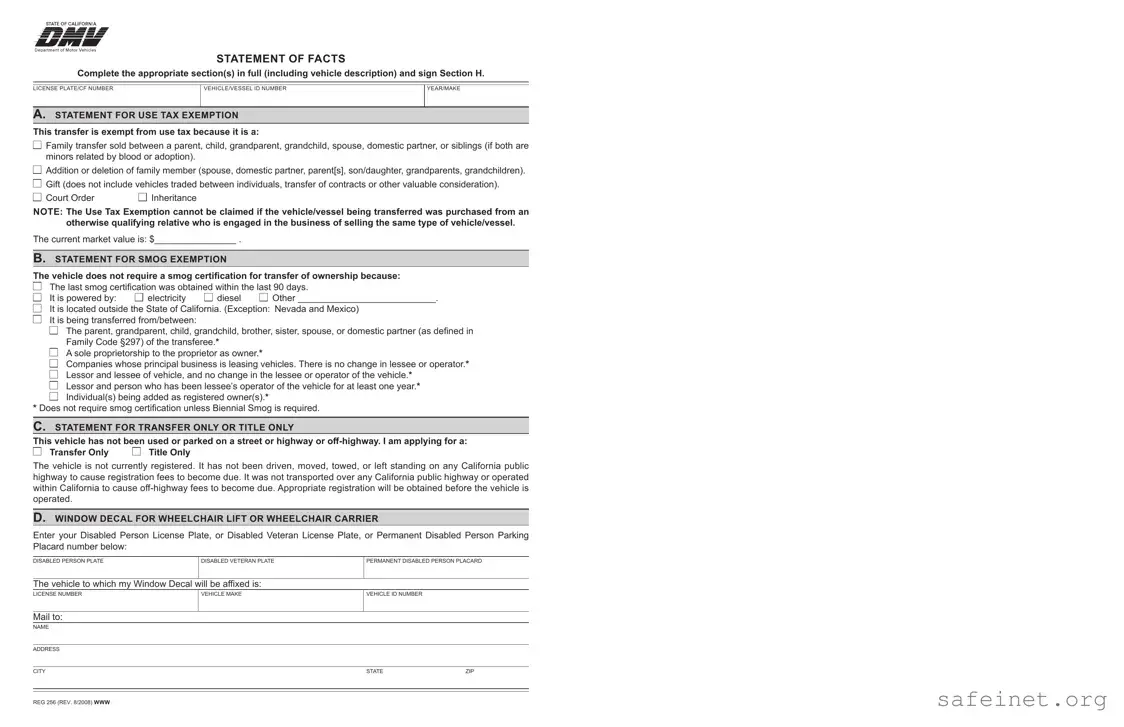
Homepage > Blank Dmv Reg 256 Template
Article Structure

The DMV Reg 256 form serves as a crucial document for various vehicle ownership scenarios in California. It is designed to capture essential information regarding vehicle transfers, including details like the vehicle identification number, license plate number, and the year and make of the vehicle. This form allows users to claim exemptions from use tax under specific circumstances, such as family transfers, gifts, or court orders. Additionally, it includes sections for smog exemption, ensuring that certain vehicles do not require a smog certification for ownership transfer. The form also accommodates requests for title-only transfers and provides a space for individuals with disabilities to obtain a window decal for wheelchair lifts or carriers. Furthermore, it addresses changes in vehicle body specifications and name corrections, making it a comprehensive tool for managing vehicle-related documentation. Completing the DMV Reg 256 form accurately is essential for compliance with California's vehicle registration laws, and it must be signed under penalty of perjury, affirming the truthfulness of the provided information.
Form Sample

STATE
OF
CALIFORNIA
~S6l!l!!I
_.,,.,,..,
Department
of
Motor Vehicles
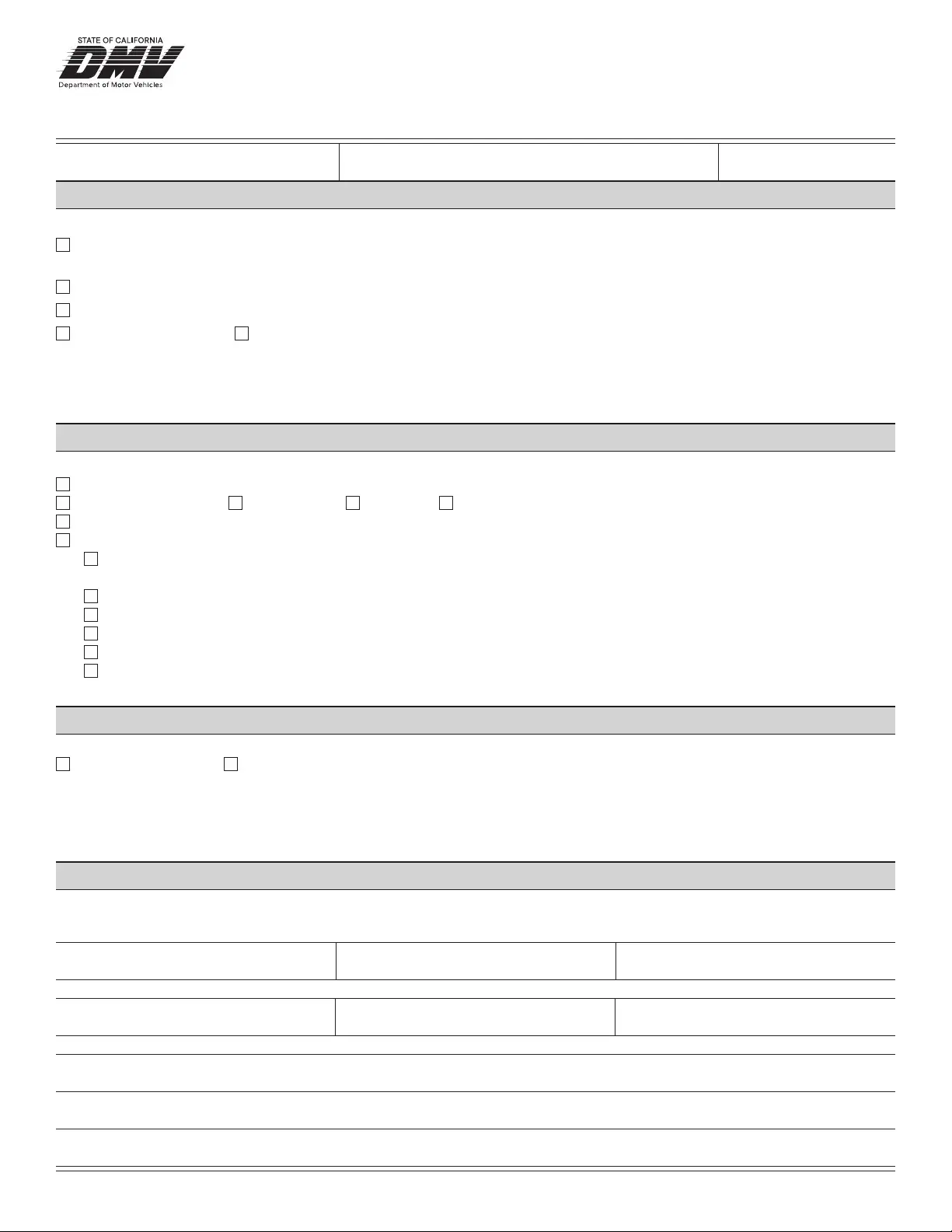
STATEMENT OF FACTS
Complete the appropriate section(s) in full (including vehicle description) and sign Section H.
LICENSE PLATE/CF NUMBER VEHICLE/VESSEL ID NUMBER YEAR/MAKE
A. STATEMENT FOR USE TAX EXEMPTION
This transfer is exempt from use tax because it is a:
Family transfer sold between a parent, child, grandparent, grandchild, spouse, domestic partner, or siblings (if both are
minors related by blood or adoption).
Addition or deletion of family member (spouse, domestic partner, parent[s], son/daughter, grandparents, grandchildren).
Gift (does not include vehicles traded between individuals, transfer of contracts or other valuable consideration).
Court Order Inheritance
NOTE: The Use Tax Exemption cannot be claimed if the vehicle/vessel being transferred was purchased from an
otherwise qualifying relative who is engaged in the business of selling the same type of vehicle/vessel.
The current market value is: $________________ .
B. STATEMENT FOR SMOG EXEMPTION
The vehicle does not require a smog certication for transfer of ownership because:
The last smog certication was obtained within the last 90 days.
It is powered by: electricity diesel Other ___________________________.
It is located outside the State of California. (Exception: Nevada and Mexico)
It is being transferred from/between:
The parent, grandparent, child, grandchild, brother, sister, spouse, or domestic partner (as dened in
Family Code §297) of the transferee.*
A sole proprietorship to the proprietor as owner.*
Companies whose principal business is leasing vehicles. There is no change in lessee or operator.*
Lessor and lessee of vehicle, and no change in the lessee or operator of the vehicle.*
Lessor and person who has been lessee’s operator of the vehicle for at least one year.*
Individual(s) being added as registered owner(s).*
* Does not require smog certication unless Biennial Smog is required.
C. STATEMENT FOR TRANSFER ONLY OR TITLE ONLY
This vehicle has not been used or parked on a street or highway or o󰀨-highway. I am applying for a:
Transfer Only Title Only
The vehicle is not currently registered. It has not been driven, moved, towed, or left standing on any California public
highway to cause registration fees to become due. It was not transported over any California public highway or operated
within California to cause o󰀨-highway fees to become due. Appropriate registration will be obtained before the vehicle is
operated.
D. WINDOW DECAL FOR WHEELCHAIR LIFT OR WHEELCHAIR CARRIER
Enter your Disabled Person License Plate, or Disabled Veteran License Plate, or Permanent Disabled Person Parking
Placard number below:
DISABLED PERSON PLATE DISABLED VETERAN PLATE PERMANENT DISABLED PERSON PLACARD
The vehicle to which my Window Decal will be a󰀩xed is:
LICENSE NUMBER VEHICLE MAKE VEHICLE ID NUMBER
Mail to:
NAME
ADDRESS
CITY STATE ZIP
REG 256 (REV. 8/2008) WWW
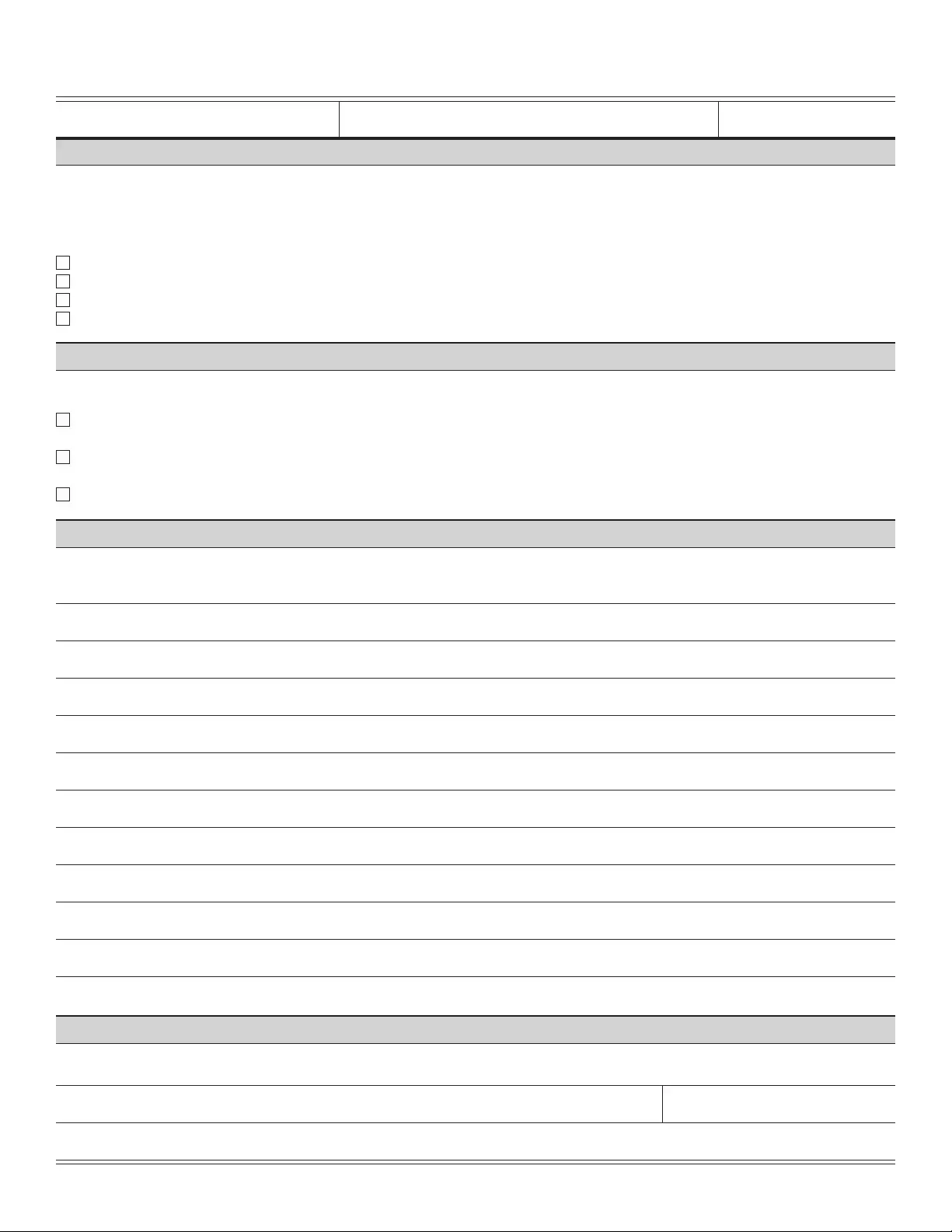
STATEMENT OF FACTS
Complete the appropriate section(s) in full (including vehicle description) and sign Section H.
LICENSE PLATE/CF NUMBER VEHICLE/VESSEL ID NUMBER YEAR/MAKE
E. STATEMENT FOR VEHICLE BODY CHANGE (OWNERSHIP CERTIFICATE REQUIRED)
The current market value of the vehicle or vessel is: $________________ .
Changes were made at a cost of $________________ on this date ________________ .
This is what I changed: Check all that apply:
Unladen Weight changed because __________________ (Public Weighmaster Certicate is required. Exception: Trailers)
Motive Power changed from ________________ to ________________ .
Body Type changed from ________________ to ________________ .
Number of Axles changed from ________________ to________________ .
F. NAME STATEMENT (OWNERSHIP CERTIFICATE REQUIRED)
Please print
I, _______________________________ and _______________________________ are one and the same person.
My name is misspelled. Please correct it to: _________________________________________________________
I am changing my name from _____________________________ to ___________________________________
G. STATEMENT OF FACTS
I, the undersigned, state:
H. APPLICANT’S SIGNATURE
I certify (or declare) under penalty of perjury under the laws of the State of California that the foregoing is true and
correct.
PRINTED LAST NAME FIRST NAME MIDDLE NAME DAYTIME PHONE NUMBER
( )
SIGNATURE DATE
REG 256 (REV. 8/2008) WWW
X

Document Specifications

Fact Name Details
Form Purpose The DMV Reg 256 form is used for various statements of facts regarding vehicle transfers in California.
Use Tax Exemption This form allows for exemptions from use tax under certain conditions, such as family transfers or gifts.
Smog Certification A vehicle may be exempt from smog certification for transfer if specific criteria are met, including recent certification or vehicle type.
Transfer Only Option The form can be used to apply for a transfer only or title only, indicating the vehicle has not been used on public roads.
Disabled Access Section D allows applicants to apply for a window decal for wheelchair lifts or carriers, requiring specific license plate information.
Vehicle Body Change Changes made to a vehicle's body type or other specifications must be documented, including associated costs.
Name Correction Section F is dedicated to correcting name misspellings or changes, ensuring accurate ownership records.
Governing Law The form operates under California Vehicle Code regulations, specifically related to vehicle ownership and transfers.

Steps to Filling Out Dmv Reg 256

Filling out the DMV Reg 256 form requires attention to detail. After completing the form, you will need to submit it to the appropriate DMV office for processing. Ensure that all information is accurate to avoid delays in your request.

  1. Begin by entering the License Plate/CF Number and Vehicle/Vessel ID Number at the top of the form.
  2. Fill in the Year and Make of the vehicle.
  3. Choose the appropriate section that applies to your situation:
    • A. Statement for Use Tax Exemption: Check the box that applies to your transfer situation.
    • B. Statement for Smog Exemption: Select the reason your vehicle does not require a smog certification.
    • C. Statement for Transfer Only or Title Only: Indicate if you are applying for transfer only or title only.
    • D. Window Decal for Wheelchair Lift or Wheelchair Carrier: Provide the required disabled plate or placard number.
    • E. Statement for Vehicle Body Change: Enter the current market value and describe the changes made to the vehicle.
    • F. Name Statement: Indicate if you need to correct or change your name.
  4. Complete Section G by providing any additional facts or statements as required.
  5. In Section H, print your last name, first name, and middle name.
  6. Provide your daytime phone number in the designated space.
  7. Sign and date the form to certify that the information is true and correct.

More About Dmv Reg 256

What is the DMV Reg 256 form used for?

The DMV Reg 256 form, also known as the Statement of Facts, serves multiple purposes related to vehicle ownership and transfer in California. It allows individuals to declare certain exemptions, such as use tax exemptions for family transfers or gifts. Additionally, it can be used to confirm that a vehicle does not require a smog certification for ownership transfer. The form is essential for various scenarios, including title-only transfers, changes in vehicle body, and name corrections.

Who can use the use tax exemption section of the DMV Reg 256 form?

This section can be utilized by individuals transferring a vehicle between certain family members, such as parents, children, siblings, and spouses. It also applies to gifts that do not involve any monetary exchange or trade. However, if the vehicle was purchased from a relative who is in the business of selling vehicles, the exemption cannot be claimed. It's crucial to accurately fill out this section to avoid potential tax liabilities.

What are the requirements for claiming a smog exemption on the DMV Reg 256 form?

To claim a smog exemption, the vehicle must meet specific criteria. For instance, if the last smog certification was obtained within the last 90 days, no further certification is required. Additionally, vehicles powered by electricity or diesel, or those located outside California (except Nevada and Mexico), may also qualify. Transfers between family members or certain business arrangements can also be exempt from smog certification, provided no changes in the lessee or operator occur.

Can I use the DMV Reg 256 form for a vehicle that has not been registered?

Yes, the DMV Reg 256 form can be used for vehicles that are not currently registered. If you are applying for a transfer or title only, you must declare that the vehicle has not been used or parked on public highways. It's essential to ensure that appropriate registration is obtained before operating the vehicle to avoid incurring any registration fees.

What should I do if I need to correct my name on the DMV Reg 256 form?

If your name is misspelled or if you are changing your name, you can indicate this on the form. You will need to provide the correct spelling or your new name. Make sure to include any necessary documentation that supports your name change. This ensures that the DMV has accurate records, which is vital for vehicle registration and ownership verification.

Common mistakes

  1. Incomplete Information: Failing to fill out all required sections, such as vehicle description or ownership details, can lead to delays in processing. Ensure every section that applies is completed in full.

  2. Incorrect Signatures: Not signing Section H can result in the form being rejected. Always remember to sign and date the application to validate it.

  3. Misunderstanding Exemptions: Misinterpreting the exemptions for use tax or smog requirements can lead to incorrect claims. Review the criteria carefully to ensure eligibility.

  4. Omitting Required Documents: Forgetting to include necessary documents, such as the ownership certificate or public weighmaster certificate, may cause processing delays. Check the checklist of required attachments before submission.

  5. Providing Inaccurate Values: Entering incorrect market values for the vehicle or vessel can raise questions. Ensure the values reflect current market conditions to avoid issues.

  6. Neglecting to Double-Check: Skimming through the form can lead to overlooked errors. Always review the completed form for accuracy before submission to prevent complications.

Documents used along the form

The DMV REG 256 form is often accompanied by various other documents that help facilitate vehicle registration and ownership transfers. Here are some commonly used forms and documents:

  • DMV Form REG 343: This is the application for a duplicate title. It is used when the original title has been lost, stolen, or damaged.
  • DMV Form REG 227: This form is for the transfer of ownership of a vehicle. It includes details about the buyer and seller, ensuring a clear record of the transaction.
  • DMV Form REG 31: This is the application for a California Certificate of Title. It is necessary for registering a vehicle that does not have a title or was purchased out of state.
  • DMV Form REG 504: This form is used for reporting the sale or transfer of a vehicle. It helps keep the DMV informed about changes in ownership.
  • DMV Form REG 256A: This is a supplementary statement of facts that provides additional information related to the vehicle transfer, often required for specific situations.
  • Proof of Insurance: A document proving that the vehicle is insured. This is often required for registration and transfer processes.
  • Bill of Sale: A receipt that documents the sale of the vehicle, including purchase price and details about the buyer and seller. It serves as proof of the transaction.

Having these documents ready can streamline the registration process and ensure compliance with state regulations. Always double-check that you have the necessary forms before visiting the DMV.

Similar forms

The DMV Reg 256 form shares similarities with the DMV Form REG 343, which is used for vehicle title applications. Both forms require detailed information about the vehicle and the applicant. They serve to establish ownership and facilitate the transfer of title. Just like the REG 256, the REG 343 may require signatures and additional documentation to verify identity and ownership claims. The REG 343 is essential for anyone looking to officially register a vehicle in California.

Another related document is the DMV Form REG 227, which is the application for a duplicate title. This form is similar in that it also requires vehicle identification details and personal information from the applicant. Both forms aim to provide clarity and legitimacy in vehicle ownership. If a title is lost or damaged, the REG 227 allows for a replacement, ensuring that the owner can maintain proper documentation.

The DMV Form REG 262, used for a vehicle transfer between family members, is another document akin to the DMV Reg 256. Both forms outline exemptions and conditions under which a vehicle can be transferred without incurring taxes. Family transfers are treated with specific exemptions in both forms, making it easier for relatives to pass ownership without financial burdens. This highlights the importance of understanding familial relationships in vehicle transactions.

DMV Form REG 31, which is a statement of facts for a vehicle registration, is also similar. It serves to provide factual information about a vehicle's status and ownership. Both the REG 256 and REG 31 require the applicant to declare specific facts about the vehicle, such as its usage and any exemptions that may apply. This ensures that the DMV has accurate records for each vehicle on the road.

Another related document is the DMV Form REG 504, which is used for smog exemption requests. Like the DMV Reg 256, this form requires the applicant to provide details about the vehicle's smog certification status. Both forms aim to streamline the process of vehicle ownership transfer while ensuring compliance with state regulations. They are essential in situations where smog certification is not applicable.

The DMV Form REG 256 is also similar to the DMV Form REG 343A, which is used for declaring a vehicle's status for commercial purposes. Both forms involve declaring specific facts about the vehicle and its use. They require the applicant to provide information that justifies the vehicle's classification, ensuring that the DMV can maintain accurate records for both personal and commercial vehicles.

Finally, the DMV Form REG 256 resembles the DMV Form REG 510, which is a request for a vehicle identification number (VIN) verification. Both forms require detailed vehicle information and serve to clarify ownership and registration status. This is particularly important for ensuring that vehicles meet state regulations and that ownership claims are legitimate.

Dos and Don'ts

When filling out the DMV Reg 256 form, it is important to approach the task with care. Here are some guidelines to follow:

  • Do read the instructions carefully before starting. Understanding what is required can save you time and prevent mistakes.
  • Do fill in all necessary sections completely. Incomplete forms may delay processing or lead to rejection.
  • Don't leave any fields blank unless specified. If a section does not apply to you, indicate that clearly.
  • Don't forget to sign Section H. Your signature is essential for the form to be valid.

Misconceptions

Understanding the DMV Reg 256 form can be confusing. Here are some common misconceptions that people have about this important document:

  • It's only for tax exemptions. Many believe the DMV Reg 256 is solely for claiming use tax exemptions. In reality, it serves multiple purposes, including smog exemptions, name changes, and vehicle body changes.
  • Only vehicle sales require this form. Some think this form is only necessary for buying or selling vehicles. However, it is also used for transferring ownership without a sale, such as gifts or family transfers.
  • Filling it out is optional. Many assume they can skip this form if they don't think it's needed. In fact, it is often required for various transactions, and not using it can lead to complications.
  • Smog exemptions apply to all vehicles. There's a misconception that all vehicles are exempt from smog certification with this form. Exemptions depend on specific criteria, such as vehicle age and type.
  • Only the seller needs to sign it. Some believe that only the seller's signature is required. In truth, the buyer or transferee must also sign to validate the transaction.
  • It can be submitted online. Many people think they can easily submit the DMV Reg 256 online. However, this form typically needs to be mailed or submitted in person at a DMV office.
  • It's the same as a title transfer. Some confuse the DMV Reg 256 with the title transfer process. While related, the Reg 256 is a statement of facts that supports the title transfer.
  • All information is optional. A common misunderstanding is that not all sections need to be filled out. Each relevant section must be completed to ensure the form is valid and accepted.

Being aware of these misconceptions can help streamline your experience with the DMV and ensure that you complete the necessary paperwork correctly.

Key takeaways

When filling out and using the DMV Reg 256 form, it is essential to understand the requirements and implications of each section. Here are some key takeaways:

  • Complete All Sections: Ensure that you fill out the appropriate sections completely, including vehicle descriptions and other required information.
  • Use Tax Exemption: Identify if your transfer qualifies for a use tax exemption. This includes family transfers, gifts, or transfers due to court orders or inheritance.
  • Smog Certification: Determine if your vehicle requires a smog certification. Certain exemptions apply, such as recent certification or specific family transfers.
  • Transfer Only or Title Only: If the vehicle has not been used or registered, you may apply for a transfer only or title only. Ensure that it has not caused any registration fees to accrue.
  • Window Decal: If applicable, provide your Disabled Person License Plate or other relevant numbers for a wheelchair lift or carrier decal.
  • Vehicle Body Changes: If changes have been made to the vehicle, document these accurately. Include the current market value and any costs associated with modifications.
  • Name Statement: If there are discrepancies in your name or you are changing it, clearly state the corrections or changes needed.
  • Signature Requirement: Remember to sign Section H, certifying that the information provided is true and correct under penalty of perjury.

Following these guidelines will help ensure that your DMV Reg 256 form is filled out correctly and processed efficiently.