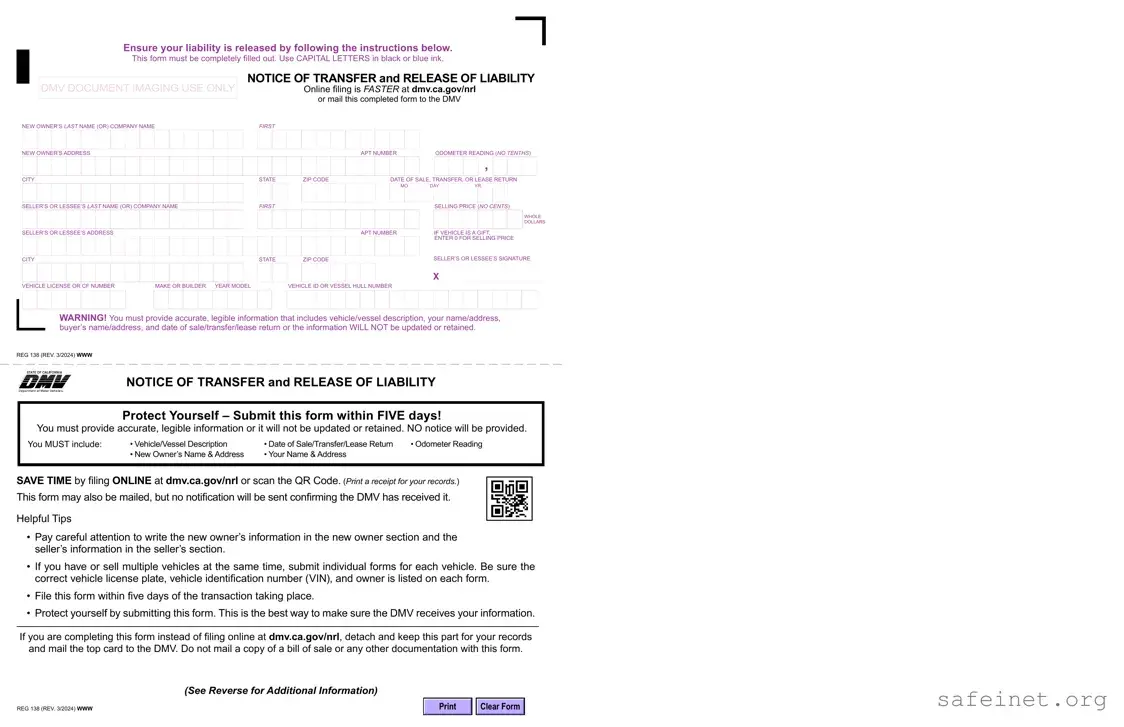
The DMV Reg 138 form, also known as the Notice of Transfer and Release of Liability, plays a crucial role in the vehicle sale process in California. This form must be filled out completely and accurately to ensure that the seller is no longer held responsible for any liabilities associated with the vehicle after it has been sold. It includes essential information such as the new owner's name and address, the odometer reading, and the date of sale. Sellers must also provide their own details, including their name and address, and sign the form. It's important to use capital letters and black or blue ink for clarity. This form can be submitted online at dmv.ca.gov or mailed directly to the DMV, but keep in mind that no notification will be sent if it is mailed. Filing this form within five days of the transaction is a legal requirement, and it helps protect the seller from potential issues that may arise after the sale, such as traffic violations or civil litigation linked to the vehicle. Properly completing and submitting the DMV Reg 138 form ensures a smooth transition of ownership and mitigates future liability concerns.
Ensure your liability is released by following the instructions below.
This form must be completely filled out. Use CAPITAL LETTERS in black or blue ink.
DMV DOCUMENT IMAGING USE ONLY
NOTICE OF TRANSFER and RELEASE OF LIABILITY
Online filing is FASTER at dmv.ca.gov/nrl
or mail this completed form to the DMV
NEW OWNER’S LAST NAME (OR) COMPANY NAME |
|
FIRST |
|
|
|
|
|
|
|
|
|
|
|
|
|
|
|
|
|
|||||||||||||||
|
|
|
|
|
|
|
|
|
|
|
|
|
|
|
|
|
|
|
|
|
|
|
|
|
|
|
|
ODOMETER READING (NO TENTHS) |
||||||
NEW OWNER’S ADDRESS |
|
|
|
|
|
|
|
|
APT NUMBER |
|||||||||||||||||||||||||
|
|
|
|
|
|
|
|
|
|
|
|
|
|
|
|
|
|
|
|
|
|
|
|
|
|
|
|
|
|
|
, |
|
|
|
|
|
|
|
|
|
|
|
|
|
|
|
|
|
|
|
|
|
|
|
|
|
|
|
|
|
|
|
|
|
|
|
|
|
|
CITY |
|
STATE |
|
ZIP CODE |
|
|
|
|
DATE OF SALE, TRANSFER, OR LEASE RETURN |
|||||||||||||||||||||||||
MO.
DAY
YR.
SELLER’S OR LESSEE’S LAST NAME (OR) COMPANY NAME |
FIRST |
|
|
|
|
|
|
|
|
|
|
SELLING PRICE (NO CENTS) |
|||||||||||||||||||||||
|
|
|
|
|
|
|
|
|
|
|
|
|
|
|
|
|
|
|
|
|
|
|
|
|
|
|
|
|
|
|
|
|
|
WHOLE |
|
|
|
|
|
|
|
|
|
|
|
|
|
|
|
|
|
|
|
|
|
|
|
|
|
|
|
|
|
|
|
|
|
|
|
DOLLARS |
|
|
|
|
|
|
|
|
|
|
|
|
|
|
|
|
|
|
|
|
|
|
|
|
|
|
|
|
|
|
|
|
|
|
|
|
|
SELLER’S OR LESSEE’S ADDRESS |
|
|
|
|
|
|
|
|
|
|
|
|
|
|
|
|
APT NUMBER |
|
IF VEHICLE IS A GIFT, |
||||||||||||||||
|
|
|
|
|
|
|
|
|
|
|
|
|
|
|
|
|
|
|
|
|
|
|
|
|
|
|
|
ENTER 0 FOR SELLING PRICE |
|||||||
|
|
|
|
|
|
|
|
|
|
|
|
|
|
|
|
|
|
|
|
|
|
|
|
|
|
|
|
SELLER’S OR LESSEE’S SIGNATURE |
|||||||
CITY |
|
|
|
|
|
|
|
|
|
STATE |
|
ZIP CODE |
|
||||||||||||||||||||||
|
|
|
|
|
|
|
|
|
|
|
|
|
|
|
|
|
|
|
|
|
|
|
|
|
|
|
X |
||||||||
|
|
|
|
|
|
|
|
|
|
|
|
|
|
|
|
|
|
|
|
|
|
|
|
|
|
|
|
|
|
|
|
|
|
|
|
VEHICLE LICENSE OR CF NUMBER |
|
|
MAKE OR BUILDER YEAR MODEL |
|
|
VEHICLE ID OR VESSEL HULL NUMBER |
|
|
|
|
|
|
|
|
|
||||||||||||||||||||
|
|
|
|
|
|
|
|
|
|
|
|
|
|
|
|
|
|
|
|
|
|
|
|
|
|
|
|
|
|
|
|
|
|
|
|
WARNING! You must provide accurate, legible information that includes vehicle/vessel description, your name/address, buyer’s name/address, and date of sale/transfer/lease return or the information WILL NOT be updated or retained.
REG 138 (REV. 3/2024) WWW
NOTICE OF TRANSFER and RELEASE OF LIABILITY
Protect Yourself – Submit this form within FIVE days!
You must provide accurate, legible information or it will not be updated or retained. NO notice will be provided.
You MUST include: |
• Vehicle/Vessel Description |
• Date of Sale/Transfer/Lease Return |
• Odometer Reading |
|
• New Owner’s Name & Address |
• Your Name & Address |
|
SAVE TIME by filing ONLINE at dmv.ca.gov/nrl or scan the QR Code. (Print a receipt for your records.) This form may also be mailed, but no notification will be sent confirming the DMV has received it.
Helpful Tips
•Pay careful attention to write the new owner’s information in the new owner section and the
seller’s information in the seller’s section.
•If you have or sell multiple vehicles at the same time, submit individual forms for each vehicle. Be sure the
correct vehicle license plate, vehicle identification number (VIN), and owner is listed on each form.
•File this form within five days of the transaction taking place.
•Protect yourself by submitting this form. This is the best way to make sure the DMV receives your information.
If you are completing this form instead of filing online at dmv.ca.gov/nrl, detach and keep this part for your records and mail the top card to the DMV. Do not mail a copy of a bill of sale or any other documentation with this form.
REG 138 (REV. 3/2024) WWW
(See Reverse for Additional Information)
Clear Form |

REG 138 (REV. 3/2024) WWW
From:
____________________________________
____________________________________
____________________________________
A
FIRST
CLASS
LETTER
POSTAGE REQUIRED
DEPARTMENT OF MOTOR VEHICLES
NOTICE OF TRANSFER AND RELEASE OF LIABILITY
P. O. BOX 942859
SACRAMENTO, CA
FDDFTADDAFAAAFTTFATDAFATDTAADDFTATTFDFFTTTTADFADTDAAFATFAFFTTTDAA
DEPARTMENT OF MOTOR VEHICLES
P. O. BOX 942859
SACRAMENTO, CA
If you do not file this form online at dmv.ca.gov/nrl, complete and mail the top card to the DMV.
Detach and keep this part for your records.
You are required by law to notify the Department of Motor Vehicles (DMV) within five days from the date you sell or dispose of a vehicle or vessel. This form must be provided to the DMV to report a vehicle/vessel sale or transfer. The filing of this form does not constitute application for transfer of ownership (title).
Before your name is removed from DMV records related to this vehicle/vessel, the NEW OWNER MUST APPLY FOR TRANSFER using the endorsed Certificate of Ownership (Title) received from you. The new owner must complete all transfer requirements.
When this form is properly completed and the information is recorded by the DMV, liability for parking and/or traffic violations and civil
litigation resulting from the operation of the vehicle/vessel after the date of sale, transfer, or lease return, becomes the responsibility of the subsequent new owners(s).
You may want to verify the new owner’s identification to ensure the new owner is providing you with accurate name information. Keep
a copy of the completed form for your records because collection notices can be received months/years after the vehicle/vessel has been sold. Do not ignore any collection notice. Refer to California Vehicle Code §5602 for requirements about releasing liability and any liability disputes.
VEHICLE LICENSE OR CF NUMBER
MAKE OR BUILDER
YEAR MODEL
VEHICLE ID OR VESSEL HULL NUMBER
ODOMETER READING
DATE OF SALE, TRANSFER, OR LEASE RETURN
SELLING PRICE (IF VEHICLE IS GIFT, ENTER 0)
NAME OF NEW OWNER
ADDRESS OF NEW OWNER
PRIVACY NOTICE ON COLLECTION: DMV collection of personal information is governed by: California Information Practices Act, Civil Code §1798 et seq; Government
Code (GC) §11015.5; California Public Records Act GC §6250 et seq.; California Vehicle Code §1808; Driver’s Privacy Protection
The information collected will not be shared unless required or allowed by law. Except where noted; submission is mandatory for each information item on this form. DMV
uses the information to record vehicle/vessel ownership changes and release previous owner liability. Failure to provide mandatory information may result in DMV’s inability
to update vehicle record and disqualify your liability exemption. You have the right to review and request corrections/deletions of DMV maintained records containing your
Clear Form
REG 138 (REV. 3/2024) WWW
| Fact Name | Details |
|---|---|
| Purpose | The DMV Reg 138 form is used to notify the Department of Motor Vehicles about the sale or transfer of a vehicle or vessel. |
| Filing Deadline | This form must be filed within 5 days of the sale, transfer, or lease return to ensure liability is released. |
| Submission Options | You can file the form online at dmv.ca.gov or mail it to the DMV. Filing online provides a receipt for your records. |
| Information Required | Complete all sections accurately, including vehicle details, new owner's information, and the date of the transaction. |
| Liability Release | Once the form is processed, the new owner assumes liability for any violations or issues related to the vehicle after the sale date. |
| Legal Reference | California Vehicle Code (CVC) §5602 outlines the requirements for releasing liability when a vehicle is sold or transferred. |
| Record Keeping | Keep a copy of the completed form for your records. This is important in case you receive collection notices after the sale. |
After completing the DMV REG 138 form, you will need to submit it to the DMV either by mailing it or filing online. Ensure that you keep a copy for your records. This step is crucial to protect yourself from any liability related to the vehicle after the sale.
What is the purpose of the DMV REG 138 form?
The DMV REG 138 form, officially known as the Notice of Transfer and Release of Liability, serves to inform the California Department of Motor Vehicles (DMV) about the sale or transfer of a vehicle or vessel. By submitting this form, the seller releases themselves from liability for any future parking or traffic violations and civil litigation related to the vehicle after the date of sale. It is crucial for the seller to file this form within five days of the transaction to ensure that their liability is effectively released.
How should the DMV REG 138 form be completed?
To complete the DMV REG 138 form, individuals must fill out all required fields in full. This includes providing the new owner's name and address, the vehicle's description, the odometer reading, and the date of sale. It is important to use capital letters and either black or blue ink for clarity. The form must be signed by the seller or lessee. In cases where the vehicle is a gift, the selling price should be entered as zero. Accuracy is essential; any errors may result in the information not being updated or retained by the DMV.
Can the DMV REG 138 form be submitted online?
Yes, the DMV REG 138 form can be submitted online through the DMV's official website at dmv.ca.gov. Filing online is often the most efficient method, as it allows the seller to receive a confirmation receipt that the form has been successfully submitted. If individuals choose to mail the form instead, they will not receive any notification confirming its receipt, which could lead to complications if the form is not processed correctly.
What happens if the form is not submitted on time?
If the DMV REG 138 form is not submitted within five days of the sale or transfer, the seller may remain liable for any future issues related to the vehicle, including parking tickets or accidents. This could lead to unwanted legal and financial consequences. Therefore, it is strongly advised that sellers take the necessary steps to ensure timely submission of the form to protect themselves from potential liabilities.
What should be done if there are multiple vehicles being sold?
In cases where multiple vehicles are sold simultaneously, it is critical to complete a separate DMV REG 138 form for each vehicle. Each form should accurately reflect the specific vehicle's license plate number and vehicle identification number (VIN), along with the corresponding new owner's information. Failure to do so may result in confusion and potential liability issues for the seller, as the DMV may not be able to correctly associate the transfer of ownership with the appropriate vehicle.
Incomplete Information: Failing to fill out all required sections can lead to delays or rejection of your form. Ensure every part is completed.
Illegible Handwriting: Using unclear handwriting can cause confusion. Always print in capital letters using black or blue ink for clarity.
Incorrect Odometer Reading: Entering tenths or decimals in the odometer reading is a common mistake. Only whole numbers should be included.
Wrong Dates: Ensure the date of sale, transfer, or lease return is accurate. This date is critical for liability release.
Seller’s Signature Missing: Forgetting to sign the form can invalidate it. Always check that your signature is included.
New Owner’s Information Errors: Double-check the new owner's name and address. Mistakes here can lead to liability issues.
Mailing Issues: If you choose to mail the form, ensure you send it to the correct address. Using the wrong address can result in lost paperwork.
Not Filing Timely: Remember to file the form within 5 days of the transaction. Delays can lead to complications with liability.
When completing the DMV Reg 138 form, there are several other documents that may be necessary to ensure a smooth transfer of vehicle ownership. Each of these documents plays a specific role in the process and helps protect both the seller and the buyer. Understanding these forms can streamline your experience at the DMV.
Gathering these documents in advance can help facilitate the transfer process. It ensures that all necessary information is available and reduces the chances of delays or complications at the DMV. Being prepared can make the experience more efficient and less stressful for everyone involved.
The DMV Form REG 138 is similar to the Bill of Sale, which serves as a receipt for the transaction between the buyer and seller. A Bill of Sale includes details about the vehicle, such as its make, model, and identification number, along with the selling price. Both documents are essential for transferring ownership and protecting the seller from future liabilities. While the REG 138 focuses on notifying the DMV about the transfer, the Bill of Sale acts as proof of the transaction itself.
Another document that shares similarities with the REG 138 is the Title Transfer Application. This form is used when the ownership of a vehicle is officially changed. Like the REG 138, it requires the new owner's information and details about the vehicle. However, the Title Transfer Application is primarily concerned with updating the title records, while the REG 138 emphasizes releasing liability for the seller.
The Vehicle Registration Application also resembles the REG 138. This document is used when registering a newly acquired vehicle. Both forms require the new owner's information and vehicle details. However, the Vehicle Registration Application focuses on obtaining a new registration, whereas the REG 138 is about notifying the DMV of a sale or transfer to protect the seller from future liabilities.
Similar to the REG 138 is the Notice of Sale form, which is often used in private vehicle sales. This document notifies the DMV that a vehicle has been sold. It includes information about the seller, the buyer, and the vehicle. Both forms aim to inform the DMV about ownership changes, but the Notice of Sale may not always include liability release details like the REG 138 does.
The Application for Duplicate Title is another document that has some similarities. This form is used when a vehicle owner needs a replacement title. While it does not directly relate to the sale of a vehicle, it requires accurate vehicle information, much like the REG 138. Both forms emphasize the importance of providing correct details to ensure proper processing.
The Release of Liability form is closely related to the REG 138. This document explicitly states that the seller is no longer responsible for the vehicle after the sale. While the REG 138 serves a dual purpose of notifying the DMV and releasing liability, the Release of Liability form is solely focused on the latter. Both documents are crucial for protecting the seller from future claims.
The Odometer Disclosure Statement is another document that is often used in vehicle sales. This form records the vehicle's odometer reading at the time of sale, which is a requirement in many states. Like the REG 138, it aims to provide accurate information regarding the vehicle's status. However, the Odometer Disclosure Statement does not address liability release, which is a key feature of the REG 138.
The Affidavit of Vehicle Ownership is similar to the REG 138 in that it can be used to assert ownership of a vehicle. This document is often used when there is no title available. Both forms require detailed information about the vehicle and its ownership. However, the Affidavit focuses more on establishing ownership rather than notifying the DMV of a sale.
Finally, the Vehicle Transfer Notification is another document that resembles the REG 138. This form is used to inform the DMV about a vehicle transfer. It includes similar information about the buyer, seller, and vehicle details. However, the Vehicle Transfer Notification is often used in specific circumstances, such as when the vehicle is gifted or transferred without a sale, while the REG 138 is more commonly used in standard sales.
When filling out the DMV Reg 138 form, there are important steps to follow to ensure a smooth process. Below are some do's and don'ts to keep in mind.
Here are eight common misconceptions about the DMV REG 138 form, along with clarifications to help you understand its purpose and requirements.
Complete the Form in Full: Ensure every section of the DMV Reg 138 form is filled out completely. Incomplete forms may lead to delays or issues with liability release.
Use Capital Letters: Fill out the form using capital letters and either black or blue ink to ensure legibility. This helps avoid any confusion during processing.
Submit Timely: File the form within five days of the sale, transfer, or lease return. Timely submission is crucial for releasing your liability.
Accurate Information is Key: Provide accurate and clear information regarding the vehicle, the new owner's details, and the date of the transaction. Errors can prevent the DMV from updating records.
Mailing vs. Online Submission: You can submit the form online at dmv.ca.gov or mail it. Online submission allows you to print a receipt, confirming your submission.
Keep a Copy: Always keep a copy of the completed form for your records. This can be helpful if you receive any collection notices related to the vehicle after the sale.
Do Not Include Additional Documents: When mailing the form, do not send a copy of the bill of sale or any other documentation. Only the completed form is necessary.
Verify New Owner's Information: It’s wise to verify the new owner's identification and details to ensure that the information provided on the form is accurate.