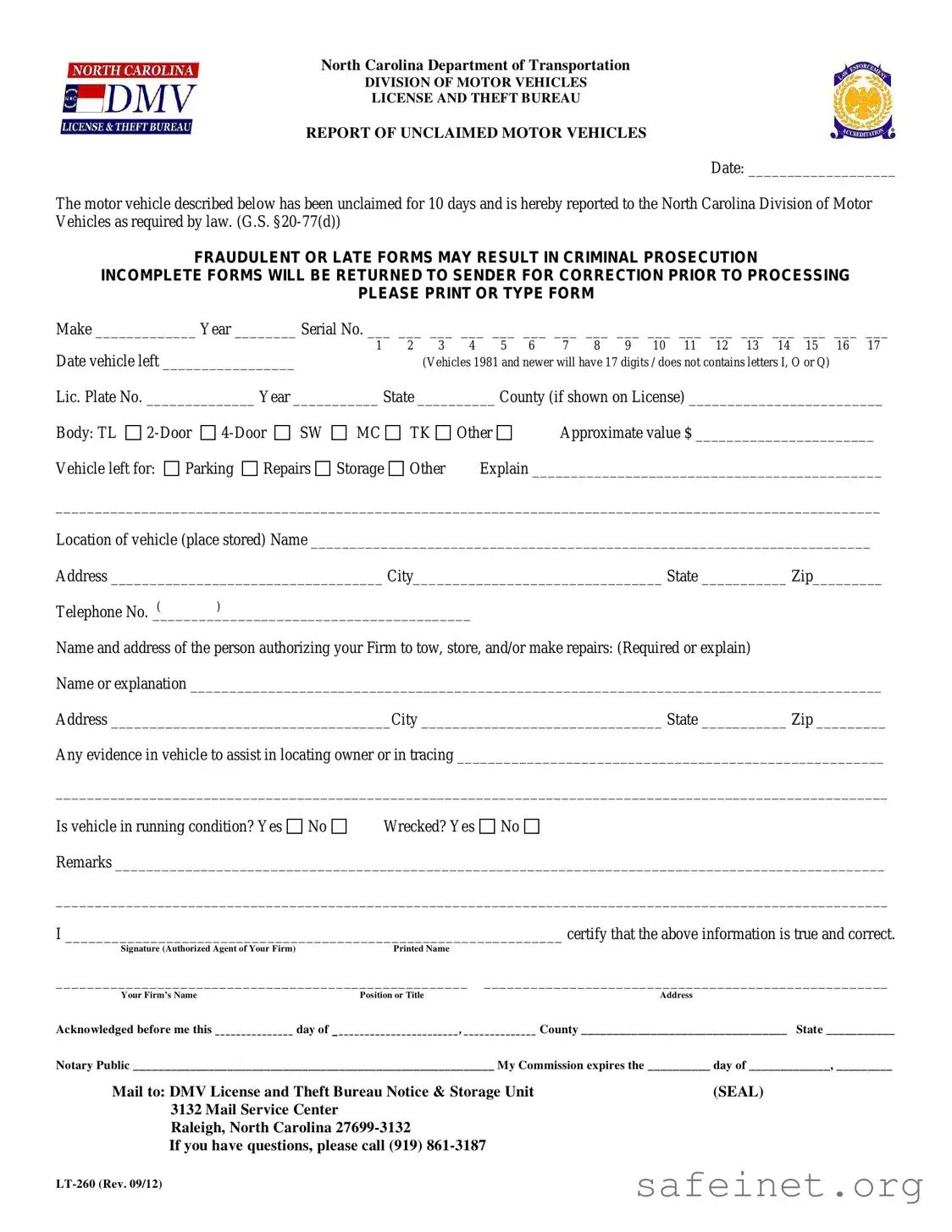
The DMV LT-260 form is a critical document used in North Carolina for reporting unclaimed motor vehicles. When a vehicle remains unclaimed for a period of ten days, it must be reported to the North Carolina Division of Motor Vehicles as mandated by law. This form captures essential details about the vehicle, including its make, year, and serial number, which are necessary for identification purposes. It also requires information about the vehicle's license plate, location, and the circumstances under which it was left, such as parking or repairs. Additionally, the form demands a declaration from an authorized agent certifying the accuracy of the provided information, underscoring the importance of honesty in the reporting process. Failure to complete the form accurately can lead to delays or even criminal prosecution for fraudulent submissions. The completed form must be mailed to the DMV License and Theft Bureau, ensuring that the proper authorities are notified of the unclaimed status of the vehicle. Overall, the LT-260 form serves as a formal record that facilitates the management of unclaimed vehicles within the state, ensuring compliance with legal requirements while protecting the rights of vehicle owners.
| Fact Name | Description |
|---|---|
| Purpose | The LT-260 form is used to report unclaimed motor vehicles to the North Carolina Division of Motor Vehicles after they have been unclaimed for 10 days. |
| Governing Law | This form is governed by North Carolina General Statutes, specifically G.S. §20-77(d). |
| Filing Requirements | Incomplete forms will be returned to the sender for correction before processing can occur. |
| Criminal Penalties | Submitting fraudulent or late forms may lead to criminal prosecution. |
| Contact Information | For questions regarding the form, individuals can call the DMV License and Theft Bureau at (919) 861-3187. |
Completing the DMV LT 260 form is a straightforward process, but it’s essential to provide accurate information to avoid delays or complications. Follow the steps below to ensure that the form is filled out correctly. After completing the form, it will need to be submitted to the DMV License and Theft Bureau for processing.
Once you have completed all sections of the LT 260 form, ensure that it is signed and dated as required. Then, mail the form to the DMV License and Theft Bureau at the address provided. If you have any questions during the process, don’t hesitate to reach out to the DMV for assistance.
What is the DMV LT 260 form?
The DMV LT 260 form is a report used in North Carolina to document unclaimed motor vehicles. When a vehicle has been unclaimed for a period of 10 days, this form must be submitted to the North Carolina Division of Motor Vehicles (DMV) as required by law. It includes details about the vehicle, its location, and the circumstances under which it was left unclaimed.
Who needs to complete the DMV LT 260 form?
The form must be completed by authorized agents of towing companies, storage facilities, or repair shops that have custody of an unclaimed vehicle. These agents are responsible for providing accurate information about the vehicle and its owner, if known.
What information is required on the DMV LT 260 form?
Essential information includes the vehicle's make, year, serial number, license plate number, approximate value, and the reason the vehicle was left unclaimed. Additionally, the form requires details about the location where the vehicle is stored and the person authorizing the towing or storage. A certification statement by the authorized agent is also necessary.
What happens if the DMV LT 260 form is incomplete?
If the form is not filled out completely, it will be returned to the sender for correction before processing. This means that any missing information must be provided to ensure the form can be accepted and processed by the DMV.
Are there any legal consequences for submitting fraudulent information on the DMV LT 260 form?
Yes, submitting fraudulent or misleading information on the DMV LT 260 form may lead to criminal prosecution. It is crucial to provide truthful and accurate information to avoid legal issues.
Where should the completed DMV LT 260 form be sent?
The completed form should be mailed to the DMV License and Theft Bureau, Notice & Storage Unit, at 3132 Mail Service Center, Raleigh, North Carolina 27699-3132. For any questions regarding the form, individuals can contact the DMV at (919) 861-3187.
Neglecting to complete all required fields: Ensure every section is filled out, as incomplete forms will be returned for correction.
Failing to use the correct vehicle identification number (VIN): The VIN must be 17 digits long and should not contain the letters I, O, or Q.
Incorrectly stating the vehicle's condition: Be honest about whether the vehicle is in running condition or wrecked. Misrepresentation can lead to issues.
Omitting the date the vehicle was left: This date is crucial for determining the unclaimed status of the vehicle.
Providing inaccurate contact information: Ensure that the telephone number and address are correct for any follow-up communications.
Not including the name of the person authorizing the tow: This is a required field. If there is no authorization, provide an explanation.
Ignoring the need for a notary: The form must be acknowledged by a notary public. Failure to do so can invalidate the submission.
Misunderstanding the purpose of the form: This form is specifically for reporting unclaimed vehicles. Ensure you are using it for the correct purpose.
Forgetting to mail to the correct address: Double-check the mailing address for the DMV License and Theft Bureau to avoid delays.
The DMV LT-260 form is essential for reporting unclaimed motor vehicles in North Carolina. However, it is often accompanied by several other documents and forms that streamline the process of vehicle reporting, towing, and storage. Below is a list of related forms that individuals and businesses may need to consider when dealing with unclaimed vehicles.
Understanding these forms can help simplify the process of handling unclaimed vehicles. Each document plays a crucial role in ensuring that all legal requirements are met, protecting the rights of all parties involved. When dealing with unclaimed vehicles, being well-prepared with the necessary paperwork can save time and prevent potential legal complications.
The DMV LT-260 form is similar to the Vehicle Bill of Sale. This document serves as proof of the transfer of ownership from the seller to the buyer. Like the LT-260, it requires details about the vehicle, including make, model, and identification number. Both documents must be filled out accurately to avoid legal complications. While the LT-260 focuses on unclaimed vehicles, the Bill of Sale is used in transactions where ownership is actively changing hands.
Another document akin to the LT-260 is the Abandoned Vehicle Report. This form is used to report vehicles that have been left unattended on public property. Both documents require information about the vehicle's condition and location. They also aim to facilitate the removal of vehicles that are no longer in use. The key difference lies in the context; the LT-260 pertains to unclaimed vehicles that have been stored, while the Abandoned Vehicle Report addresses those left in public spaces.
The Salvage Title Application is also similar to the LT-260. This document is used to apply for a salvage title for a vehicle that has been declared a total loss by an insurance company. Both forms require detailed vehicle information and aim to clarify the vehicle's status. The LT-260 is concerned with unclaimed vehicles, while the Salvage Title Application focuses on the vehicle's condition post-accident or damage.
The Vehicle Registration Application shares similarities with the LT-260 form. Both documents require specific vehicle details and are submitted to the DMV. The purpose of the Vehicle Registration Application is to officially register a vehicle for road use, while the LT-260 serves to report unclaimed vehicles. Accurate completion of both forms is crucial for proper processing.
The Tow Report is another document that aligns with the LT-260. This report is submitted by towing companies to notify the DMV of vehicles they have towed. Similar to the LT-260, it includes details about the vehicle and its location. Both forms aim to ensure that the DMV has accurate records of vehicle statuses, but the Tow Report specifically addresses vehicles that have been removed from private or public property.
The Notice of Abandonment is akin to the LT-260 in that it is used to declare a vehicle as abandoned. This document provides information about the vehicle and its last known owner. Both forms require details about the vehicle's condition and location. The primary difference is that the Notice of Abandonment is often used in legal proceedings to establish ownership rights after a vehicle has been left unattended for a certain period.
The Vehicle Identification Number (VIN) Verification Form also shares characteristics with the LT-260. This form is used to verify the VIN for various purposes, including registration and title transfers. Both documents require the VIN and other vehicle details. The LT-260 focuses on unclaimed vehicles, while the VIN Verification Form is primarily concerned with confirming the identity of a vehicle.
The DMV Title Application is similar to the LT-260 in that it involves the processing of vehicle ownership documentation. Both forms require vehicle information and serve to update the DMV's records. However, the Title Application is used to obtain a new title for a vehicle, whereas the LT-260 is used to report unclaimed vehicles that have been stored for a certain period.
The Report of Sale is another document that resembles the LT-260. This form is used to notify the DMV of the sale of a vehicle. Like the LT-260, it requires vehicle details and seller information. Both documents are essential for maintaining accurate vehicle records with the DMV. The main distinction is that the Report of Sale is used during an active sale, while the LT-260 is for vehicles that have not been claimed.
Lastly, the DMV Release of Liability form is similar to the LT-260. This document is used to notify the DMV that the seller is no longer responsible for a vehicle after it has been sold. Both forms require details about the vehicle and the parties involved. However, the Release of Liability focuses on transferring responsibility, while the LT-260 is concerned with reporting unclaimed vehicles.
When filling out the DMV LT 260 form, it’s important to follow certain guidelines to ensure your submission is accepted without delays. Here’s a helpful list of things you should and shouldn’t do:
By following these guidelines, you can help ensure that your form is processed smoothly and efficiently.
Misconceptions about the DMV LT 260 form can lead to confusion and delays. Here are ten common misunderstandings, along with clarifications:
Understanding these misconceptions can help ensure that the LT 260 form is completed accurately and submitted properly. If there are any questions or uncertainties, it is advisable to contact the DMV for clarification.
When filling out and using the DMV LT 260 form, there are several important points to keep in mind. Below are key takeaways to ensure proper completion and submission of the form.
By following these guidelines, the process of filling out and using the DMV LT 260 form will be more straightforward, reducing the likelihood of delays or complications.