Homepage > Blank Dmv H 13 Template
Article Structure

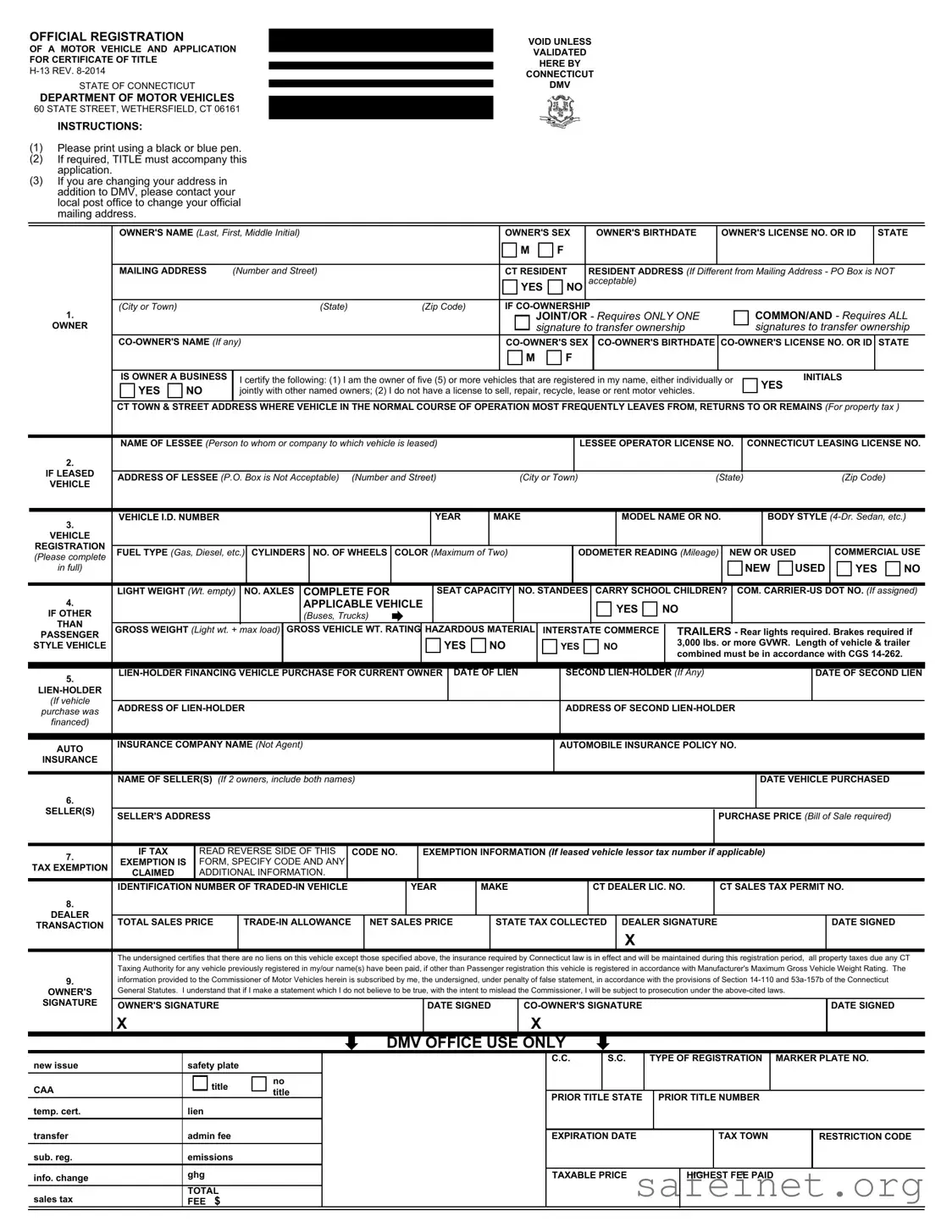
The DMV H 13 form serves as a critical document for individuals and businesses seeking to register a motor vehicle and apply for a certificate of title in the state of Connecticut. This form, officially titled "Registration of a Motor Vehicle and Application for Certificate of Title," requires detailed information about the vehicle, including its identification number, make, model, and year, as well as the owner’s personal details such as name, address, and birthdate. Co-ownership situations are also addressed, with specific instructions on how to handle signatures based on the type of ownership. Additionally, the form includes sections for lien-holder information, ensuring that any financing related to the vehicle is properly documented. Tax exemptions and sales tax calculations are also integral to the form, outlining various scenarios where tax may be waived, such as transfers between immediate family members or vehicles purchased out of state. Completing the DMV H 13 form accurately is essential, as it not only facilitates the registration process but also ensures compliance with Connecticut laws governing vehicle ownership and taxation.

Form Sample

COM. CARRIER-US DOT NO. (If assigned)
DMV OFFICE USE ONLY
OFFICIAL REGISTRATION
OF A MOTOR VEHICLE AND APPLICATION
FOR CERTIFICATE OF TITLE
H-13 REV. 8-2014
STATE OF CONNECTICUT
DEPARTMENT OF MOTOR VEHICLES
60 STATE STREET, WETHERSFIELD, CT 06161
INSTRUCTIONS:
Please print using a black or blue pen.
If required, TITLE must accompany this
application.
If you are changing your address in
addition to DMV, please contact your
local post office to change your official
mailing address.
TOTAL
FEE
$
new issue
transfer
temp. cert.
sub. reg. emissions
info. change
sales tax
safety plate
lien
title
no
title
VOID UNLESS
VALIDATED
HERE BY
CONNECTICUT
DMV
3.
VEHICLE
REGISTRATION
(Please complete
in full)
CO-OWNER'S NAME (If any)
OWNER'S NAME (Last, First, Middle Initial)
IF CO-OWNERSHIP
COMMON/AND - Requires ALL
signatures to transfer ownership
CAA
admin fee
(1)
(2)
(3)
CT TOWN & STREET ADDRESS WHERE VEHICLE IN THE NORMAL COURSE OF OPERATION MOST FREQUENTLY LEAVES FROM, RETURNS TO OR REMAINS (For property tax )
MAILING ADDRESS (Number and Street)
VEHICLE I.D. NUMBER
COLOR (Maximum of Two)
MODEL NAME OR NO.MAKEYEAR
FUEL TYPE (Gas, Diesel, etc.)
BODY STYLE (4-Dr. Sedan, etc.)
NEW OR USED
COMMERCIAL USE
NEW USED
YES NO
INSURANCE COMPANY NAME (Not Agent)
AUTOMOBILE INSURANCE POLICY NO.
IF TAX
EXEMPTION IS
CLAIMED
READ REVERSE SIDE OF THIS
FORM, SPECIFY CODE AND ANY
ADDITIONAL INFORMATION.
CODE NO. EXEMPTION INFORMATION (If leased vehicle lessor tax number if applicable)
NAME OF SELLER(S) (If 2 owners, include both names)
ADDRESS OF LESSEE (P.O. Box is Not Acceptable)
CONNECTICUT LEASING LICENSE NO.NAME OF LESSEE (Person to whom or company to which vehicle is leased)
5.
LIEN-HOLDER
(If vehicle
purchase was
financed)
LIEN-HOLDER FINANCING VEHICLE PURCHASE FOR CURRENT OWNER
DATE OF LIEN
DATE OF SECOND LIEN
SECOND LIEN-HOLDER (If Any)
(Number and Street) (City or Town) (State) (Zip Code)
ADDRESS OF LIEN-HOLDER
8.
DEALER
TRANSACTION
IDENTIFICATION NUMBER OF TRADED-IN VEHICLE MAKEYEAR
CT DEALER LIC. NO.
TOTAL SALES PRICE
TRADE-IN ALLOWANCE NET SALES PRICE STATE TAX COLLECTED DEALER SIGNATURE DATE SIGNED
X
PRIOR TITLE STATE PRIOR TITLE NUMBER
C.C. S.C. TYPE OF REGISTRATION MARKER PLATE NO.
OWNER'S SIGNATURE CO-OWNER'S SIGNATURE
The undersigned certifies that there are no liens on this vehicle except those specified above, the insurance required by Connecticut law is in effect and will be maintained during this registration period, all property taxes due any CT
Taxing Authority for any vehicle previously registered in my/our name(s) have been paid, if other than Passenger registration this vehicle is registered in accordance with Manufacturer's Maximum Gross Vehicle Weight Rating. The
information provided to the Commissioner of Motor Vehicles herein is subscribed by me, the undersigned, under penalty of false statement, in accordance with the provisions of Section 14-110 and 53a-157b of the Connecticut
General Statutes. I understand that if I make a statement which I do not believe to be true, with the intent to mislead the Commissioner, I will be subject to prosecution under the above-cited laws.
XX
9.
OWNER'S
SIGNATURE
JOINT/OR - Requires ONLY ONE
signature to transfer ownership
ghg
ADDRESS OF SECOND LIEN-HOLDER
4.
IF OTHER
THAN
PASSENGER
STYLE VEHICLE
LIGHT WEIGHT (Wt. empty)
COMPLETE FOR
APPLICABLE VEHICLE
(Buses, Trucks)
TRAILERS - Rear lights required. Brakes required if
3,000 lbs. or more GVWR. Length of vehicle & trailer
combined must be in accordance with CGS 14-262.
SEAT CAPACITY NO. STANDEES
NO. AXLES
CARRY SCHOOL CHILDREN?
YES NO
GROSS VEHICLE WT. RATING
GROSS WEIGHT (Light wt. + max load)
LESSEE OPERATOR LICENSE NO.
CT SALES TAX PERMIT NO.
OWNER'S SEX
M F
OWNER'S BIRTHDATE
OWNER'S LICENSE NO. OR ID
CO-OWNER'S SEX
M F
CO-OWNER'S BIRTHDATE
CO-OWNER'S LICENSE NO. OR ID
1.
OWNER
TAX TOWN
CYLINDERS
ODOMETER READING (Mileage)
2.
IF LEASED
VEHICLE
HAZARDOUS MATERIAL
YES NO
AUTO
INSURANCE
SELLER'S ADDRESS
DATE VEHICLE PURCHASED
PURCHASE PRICE (Bill of Sale required)
6.
SELLER(S)
STATE
STATE
(City or Town)
(State) (Zip Code)
IS OWNER A BUSINESS
YES
NO
NO. OF WHEELS
INTERSTATE COMMERCE
YES NO
I certify the following: (1) I am the owner of five (5) or more vehicles that are registered in my name, either individually or
jointly with other named owners; (2) I do not have a license to sell, repair, recycle, lease or rent motor vehicles.
YES
INITIALS
7.
TAX EXEMPTION
EXPIRATION DATE
TAXABLE PRICE HIGHEST FEE PAID
RESIDENT ADDRESS (If Different from Mailing Address - PO Box is NOT
acceptable)
RESTRICTION CODE
DATE SIGNED
DATE SIGNED
CT RESIDENT
YES NO
SALES OR USE TAX COMPUTATION - The sales or use tax is based on the invoiced purchase price for vehicles purchased from a licensed dealer. If
the vehicle is purchased from a private individual, not from a licensed dealer, the sales or use tax is based on the current month's issue of the N.A.D.A.
Official Used Car Guide, Eastern Edition or the Bill of Sale, whichever is greater.
SALES TAX PAID IN ANOTHER STATE - In order to obtain credit for sales/use tax paid to another jurisdiction, you must present proof of payment in
the form of an official receipt or dealer's invoice.
BARTER, TRADE, SWAP - When two individuals trade vehicles, each must pay sales/use tax on the value of the vehicle received based on the current
month's issue of the N.A.D.A. Official Used Car Guide, Eastern Edition.
CHECKS - Please make your check payable to "DMV". The total for all DMV fees also will include the sales tax.
REFUNDS - Claims for sales or use tax refunds must be submitted to the Department of Revenue Services. Use CERT-106, Claim for Refund of Use
Tax Paid on Motor Vehicle Purchased fromOther Than a Motor Vehicle Dealer, to claim a refund of use tax paid on a motor vehicle purchased from
other than a motor vehicle dealer. A CERT-106 form is available at all DMV branches. All other claims for refund, with supporting documents, must be
directed to the Department of Revenue Services, Refunds, Clearance and Adjustments Unit, 25 Sigourney Street, Hartford, CT 06106.
A)
B)
C)
D)
E)
SALES TAX INSTRUCTIONS
SPECIAL INSTRUCTIONS FOR THOSE CLAIMING EXEMPTION FROM CONNECTICUT SALES OR USE TAX
Specify the applicable code (1, 2, 3, 4, or 5) as described below in the space on the front in SECTION 1 labeled IF TAX EXEMPTION IS CLAIMED. Include
additional information as required below for the applicable code in the area labeled EXEMPTION INFORMATION.
Transfer between immediate family members (Only MOTHER, FATHER, SPOUSE (wife, husband, civil union), DAUGHTER, SON,
SISTER or BROTHER qualify as "immediate family members"). Specify code "1" and in the area labeled EXEMPTION INFORMATION,
write which of the above-listed relationships describes the person from whom you obtained the vehicle. Specify the state in which this
immediate family member previously registered the vehicle. In order to qualify for this exemption, the vehicle must have been registered in
this immediate family member's name for at least 60 days.
Sale to a Connecticut exempt organization or to a governmental agency. Specify code "2" and write the Connecticut Tax Exemption
Number beginning with "E" in the area labeled EXEMPTION INFORMATION or attach a copy of the organization's Internal Revenue Code
Section 501(c)(3) or 501(c)(13) exemption letter issued by the IRS.
Sales or Use Tax was paid to another jurisdiction. An official receipt or dealer's invoice must be presented identifying the amount of
sales tax paid. Specify code "3" and, in the area labeled EXEMPTION INFORMATION, write the amount of tax paid and the jurisdiction to
which this tax was paid.
Vehicles purchased while residing outside of Connecticut. Out-of-state registration or photocopy is required. Vehicles should have
been registered out-of-state at least 30 days prior to application for Connecticut registration. Specify code "4" and, in the area labeled
EXEMPTION INFORMATION, write in order (1) the state in which you were residing when you purchased vehicle, (2) the date the vehicle
was purchased, (3) the date the vehicle was registered in that state, and (4) the date the vehicle was first moved to Connecticut.
Other reasons. Specify code "5" and write the applicable letter from the list below in the area labeled EXEMPTION INFORMATION.
Code 1:
5A)
5B)
5C)
5D)
5E)
5F)
5G)
GIFT - If vehicle was received as a gift, provide a copy of form AU-463, "Motor Vehicle and Vessel Gift Declaration". These forms
are available at all DMV offices.
VEHICLE PURCHASED BY A LESSOR EXCLUSIVELY FOR LEASE OR RENTAL - Provide the Connecticut Tax Registration
Number of the lessor/purchaser.
SALE BY A FEDERAL AGENCY, FEDERAL CREDIT UNION OR AMERICAN RED CROSS - Vehicle must have been obtained
from a Federal Agency, a Federal Credit Union or the American Red Cross.
CORPORATE ORGANIZATION, REORGANIZATION OR LIQUIDATION - Acquiring a vehicle in connection with the organization,
reorganization or liquidation of an incorporated business provided (a) the last taxable sale, transfer or use of the motor vehicle was
subjected to Connecticut sales or use tax, (b) the transferee is the incorporated business or a stockholder thereof.
PARTNERSHIP OR LLC ORGANIZATION OR TERMINATION - Acquiring a vehicle in connection with the organization or
termination of a partnership or LLC provided (a) the last taxable sale, transfer or use of the motor vehicle was subjected to
Connecticut sales or use tax, and (b) the purchaser is the partnership or limited liability company, as the case may be, or a partner
or member, thereof, as the case may be.
HIGH MPG PASSENGER MOTOR VEHICLES - Section 12-412(110) exempts the sale on and after January 1, 2008, and prior to
July 1, 2010, of any passenger motor vehicle, as defined in section 14-1, that has a U.S. EPA estimated city or highway gasoline
mileage rating of at least 40 miles per gallon.
COMMERCIAL TRUCKS, TRUCK TRACTORS, TRACTORS AND SEMITRAILERS AND VEHICLES USED IN COMBINATION
THEREWITH - Section 12-412(70)(A)(i) exempts commercial trucks, truck tractors, tractors and semitrailers and vehicles used in
combination therewith which have a gross vehicle weight rating in excess of 26,000 pounds.
Section 12-412(70)(A)(ii) exempts commercial trucks, truck tractors, tractors and semitrailers and vehicles used in combination
therewith operated actively and exclusively during the period commencing upon its purchase and ending one year after the date of
purchase for the carriage of interstate freight pursuant to a certificate or permit issued by the Interstate Commerce Commission
(ICC) or its successor agency. Purchaser - please attach a copy of your certificate or permit that was issued by the ICC or its
successor agency, and a copy of a properly completed Dept. of Revenue Services CERT-105, Commercial Motor Vehicle
Purchased Within Connecticut for Use in the Carriage of Freight in Interstate Commerce.
Code 2:
Code 3:
Code 4:
Code 5:
For further information about sales and use taxes, see the DRS website (www.ct.gov/drs) or call DRS during business hours, Monday through Friday:
1-800-382-9463 (Connecticut calls outside the Greater Hartford calling area only); or
860-297-5962 (from anywhere).
TTY, TDD, and Text Telephone users only may transmit inquiries anytime by calling 860-297-4911.

Document Specifications

Fact Name Fact Description
Form Purpose The DMV H-13 form is used for the official registration of a motor vehicle and for applying for a certificate of title in Connecticut.
Governing Law This form is governed by the Connecticut General Statutes, specifically Sections 14-110 and 53a-157b.
Validation Requirement The form is void unless validated by the Connecticut Department of Motor Vehicles (DMV).
Signature Requirements For co-ownership, all joint owners must sign if the ownership type is common/and, while only one signature is needed for joint/or ownership transfers.
Address Change Notification If an applicant is changing their address, they must also notify their local post office to update their official mailing address.
Liens and Financing The form requires disclosure of any liens on the vehicle, including information about lien holders and financing details.
Tax Exemptions There are specific codes for claiming tax exemptions, such as transfers between family members or vehicles purchased while residing out of state.
Insurance Requirement Applicants must certify that the required insurance is in effect and will be maintained during the registration period.
Submission Instructions Checks for fees should be made payable to the DMV, and all required documents must be included with the application.

Steps to Filling Out Dmv H 13

Filling out the DMV H-13 form is an important step in registering your vehicle and obtaining a title in Connecticut. Following the steps below will help ensure that you complete the form accurately and efficiently.

  1. Use a black or blue pen to fill out the form. Print clearly to avoid any confusion.
  2. Begin with the owner's information. Enter the owner's name, including last name, first name, and middle initial.
  3. Indicate the owner's sex by marking either "M" for male or "F" for female.
  4. Fill in the owner's birthdate in the specified format.
  5. Provide the owner's license number or ID and the state of issuance.
  6. Enter the mailing address, including the number and street. Ensure you are a Connecticut resident.
  7. If the resident address differs from the mailing address, provide that information. Note that a P.O. Box is not acceptable.
  8. If applicable, complete the co-owner's information, including their name, sex, birthdate, and license number or ID.
  9. Indicate whether the owner is a business by marking "Yes" or "No."
  10. Certify that you own five or more vehicles registered in your name, and confirm you do not have a license to sell, repair, recycle, lease, or rent motor vehicles by providing your initials.
  11. Fill in the town and street address where the vehicle most frequently operates.
  12. Complete the vehicle information section. Enter the vehicle ID number, year, make, model, and body style.
  13. Provide details about the vehicle registration, including fuel type, cylinders, number of wheels, color, odometer reading, and whether the vehicle is new or used.
  14. Indicate if the vehicle will be used commercially by marking "Yes" or "No."
  15. Fill in the applicable vehicle weight and capacity information if necessary.
  16. Complete the lien-holder section if the vehicle purchase was financed, including names and addresses of lien-holders.
  17. Provide the name and address of the seller, along with the purchase price and date of purchase.
  18. If applicable, fill out the tax exemption information on the reverse side of the form.
  19. Sign and date the form, ensuring all required signatures are included.

After completing the form, review it for accuracy before submitting it to the DMV. Ensure that all required documents, such as the title and any necessary identification, are included with your application. This will help streamline the process and prevent any delays in registration or titling.

More About Dmv H 13

What is the DMV H-13 form used for?

The DMV H-13 form is an official application for the registration of a motor vehicle and the issuance of a certificate of title in Connecticut. This form is essential for individuals or businesses looking to register a vehicle or transfer ownership. It collects vital information about the vehicle, its owner, and any liens associated with it.

Who needs to complete the H-13 form?

Anyone who is registering a vehicle in Connecticut or applying for a title must complete the H-13 form. This includes individuals purchasing new or used vehicles, businesses that own vehicles, and those transferring ownership of a vehicle. If you have five or more vehicles registered in your name, you will also need to certify that you do not hold a license for vehicle sales or repairs.

What information is required on the H-13 form?

The form requires detailed information such as the owner's name, birthdate, address, vehicle identification number (VIN), year, make, model, and purchase price of the vehicle. Additionally, it asks for information about any liens on the vehicle and insurance details. Accurate completion is crucial to avoid delays in processing.

Is there a fee associated with submitting the H-13 form?

Yes, there is a fee for processing the H-13 form. This fee varies based on the type of registration and any applicable sales tax. It is important to include payment with your application to prevent processing delays. Checks should be made payable to "DMV."

What if I am claiming a tax exemption?

If you are claiming a tax exemption, you must specify the applicable code on the form and provide any necessary documentation. This could include proof of payment of sales tax in another jurisdiction or documentation showing that the vehicle was a gift. Ensure you follow the specific instructions for each exemption type to avoid complications.

Can I submit the H-13 form online?

Currently, the H-13 form must be submitted in person or by mail to the Connecticut DMV. Online submission is not available for this form. It is advisable to check the DMV's website for any updates regarding online services.

What should I do if I make a mistake on the H-13 form?

If you make a mistake while filling out the H-13 form, do not attempt to correct it with white-out or similar methods. Instead, it is best to complete a new form to ensure all information is accurate. This helps prevent any delays in processing your application.

How long does it take to process the H-13 form?

The processing time for the H-13 form can vary depending on the volume of applications received by the DMV. Typically, you can expect processing to take several weeks. If you need your registration or title urgently, consider contacting the DMV for guidance on expedited options.

Where can I find additional help with the H-13 form?

If you need further assistance with the H-13 form, you can visit your local DMV office or check the Connecticut DMV website. There, you will find resources and contact information for customer service representatives who can answer your questions and provide guidance.

Common mistakes

  1. Neglecting to Use the Correct Writing Instrument: Individuals often fail to use a black or blue pen when filling out the DMV H 13 form. This oversight can render the application invalid.

  2. Omitting Required Documentation: Many applicants forget to include the vehicle title when it is required. Without this essential document, the registration process cannot proceed.

  3. Incorrect Address Information: It is common for people to either provide an incorrect mailing address or fail to update their address with the local post office. This can lead to significant delays in receiving important documents.

  4. Inaccurate Vehicle Information: Mistakes in the vehicle identification number, year, make, or model are frequent. Such inaccuracies can complicate the registration process and lead to legal issues.

  5. Ignoring Co-Ownership Requirements: If the vehicle has co-owners, applicants sometimes neglect to secure the necessary signatures from all parties. This can halt the transfer of ownership.

  6. Failure to Understand Tax Exemptions: Many individuals do not specify the correct tax exemption code when applicable. This can result in unexpected tax liabilities or delays in processing the application.

Documents used along the form

The DMV H-13 form is essential for registering a motor vehicle and applying for a certificate of title in Connecticut. However, several other forms and documents often accompany it to ensure a smooth registration process. Below are four commonly used documents that may be required alongside the H-13 form.

  • Bill of Sale: This document serves as proof of the transaction between the buyer and the seller. It includes details such as the purchase price, vehicle identification number, and the names of both parties. A bill of sale is particularly important when purchasing a vehicle from a private seller.
  • Certificate of Title: If the vehicle has been previously registered, the existing title must be submitted with the H-13 form. This document establishes ownership and must be transferred to the new owner during the registration process.
  • Proof of Insurance: Connecticut law requires that all vehicles have insurance coverage. A copy of the insurance policy or a declaration page must be provided to demonstrate compliance with this requirement before registration can be completed.
  • Identification Documents: Owners must present valid identification, such as a driver's license or state-issued ID. This ensures that the individual applying for the vehicle registration is authorized to do so.

Gathering these documents ahead of time can help streamline the registration process and avoid potential delays. Always double-check the requirements with the Connecticut DMV to ensure you have everything needed for a successful application.

Similar forms

The DMV H-13 form is similar to the DMV H-6 form, which is used for the transfer of vehicle ownership. Both forms require the owner's information and vehicle details. However, the H-6 form specifically focuses on situations where a vehicle is being sold or transferred to a new owner, while the H-13 is more about registering a vehicle and obtaining a title. Both forms ensure that the DMV has accurate records of vehicle ownership and registration status.

Another document that parallels the H-13 is the DMV H-10 form, which is the application for a duplicate title. Like the H-13, the H-10 requires personal information and details about the vehicle. The primary difference lies in the purpose; the H-10 is used when the original title is lost or damaged, whereas the H-13 is for registering a vehicle and obtaining a new title. Both forms help maintain proper vehicle records with the DMV.

The DMV H-14 form, which is an application for a certificate of title for a vehicle purchased from a dealer, shares similarities with the H-13. Both forms require details about the vehicle, such as the Vehicle Identification Number (VIN) and purchase information. The H-14, however, is specifically for transactions involving dealers, while the H-13 can be used for both private sales and dealer purchases. Both forms facilitate the transfer of title and registration with the DMV.

Additionally, the DMV H-15 form is relevant as it serves as a notice of lien. This document is similar to the H-13 in that it involves ownership details and vehicle information. The H-15 specifically focuses on indicating that a lien exists on the vehicle, whereas the H-13 is about registering the vehicle and obtaining a title. Both documents are essential for accurate record-keeping by the DMV.

The DMV H-31 form, which is used for registering a vehicle that has been imported from another state or country, also resembles the H-13. Both forms require vehicle details and owner information. However, the H-31 includes additional information regarding the import process, while the H-13 is more focused on general registration and title issuance. Both documents ensure that the DMV has the necessary information to maintain accurate vehicle records.

Another similar document is the DMV H-20 form, which is an application for a special registration for certain vehicles. Like the H-13, the H-20 requires detailed information about the vehicle and the owner. The H-20 is specifically for vehicles that may require special plates or registrations, while the H-13 is for standard vehicle registration and title. Both forms help the DMV manage vehicle registrations effectively.

Lastly, the DMV H-12 form, which is used for the registration of a commercial vehicle, shares similarities with the H-13. Both forms require comprehensive details about the vehicle and the owner. The H-12 is specifically tailored for commercial vehicles and includes additional requirements related to business use, while the H-13 is for personal vehicles. Both documents are crucial for ensuring that the DMV has accurate information regarding vehicle registrations.

Dos and Don'ts

When filling out the DMV H-13 form, it's essential to ensure accuracy and completeness. Here’s a helpful list of things to do and avoid:

  • Do use a black or blue pen to fill out the form.
  • Do include the title if it is required for your application.
  • Do verify that all information is correct before submitting the form.
  • Do contact your local post office to update your address if it has changed.
  • Don't leave any required fields blank; incomplete forms may delay processing.
  • Don't use a P.O. Box for your resident address if it differs from your mailing address.

Misconceptions

There are several misconceptions about the DMV H 13 form. Understanding the truth behind these can help streamline your vehicle registration process. Here are eight common misconceptions:

  • The H 13 form is only for new vehicle registrations. This form is also used for transferring ownership of used vehicles.
  • You don't need to provide proof of insurance when submitting the H 13 form. In fact, proof of insurance is required by Connecticut law when registering a vehicle.
  • Only individuals can fill out the H 13 form. Businesses can also use this form to register vehicles in their name.
  • The form can be submitted without a title. If you are applying for a title, the title must accompany the application.
  • Filling out the form incorrectly will not have consequences. Errors can delay your registration and may require you to resubmit the form.
  • You can use a P.O. Box as your mailing address. The DMV does not accept P.O. Boxes for the mailing address on the H 13 form.
  • All co-owners must sign the form for any transfer. If you choose "AND," all signatures are required. If you choose "OR," only one signature is necessary.
  • The H 13 form is the same in all states. Each state has its own specific forms and requirements, so it's important to use the correct form for Connecticut.

By clearing up these misconceptions, you can better navigate the vehicle registration process in Connecticut.

Key takeaways

When filling out the DMV H-13 form for vehicle registration and title application in Connecticut, keep these key takeaways in mind:

  • Use the Right Pen: Always print your information using a black or blue pen to ensure clarity.
  • Include Required Documents: If you are applying for a title, make sure to include the original title with your application.
  • Address Changes: If you are changing your address, notify your local post office as well as the DMV.
  • Co-Ownership Requirements: If the vehicle is co-owned, both owners must sign if it’s a common ownership, while only one signature is needed for joint ownership.
  • Tax Exemption Codes: If you claim a tax exemption, specify the appropriate code and provide additional information as required.
  • Accurate Information is Crucial: Ensure all details are correct to avoid delays or issues with your application.

These points will help streamline your experience with the DMV H-13 form and ensure that your vehicle registration process goes smoothly.