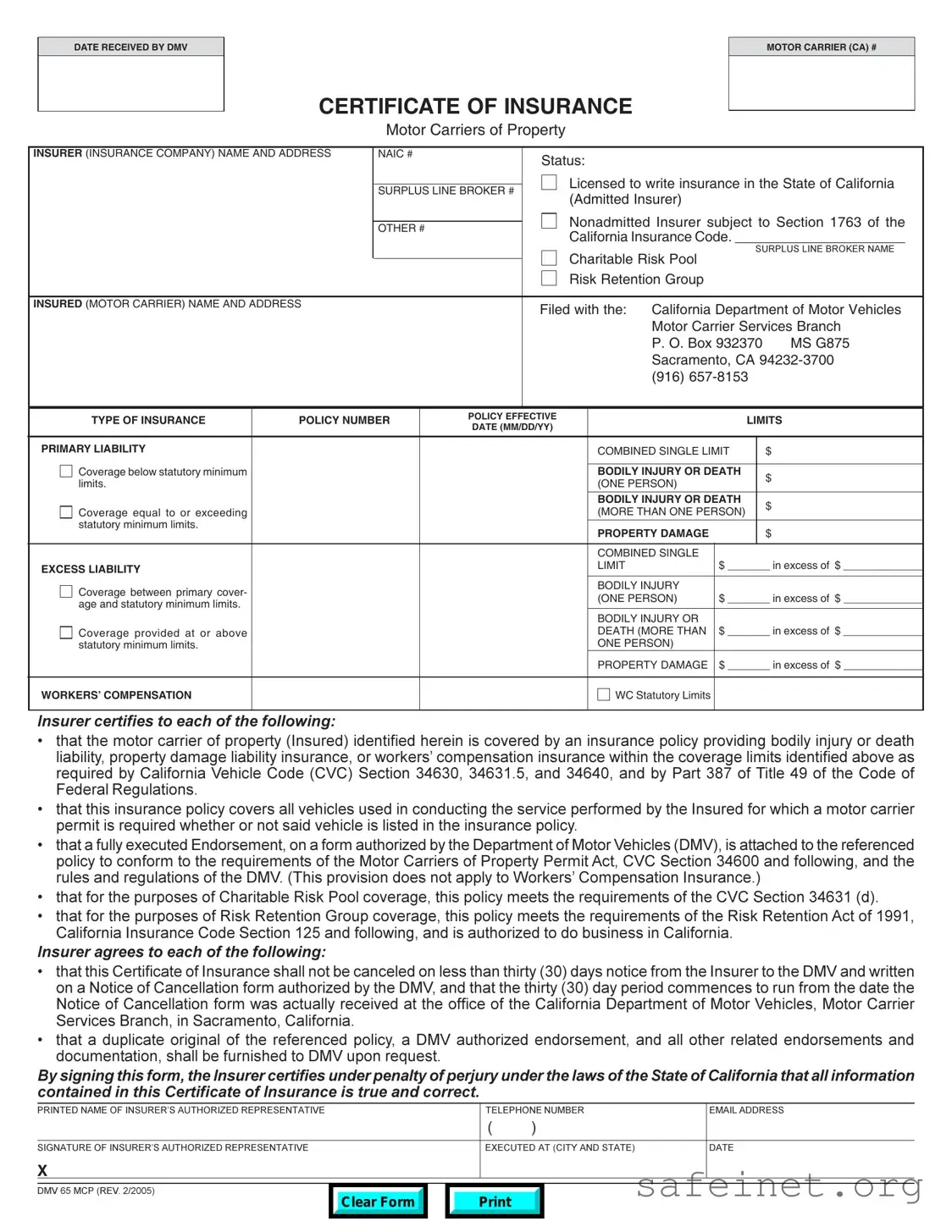
The DMV 65 MCP form plays a crucial role in ensuring that motor carriers of property in California meet the necessary insurance requirements. This form is submitted to the California Department of Motor Vehicles (DMV) and serves as a Certificate of Insurance. It outlines essential details such as the motor carrier's name, the insurer's information, and the specific types of coverage provided. The form also specifies the insurance limits for bodily injury, property damage, and workers' compensation, ensuring compliance with state and federal regulations. It requires the insurer to certify that the motor carrier is adequately covered and that the insurance policy extends to all vehicles used in their operations. Additionally, the DMV 65 MCP form mandates that the insurer agrees to notify the DMV of any cancellations with a minimum of thirty days' notice. By signing this form, the insurer confirms the accuracy of the information provided, reinforcing the importance of transparency and accountability in the insurance process for motor carriers.
| Fact Name | Details |
|---|---|
| Purpose | The DMV 65 MCP form serves as a Certificate of Insurance for motor carriers of property in California. |
| Governing Law | This form is governed by the California Vehicle Code, specifically Sections 34630, 34631.5, and 34640. |
| Insurance Coverage | The form requires proof of liability insurance covering bodily injury, property damage, and workers' compensation. |
| Policy Requirements | Insurers must provide coverage for all vehicles used by the motor carrier, regardless of whether they are listed in the policy. |
| Cancellation Notice | Insurers must give at least 30 days' notice to the DMV before canceling the insurance policy. |
| Endorsement Requirement | A fully executed endorsement must be attached to the insurance policy to comply with DMV regulations. |
| Charitable Risk Pool | Insurance policies covering Charitable Risk Pools must meet specific requirements outlined in CVC Section 34631(d). |
| Risk Retention Group | Policies for Risk Retention Groups must comply with the Risk Retention Act of 1991 and California Insurance Code Section 125. |
| Documentation | Insurers must provide a duplicate original of the insurance policy and all related documentation upon DMV request. |
| Certification | By signing the form, the insurer certifies that all information provided is true and correct under penalty of perjury. |
Completing the DMV 65 MCP form is an essential step for motor carriers of property in California. After filling it out, you will need to submit it to the California Department of Motor Vehicles (DMV) for processing. Ensure that all information is accurate to avoid delays.
What is the DMV 65 MCP form?
The DMV 65 MCP form is a Certificate of Insurance specifically for Motor Carriers of Property in California. It serves as proof that a motor carrier has the required insurance coverage to operate legally within the state. This form must be filed with the California Department of Motor Vehicles (DMV) to obtain or maintain a motor carrier permit.
Who needs to fill out the DMV 65 MCP form?
Motor carriers operating in California are required to complete the DMV 65 MCP form. This includes businesses or individuals who transport property for hire. The form ensures that they have the necessary insurance coverage as mandated by California law.
What types of insurance are covered by the DMV 65 MCP form?
The form covers various types of insurance, including primary liability insurance, excess liability insurance, and workers’ compensation insurance. It specifies the coverage limits for bodily injury, property damage, and other relevant areas to ensure compliance with state regulations.
How does one submit the DMV 65 MCP form?
To submit the DMV 65 MCP form, it should be mailed to the California Department of Motor Vehicles, Motor Carrier Services Branch, at the designated address. It is important to ensure that all required information is accurately filled out before submission to avoid any delays in processing.
What information is required on the DMV 65 MCP form?
The form requires details such as the motor carrier's name and address, the insurer's information, policy number, coverage limits, and effective dates. Additionally, it must include a certification from the insurer confirming that the motor carrier is adequately covered.
Can the DMV 65 MCP form be canceled?
Yes, the DMV 65 MCP form can be canceled. However, the insurer must provide at least thirty days' notice to the DMV using an authorized Notice of Cancellation form. The thirty-day notice period begins once the DMV receives the cancellation notice.
What happens if the insurance coverage changes?
If there are any changes to the insurance coverage, the motor carrier must update the DMV by submitting a new DMV 65 MCP form. This ensures that the DMV has the most current information regarding the motor carrier's insurance status.
Is there a penalty for providing false information on the DMV 65 MCP form?
Yes, providing false information on the DMV 65 MCP form is considered perjury under California law. The insurer certifies the accuracy of the information under penalty of perjury, which can lead to legal consequences if the information is found to be false.
How can I contact the DMV for questions regarding the DMV 65 MCP form?
For questions about the DMV 65 MCP form, individuals can contact the California DMV Motor Carrier Services Branch at (916) 657-8153. They can provide assistance and clarify any concerns regarding the form and its requirements.
Failing to provide the correct motor carrier number. This number is essential for identifying the insured entity.
Not including the complete name and address of the insurer. Incomplete information can lead to processing delays.
Overlooking the policy number. This must be accurately filled in to ensure proper coverage verification.
Neglecting to specify the type of insurance being provided. This information is critical for compliance with state regulations.
Incorrectly entering the policy effective date. This date must be valid and correspond with the coverage period.
Not indicating the limits of coverage for bodily injury and property damage. This can result in legal complications.
Forgetting to attach the required endorsement as mandated by the DMV. This step is crucial for validating the insurance policy.
Failing to provide a signature from an authorized representative. Without this, the form cannot be processed.
Leaving out the contact information for the insurer’s representative. This information is necessary for any follow-up communication.
Not keeping a copy of the submitted form for personal records. This can help in future inquiries or disputes.
The DMV 65 MCP form is a crucial document for motor carriers in California, ensuring they meet insurance requirements. However, it is often accompanied by several other forms and documents that help facilitate the process of obtaining and maintaining a motor carrier permit. Below is a list of these important documents.
Understanding these accompanying documents is vital for motor carriers to ensure compliance with state regulations and to maintain their operational status. Proper documentation not only protects the carrier but also enhances safety on the roads.
The DMV 65 MCP form bears similarities to the Certificate of Insurance (COI). A COI serves as proof that an individual or business holds an insurance policy. Like the DMV 65 MCP, it includes essential details such as the insured's name, the insurance provider, and the policy's coverage limits. Both documents verify that the insured has the necessary coverage required by law, ensuring compliance with state regulations. The COI is often used in various industries to demonstrate insurance coverage for contractual obligations, making it a vital document for risk management.
Another document akin to the DMV 65 MCP is the Commercial Vehicle Insurance Policy. This policy outlines the coverage specifics for vehicles used for business purposes. Similar to the DMV 65 MCP, it details the types of coverage available, such as liability and property damage. The commercial vehicle policy must meet certain state requirements, just like the DMV form, ensuring that businesses are adequately protected while operating their vehicles on public roads.
The Motor Carrier Permit (MCP) itself is another closely related document. The MCP is issued by the DMV and grants permission for a motor carrier to operate legally within California. Like the DMV 65 MCP, it requires proof of insurance to ensure that carriers have the necessary financial protection in place. Both documents work together to ensure that motor carriers adhere to state regulations, promoting safety and accountability on the roads.
The Certificate of Liability Insurance (CLI) is also comparable to the DMV 65 MCP. A CLI provides evidence of liability coverage for a specific event or contract. It includes similar information, such as the insured's details and coverage limits. Both documents are essential for demonstrating compliance with legal requirements, whether for operating a vehicle or fulfilling contractual obligations. The CLI is often requested by clients or partners to ensure that a business is adequately insured.
Additionally, the Workers' Compensation Insurance Certificate shares similarities with the DMV 65 MCP. This certificate confirms that an employer has workers' compensation coverage for their employees. Both documents are critical for compliance with state laws, ensuring that businesses protect their employees from work-related injuries. The information contained in both certificates must be accurate and up to date to avoid legal repercussions.
The Endorsement Form, which modifies an insurance policy, is another document similar to the DMV 65 MCP. Endorsements can add or change coverage details, much like how the DMV form requires specific endorsements to comply with regulations. Both documents must be executed properly to ensure that the insurance policy meets legal requirements and adequately covers the insured's needs.
The Proof of Insurance Card is also comparable to the DMV 65 MCP. This card serves as a quick reference for drivers to show that they have the required insurance coverage. It includes essential details such as the policy number and coverage dates, similar to the information provided in the DMV form. Both documents are critical for drivers to carry, ensuring they can prove compliance with state insurance laws while operating a vehicle.
Lastly, the Insurance Policy Declaration Page resembles the DMV 65 MCP in that it summarizes the key details of an insurance policy. This page outlines the coverage limits, types of coverage, and the insured's information. Like the DMV form, it is a crucial document for verifying that the insured has the necessary coverage to operate legally. Both documents play a vital role in ensuring that individuals and businesses meet their insurance obligations.
When filling out the DMV 65 MCP form, it's essential to ensure accuracy and compliance. Here are six things to keep in mind:
Understanding the DMV 65 MCP form can be challenging, and there are several misconceptions that often arise. Here are eight common misunderstandings:
Being aware of these misconceptions can help motor carriers navigate the insurance requirements more effectively and ensure compliance with California regulations.
Understand the purpose of the DMV 65 MCP form. This document serves as a Certificate of Insurance for motor carriers of property in California, ensuring compliance with state regulations.
Ensure accurate completion. All sections, including the motor carrier's name, insurer details, and coverage limits, must be filled out correctly to avoid delays.
Verify insurance coverage. The form requires confirmation that the insurance policy meets California Vehicle Code requirements for bodily injury, property damage, and workers' compensation.
Attach necessary endorsements. A fully executed endorsement, as authorized by the DMV, must accompany the policy to satisfy the Motor Carriers of Property Permit Act.
Note cancellation terms. The insurer must provide a minimum of thirty days' notice to the DMV before canceling the policy, using the appropriate Notice of Cancellation form.
Be aware of documentation requirements. Upon request, the DMV may require a duplicate original of the policy and any related endorsements to verify compliance.
Sign under penalty of perjury. The authorized representative of the insurer must certify that all information is true and correct, emphasizing the importance of accuracy in the provided details.