Homepage > Blank Divorce Decree Sample Template
Article Structure

When navigating the complexities of divorce, understanding the Divorce Decree Sample form is essential for both parties involved. This document serves as a critical legal instrument, outlining the terms and conditions agreed upon by the couple, including child custody, support obligations, and property division. The decree begins with a formal introduction, identifying the court and the parties involved, followed by the details of the marriage and any children born during the union. It specifies the grounds for divorce and confirms the court's jurisdiction. The decree also incorporates any separation agreements, ensuring that both parties acknowledge their financial disclosures and understand the terms. Child custody arrangements are clearly defined, stating who will be the residential parent and the visitation rights of the non-residential parent. Financial responsibilities, including child support and spousal support, are articulated with specific amounts and payment schedules, emphasizing the importance of adhering to these obligations. Additionally, the decree addresses health insurance responsibilities for the children and outlines the process for property division, ensuring that both parties are protected and informed. This sample serves as a vital reference point, guiding individuals through the often overwhelming process of finalizing a divorce.


Form Sample

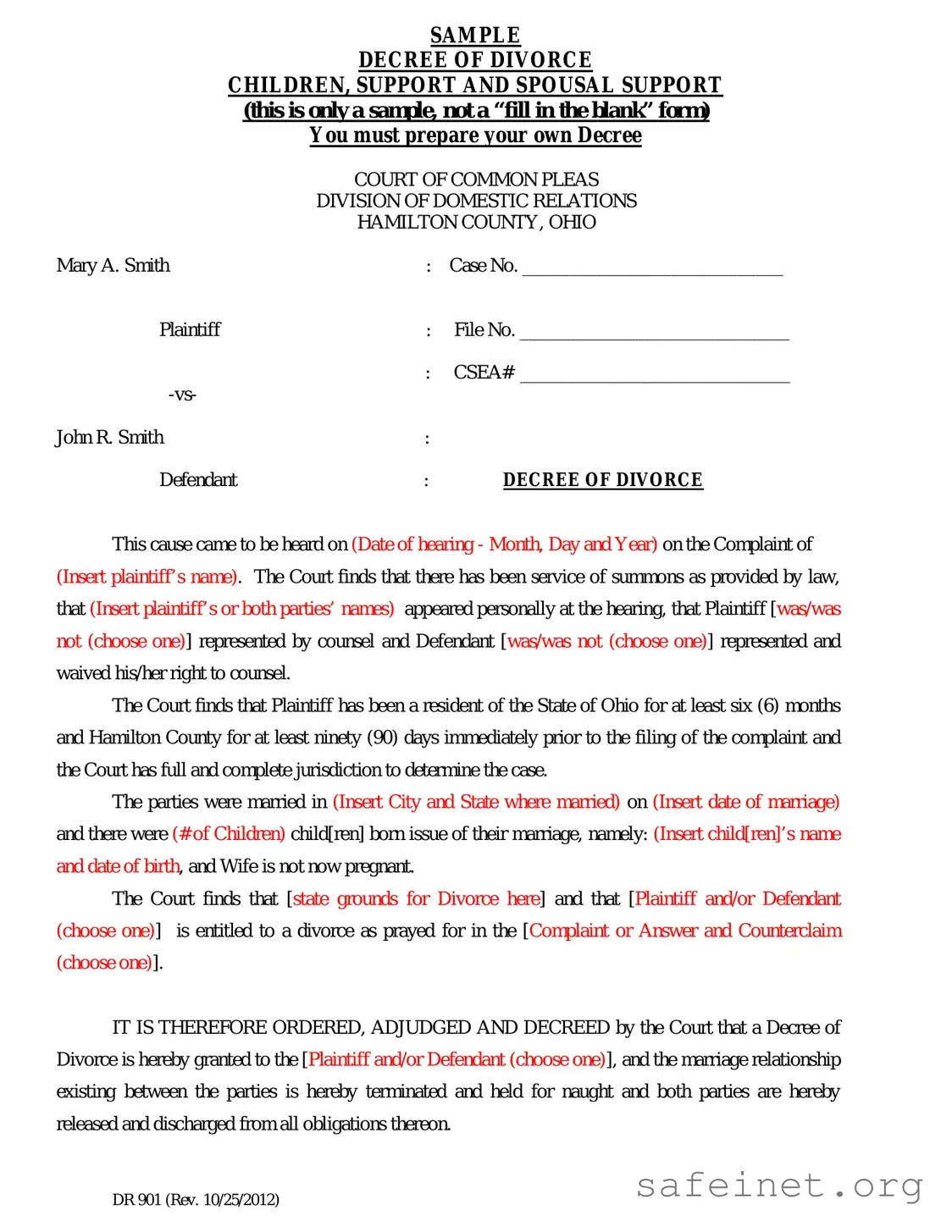
DR 901 (Rev. 10/25/2012)
SAMPLE
DECREE OF DIVORCE
CHILDREN, SUPPORT AND SPOUSAL SUPPORT
(this is only a sample, not a “fill in the blank” form)
You must prepare your own Decree
COURT OF COMMON PLEAS
DIVISION OF DOMESTIC RELATIONS
HAMILTON COUNTY, OHIO
Mary A. Smith : Case No. ____________________________
Plaintiff : File No. _____________________________
: CSEA# _____________________________
-vs-
John R. Smith :
Defendant : DECREE OF DIVORCE
This cause came to be heard on (Date of hearing - Month, Day and Year) on the Complaint of
(Insert plaintiff’s name). The Court finds that there has been service of summons as provided by law,
that (Insert plaintiff’s or both parties’ names) appeared personally at the hearing, that Plaintiff [was/was
not (choose one)] represented by counsel and Defendant [was/was not (choose one)] represented and
waived his/her right to counsel.
The Court finds that Plaintiff has been a resident of the State of Ohio for at least six (6) months
and Hamilton County for at least ninety (90) days immediately prior to the filing of the complaint and
the Court has full and complete jurisdiction to determine the case.
The parties were married in (Insert City and State where married) on (Insert date of marriage)
and there were (# of Children) child[ren] born issue of their marriage, namely: (Insert child[ren]’s name
and date of birth, and Wife is not now pregnant.
The Court finds that [state grounds for Divorce here] and that [Plaintiff and/or Defendant
(choose one)] is entitled to a divorce as prayed for in the [Complaint or Answer and Counterclaim
(choose one)].
IT IS THEREFORE ORDERED, ADJUDGED AND DECREED by the Court that a Decree of
Divorce is hereby granted to the [Plaintiff and/or Defendant (choose one)], and the marriage relationship
existing between the parties is hereby terminated and held for naught and both parties are hereby
released and discharged from all obligations thereon.
DR 901 (Rev. 10/25/2012)
IT IS FURTHER ORDERED THAT THE [Separation Agreement/Agreed Entry (choose one)]
which is attached hereto is hereby incorporated into the Court’s order and is a part of this Decree of
Divorce as if fully rewritten. The parties acknowledge under oath that they have voluntarily entered into
the [Separation Agreement/Agreed Entry (choose one)], that they have made full disclosure of all assets
and liabilities, and that they understand the terms of said agreement.
IT IS FURTHER ORDERED that the (Insert name of residential parent) is the residential parent
and legal custodian of the minor child[ren], (Insert names of child[ren]) and (Insert non-residential
parent’s name) shall have parenting time with said minor child[ren] in accordance with the Court’s
Standard Parenting Order, a copy of which is attached hereto. (OR OTHER DETAILED PARENTING
TIME AGREEMENT/ORDER)
OR
IT IS FURTHER ORDERED that the parties have entered into a Shared Parenting Plan which
has been submitted to and approved by the Court. Both parents shall be designated residential parent
and legal custodian, with parenting time as outlined in the Decree of Shared Parenting, filed herewith.
IT IS FURTHER ORDERED that (Insert name of parent ordered to pay child support)
(Obligor)shall pay as and for the support of the minor child[ren] the sum of $(Insert Dollar Amount to
pay) per month, per child, plus 2% processing charge, payable through The Office of Child Support of
The Department of Jobs and Family Services for the parties' child[ren]. This order is effective (Insert
date child support order begins) and is payable monthly in the total amount of $(Insert total child
support obligation), including the processing charge.
This support order amount is the same as that indicated on the signed and attached child support
worksheet
OR
This support order amount is different from that indicated on the attached child support
worksheet and the deviation is in the child(ren)’s best interest because: (state specific reasons).
Notwithstanding Section 3109.01 of the Revised Code, the parental duty of support to children,
including the duty of a parent to pay support pursuant to a child support order shall continue beyond the
child's eighteenth birthday only in accordance with Section 3119.86 of the Revised Code. The duty of
support shall continue during seasonal vacations. The Obligor is responsible for making payments
directly to The Office of Child Support of The Department of Jobs and Family Services until such time
as a deduction order takes effect. Any payment made directly to the residential parent and not through
The Office of Child Support of The Department of Jobs and Family Services shall be deemed a gift and
not credited to the support account.
DR 901 (Rev. 10/25/2012)
All support under this order shall be withheld or deducted from the income or assets of the
obligor pursuant to a withholding or deduction notice or appropriate order issued in accordance with
Chapters 3119, 3121, 3123, and 3125 of the Revised Code or a withdrawal directive issued pursuant to
sections 3123.24 to 3123.38 of the Revised Code and shall be forwarded to the obligee in accordance
with Chapters 3119, 3121, 3123 and 3125 of the Revised Code. A person and/or entity required to
comply with withholding or deduction notices described in Section 3121.03 of the Revised Code shall
determine the manner of withholding or deducting from the specific requirement included in the notices
without the need for any amendment to the support order, and a person required to comply with an order
described in sections 3121.03, 3121.04 to 3121.06 and 3121.12 of the Revised Code shall comply
without need for any amendment to the support order. The withholding or deduction noticed and other
orders issued under sections 3121.03, 3121.04 to 3121.06 and 3121.12 of the Revised Code, and the
notices that require the obligor to notify the child support enforcement agency administering the support
order of any change in the obligor’s employment status or of any other change in the status of the
obligor’s assets, are final and enforceable by the court.
EACH PARTY TO THIS SUPPORT ORDER MUST NOTIFY THE CHILD SUPPORT
ENFORCEMENT AGENCY IN WRITING OF HIS OR HER CURRENT MAILING ADDRESS,
CURRENT RESIDENCE ADDRESS, CURRENT RESIDENCE TELEPHONE NUMBER,
CURRENT DRIVER’S LICENSE NUMBER, AND OF ANY CHANGES IN THAT
INFORMATION. EACH PARTY MUST NOTIFY THE AGENCY OF ALL CHANGES UNTIL
FURTHER NOTICE FROM THE COURT OR AGENCY, WHICHEVER ISSUED THE
SUPPORT ORDER. IF YOU ARE THE OBLIGOR UNDER A CHILD SUPPORT ORDER AND
YOU FAIL TO MAKE THE REQUIRED NOTIFICATIONS, YOU MAY BE FINED UP TO $50
FOR A FIRST OFFENSE, $100 FOR A SECOND OFFENSE, AND $500 FOR EACH
SUBSEQUENT OFFENSE. IF YOU ARE AN OBLIGOR OR OBLIGEE UNDER ANY CHILD
SUPPORT ORDER ISSUED BY A COURT AND YOU WILLFULLY FAIL TO GIVE THE
REQUIRED NOTICES, YOU MAY BE FOUND IN CONTEMPT OF COURT AND BE
SUBJECTED TO FINES UP TO $1,000 AND IMPRISONMENT FOR NOT MORE THAN 90
DAYS.
IF YOU ARE AN OBLIGOR AND YOU FAIL TO GIVE THE REQUIRED NOTICES,
YOU MAY NOT RECEIVE NOTICE OF THE FOLLOWING ENFORCEMENT ACTIONS
AGAINST YOU: IMPOSITION OF LIENS AGAINST YOUR PROPERTY; LOSS OF YOUR
PROFESSIONAL OR OCCUPATIONAL LICENSE, DRIVER’S LICENSE, OR
RECREATIONAL LICENSE; WITHHOLDING FROM YOUR INCOME; ACCESS
RESTRICTION AND DEDUCTION FROM YOUR ACCOUNTS IN FINANCIAL
INSTITUTIONS; AND ANY OTHER ACTION PERMITTED BY LAW TO OBTAIN MONEY
FROM YOU TO SATISFY YOUR SUPPORT OBLIGATION.
DR 901 (Rev. 10/25/2012)
IT IS FURTHER ORDERED THAT [Mother/Father (choose one)] shall maintain private health
insurance for the parties’ child/children so long as [he/she (choose one) ]has accessible health insurance
available for 5% or less of his/her gross annual income. A Qualified Medical Child Support Order [if no
health insurance is available to either party, a Shared Liability Health Care Order] shall issue. This
order shall remain in effect until the child reaches the age of eighteen (18) and no longer attends an
accredited high school on a full-time basis unless otherwise ordered. Except in cases in which a child
support order requires the duty of support to continue for any period after the child reaches age nineteen,
the order shall not remain in effect after the child reaches age nineteen. A Cash Medical Order is
attached and incorporated for all purposes.
IT IS FURTHER ORDERED that (Insert Plaintiff’s or Defendant’s name) shall pay spousal
support in the amount of $(Insert Dollar Amount to pay) per month for (Insert # of months) months,
effective (Insert date spousal support shall begin), payable through the The Office of Child Support of
The Department of Jobs and Family Services, plus 2% processing fee. The Court [shall/shall not
(choose one)] retain jurisdiction over the term or the amount of this order.
IT IS FURTHER ORDERED that [each party shall retain all property presently held in his/her
name or possession, free and clear of any claim by the other and shall be solely liable for any debts
presently held in his/her name and hold the other harmless on same] or [property shall be divided
pursuant to the attached Separation Agreement] or [repeat the property distribution as stated in a
Magistrate’s Decision-DO NOT ATTACH A MAGISTRATE’S DECISION TO THE DIVORCE
DECREE]. (choose one method of property division)
(Insert Plaintiff’s or Defendant’s Name) shall be restored to her maiden name of (Insert name to
be restored to).
[Insert name of person to be responsible to pay or ½ each] shall pay court costs.
_____________________________________
Judge
_______________________________ _____________________________________
Plaintiff Defendant
_______________________________ _____________________________________
Attorney Attorney
DR 901 (Rev. 10/25/2012)
REQUIRED FORMS FOR DECREE: (ORIGINAL + 4 COPIES)
Divorce Decree
o Separation Agreement or Agreed Entry (if appropriate)
Child Support Worksheet (form 7.5A or 7.6)
Standard Parenting Order (if appropriate- form 2.7)
Appropriate Health Care Order (7.17 if private health insurance is available-
7.20 if private health insurance is not available)
Cash Medical Order (form 7.24)
IF SHARED PARENTING: (ORIGINAL + 4 COPIES)
Divorce Decree
Separation Agreement or Agreed Entry (if appropriate)
Final Decree of Shared Parenting (form 2.3)
Approved Shared Parenting Plan
Child Support Worksheet (form 7.5A or 7.6)
Standard Parenting Order (if appropriate- form 2.7)
Appropriate Health Care Order (7.17 if private health insurance is available-
7.20 if not)
Cash Medical Order (form 7.24)
ADDITIONAL FORMS: (1 COPY)
SUPPORT ACCOUNT DATA FORM (CDR4905)
COPY OF IV-D APPLICATION
HEALTH CARE VERIFICATION (IF APPROPRIATE- FORM 7.21)

Document Specifications

Fact Name Details
Governing Law This decree is governed by Ohio Revised Code Sections 3109.01, 3119.86, 3121, 3123, and 3125.
Purpose The Divorce Decree outlines the terms of the divorce, including custody, support, and property distribution.
Residency Requirement The Plaintiff must have resided in Ohio for at least six months and in Hamilton County for at least ninety days prior to filing.
Child Support Obligation The Obligor is required to pay child support, which is determined based on the attached child support worksheet.
Spousal Support Spousal support may be ordered, with specific terms outlined in the decree, including payment amounts and duration.
Health Insurance Requirement The decree mandates that one parent maintain health insurance for the children if it is available at a reasonable cost.
Notification of Changes Each party must notify the Child Support Enforcement Agency of any changes to their contact information.
Finality of Order The decree is final and enforceable, terminating the marriage and releasing both parties from obligations related to the marriage.

Steps to Filling Out Divorce Decree Sample

Completing the Divorce Decree Sample form requires careful attention to detail. This document is essential for finalizing the divorce process and addressing important matters such as child custody, support, and property division. Follow the steps outlined below to ensure that you fill out the form accurately and completely.

  1. Begin by entering the case number and file number at the top of the form.
  2. Identify the plaintiff and defendant by inserting the full names of both parties.
  3. Fill in the date of the hearing in the specified format (Month, Day, Year).
  4. State whether the plaintiff and defendant were represented by counsel by checking the appropriate boxes.
  5. Indicate the marriage location (City and State) and the date of marriage.
  6. Specify the number of children born of the marriage and list their names and dates of birth.
  7. Provide the grounds for divorce in the designated section.
  8. Select whether the divorce is granted to the plaintiff or defendant.
  9. Choose between a Separation Agreement or Agreed Entry and indicate which is incorporated into the decree.
  10. Identify the residential parent and legal custodian of the minor children, along with the non-residential parent’s name.
  11. Specify the amount of child support to be paid per month, including any processing charges, and the effective date.
  12. State whether the obligor is responsible for maintaining health insurance for the children and detail the conditions.
  13. Indicate the amount of spousal support to be paid, the duration, and the effective date.
  14. Choose the method of property division and provide any necessary details.
  15. State the name to be restored to, if applicable.
  16. Sign the form and have the judge sign it as well.

Once you have completed the form, gather any required additional documents, such as the Child Support Worksheet and Separation Agreement, if applicable. Make sure to keep copies for your records. This step is crucial to ensure that all aspects of the divorce are legally recognized and enforceable.

More About Divorce Decree Sample

What is a Divorce Decree Sample form?

A Divorce Decree Sample form is a template that outlines the terms and conditions of a divorce. It is not a fill-in-the-blank form but serves as a guide for individuals preparing their own divorce decree. This document includes essential details such as child custody arrangements, child support obligations, and spousal support terms. It also provides a structured format that can help ensure that all necessary information is included in the final decree.

What should I include in my Divorce Decree?

Your Divorce Decree should include several key components. Start with the names of both parties and the date of the marriage. Clearly state the grounds for divorce and detail any children involved, including their names and birth dates. Outline the custody arrangement, specifying which parent will be the residential custodian. Include child support amounts, spousal support details, and how property will be divided. Finally, ensure that any agreements made between both parties are documented and incorporated into the decree.

How does child support work in the Divorce Decree?

Child support is a critical element of the Divorce Decree. It specifies the amount one parent (the obligor) must pay for the support of the children. This amount is typically calculated based on state guidelines and may include additional processing fees. The decree should indicate when payments begin and how they will be processed, usually through the Office of Child Support. It is essential to note that any direct payments made to the residential parent outside of this system may not count towards the support obligation.

Can I change the terms of the Divorce Decree after it is finalized?

Once a Divorce Decree is finalized, changing its terms can be challenging but not impossible. If you wish to modify aspects like child support or custody arrangements, you must usually file a motion with the court. The court will then review the request and determine if the changes are warranted based on current circumstances. It is important to understand that both parties should agree to any modifications, and legal guidance may be beneficial during this process.

Common mistakes

  1. Failing to include accurate personal information. Individuals often overlook the importance of correctly filling in names, addresses, and case numbers, which can lead to delays or complications.

  2. Not specifying the grounds for divorce. Many people neglect to clearly state the reasons for the divorce, which is essential for the court's understanding of the case.

  3. Choosing the wrong parenting arrangement. Selecting between a Standard Parenting Order and a Shared Parenting Plan without fully understanding the implications can lead to disputes later.

  4. Omitting details about child support obligations. Failing to accurately calculate or specify the child support amount can result in financial strain and legal issues.

  5. Not including a health care provision for children. This is a critical aspect that can affect the well-being of the children involved.

  6. Ignoring the requirement for attachments. Many individuals forget to attach necessary documents, such as the Child Support Worksheet or Separation Agreement, which are vital for the decree.

  7. Misunderstanding the spousal support terms. It's crucial to specify the amount and duration of spousal support clearly to avoid future disputes.

  8. Failing to review the entire document before submission. A thorough review can help catch mistakes that may lead to complications down the line.

Documents used along the form

When navigating a divorce, several documents often accompany the Divorce Decree. Each of these forms serves a specific purpose in the process, ensuring that all aspects of the divorce are addressed comprehensively. Below is a list of common forms used alongside the Divorce Decree.

  • Separation Agreement: This document outlines the terms agreed upon by both parties regarding the division of property, debts, and other matters such as child custody and support. It is incorporated into the Divorce Decree.
  • Child Support Worksheet: This form calculates the amount of child support owed, based on the income of both parents and the needs of the child. It is essential for establishing financial responsibilities.
  • Standard Parenting Order: This order details the parenting time and responsibilities of each parent regarding their minor children. It is critical for ensuring that both parents understand their rights and obligations.
  • Health Care Order: This document specifies the health insurance obligations of each parent for their children. It ensures that medical coverage is maintained as required by law.
  • Cash Medical Order: This order addresses additional medical expenses not covered by insurance, outlining how these costs will be shared between parents.
  • Final Decree of Shared Parenting: If parents choose shared parenting, this decree formalizes the arrangement, detailing how parenting responsibilities and time will be divided.

Understanding these documents can significantly ease the divorce process. Each form plays a vital role in protecting the rights and responsibilities of both parties, particularly when children are involved. Properly completing and submitting these forms can help ensure a smoother transition into post-divorce life.

Similar forms

The Divorce Decree is often compared to a Separation Agreement, as both documents address the division of assets and responsibilities between spouses. A Separation Agreement is typically created during the period when spouses are living apart but not yet divorced. It outlines how the couple will handle issues such as property division, child custody, and support obligations. While the Divorce Decree formalizes these arrangements following the court's approval, the Separation Agreement serves as a preliminary agreement that can be incorporated into the final decree.

Another document similar to the Divorce Decree is the Child Support Order. This order specifically addresses the financial obligations of one parent to support their child or children following a separation or divorce. Like the Divorce Decree, a Child Support Order is legally binding and outlines the amount of support to be paid, the frequency of payments, and the duration of the obligation. Both documents aim to ensure the well-being of the children involved, but the Child Support Order focuses solely on financial responsibilities.

The Parenting Plan is another important document that often accompanies a Divorce Decree. This plan outlines the specifics of child custody and visitation arrangements. It details how parents will share responsibilities and time with their children, ensuring that their needs are met post-divorce. While the Divorce Decree may grant custody, the Parenting Plan provides the framework for how that custody will be implemented in daily life.

Similar to the Divorce Decree, a Spousal Support Order addresses financial support between ex-spouses. This order specifies the amount and duration of support one spouse must pay to the other after the divorce. Like the provisions in a Divorce Decree, a Spousal Support Order is enforceable by the court and is intended to ensure that the receiving spouse can maintain a reasonable standard of living after the marriage ends.

The Final Judgment of Divorce is another document closely related to the Divorce Decree. This judgment is the court's official decision to dissolve the marriage and can include all the terms agreed upon in the Divorce Decree. While the Divorce Decree may contain specific details about child custody and support, the Final Judgment serves as the overarching legal document that confirms the dissolution of the marriage itself.

A Custody Agreement is also similar in that it addresses child custody arrangements but may be less formal than a Parenting Plan. This document can be created by the parents themselves without court intervention. However, once submitted to the court and approved, it can become part of the Divorce Decree. Both documents aim to clarify custody arrangements, but the Custody Agreement may not carry the same legal weight until it is incorporated into the Divorce Decree.

The Marital Settlement Agreement is another document that often accompanies a Divorce Decree. This agreement outlines how the couple will divide their assets and liabilities. While the Divorce Decree finalizes the divorce, the Marital Settlement Agreement details the terms under which the divorce is granted. It can include agreements on property division, debt responsibility, and other financial matters, serving as a comprehensive roadmap for the couple's post-marriage financial relationship.

A Qualified Domestic Relations Order (QDRO) is similar in that it addresses the division of retirement assets in a divorce. This court order is necessary to divide certain retirement plans, ensuring that both parties receive their fair share of the benefits accrued during the marriage. Like the Divorce Decree, a QDRO is enforceable and must be approved by the court to ensure compliance with the terms of the divorce.

The Affidavit of Support is another document that can be relevant in divorce proceedings, particularly when financial support is a concern. This affidavit serves as a sworn statement regarding the financial circumstances of one or both parties. It can be used to demonstrate the need for spousal or child support and may be referenced in the Divorce Decree to justify the terms of support outlined in that document.

Lastly, the Certificate of Dissolution of Marriage is a document that officially records the end of a marriage. Similar to the Divorce Decree, it serves as a legal acknowledgment that the marriage has been dissolved. This certificate is often required for various legal and administrative purposes, such as changing names or remarrying. Both documents signify the conclusion of the marital relationship, but the Certificate of Dissolution is a more formal record of that conclusion.

Dos and Don'ts

When filling out the Divorce Decree Sample form, it is essential to adhere to certain guidelines to ensure accuracy and compliance. Below is a list of ten things to do and not to do during this process.

  • Do read the entire form carefully before beginning to fill it out.
  • Do provide accurate and complete information regarding both parties.
  • Do ensure that all dates, especially those related to marriage and children, are correct.
  • Do include the correct case number and file number as required.
  • Do indicate whether each party was represented by counsel during the hearing.
  • Don't leave any sections blank unless specifically instructed to do so.
  • Don't use abbreviations or informal language; clarity is crucial.
  • Don't submit the form without checking for spelling and grammatical errors.
  • Don't forget to attach any required supporting documents.
  • Don't assume that verbal agreements will be recognized without written documentation.

Misconceptions

  • Misconception 1: The Divorce Decree Sample form is a fill-in-the-blank template.
  • This is incorrect. The sample form is intended to serve as a guideline. Individuals must prepare their own decree based on their specific circumstances, using the sample for reference.

  • Misconception 2: The form guarantees a divorce will be granted.
  • Simply using the sample form does not ensure that a court will grant a divorce. The decision depends on various factors, including jurisdictional requirements and the specifics of the case.

  • Misconception 3: All divorce cases require a lawyer.
  • While having legal representation can be beneficial, it is not mandatory. Some individuals choose to represent themselves, especially in uncontested divorces, but this requires a thorough understanding of the process.

  • Misconception 4: The Divorce Decree Sample form includes all necessary legal language.
  • The sample form may not cover every possible legal situation or requirement. It is essential to consult with legal resources or professionals to ensure all necessary provisions are included.

  • Misconception 5: Once the decree is signed, it cannot be modified.
  • This is misleading. A divorce decree can be modified under certain circumstances, such as changes in income or living situations. However, the process for modification must be followed according to state laws.

  • Misconception 6: Child support payments are fixed and cannot change.
  • Child support amounts can be adjusted based on changes in circumstances. The decree may specify an amount, but it can be reviewed and modified if necessary, following legal procedures.

  • Misconception 7: The sample form applies universally across all states.
  • Each state has its own laws and requirements regarding divorce. The sample form is specific to Hamilton County, Ohio, and may not be applicable in other jurisdictions.

  • Misconception 8: The Divorce Decree Sample form addresses all aspects of divorce.
  • The sample primarily focuses on the decree itself. It does not cover every detail, such as division of property or specific custody arrangements, which may need to be addressed in separate documents.

Key takeaways

Here are some key takeaways regarding the Divorce Decree Sample form:

  • Preparation is essential: You must create your own Decree based on the sample provided. It is not a fill-in-the-blank form.
  • Jurisdiction matters: Ensure that residency requirements are met. The Plaintiff must have lived in Ohio for at least six months and in Hamilton County for at least ninety days before filing.
  • Details are crucial: Fill in all necessary information, including names, dates of marriage, and the number of children involved.
  • Child support obligations: Clearly state the amount to be paid for child support and ensure it aligns with the attached child support worksheet.
  • Health insurance requirements: Specify which parent will maintain health insurance for the children, ensuring it meets affordability criteria.
  • Spousal support: If applicable, include the monthly amount and duration for spousal support payments, along with payment processing details.
  • Property division: Clearly outline how property will be divided or retained by each party, and ensure it is consistent with any attached agreements.

Completing the Divorce Decree Sample form accurately is vital for a smooth legal process. Double-check all entries for correctness and completeness.