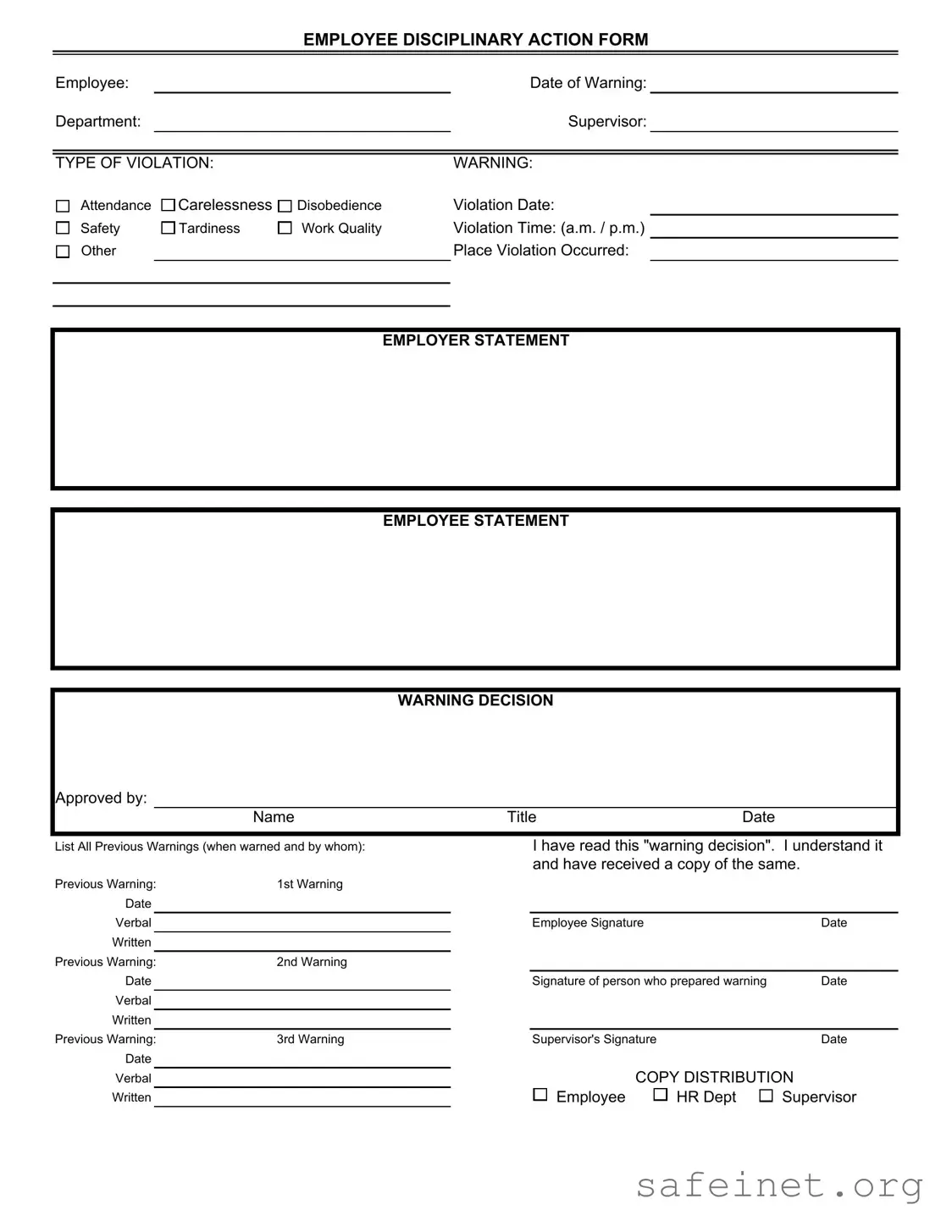
The Disciplinary Action form serves as a critical tool for employers to document employee misconduct and the corresponding corrective actions taken. It includes essential information such as the employee's name, the date of the warning, and the department involved, ensuring clarity and accountability. The form categorizes violations into specific types, such as attendance issues, carelessness, safety concerns, and tardiness, allowing for a structured approach to addressing various infractions. Additionally, it captures vital details about the violation, including the date, time, and location where the incident occurred. Both the employer and employee have sections to provide their statements, fostering open communication regarding the circumstances surrounding the disciplinary action. A record of previous warnings is also included, which helps track an employee's history and informs future decisions. The form concludes with a decision section that requires approval from a designated authority, reinforcing the importance of a fair and consistent disciplinary process. By ensuring that all parties involved understand the implications of the warning, this form plays a pivotal role in maintaining workplace standards and promoting a culture of accountability.
| Fact Name | Description |
|---|---|
| Purpose of the Form | The Disciplinary Action form is used to document violations of company policy and the corresponding disciplinary measures taken against an employee. |
| Employee Information | Essential details about the employee, including their name, department, and supervisor, are recorded to ensure clarity and accountability. |
| Types of Violations | Common types of violations listed on the form include attendance issues, carelessness, safety violations, tardiness, and other infractions. |
| Warning Details | The form captures the date and time of the violation, as well as the location where it occurred, providing a clear context for the disciplinary action. |
| Previous Warnings | It is important to list all previous warnings issued to the employee, including the dates and the individuals who provided them, to show a history of the employee's conduct. |
| Legal Compliance | In some states, specific laws govern the disciplinary process, ensuring that employers follow fair practices. For example, in California, employers must comply with the Fair Employment and Housing Act. |
Once you have the Disciplinary Action form ready, you can begin filling it out. Make sure to gather all necessary information before you start. Follow these steps to ensure the form is completed correctly.
After completing the form, distribute copies to the employee, HR department, and supervisor as indicated. Ensure that all signatures are collected before finalizing the document.
What is the purpose of the Disciplinary Action form?
The Disciplinary Action form serves as a formal record of any violations of company policy or standards by an employee. It documents the type of violation, the details surrounding the incident, and the actions taken by the employer. This ensures that there is a clear understanding between the employee and the employer regarding the expectations and consequences of specific behaviors.
What types of violations can be documented on the form?
The form allows for various types of violations to be recorded, including attendance issues, carelessness, safety violations, tardiness, and other infractions. Each category is designed to address different aspects of workplace behavior, ensuring that all potential issues are covered and addressed appropriately.
How is the warning decision approved?
The warning decision is approved by a designated authority within the organization, typically a supervisor or manager. This approval is documented on the form, along with the name, title, and date of approval. This step is crucial as it adds a layer of accountability and ensures that the disciplinary process is handled consistently across the organization.
What should be included in the "List All Previous Warnings" section?
This section should include a comprehensive history of any prior warnings issued to the employee. It should detail when the warnings were given, the nature of the violations, and who issued the warnings. This information is vital for tracking the employee's performance and behavior over time, helping to make informed decisions about further disciplinary action if necessary.
What does the employee need to acknowledge on the form?
The employee is required to read and acknowledge the warning decision by signing the form. This indicates that they understand the nature of the warning and have received a copy for their records. Acknowledgment does not imply agreement with the warning, but rather an understanding of the situation and the consequences outlined.
How are previous warnings categorized on the form?
Previous warnings are categorized into three distinct sections: the 1st Warning, the 2nd Warning, and the 3rd Warning. Each section includes fields for the date of the warning, whether it was verbal or written, and the signatures of the employee and the person who prepared the warning. This structured approach helps to maintain clarity and organization in the disciplinary process.
What happens after the Disciplinary Action form is completed?
Once the form is completed and signed, copies are distributed to the employee, the HR department, and the supervisor. This ensures that all relevant parties have access to the documentation, promoting transparency and accountability. It also allows HR to maintain accurate records of disciplinary actions taken within the organization.
Can an employee contest a warning documented on the form?
Yes, an employee has the right to contest a warning if they believe it is unjust. They can provide their statement on the form, which allows them to express their perspective regarding the incident. This feedback can be valuable in reviewing the situation and determining the appropriate course of action moving forward.
Is there a follow-up process after a warning is issued?
Typically, after a warning is issued, there may be a follow-up process to monitor the employee's behavior and performance. This could involve regular check-ins by the supervisor or additional training if necessary. The goal is to support the employee in making improvements and to prevent future violations.
Failing to provide accurate employee information. It’s important to ensure that the employee’s name, department, and supervisor are filled out correctly. Mistakes here can lead to confusion.
Neglecting to specify the type of violation. Clearly identifying whether the issue is related to attendance, carelessness, safety, or tardiness is crucial for proper documentation.
Omitting the date and time of the violation. This information is essential for establishing a timeline of events and understanding the context of the disciplinary action.
Not including a detailed employer statement. This section should provide a clear explanation of the circumstances surrounding the violation. A vague statement may lead to misunderstandings.
Forgetting to document previous warnings. Listing all prior warnings helps to establish a pattern of behavior and shows the employee that the issue has been addressed before.
Failing to obtain necessary signatures. Ensure that both the employee and the supervisor sign the form to acknowledge the warning. This step is important for accountability.
Not distributing copies appropriately. After completing the form, it’s essential to provide copies to the employee, HR department, and the supervisor. This ensures everyone involved has access to the same information.
Using unclear language. When filling out the form, it’s important to use straightforward language. Avoiding jargon helps ensure that the employee fully understands the warning.
When addressing employee behavior, the Disciplinary Action form is just one piece of the puzzle. Several other documents often accompany it to ensure a comprehensive approach to managing workplace issues. Each of these forms plays a unique role in the disciplinary process, providing clarity and structure.
By utilizing these documents alongside the Disciplinary Action form, employers can create a fair and transparent process. This not only helps in addressing issues effectively but also supports a positive work environment where employees understand expectations and consequences.
The Performance Improvement Plan (PIP) is a document that outlines specific areas where an employee needs to improve their performance. Like the Disciplinary Action form, it includes details about the employee, the supervisor, and the nature of the performance issues. Both documents serve as formal records that can help track an employee's progress over time. The PIP typically sets clear expectations and timelines for improvement, similar to how the Disciplinary Action form specifies the type of violation and previous warnings. This helps ensure that both the employee and employer are on the same page regarding expectations and consequences.
The Employee Warning Notice is another document that shares similarities with the Disciplinary Action form. This notice is often used to formally alert an employee about a specific violation of company policy or performance standards. Like the Disciplinary Action form, it includes the employee's information, details about the violation, and a record of prior warnings. Both documents aim to communicate issues clearly and provide a framework for addressing them, ensuring that employees understand the seriousness of their actions and the potential consequences.
The Termination Notice is a critical document that, while more severe, has similarities to the Disciplinary Action form. It typically includes information about the employee, the reasons for termination, and any prior disciplinary actions taken. Both documents serve as formal records that can protect the employer in case of disputes. The Termination Notice may reference previous warnings or disciplinary actions, highlighting the progression of issues that led to the decision. This connection underscores the importance of maintaining clear documentation throughout the employee's tenure.
The Incident Report is another document that aligns closely with the Disciplinary Action form. An Incident Report details specific events or behaviors that led to disciplinary action, capturing the facts surrounding a violation. Like the Disciplinary Action form, it includes information about the employee and the context of the incident. Both documents aim to provide a clear and factual account of the situation, ensuring that all parties have a comprehensive understanding of what transpired. This can be crucial for both resolving the issue at hand and for any potential future actions.
When filling out the Disciplinary Action form, it’s important to approach the task with care and clarity. Here are some guidelines to help you navigate this process effectively.
Here are six common misconceptions about the Disciplinary Action form:
Filling out and using the Disciplinary Action form is an important process for both employers and employees. Here are key takeaways to keep in mind: