Homepage > Blank Discharging Indemnity Funding Bond Template
Article Structure

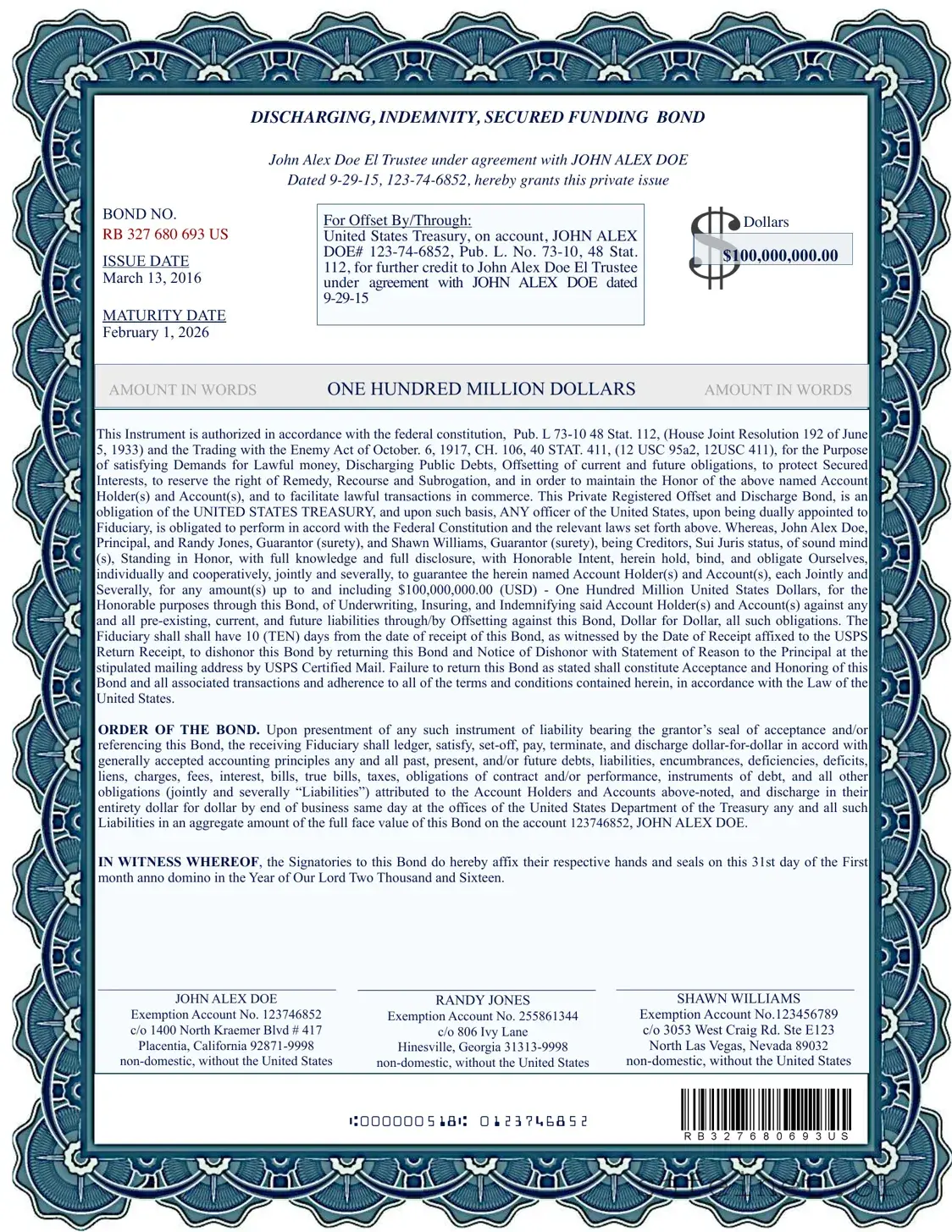
The Discharging Indemnity Funding Bond form serves as a crucial financial instrument designed to facilitate the offsetting and discharging of debts. This specific bond, identified by the number RB 327 680 693, was issued on March 13, 2016, and is set to mature on February 1, 2026. It encompasses a significant amount of $100 million, clearly stated in both numerical and written forms, ensuring clarity in its purpose. The bond is authorized under federal law, referencing key legislative acts such as Pub. L. No. 73-10 and the Trading with the Enemy Act. Its primary function is to satisfy lawful monetary demands and discharge public debts while protecting the secured interests of the involved parties. The bond outlines the obligations of the principal, John Alex Doe, alongside two guarantors, Randy Jones and Shawn Williams, who collectively agree to indemnify the account holder against various liabilities. A notable aspect of this bond is the provision that allows for a ten-day period during which the fiduciary may choose to dishonor the bond. If the bond is not returned within this timeframe, it is considered accepted, binding the fiduciary to its terms. The document also specifies that any liabilities presented against the bond must be settled dollar-for-dollar, ensuring comprehensive coverage for the account holders. Witnesses to the signing of this bond further validate its legitimacy, adding an additional layer of assurance for all parties involved.

Form Sample

Dollars
DISCHARGING, INDEMNITY, SECURED FUNDING BOND
John Alex Doe El Trustee under agreement with JOHN ALEX DOE
Dated 9-29-15, 123-74-6852, hereby grants this private issue
ISSUE DATE
March 13, 2016
MATURITY DATE
February 1, 2026
$100,000,000.00
BOND NO.
RB 327 680 693 US
This Instrument is authorized in accordance with the federal constitution, Pub. L 73-10 48 Stat. 112, (House Joint Resolution 192 of June
5, 1933) and the Trading with the Enemy Act of October. 6, 1917, CH. 106, 40 STAT. 411, (12 USC 95a2, 12USC 411), for the Purpose
of satisfying Demands for Lawful money, Discharging Public Debts, Offsetting of current and future obligations, to protect Secured
Interests, to reserve the right of Remedy, Recourse and Subrogation, and in order to maintain the Honor of the above named Account
Holder(s) and Account(s), and to facilitate lawful transactions in commerce. This Private Registered Offset and Discharge Bond, is an
obligation of the UNITED STATES TREASURY, and upon such basis, ANY officer of the United States, upon being dually appointed to
Fiduciary, is obligated to perform in accord with the Federal Constitution and the relevant laws set forth above. Whereas, John Alex Doe,
Principal, and Randy Jones, Guarantor (surety), and Shawn Williams, Guarantor (surety), being Creditors, Sui Juris status, of sound mind
(s), Standing in Honor, with full knowledge and full disclosure, with Honorable Intent, herein hold, bind, and obligate Ourselves,
individually and cooperatively, jointly and severally, to guarantee the herein named Account Holder(s) and Account(s), each Jointly and
Severally, for any amount(s) up to and including $100,000,000.00 (USD) - One Hundred Million United States Dollars, for the
Honorable purposes through this Bond, of Underwriting, Insuring, and Indemnifying said Account Holder(s) and Account(s) against any
and all pre-existing, current, and future liabilities through/by Offsetting against this Bond, Dollar for Dollar, all such obligations. The
Fiduciary shall shall have 10 (TEN) days from the date of receipt of this Bond, as witnessed by the Date of Receipt affixed to the USPS
Return Receipt, to dishonor this Bond by returning this Bond and Notice of Dishonor with Statement of Reason to the Principal at the
stipulated mailing address by USPS Certified Mail. Failure to return this Bond as stated shall constitute Acceptance and Honoring of this
Bond and all associated transactions and adherence to all of the terms and conditions contained herein, in accordance with the Law of the
United States.
ORDER OF THE BOND. Upon presentment of any such instrument of liability bearing the grantor’s seal of acceptance and/or
referencing this Bond, the receiving Fiduciary shall ledger, satisfy, set-off, pay, terminate, and discharge dollar-for-dollar in accord with
generally accepted accounting principles any and all past, present, and/or future debts, liabilities, encumbrances, deficiencies, deficits,
liens, charges, fees, interest, bills, true bills, taxes, obligations of contract and/or performance, instruments of debt, and all other
obligations (jointly and severally “Liabilities”) attributed to the Account Holders and Accounts above-noted, and discharge in their
entirety dollar for dollar by end of business same day at the offices of the United States Department of the Treasury any and all such
Liabilities in an aggregate amount of the full face value of this Bond on the account 123746852, JOHN ALEX DOE.
IN WITNESS WHEREOF, the Signatories to this Bond do hereby affix their respective hands and seals on this 31st day of the First
month anno domino in the Year of Our Lord Two Thousand and Sixteen.
__________________________________
SHAWN WILLIAMS
Exemption Account No.123456789
c/o 3053 West Craig Rd. Ste E123
North Las Vegas, Nevada 89032
non-domestic, without the United States
AMOUNT IN WORDS ONE HUNDRED MILLION DOLLARS AMOUNT IN WORDS
a000000518a 0123746852
For Offset By/Through:
United States Treasury, on account, JOHN ALEX
DOE# 123-74-6852, Pub. L. No. 73-10, 48 Stat.
112, for further credit to John Alex Doe El Trustee
under agreement with JOHN ALEX DOE dated
9-29-15
__________________________________
RANDY JONES
Exemption Account No. 255861344
c/o 806 Ivy Lane
Hinesville, Georgia 31313-9998
non-domestic, without the United States
__________________________________
JOHN ALEX DOE
Exemption Account No. 123746852
c/o 1400 North Kraemer Blvd # 417
Placentia, California 92871-9998
non-domestic, without the United States
INDEMNITY BOND
WE THE WITNESSES NAMED BELOW DO hereby attest to witnessing the signatories to this Bond affixing
their respective hands hereto on this 31
st
Day of January, 2016.
Witness 1
Sign
Print
Mailing Address
Witness 2
Sign
Print
Mailing Address
NOTES BELOW THIS LINE
I would highly advise that you do NOT use this template and that you create your own
unique bond, based on Pub L. 73-10, 48 Stat. 112, or other private agreement. I am only
providing this bond as a basic template for you to build upon. I am not suggesting that
ANYTHING on this BOND is required or NOT required. The 000000xxx number at the
bottom is a ROUTING TRANSIT NUMBER the 0123456789 is a 123-45-6789 with a
zero in front and no dashes, the RBXXXXX is a registered Mail number that was
converted into a BARCODE by using http://generator.barcoding.com

Document Specifications

Fact Name Details
Bond Number RB 327 680 693
Issue Date March 13, 2016
Maturity Date February 1, 2026
Authorized Amount $100,000,000.00 (One Hundred Million Dollars)
Governing Laws Pub. L. No. 73-10, 48 Stat. 112; House Joint Resolution 192 of June 5, 1933; Trading with the Enemy Act of October 6, 1917

Steps to Filling Out Discharging Indemnity Funding Bond

Completing the Discharging Indemnity Funding Bond form requires careful attention to detail. After filling out the form, ensure you review it for accuracy before submission. This will help avoid any delays or issues with processing.

  1. Begin by entering the BOND NO. at the top of the form. Write RB 327 680 693.
  2. Fill in the US ISSUE DATE as March 13, 2016.
  3. Enter the MATURITY DATE as February 1, 2026.
  4. In the Principal section, write John Alex Doe El Trustee under agreement with JOHN ALEX DOE.
  5. Next, provide the Social Security Number as 123-74-6852.
  6. For the amount, enter $100,000,000.00 in the appropriate field.
  7. In the AMOUNT IN WORDS section, write ONE HUNDRED MILLION DOLLARS.
  8. Review the Instrument Authorization section. Ensure it reflects the necessary legal references.
  9. List the names of the Guarantors: Randy Jones and Shawn Williams.
  10. In the Exemption Account No. section, fill in the respective account numbers for each party.
  11. Complete the Mailing Addresses for each party involved in the bond.
  12. Sign and date the form at the bottom where indicated.
  13. Have two witnesses sign and print their names along with their mailing addresses in the designated area.

More About Discharging Indemnity Funding Bond

What is the purpose of the Discharging Indemnity Funding Bond form?

The Discharging Indemnity Funding Bond form serves multiple purposes. It is designed to facilitate the discharge of public debts and obligations. This bond can offset current and future liabilities, ensuring the protection of secured interests. It also aims to maintain the honor of the account holders involved and facilitate lawful transactions in commerce.

Who are the parties involved in this bond?

The bond involves several key parties. John Alex Doe is identified as the principal, while Randy Jones and Shawn Williams act as guarantors. Each party has a specific role in guaranteeing the bond's obligations, ensuring that the principal is supported in meeting any financial liabilities up to the bond's face value of $100,000,000.

What happens if the bond is dishonored?

If the bond is dishonored, the fiduciary must return the bond along with a notice of dishonor and a statement of reasons within ten days of receipt. This must be done through USPS Certified Mail. Failure to return the bond in this timeframe will result in the acceptance and honoring of the bond and all its associated terms.

How does the bond discharge liabilities?

The bond discharges liabilities by allowing the fiduciary to satisfy any debts attributed to the account holders. Upon presentment of a liability instrument referencing the bond, the fiduciary must ledger and pay off these debts dollar-for-dollar, in accordance with generally accepted accounting principles. This must occur by the end of the business day at the U.S. Department of the Treasury.

What is the significance of the date on the bond?

The issue date of the bond is March 13, 2016, and it has a maturity date of February 1, 2026. This timeframe indicates the period during which the bond is active and can be utilized for discharging liabilities. After the maturity date, the bond may no longer hold legal significance for its intended purpose.

Is there a recommended way to use this bond?

It is advised that individuals do not use this bond template as it is. Instead, they should create a unique bond based on the relevant laws and agreements. The document provided serves merely as a basic template, and using it without modification may not meet specific legal requirements.

Common mistakes

  1. Incomplete Information: Failing to provide all required details can lead to delays. Make sure to fill in every section, including names, addresses, and account numbers.

  2. Incorrect Amounts: Double-check the amounts entered. Errors in the dollar figures or in the written amounts can cause confusion and may invalidate the bond.

  3. Missing Signatures: All parties involved must sign the form. Neglecting to include a signature can result in the bond being rejected.

  4. Improper Mailing: Sending the bond to the wrong address can lead to non-receipt. Ensure that you have the correct mailing address for the intended recipient.

  5. Ignoring Deadlines: Pay attention to any deadlines mentioned in the form. Missing a deadline can affect the validity of the bond and your ability to enforce it.

Documents used along the form

The Discharging Indemnity Funding Bond form is often accompanied by several other documents that serve various purposes in the context of financial transactions and obligations. Below is a list of five commonly used forms and documents that may be associated with this bond.

  • Indemnity Agreement: This document outlines the terms under which one party agrees to indemnify another against certain losses or damages. It specifies the scope of indemnification, the obligations of each party, and the conditions under which indemnification applies.
  • Guaranty Agreement: A guaranty agreement involves a third party who agrees to take responsibility for the obligations of the principal borrower if they default. This document provides assurance to the lender that the debt will be repaid, even if the primary borrower fails to meet their obligations.
  • Trust Agreement: A trust agreement establishes a legal relationship in which one party holds assets for the benefit of another. This document details the responsibilities of the trustee, the rights of the beneficiaries, and the management of the trust assets.
  • Power of Attorney: This document allows one individual to act on behalf of another in legal or financial matters. It grants authority to the agent to make decisions, sign documents, and manage financial affairs as specified by the principal.
  • Notice of Default: This document serves as a formal notification to a borrower that they have failed to meet the terms of a loan or agreement. It outlines the specific defaults and may provide a timeframe for rectifying the situation before further action is taken.

Each of these documents plays a crucial role in the framework of financial agreements and obligations. Understanding their purposes can help parties navigate their responsibilities and rights more effectively.

Similar forms

The first document similar to the Discharging Indemnity Funding Bond is a Surety Bond. This type of bond is a three-party agreement where one party guarantees the performance or obligations of another. In this case, if the principal fails to fulfill their obligations, the surety is responsible for covering the losses. Like the Discharging Indemnity Funding Bond, it serves to protect the interests of those involved and ensures that obligations are met, providing a safety net for creditors.

Another closely related document is the Indemnity Agreement. This agreement is designed to protect one party from financial loss or liability caused by the actions of another party. It outlines the responsibilities of each party and the extent of protection offered. Similar to the Discharging Indemnity Funding Bond, it emphasizes the concept of indemnification, ensuring that parties are held harmless from certain liabilities.

A Performance Bond is also akin to the Discharging Indemnity Funding Bond. This document guarantees that a contractor will complete a project according to the terms of a contract. If the contractor fails to do so, the surety will compensate the project owner. Both bonds aim to ensure that obligations are fulfilled, thereby safeguarding the interests of the parties involved.

The next document is a Letter of Credit. This financial instrument provides a guarantee of payment from a bank on behalf of a buyer to a seller. In the event that the buyer cannot pay, the bank will step in to fulfill the payment. Like the Discharging Indemnity Funding Bond, it serves as a financial assurance that obligations will be met, fostering trust in commercial transactions.

Another similar document is a Trust Indenture. This legal agreement outlines the terms of a bond issue and the rights of bondholders. It often includes provisions for the protection of the bondholders, ensuring that the issuer meets its obligations. This is reminiscent of the Discharging Indemnity Funding Bond, which also aims to protect the interests of those involved in financial agreements.

An Escrow Agreement is also relevant. This agreement involves a third party holding funds or assets until certain conditions are met. It ensures that both parties adhere to the terms of the agreement before any exchange occurs. Like the Discharging Indemnity Funding Bond, it provides a layer of security and trust, ensuring that obligations are fulfilled before transactions are completed.

A Guaranty Agreement is another document that shares similarities. This agreement involves one party agreeing to pay a debt or perform a duty if the original party fails to do so. It provides a safety net for creditors, similar to the protections offered by the Discharging Indemnity Funding Bond, ensuring that obligations are met even if the principal defaults.

Lastly, a Collateral Agreement can be compared to the Discharging Indemnity Funding Bond. This document secures a loan with an asset, providing assurance to the lender that they will be compensated in case of default. Both documents serve to protect the interests of creditors and ensure that financial obligations are met, establishing a framework for trust in financial transactions.

Dos and Don'ts

When filling out the Discharging Indemnity Funding Bond form, it is important to follow specific guidelines to ensure accuracy and compliance. Below is a list of things you should and shouldn't do:

  • Do read the entire form carefully before filling it out.
  • Do provide accurate personal information, including full names and addresses.
  • Do use clear and legible handwriting or type the information.
  • Do sign the form where required to validate the bond.
  • Do double-check all amounts to ensure they are correct.
  • Don't leave any required fields blank; all sections must be completed.
  • Don't use abbreviations or nicknames; use legal names as they appear on official documents.
  • Don't alter the form in any way that may affect its validity.
  • Don't ignore the instructions regarding submission and mailing.
  • Don't forget to keep a copy of the completed form for your records.

Misconceptions

Understanding the Discharging Indemnity Funding Bond form can be challenging due to various misconceptions. Below is a list of common misunderstandings along with clarifications.

  • This bond is a government-issued financial instrument. Many believe this bond is issued by the government. In reality, it is a private bond that operates under specific agreements.
  • The bond guarantees payment without conditions. Some think that simply holding the bond guarantees payment. However, it requires compliance with specific terms and conditions outlined in the document.
  • All debts can be discharged with this bond. It is a misconception that this bond can discharge any and all debts. It is only valid for debts specified in the bond and must adhere to applicable laws.
  • The bond is effective immediately upon issuance. This bond does not take effect until it has been accepted by the relevant fiduciary. A failure to return the bond within ten days constitutes acceptance.
  • This bond can be used for any financial transaction. Some believe this bond can be used for any transaction. It is intended for specific purposes, such as offsetting public debts and liabilities.
  • It is unnecessary to understand the legal framework behind the bond. Many assume that understanding the legal context is irrelevant. In fact, knowledge of laws like Pub. L. 73-10 is crucial for proper use.
  • The bond has no expiration date. Some individuals think that this bond remains valid indefinitely. It has a maturity date, which is February 1, 2026, after which it is no longer effective.
  • Anyone can issue this bond without restrictions. There is a misconception that any individual can create this bond. Only those with proper authority and understanding of the legal implications can issue it.
  • The bond guarantees protection against all future liabilities. It is incorrect to assume that this bond protects against all future liabilities. It is limited to those liabilities explicitly mentioned in the bond.

Being aware of these misconceptions can help individuals navigate the complexities of the Discharging Indemnity Funding Bond more effectively. Always consult with knowledgeable sources when dealing with such financial instruments.

Key takeaways

Key Takeaways for Filling Out and Using the Discharging Indemnity Funding Bond Form:

  1. Ensure all names and details are accurate. This includes the principal, guarantors, and account numbers.
  2. Understand the purpose of the bond. It is designed to offset liabilities and protect secured interests.
  3. Use the correct amount in both numbers and words. For example, write “$100,000,000.00” and “ONE HUNDRED MILLION DOLLARS” clearly.
  4. Be aware of the time frame. The fiduciary has 10 days to dishonor the bond if necessary.
  5. Include all required signatures. This includes those of the principal and guarantors, as well as witnesses.
  6. Make sure to keep a record of the mailing address for all parties involved. This helps in case of any disputes.
  7. Be mindful of the routing transit number and any other unique identifiers. These are crucial for processing.
  8. Understand that failure to return the bond within the specified time frame constitutes acceptance of its terms.
  9. Consider creating a unique bond rather than using a template. This allows for customization based on your specific needs.