Homepage > Blank Disabled Toll Permit Template
Article Structure

The Disabled Toll Permit form is a vital document for individuals with severe physical disabilities in Florida, enabling them to navigate toll facilities without the burden of toll fees. This permit is specifically designed for those who have permanent upper limb mobility or dexterity impairments that hinder their ability to deposit coins into toll baskets. To apply, individuals must complete the form with accurate personal information, including their name, contact details, and vehicle specifics. A physician or adjudication officer must certify the applicant's disability, ensuring that they meet the criteria set forth in the Beverly Chapman Act. It is essential to submit the completed application via mail, as electronic submissions are not accepted. Applicants should also attach proof of vehicle insurance and be aware that the processing time can take six to eight weeks. If the vehicle is sold or the permit holder is no longer eligible, it is the applicant's responsibility to return the permit to the Florida Commission for the Transportation Disadvantaged. By adhering to these guidelines, eligible individuals can secure their toll exemption and enjoy greater mobility throughout the state.

Form Sample

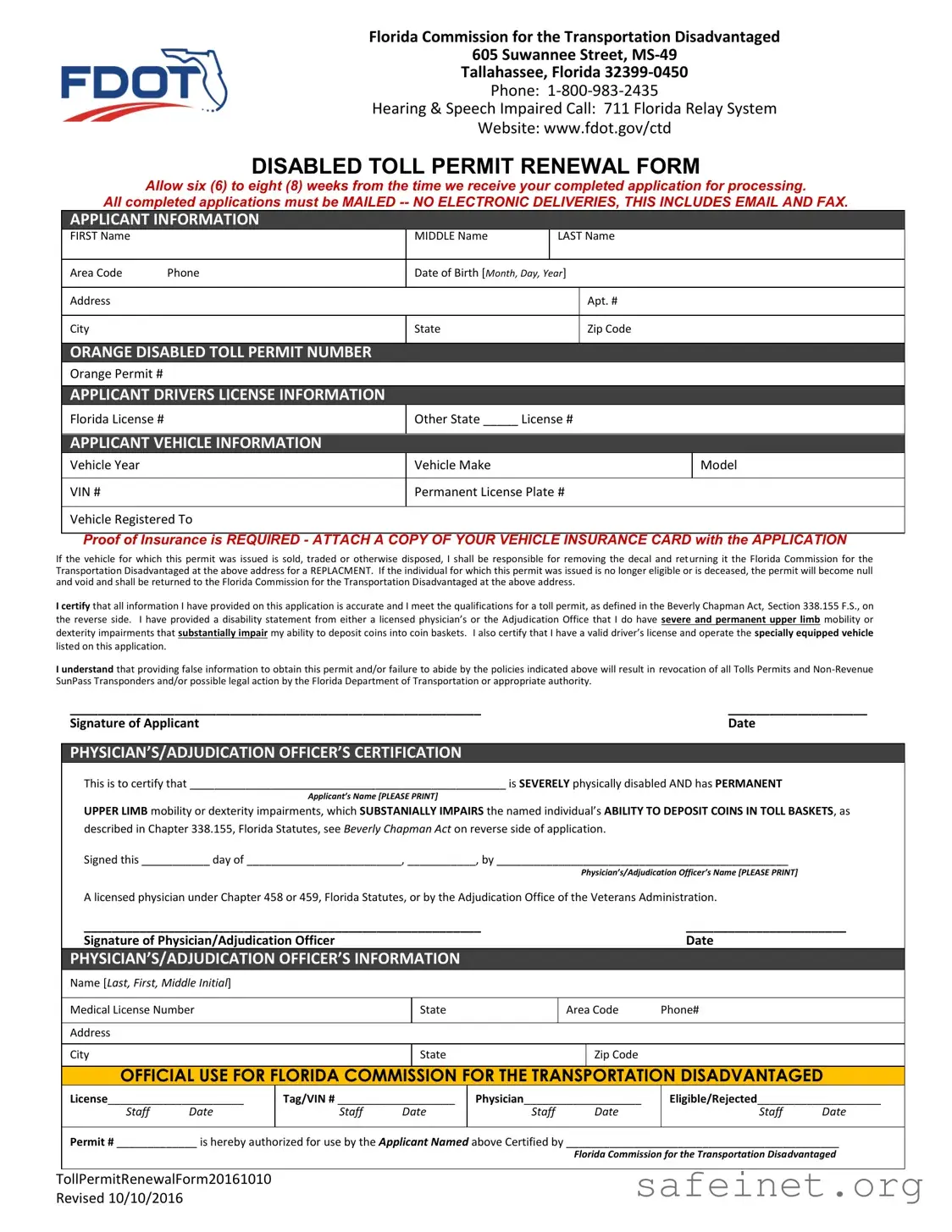
Florida Commission for the Transportation Disadvantaged
605 Suwannee Street, MS-49
Tallahassee, Florida 32399-0450
Phone: 1-800-983-2435
Hearing & Speech Impaired Call: 711 Florida Relay System
Website: www.fdot.gov/ctd
TollPermitRenewalForm20161010
Revised 10/10/2016
DISABLED TOLL PERMIT RENEWAL FORM
Allow six (6) to eight (8) weeks from the time we receive your completed application for processing.
All completed applications must be MAILED -- NO ELECTRONIC DELIVERIES, THIS INCLUDES EMAIL AND FAX.
APPLICANT INFORMATION
FIRST Name
MIDDLE Name
LAST Name
Area Code Phone
Date of Birth [Month, Day, Year]
Apt. #
City
State
Zip Code
ORANGE DISABLED TOLL PERMIT NUMBER
Orange Permit #
APPLICANT DRIVERS LICENSE INFORMATION
Florida License #
Other State _____ License #
APPLICANT VEHICLE INFORMATION
Vehicle Year
Vehicle Make
Model
VIN #
Permanent License Plate #
Vehicle Registered To
Proof of Insurance is REQUIRED - ATTACH A COPY OF YOUR VEHICLE INSURANCE CARD with the APPLICATION
If the vehicle for which this permit was issued is sold, traded or otherwise disposed, I shall be responsible for removing the decal and returning it the Florida Commission for the
Transportation Disadvantaged at the above address for a REPLACMENT. If the individual for which this permit was issued is no longer eligible or is deceased, the permit will become null
and void and shall be returned to the Florida Commission for the Transportation Disadvantaged at the above address.
I certify that all information I have provided on this application is accurate and I meet the qualifications for a toll permit, as defined in the Beverly Chapman Act, Section 338.155 F.S., on
the reverse side. I have provided a disaility stateet fro either a liesed physiia’s or the Adjudication Office that I do have severe and permanent upper limb mobility or
dexterity impairments that substantially impair my ability to deposit coins into coin baskets. I also ertify that I have a valid driver’s liese ad operate the specially equipped vehicle
listed on this application.
I understand that providing false information to obtain this permit and/or failure to abide by the policies indicated above will result in revocation of all Tolls Permits and Non-Revenue
SunPass Transponders and/or possible legal action by the Florida Department of Transportation or appropriate authority.
___________________________________________________________ ____________________
Signature of Applicant Date
PHYSICIAN’S/ADJUDICATION OFFICER’S CERTIFICATION
This is to certify that ___________________________________________________ is SEVERELY physically disabled AND has PERMANENT
Applicat’s Nae [PLEASE PRINT]
UPPER LIMB mobility or dexterity impairments, which SUBSTANIALLY IMPAIRS the aed idividual’s ABILITY TO DEPOSIT COINS IN TOLL BASKETS, as
described in Chapter 338.155, Florida Statutes, see Beverly Chapman Act on reverse side of application.
Signed this ___________ day of _________________________, ___________, by _______________________________________________
Physicia’s/Adjudicatio Officer’s Nae [PLEASE PRINT]
A licensed physician under Chapter 458 or 459, Florida Statutes, or by the Adjudication Office of the Veterans Administration.
_________________________________________________________ _______________________
Signature of Physician/Adjudication Officer Date
PHYSICIAN’S/ADJUDICATION OFFICER’S INFORMATION
Name [Last, First, Middle Initial]
Medical License Number
State
Area Code Phone#
Address
City
State
Zip Code
OFFICIAL USE FOR FLORIDA COMMISSION FOR THE TRANSPORTATION DISADVANTAGED
License______________________
Staff Date
Tag/VIN # ___________________
Staff Date
Physician___________________
Staff Date
Eligible/Rejected____________________
Staff Date
Permit # _____________ is hereby authorized for use by the Applicant Named above Certified by ____________________________________________
Florida Commission for the Transportation Disadvantaged
605 Suwannee Street, MS-49
Tallahassee, Florida 32399-0450
Phone: 1-800-983-2435
Hearing & Speech Impaired Call: 711 Florida Relay System
Website: www.fdot.gov/ctd
TollPermitRenewalForm20161010
Revised 10/10/2016
"Beverly Chapman Act"
(P.L. 88-252)
Section 338.155, F.S.
Payment of toll on toll facilities required; exemptions.
(1) No persons are permitted to use any toll facility without payment of tolls, except employees of the agency
operating the toll project when using the toll facility on official state business, state military personnel while on
official military business, handicapped persons as provided in this section, persons exempt from toll payment by
the authorizing resolution for bonds issued to finance the facility, and persons exempt on a temporary basis
where use of such toll facility is required as a detour route. Any law enforcement officer operating a marked
official vehicle is exempt from toll payment when on official law enforcement business. Any person operating a
fire vehicle when on official business or a rescue vehicle when on official business is exempt from toll payment.
The secretary, or the secretary's designee, may suspend the payment of tolls on a toll facility when necessary to
assist in emergency evacuation. The failure to pay a prescribed toll constitutes a noncriminal traffic infraction,
punishable as a moving violation pursuant to s.
318.18. The department is authorized to adopt rules relating to
guaranteed toll accounts.
(2) Any person driving an automobile or other vehicle belonging to the Department of Military Affairs used for
transporting military personnel, stores, and property, when properly identified, shall, together with any such
conveyance and military personnel and property of the state in his or her charge, be allowed to pass free through
all tollgates and over all toll bridges and ferries in this state.
(3) Any handicapped person who has a valid driver's license, who operates a vehicle specially equipped for use
by the handicapped, and who is certified by a physician licensed under chapter 458 or chapter 459 or by
comparable licensing in another state or by the Adjudication Office of the United States Department of
Veterans Affairs or its predecessor as being severely physically disabled and having permanent upper limb
mobility or dexterity impairments which substantially impair the person's ability to deposit coins in toll baskets,
shall be allowed to pass free through all tollgates and over all toll bridges and ferries in this state. A person who
meets the requirements of this subsection shall, upon application, be issued a vehicle window sticker by the
Department of Transportation.
(4) A copy of this section shall be posted at each toll bridge and on each ferry.
(5) The Department of Transportation shall provide envelopes for voluntary payments of tolls by those persons
exempted from the payment of tolls pursuant to this section. The department shall accept any voluntary
payments made by exempt persons.
(6) Personal identifying information provided to, acquired by, or in the possession of the Department of
Transportation, a county, or an expressway authority for the purpose of using a credit card, charge card, or check
for the prepayment of electronic toll facilities charges to the department, a county, or an expressway authority is
exempt from s.
119.07(1) and s. 24(a), Art. I of the State Constitution.

Document Specifications

Fact Name Details
Governing Law The Disabled Toll Permit is governed by the Beverly Chapman Act, specifically Section 338.155 of the Florida Statutes.
Application Processing Time Applicants should allow six to eight weeks for their completed applications to be processed.
Submission Method All applications must be mailed. Electronic submissions, including email and fax, are not accepted.
Eligibility Criteria Applicants must provide proof of severe and permanent upper limb mobility or dexterity impairments certified by a licensed physician or the Adjudication Office.
Required Documentation A copy of the vehicle insurance card must be attached to the application to demonstrate proof of insurance.
Permit Revocation Providing false information or failing to comply with the policies can lead to the revocation of the toll permit and potential legal action.

Steps to Filling Out Disabled Toll Permit

After completing the Disabled Toll Permit form, you will need to mail it to the Florida Commission for the Transportation Disadvantaged. Ensure that all required information is filled out accurately and that you include a copy of your vehicle insurance card. Processing can take between six to eight weeks, so it's advisable to submit your application well in advance of any planned travel.

  1. Begin by entering your Applicant Information in the designated fields. This includes your first name, middle name, last name, area code phone number, date of birth, and address (including apartment number, city, state, and zip code).
  2. If you have an existing Orange Disabled Toll Permit Number, include that in the specified section.
  3. Provide your Driver’s License Information. Fill in your Florida driver's license number and, if applicable, the license number from another state.
  4. Next, fill out the Vehicle Information section. Include the vehicle year, make, model, VIN number, and permanent license plate number. Also, indicate who the vehicle is registered to.
  5. Attach a copy of your Proof of Insurance by including your vehicle insurance card with the application.
  6. Read the certification statement carefully. You must sign and date the form, confirming that the information provided is accurate and that you meet the qualifications for the toll permit.
  7. In the Physician’s/Adjudication Officer’s Certification section, have your physician or adjudication officer complete the necessary details, including their signature and date.
  8. Lastly, fill out the Physician’s/Adjudication Officer’s Information section, providing their name, medical license number, state, area code phone number, and address.

More About Disabled Toll Permit

What is the Disabled Toll Permit?

The Disabled Toll Permit allows individuals with severe physical disabilities, specifically those with permanent upper limb mobility or dexterity impairments, to pass through toll facilities in Florida without paying tolls. This permit is issued to eligible applicants who meet specific criteria outlined in the Beverly Chapman Act.

How do I apply for the Disabled Toll Permit?

To apply for the Disabled Toll Permit, you must complete the application form. This form requires personal information, proof of disability from a licensed physician or the Adjudication Office, and details about your vehicle. Once completed, mail the application to the Florida Commission for the Transportation Disadvantaged at the address provided on the form. Electronic submissions, including email and fax, are not accepted.

What information do I need to provide on the application?

The application requires your full name, contact information, date of birth, vehicle details, and proof of insurance. Additionally, you must provide a certification from a physician or adjudication officer confirming your disability. Ensure all information is accurate to avoid delays in processing.

How long does it take to process my application?

Once the Florida Commission for the Transportation Disadvantaged receives your completed application, allow six to eight weeks for processing. This timeframe is important to ensure that all applications are reviewed thoroughly.

What should I do if my vehicle is sold or no longer eligible?

If the vehicle associated with your Disabled Toll Permit is sold, traded, or otherwise disposed of, you must remove the decal and return it to the Florida Commission for the Transportation Disadvantaged. If the individual for whom the permit was issued is no longer eligible or has passed away, the permit must also be returned.

Is proof of insurance required for the application?

Yes, you must attach a copy of your vehicle insurance card to the application. This proof of insurance is a necessary component of the application process and ensures that your vehicle is covered while using the permit.

Can I renew my Disabled Toll Permit?

Yes, you can renew your Disabled Toll Permit. The renewal process generally follows the same steps as the initial application. Make sure to submit your renewal application well before the permit's expiration date to avoid any lapses in your toll exemption.

What happens if I provide false information on my application?

Providing false information on your application can lead to the revocation of your Disabled Toll Permit and any associated non-revenue SunPass transponders. Additionally, it may result in legal action by the Florida Department of Transportation or other appropriate authorities.

Who can certify my disability for the application?

Your disability must be certified by a licensed physician or an adjudication officer from the Veterans Administration. The certification must confirm that you have severe physical disabilities affecting your ability to deposit coins in toll baskets, as outlined in the Beverly Chapman Act.

Common mistakes

  1. Failing to provide all required personal information, such as first name, last name, and date of birth.

  2. Not including a valid proof of insurance with the application, which is mandatory.

  3. Using electronic delivery methods like email or fax instead of mailing the completed application.

  4. Neglecting to sign the application, which is essential for processing.

  5. Providing inaccurate information regarding the applicant's disability or vehicle details.

  6. Forgetting to attach the physician’s or adjudication officer’s certification confirming the disability.

  7. Not including the correct vehicle information, such as the VIN or license plate number.

  8. Failing to check that the application is complete before submission, which can delay processing.

  9. Overlooking the renewal timeline, which requires six to eight weeks for processing.

  10. Not returning the decal if the vehicle is sold or if the individual is no longer eligible.

Documents used along the form

The Disabled Toll Permit form is essential for individuals with severe physical disabilities who require special accommodations while using toll facilities. Along with this form, several other documents may be necessary to ensure proper processing and compliance with regulations. Below is a list of related forms and documents that are often used in conjunction with the Disabled Toll Permit form.

  • Proof of Disability Certification: This document verifies that the applicant has a severe and permanent disability, typically signed by a licensed physician or an adjudication officer. It is crucial for establishing eligibility for the disabled toll permit.
  • Vehicle Registration Document: This document provides proof of ownership for the vehicle for which the disabled toll permit is being requested. It includes details such as the vehicle's make, model, and VIN.
  • Driver’s License Copy: A copy of the applicant's valid driver’s license is required to confirm their identity and driving eligibility. This helps ensure that the permit is issued to a qualified individual.
  • Insurance Card: A copy of the vehicle insurance card must be attached to the application. This demonstrates that the vehicle is properly insured, which is a requirement for receiving the disabled toll permit.
  • Application for Replacement Permit: If the original permit is lost or damaged, this form is used to request a replacement. It ensures that the applicant can continue to access toll facilities without interruption.
  • Renewal Application Form: This form is necessary for individuals who need to renew their disabled toll permit. It typically requires updated information and documentation to confirm continued eligibility.

These documents work together to facilitate the application process for the Disabled Toll Permit. Ensuring that all necessary paperwork is completed and submitted can help avoid delays and ensure compliance with state regulations.

Similar forms

The Disabled Parking Permit application shares similarities with the Disabled Veterans License Plate application. Both documents require proof of disability, typically certified by a physician or appropriate authority. The process involves submitting personal information, including contact details and vehicle information. Both permits aim to provide benefits to individuals with disabilities, allowing them to access designated parking or toll exemptions, thereby promoting mobility and accessibility.

The Temporary Disability Parking Permit application also parallels the Disabled Toll Permit form. Applicants must provide personal details and medical certification regarding their disability. While the Disabled Toll Permit focuses on toll exemptions, the Temporary Disability Parking Permit allows individuals to park in spaces designated for those with disabilities. Both forms emphasize the need for accurate information and compliance with state regulations.

The Medicare application form is another document that shares a similar structure. It requires detailed personal information, including proof of eligibility based on specific health conditions. Both forms necessitate documentation from healthcare providers to validate the applicant’s status. The goal is to ensure that individuals receive the benefits they are entitled to, whether it be toll exemptions or healthcare coverage.

The Social Security Disability Insurance (SSDI) application also resembles the Disabled Toll Permit form. Both documents require applicants to submit personal information and medical evidence of their disability. The SSDI application focuses on providing financial assistance, while the Disabled Toll Permit aims at facilitating mobility. Each form serves a specific purpose in supporting individuals with disabilities.

The Food Assistance Program application shares similarities with the Disabled Toll Permit form as well. Both require personal information, proof of eligibility, and documentation from medical professionals. While the Food Assistance Program focuses on providing nutritional support, the Disabled Toll Permit addresses transportation needs. Each application aims to assist individuals facing challenges due to their disabilities.

The Medicaid application form is comparable to the Disabled Toll Permit form in its requirement for personal and medical information. Both forms serve to verify eligibility for specific benefits. Medicaid provides healthcare coverage for low-income individuals, while the Disabled Toll Permit offers toll exemptions. Both processes are designed to ensure that applicants receive the necessary assistance based on their circumstances.

Finally, the Supplemental Security Income (SSI) application shares structural similarities with the Disabled Toll Permit form. Both require detailed personal and financial information, along with medical documentation to establish eligibility. SSI provides financial support to individuals with disabilities, while the Disabled Toll Permit addresses transportation access. Each form aims to alleviate some of the burdens faced by individuals with disabilities, facilitating a better quality of life.

Dos and Don'ts

When filling out the Disabled Toll Permit form, it is important to follow specific guidelines to ensure your application is processed efficiently. Below are four key actions to take and avoid:

  • Do provide accurate and complete information in all sections of the application.
  • Do include a copy of your vehicle insurance card with the application.
  • Do mail the completed application to the specified address; electronic submissions are not accepted.
  • Do ensure that the physician's or adjudication officer's certification is properly filled out and signed.
  • Don't leave any fields blank; incomplete applications may delay processing.
  • Don't submit the application via email or fax, as these methods are not permitted.
  • Don't forget to sign and date the application before mailing it.
  • Don't provide false information, as this can lead to revocation of the permit.

Misconceptions

Misconceptions about the Disabled Toll Permit form can lead to confusion and delays in obtaining the necessary permits. Here are five common misunderstandings:

  • Electronic submissions are allowed. Many people believe they can submit the application via email or fax. However, all completed applications must be mailed. This means you need to send your application through the postal service.
  • Proof of insurance is optional. Some individuals think they can skip the proof of insurance requirement. In reality, you must attach a copy of your vehicle insurance card with your application. Without this, your application may be rejected.
  • The permit can be transferred to another person. There is a misconception that if the permit holder no longer needs the permit, they can simply give it to someone else. This is not true. If the individual is no longer eligible or is deceased, the permit must be returned to the Florida Commission for the Transportation Disadvantaged.
  • Renewal is a quick process. Many applicants expect their renewal to be processed immediately. In fact, it can take six to eight weeks from the time the completed application is received for processing. Planning ahead is crucial to avoid any disruptions.
  • Only a physician can certify the application. Some people assume that only a licensed physician can provide the necessary certification. While a physician is one option, the Adjudication Office of the Veterans Administration can also certify that an individual meets the criteria for the permit.

Key takeaways

Applying for a Disabled Toll Permit can provide significant benefits for eligible individuals. Here are some key takeaways to keep in mind when filling out and using the Disabled Toll Permit form:

  • Mail Your Application: All completed applications must be mailed. Electronic submissions, including email and fax, are not accepted.
  • Processing Time: Expect a processing time of six to eight weeks from the date your application is received.
  • Accurate Information: Ensure that all information provided on the application is accurate. This includes personal details and vehicle information.
  • Proof of Disability: A certification from a licensed physician or the Adjudication Office is required to confirm severe physical disabilities affecting mobility or dexterity.
  • Insurance Requirements: Attach a copy of your vehicle insurance card with the application. Proof of insurance is mandatory.
  • Decal Responsibility: If the vehicle associated with the permit is sold or disposed of, the decal must be removed and returned to the Florida Commission for the Transportation Disadvantaged.
  • Permit Validity: The permit becomes null and void if the individual is no longer eligible or is deceased. In such cases, the permit should also be returned.
  • Signature Needed: The application must be signed by the applicant, certifying that all information is correct and that they meet the qualifications for a toll permit.
  • Legal Consequences: Providing false information may lead to the revocation of toll permits and potential legal action by the Florida Department of Transportation.

By following these guidelines, applicants can navigate the process more smoothly and enjoy the benefits that come with the Disabled Toll Permit.