Homepage > Blank Dhs 38 Template
Article Structure

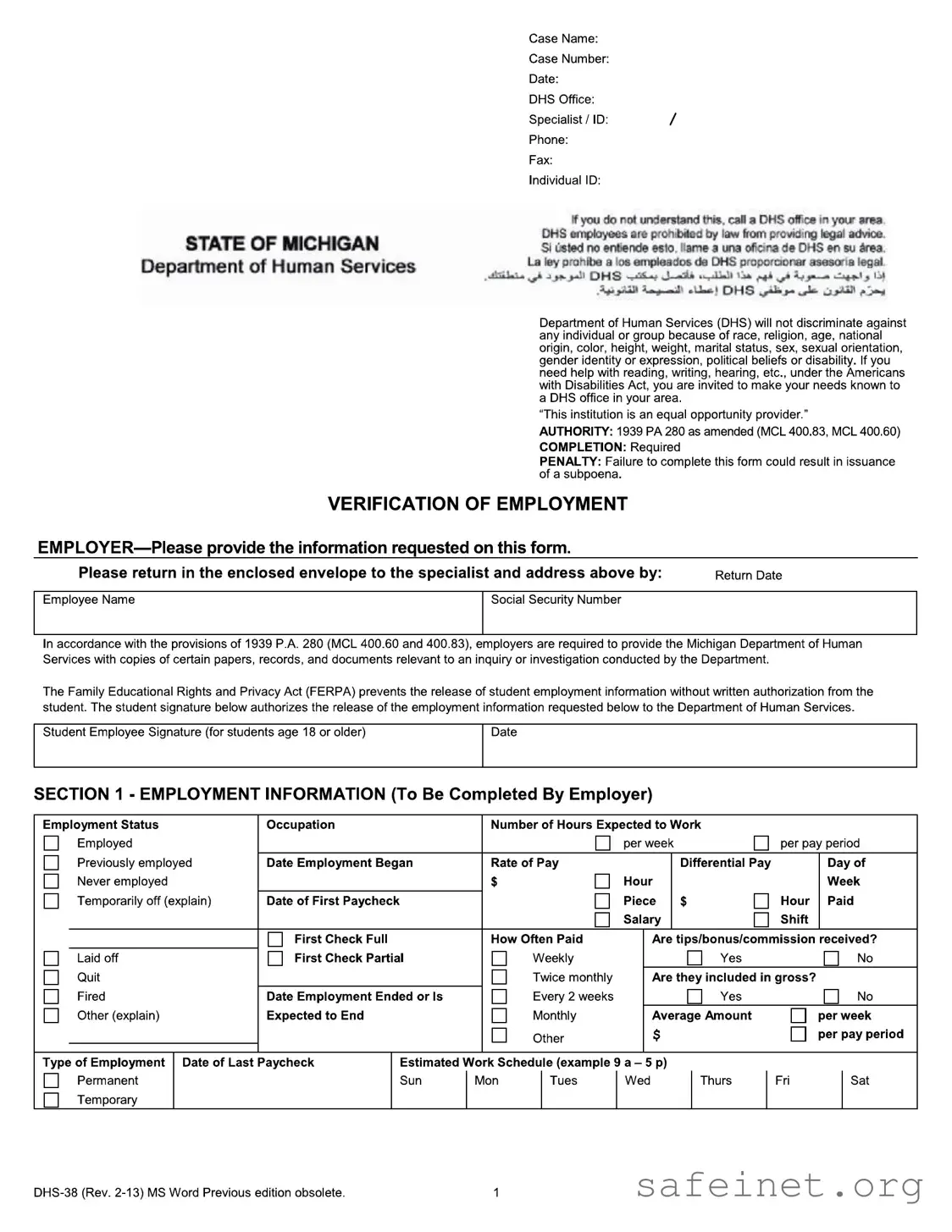
The DHS 38 form is an essential document used by the Michigan Department of Human Services to gather crucial information regarding an individual's employment status, insurance, and income. Designed to streamline the verification process, this form requires employers to provide detailed insights into their employees' work situations, including job titles, pay rates, and hours worked. It also addresses important aspects such as health insurance coverage and retirement plans. The form emphasizes the importance of accuracy, as failure to complete it can lead to legal repercussions. Moreover, it safeguards the rights of individuals by adhering to non-discrimination policies and ensuring compliance with the Americans with Disabilities Act. This form not only serves as a tool for the DHS but also protects the integrity of the information provided, facilitating a smoother interaction between employees, employers, and the Department of Human Services.

Form Sample

Document Specifications

Fact Name Description
Governing Law The DHS-38 form is governed by the Michigan Public Act 280 of 1939, specifically MCL 400.60 and MCL 400.83.
Purpose This form is used to verify employment and gather necessary information for inquiries conducted by the Michigan Department of Human Services.
Completion Requirement Completion of the DHS-38 form is mandatory. Failure to complete it may result in the issuance of a subpoena.
Non-Discrimination Clause The Department of Human Services ensures that no individual is discriminated against based on race, religion, gender identity, or other protected characteristics.

Steps to Filling Out Dhs 38

After gathering all necessary information, you can begin filling out the DHS 38 form. This form is essential for providing verification of employment, which is required by the Michigan Department of Human Services. Make sure to complete it accurately and submit it by the specified return date to avoid any penalties.

  1. Start by entering the Case Name and Case Number at the top of the form.
  2. Fill in the Date, DHS Office, and Specialist/ID fields.
  3. Provide the Phone and Fax numbers for the specialist.
  4. Enter the Individual ID in the designated space.
  5. In Section 1, indicate the Employment Status by checking the appropriate box.
  6. Complete the Occupation, Date Employment Began, and Date of First Paycheck.
  7. Fill in the Employment End Date if applicable, along with the Number of Hours Expected to Work per week and per pay period.
  8. Specify the Rate of Pay and whether it is Hourly, Piece, or Salary.
  9. Indicate the Shift and Day of Week Paid.
  10. Check how often the employee is paid and whether tips, bonuses, or commissions are received.
  11. In Section 2, answer whether the employer offers a health plan and if the employee is enrolled.
  12. Provide information about any cafeteria-style benefit plans and additional coverage.
  13. In Section 3, list all income received during the specified period, including tips and bonuses.
  14. For Section 4, indicate if any medical or disability benefits were paid and provide details about Workers’ Compensation if applicable.
  15. In Section 5, include any additional comments or information requested by the employer.
  16. Complete Section 6 by entering the Business Name and Business Address.
  17. Print the name of the person completing the form, along with their signature, title, and the date signed.
  18. Finally, provide the Employer Federal ID (FEIN), Business Telephone Number, and Business Fax Number.

More About Dhs 38

What is the purpose of the DHS 38 form?

The DHS 38 form is used by the Michigan Department of Human Services to collect employment and income information from employers. This information is essential for inquiries or investigations conducted by the Department, particularly in relation to assistance programs. The form ensures that the Department can verify employment status, income levels, and any relevant benefits that may affect an individual's eligibility for assistance.

Who is required to complete the DHS 38 form?

Employers are required to complete the DHS 38 form. This includes providing detailed information about an employee's employment status, income, and benefits. The employee's signature is also necessary to authorize the release of their employment information to the Department. Failure to complete the form could result in the issuance of a subpoena.

What information is collected on the DHS 38 form?

The form collects various types of information, including the employee's name, Social Security number, employment status, occupation, pay rate, hours worked, and any health insurance or retirement benefits. Employers must also provide details about any disability or workers' compensation benefits paid to the employee during the specified period. This comprehensive data helps the Department assess the individual's financial situation accurately.

What are the consequences of not completing the DHS 38 form?

Failure to complete the DHS 38 form may lead to legal consequences, including the issuance of a subpoena. Employers who do not provide the requested information may hinder the Department's ability to process assistance claims, potentially impacting the employee's eligibility for benefits. Additionally, making false statements on the form can result in criminal penalties, depending on the amount of assistance involved.

Can an employee refuse to authorize the release of their information?

Employees can refuse to authorize the release of their information; however, this may affect their eligibility for assistance programs. The Family Educational Rights and Privacy Act (FERPA) protects student employment information, requiring written authorization from the student before any information can be disclosed. Therefore, it is important for employees to understand the implications of withholding consent.

How does the DHS ensure confidentiality and non-discrimination?

The Michigan Department of Human Services is committed to maintaining confidentiality and ensuring that no individual is discriminated against based on race, religion, age, national origin, or other protected characteristics. The Department adheres to the Americans with Disabilities Act, inviting individuals to communicate their needs for assistance in reading, writing, or other areas. This commitment to equal opportunity is a fundamental aspect of the Department's operations.

Common mistakes

  1. Incomplete Information: Many individuals fail to provide all required details, such as the case name, case number, or contact information for the DHS specialist. Missing information can delay processing.

  2. Incorrect Employment Status: Some people mistakenly select the wrong employment status. Choosing "never employed" when they are currently employed can lead to confusion and potential issues with their application.

  3. Omitting Income Details: Applicants often forget to include all sources of income, such as bonuses or commissions. This omission can result in an inaccurate assessment of their financial situation.

  4. Neglecting Signature Requirements: Failing to sign the form or having an unauthorized person sign can invalidate the submission. It is crucial that the correct individual completes and signs the document.

  5. Ignoring Submission Deadlines: Some individuals do not pay attention to the return date specified on the form. Submitting the form late can lead to complications or denial of assistance.

Documents used along the form

The DHS 38 form is an important document used by the Michigan Department of Human Services to gather employment and income information. Along with this form, several other documents may be required to support claims or inquiries. Below is a list of related forms and documents commonly used in conjunction with the DHS 38 form.

  • Verification of Employment Form: This document is completed by employers to confirm an employee's job status, pay rate, and work schedule. It serves as a critical piece of evidence for income verification.
  • Income Verification Form: This form collects detailed income information from the employee, including all sources of income and any bonuses or commissions received. It helps establish eligibility for various assistance programs.
  • Health Insurance Information Form: This document outlines the health insurance coverage available to the employee, including details about premiums and dependents. It is essential for determining eligibility for health-related benefits.
  • Retirement Plan Information Form: Employers use this form to disclose any retirement plans the employee participates in, such as 401(k) plans. This information can impact financial assessments for assistance programs.
  • Disability Benefits Form: This form is used to report any disability benefits or workers' compensation received by the employee. It provides insight into the employee's financial situation and potential eligibility for assistance.
  • Student Employment Authorization Form: If the employee is a student, this form authorizes the release of their employment information to the DHS. It ensures compliance with privacy laws while allowing necessary information to be shared.
  • Additional Comments Form: Employers may use this form to provide any extra information or comments regarding the employee's situation. It can be helpful in clarifying any unique circumstances that may affect the case.

Each of these documents plays a vital role in the assessment process conducted by the Department of Human Services. Together, they help ensure that individuals receive the appropriate support based on their specific circumstances.

Similar forms

The DHS 38 form is similar to the W-2 form, which reports an employee's annual wages and the taxes withheld from their paycheck. Both forms are essential for verifying employment and income. The W-2 provides detailed information about earnings, while the DHS 38 focuses on employment verification for assistance programs. Employers fill out both forms, and they serve as official documentation for government agencies. Accuracy is crucial in both cases, as errors can lead to complications in tax filings or assistance eligibility.

Another document similar to the DHS 38 form is the I-9 form, which verifies an employee's identity and eligibility to work in the United States. Like the DHS 38, the I-9 requires employer input and is used to confirm employment status. While the DHS 38 is specific to Michigan's Department of Human Services, the I-9 is a federal requirement. Both documents help ensure compliance with employment laws and regulations, although their purposes differ slightly.

The 1099 form is also comparable to the DHS 38. This form is used to report income received by independent contractors and freelancers. Similar to the DHS 38, the 1099 requires accurate reporting of income, but it is specifically for non-employees. Both documents are important for financial and tax reporting, and they help verify income sources for various purposes, including government assistance programs.

The Employment Verification Letter is another document that shares similarities with the DHS 38 form. This letter is typically provided by an employer to confirm an employee's job status, salary, and duration of employment. While the DHS 38 is a standardized form, the Employment Verification Letter can vary in format and content. Both documents aim to provide proof of employment, which is often necessary for loans, housing applications, and assistance programs.

The Pay Stub is also akin to the DHS 38 form. A pay stub provides a detailed breakdown of an employee's earnings and deductions for a specific pay period. While the DHS 38 focuses on employment verification for assistance, pay stubs serve as proof of income. Both documents are crucial in assessing an individual's financial situation, especially when applying for government aid or loans.

The Social Security Administration (SSA) Benefit Verification Letter is similar to the DHS 38 in that it verifies an individual's income from Social Security benefits. This letter details the amount of benefits received and can be used to demonstrate income eligibility for various programs. Both documents are official and serve as proof of income, but they cater to different sources of financial support.

The Child Support Payment History is another document that parallels the DHS 38. This record outlines the payments made or received for child support. Like the DHS 38, it provides a clear picture of an individual's financial obligations and income. Both documents are often used in legal and financial contexts to assess eligibility for assistance programs.

The Unemployment Insurance Claim Form is similar to the DHS 38 in that it verifies an individual's employment status and income. This form is used to apply for unemployment benefits and requires information about previous employment. Both documents aim to provide proof of income and employment history, which is essential for determining eligibility for various assistance programs.

Lastly, the FAFSA (Free Application for Federal Student Aid) shares similarities with the DHS 38 form. The FAFSA collects financial information to determine eligibility for federal student aid. Both forms require accurate reporting of income and employment status, although the FAFSA is focused on educational funding. They both play a critical role in assessing financial need and eligibility for assistance programs.

Dos and Don'ts

When filling out the DHS-38 form, it's important to ensure accuracy and completeness. Here’s a list of things to do and avoid to make the process smoother:

  • Do: Read the instructions carefully before starting.
  • Do: Double-check all information for accuracy.
  • Do: Provide all required signatures to avoid delays.
  • Do: Use clear and legible handwriting if filling out by hand.
  • Do: Submit the form by the specified return date.
  • Do: Keep a copy of the completed form for your records.
  • Don’t: Leave any sections blank unless instructed.
  • Don’t: Provide false information; it can lead to legal consequences.
  • Don’t: Forget to include any additional documentation requested.
  • Don’t: Rush through the form; take your time to ensure accuracy.
  • Don’t: Ignore the privacy and confidentiality notices included in the form.
  • Don’t: Hesitate to ask for help if you have questions about the form.

Misconceptions

Understanding the DHS 38 form is crucial for individuals interacting with the Michigan Department of Human Services. However, several misconceptions often arise. Here are nine common misunderstandings:

  • The DHS 38 form is optional. Many believe that completing this form is not mandatory. In reality, failure to complete it could lead to serious consequences, including a subpoena.
  • Only employers need to fill out the form. While the employer plays a significant role, the employee's information and signature are also essential, particularly for students over 18.
  • The form is only for employed individuals. Some think it only applies to those currently employed. However, it also includes sections for those previously employed or temporarily off work.
  • Health insurance information is not required. This is a misconception. Employers must provide details about health plans, even if the employee is not enrolled.
  • The DHS 38 form does not require signatures. In fact, a signature is necessary from the person completing the form, ensuring accountability and accuracy.
  • Submitting the form late has no consequences. Delays in submission can result in penalties or complications in processing benefits, making timely submission critical.
  • All information on the form is confidential. While personal information is protected, certain details may be shared as required by law for investigations.
  • Only one copy of the form is needed. It is advisable to keep a copy for personal records. This ensures that you have access to the information provided.
  • Assistance is not available for completing the form. On the contrary, individuals can seek help from DHS offices if they have questions or need assistance in filling it out.

Addressing these misconceptions is essential for ensuring a smooth process when dealing with the DHS 38 form. Be proactive in seeking clarification and understanding the requirements involved.

Key takeaways

When filling out and using the DHS-38 form, keep the following key takeaways in mind:

  • Completion is Required: Filling out the DHS-38 form is mandatory. Failure to complete it may lead to legal consequences, such as a subpoena.
  • Provide Accurate Information: Ensure that all employment, insurance, and income details are accurately reported. Inaccuracies can delay processing or result in penalties.
  • Employer's Role: Employers must complete specific sections of the form, including employment status and income information. Their cooperation is crucial for a smooth process.
  • Privacy Matters: The Family Educational Rights and Privacy Act (FERPA) protects student employment information. A student’s signature is necessary for the release of this information.
  • Disability Accommodations: If assistance is needed due to a disability, individuals are encouraged to communicate their needs to their local DHS office.
  • Equal Opportunity Provider: The DHS emphasizes that it does not discriminate based on various factors, including race, gender, or disability, ensuring fair treatment for all applicants.

By keeping these points in mind, you can navigate the DHS-38 form more effectively and ensure compliance with all requirements.