Homepage > Blank Department Of Corrections Visitation Florida Template
Article Structure

The Florida Department of Corrections Visitation form is a crucial document for individuals seeking to visit inmates within the state's correctional facilities. This two-part application process begins with a request for visiting privileges, where the inmate must formally request that the visitor be approved. It is essential for visitors to provide comprehensive and accurate information, as any omissions or inaccuracies can lead to denial of the application. The form requires personal details such as the visitor's full legal name, relationship to the inmate, and identifying information like age and address. Additionally, it inquires about the visitor's criminal history, employment status, and any prior visitation privileges. Notably, individuals aged 12 and older must complete the form, and a signature is mandatory for processing. Visitors must refrain from visiting until they receive approval from the inmate, underscoring the importance of following the guidelines outlined in the form. Understanding the requirements and adhering to the rules can facilitate a smoother visitation experience.
Form Sample

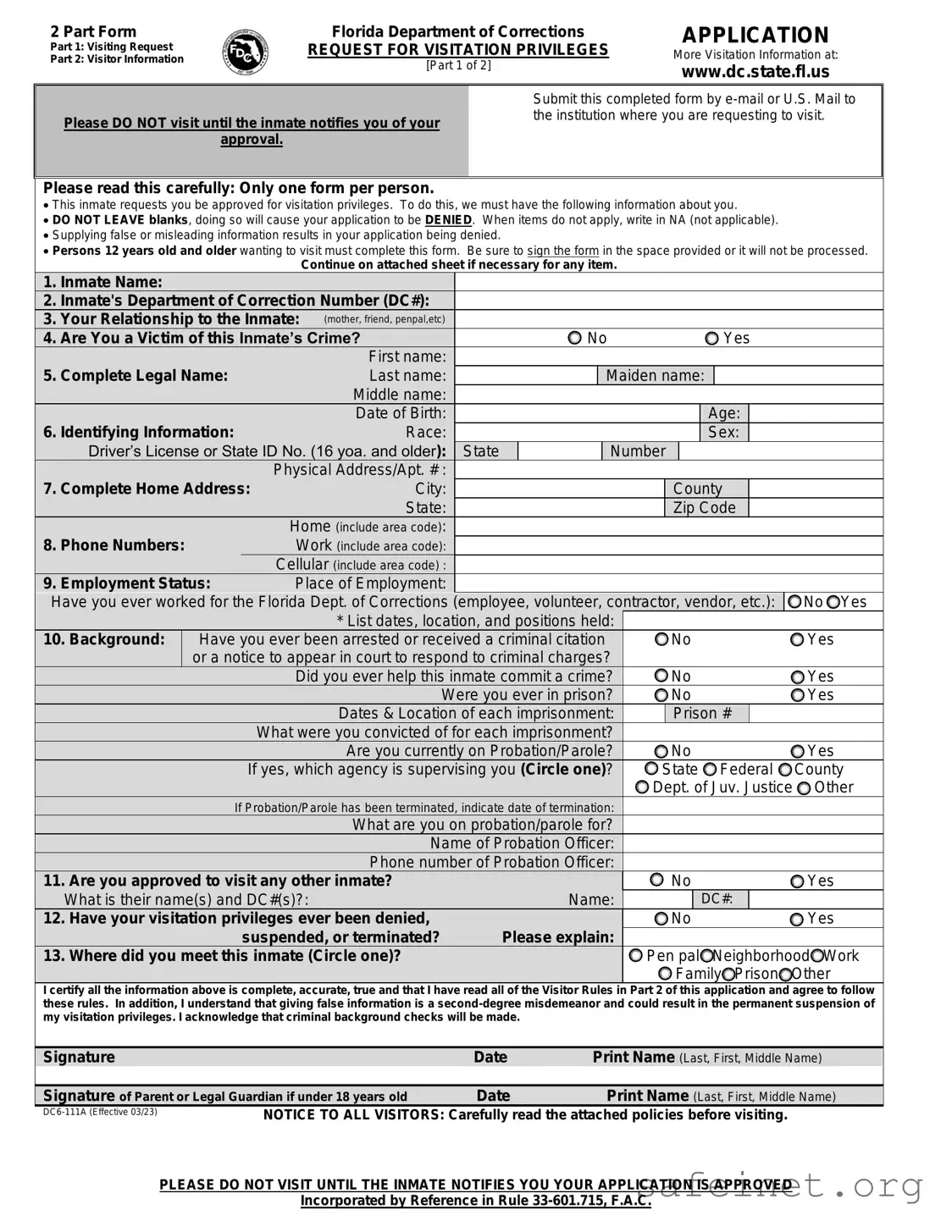
2 Part Form
Part 1: Visiting Request
Part 2: Visitor Information
Florida Department of Corrections
REQUEST FOR VISITATION PRIVILEGES
[Part 1 of 2]
APPLICATION
More Visitation Information at:
www.dc.state.fl.us
PLEASE DO NOT VISIT UNTIL THE INMATE NOTIFIES YOU YOUR APPLICATION IS APPROVED
Incorporated by Reference in Rule 33-601.715, F.A.C.
Please DO NOT visit until the inmate notifies you of your
approval.
Submit this completed form by e-mail or U.S. Mail to
the institution where you are requesting to visit.
Please read this carefully: Only one form per person.
This inmate requests you be approved for visitation privileges. To do this, we must have the following information about you.
DO NOT LEAVE blanks, doing so will cause your application to be DENIED. When items do not apply, write in NA (not applicable).
Supplying false or misleading information results in your application being denied.
Persons 12 years old and older wanting to visit must complete this form. Be sure to sign the form in the space provided or it will not be processed.
Continue on attached sheet if necessary for any item.
1. Inmate Name:
2. Inmate's Department of Correction Number (DC#):
3. Your Relationship to the Inmate:
4. Are You a Victim of this Inmate’s Crime?
No Yes
First name:
5. Complete Legal Name:
Last name:
Maiden name:
Middle name:
Date of Birth:
Age:
6. Identifying Information:
Race:
Sex:
Driver’s License or State ID No. (16 yoa. and older):
State
Number
Physical Address/Apt. # :
7. Complete Home Address:
City:
County
State:
Zip Code
8. Phone Numbers:
Home (include area code):
Work (include area code):
Cellular (include area code) :
9. Employment Status:
Place of Employment:
Have you ever worked for the Florida Dept. of Corrections (employee, volunteer, contractor, vendor, etc.):
No Yes
* List dates, location, and positions held:
10. Background:
Have you ever been arrested or received a criminal citation
or a notice to appear in court to respond to criminal charges?
No Yes
Did you ever help this inmate commit a crime?
No Yes
Were you ever in prison?
No Yes
Dates & Location of each imprisonment:
Prison #
What were you convicted of for each imprisonment?
Are you currently on Probation/Parole?
No Yes
If yes, which agency is supervising you (Circle one)?
State Federal County
Dept. of Juv. Justice Other
If Probation/Parole has been terminated, indicate date of termination:
What are you on probation/parole for?
Name of Probation Officer:
Phone number of Probation Officer:
11. Are you approved to visit any other inmate?
No Yes
What is their name(s) and DC#(s)?:
Name:
DC#:
12. Have your visitation privileges ever been denied,
No Yes
suspended, or terminated? Please explain:
13. Where did you meet this inmate (Circle one)?
Pen pal Neighborhood Work
Family Prison Other
I certify all the information above is complete, accurate, true and that I have read all of the Visitor Rules in Part 2 of this application and agree to follow
these rules. In addition, I understand that giving false information is a second-degree misdemeanor and could result in the permanent suspension of
my visitation privileges. I acknowledge that criminal background checks will be made.
Signature
Date
Print Name (Last, First, Middle Name)
Signature of Parent or Legal Guardian if under 18 years old
Date
Print Name (Last, First, Middle Name)
DC6-111A (Effective 03/23)
NOTICE TO ALL VISITORS: Carefully read the attached policies before visiting.
Formulario en 2 Partes
Parte 1: Petición para Visitas
Parte 2: Información para el Visitante
Departamento de Correction de La Florida
PETICIÓN DE PRIVILEGIOS PARA VISITAS
[Parte 1 de 2]
ENGLISH VERSION IS ON THE REVERSE.
APLICACIÓN
Para Más información Sobre Visitas:
www.dc.state.fl.us
POR FAVOR, NO VENGA A VISITAR HASTA QUE EL PRESO LE NOTIFIQUE A USTED QUE SU APLICACIÓN HA SIDO APROBADA
Incorporated by Reference in Rule 33-601.715, F.A.C.
Por favor, no venga a visitar hasta que usted sea
notificado por el preso que usted ha sido
aprobado.
Despues de llenar este formulario, devuelvalo a:
Por favor, lea esto cuidadosamente: Solo un formulario por persona.
El preso arriba nombrado, ha pedido que usted sea aprobado para visitarlo. Para hacer esto, debemos tener la siguiente información acerca de usted.
No deje ningún espacio en blanco; si lo hace, su aplicación será DENEGADA. Escriba NA (no aplicable) cuando algo no aplica a usted.
Dar información falsa ó engañosa, resultará en que su aplicación sea denegada.
Personas mayores de 12 años de edad, que deseen visitar, deberán llenar esta planilla en su totalidad. Asegúrese de firmar la planilla en el espacio
indicado porque la planilla no será procesada si no está firmada.
Continúe en una hoja adjunta si es necesario.
1. Nombre del Preso:
2. DC #:
3. ¿ Cuál Es su Relación con el Preso: (madre, padre, amigo, etc.)
4. ¿ Há sido usted víctima de este preso?
No
Apellido:
5. Nombre Legal Completo:
Primer nombre:
Apellido de soltera:
Segundo nombre:
Fecha de nacimiento:
Edad:
6. Información de Identidad:
Raza:
Sexo:
Licencia de Conducir: (16 años de edad o mayor)
Estado:
Número:
Dirección física/Apartamento #:
7. Dirección Completa:
Ciudad:
Condado:
Estado:
Código postal:
8. Números de Teléfonos:
Casa (incluya el área):
Trabajo (incluya el área):
Celular (incluva el área):
9. Empleo:
Lugar de empleo:
¿Ha sido usted empleado por el Departamento de Correcciones de La Florida?:
No Aplicación Pendiente
¿Ha Como voluntario, ó interno, ó empleado bajo contracto ó vendedor de FDC?:
No Encierre en un círculo cual
Anote fechas, lugar, y nombre de la position:
10. Antecedentes:
¿Alguna vez ha sido arrestado, o ha recibido una
citación criminal, o una notificación para presentarse en
la corte para responder a cargos criminales?
No Si
¿Por qué razón está usted on probación/libertad Conditional?
No
¿Há ayudado alguna vez a este preso a cometer un crimen?
No
¿ Há estado usted alguna vez en prisión?
No
Fechas y lugaresde cada vez que ha sido puesto en prisión:
¿De que fué usted condenado cada vez que estuvo en prisión?
¿Está usted actualmente bajo probación/o supervición bajo palabra?
Si es Sí, ¿cúal agencia lo está supervisando?
Estado Federal Condado Dept. de Justicia Juvenil otro
Si su Probación/Libertad Condicional ha sido terminada indique la
fecha de terminación:
(Encierre en un círculo cada uno que sea necesario, y liste la información sobre supervisión)
Nombre de su oficial de probación:
Número de teléfono de su oficial de probación:
11. ¿Está Ud. Aprobado para visitar algún otro preso?
No
¿Cuáles son sus nombre(s) y sus números de preso?:
Nombre:
DC#:
12. ¿Hán sido sus privilegios de visitas alguna vez negados, revocados ó suspendidos?:
No
Explique por favor:
13. ¿Dé donde usted conoce a este preso (Encierre en un
círculo)?
Por correo Vecindario Prisión trabajo Familia Otra razón
Yo certifico que toda la anterior información es verdadera, exacta, completa y que yo he leído todas las Reglas del Visitante localizada en la
Parte 2 de este formulario y que estoy de acuerdo con obedecer estas reglas. Además, yo entiendo que el dar información falsa es un delito
menor de segundo grado y podria dar lugar a la suspensión permanente de mis privilegios de visitante. Yo reconozco que se me hará
verificaciones de antecedentes penales.
Firma
Fecha
Nombre en letra de Imprenta (Apellido, Primer Nombre, Segundo Nombre)
Firma del padre o del guardian legal si menor de 18
años de edad.
Fecha
Nombre en letra de Imprenta (Apellido, Primer Nombre, Segundo Nombre)
DC6-111A (Effective 03/23
AVISO A TODOS LOS VISITANTES: Lea cuidadosamente la reglas adjuntas antes de visitar.

Document Specifications

Fact Name Details
Form Structure This is a two-part application form for visitation privileges with the Florida Department of Corrections. It consists of a visiting request and visitor information sections.
Eligibility Requirements Individuals aged 12 years and older must complete this form to visit an inmate. Each visitor must submit a separate application.
Consequences of False Information Providing false or misleading information can lead to denial of the application and may result in a second-degree misdemeanor charge.
Submission Instructions After completing the form, it must be mailed to the appropriate address. Visitors should wait for the inmate to confirm approval before visiting.
Governing Law This form is governed by Rule 33-601.715 of the Florida Administrative Code, which outlines the policies regarding inmate visitation.

Steps to Filling Out Department Of Corrections Visitation Florida

Filling out the Florida Department of Corrections Visitation form is a straightforward process. After you complete the form, you will need to mail it to the appropriate address. Remember, you cannot visit the inmate until they notify you that your application has been approved.

  1. Start with the inmate's name in the designated space.
  2. Enter the inmate's Department of Correction Number (DC#).
  3. Describe your relationship to the inmate (e.g., mother, friend, pen pal).
  4. Indicate if you are a victim of the inmate’s crime by selecting "Yes" or "No."
  5. Fill in your complete legal name: first name, last name, maiden name (if applicable), and middle name.
  6. Provide your date of birth and age.
  7. Complete the identifying information section: race, sex, and driver’s license or state ID number (if you are 16 years or older).
  8. List your complete home address, including city, county, state, and zip code.
  9. Include your phone numbers: home and work (with area codes).
  10. State your employment status and place of employment.
  11. Answer whether you have ever worked for the Florida Department of Corrections and provide details if applicable.
  12. Answer questions about your background, including arrests or criminal citations.
  13. Indicate if you have ever been in prison and provide details if so.
  14. State whether you are currently on probation or parole and provide the supervising agency's name.
  15. Specify if you are approved to visit any other inmate and list their names and DC#s.
  16. Answer whether your visitation privileges have ever been denied, suspended, or terminated, and provide an explanation.
  17. Indicate where you met the inmate by circling the appropriate option (e.g., pen pal, neighborhood, etc.).
  18. Sign the form in the designated space and include the date.
  19. If you are under 18, a parent or legal guardian must sign and date the form as well.

More About Department Of Corrections Visitation Florida

What is the purpose of the Department of Corrections Visitation Florida form?

This form is used to request visiting privileges for inmates in Florida's correctional facilities. It collects essential information about the visitor, including their relationship to the inmate and any relevant background details. Once the form is completed, it must be mailed to the appropriate address, and the visitor should not attempt to visit until they receive notification of approval from the inmate.

Who needs to fill out this form?

Anyone aged 12 years or older who wishes to visit an inmate must complete this form. This requirement ensures that the Department of Corrections has accurate information about all potential visitors. If a visitor is under 18, a parent or legal guardian must also sign the form.

What happens if I leave blanks on the form?

Leaving any blanks on the form will result in the application being denied. It is crucial to provide complete and accurate information. If a specific item does not apply to you, write "NA" (not applicable) instead of leaving it blank. This practice helps streamline the processing of your application.

Can I visit an inmate if I have a criminal record?

Having a criminal record does not automatically disqualify you from visiting an inmate. However, you must disclose any arrests or convictions on the form. The Department of Corrections will conduct a background check, and any misleading or false information could lead to denial of your application.

What should I do if my visitation privileges have been denied in the past?

If your visitation privileges have been denied, suspended, or terminated before, you must explain the circumstances on the form. This information is critical for the review process. Be honest about your past to avoid complications with your current application.

How will I know if my application has been approved?

You will receive notification from the inmate once your application has been approved. Do not attempt to visit until you have received this confirmation. This policy helps ensure that the visiting process runs smoothly and that all visitors are authorized to enter the facility.

Common mistakes

  1. Leaving Blanks on the Form: One of the most common mistakes is leaving blank spaces on the application. Every field must be filled out completely. If a particular item does not apply, it is essential to write "NA" instead of leaving it blank. Failure to do so can lead to automatic denial of the application.

  2. Providing Inaccurate Information: Supplying false or misleading information is a serious error. This can result in denial of the application and potential legal consequences. Ensure that all details, including names, dates, and relationships, are accurate and truthful.

  3. Not Signing the Form: A signature is required for the application to be processed. Forgetting to sign the form will lead to delays or denial. Always double-check to confirm that the signature is in the designated space.

  4. Failing to Understand Visitor Rules: It is crucial to read and understand all visitor rules attached to the application. Ignoring these guidelines can result in misunderstandings and complications during the visitation process. Make sure to familiarize yourself with the rules before submitting the application.

Documents used along the form

Visiting an inmate in a Florida correctional facility involves several important forms and documents beyond the Department of Corrections Visitation form. Each of these documents serves a specific purpose in ensuring that the visitation process is conducted smoothly and in compliance with regulations. Below is a list of commonly used forms and documents that individuals may encounter when seeking visitation privileges.

  • Inmate Release Form: This form is required for individuals wishing to visit an inmate who is nearing release. It provides essential information about the inmate's release date and any conditions that may apply to their post-release supervision.
  • Visitor Rules and Regulations: A document outlining the rules that visitors must adhere to while visiting inmates. This includes guidelines on acceptable behavior, dress code, and items that may or may not be brought into the facility.
  • Background Check Authorization: Visitors may be required to sign a consent form allowing the Department of Corrections to conduct a background check. This helps ensure the safety and security of both the inmates and the facility.
  • Minor Visitor Consent Form: If a visitor is under 18, a parent or legal guardian must complete this form. It grants permission for the minor to visit and acknowledges the rules that apply to minor visitors.
  • Visitation Schedule Request: This form allows visitors to request specific dates and times for their visit. It helps the facility manage visitor traffic and ensure that all visits can be accommodated.
  • Emergency Contact Information: Visitors may need to provide emergency contact details in case of an incident during their visit. This ensures that the facility can reach someone if necessary.
  • Inmate's Release Plan: This document outlines the inmate's plans upon release, including housing and employment. It may be relevant for visitors who are family members or close friends involved in the inmate's reintegration.
  • Health Screening Questionnaire: Due to health and safety protocols, visitors may be required to complete a health screening form to assess any potential health risks before entering the facility.
  • Proof of Identification: Visitors must provide valid identification, such as a driver's license or state ID, to verify their identity and relationship to the inmate.
  • Visitation Approval Notification: After processing the visitation request, the Department of Corrections sends a notification to the visitor indicating whether their application has been approved or denied.

Each of these documents plays a crucial role in the visitation process. Understanding their purpose can help visitors navigate the system more effectively, ensuring a smoother experience when visiting an inmate in Florida's correctional facilities.

Similar forms

The Florida Department of Corrections Visitation form is similar to the Visitor Application form used in many correctional facilities across the United States. This form typically requires basic personal information, including the visitor's name, address, and relationship to the inmate. Like the Florida form, it often includes questions about the visitor's criminal history and any previous visitation privileges. The purpose of both forms is to ensure the safety and security of the facility while allowing approved individuals to maintain contact with inmates.

Another document that shares similarities is the Visitor Registration form used by the Federal Bureau of Prisons. This form also collects essential information about the visitor, such as their identity, relationship to the inmate, and any criminal background. Both documents emphasize the importance of providing accurate information and outline the consequences of submitting false details. This helps maintain the integrity of the visitation process and the safety of the institution.

The Inmate Visitation Application form used in state prisons often mirrors the Florida form in structure and purpose. Both forms require visitors to disclose their full legal name, address, and any relevant background information. They also ask about the visitor's relationship to the inmate and any prior visitation history. This ensures that only eligible individuals can visit inmates, thus promoting a secure environment for everyone involved.

Many county jails have their own Visitor Application forms that resemble the Florida Department of Corrections form. These documents typically require similar information, including the visitor's personal details and relationship to the inmate. They often include sections about criminal history and any previous visitation privileges. The goal is the same: to vet visitors and maintain security within the facility.

In addition, the Visitor Approval Request form used by some private prisons shares characteristics with the Florida visitation form. Both documents require visitors to provide identifying information and answer questions regarding their criminal history. They also emphasize the need for accurate information and outline the potential consequences of providing false details. This helps ensure that only approved visitors can maintain contact with inmates.

The Visitor Information form utilized by juvenile detention centers is another document that shares similarities. This form collects personal information about the visitor and their relationship to the juvenile inmate. Like the Florida form, it often includes questions about the visitor's criminal history and previous visitation experiences. The aim is to create a safe environment for both the juveniles and their visitors.

Furthermore, the Visitor Screening form used by some rehabilitation facilities follows a similar format. This form gathers essential information about the visitor, including their identity and relationship to the inmate. It also assesses any criminal background that may affect visitation privileges. Both forms prioritize safety and aim to facilitate positive interactions between inmates and their visitors.

The Visitor Consent form used in some halfway houses also resembles the Florida form. This document requires visitors to provide their personal information and disclose any criminal history. It serves to ensure that the facility maintains a secure environment while allowing residents to receive visits from approved individuals. The focus on accurate information is a common thread between both forms.

Lastly, the Visitor Policy Agreement form used by various correctional institutions has similarities with the Florida visitation form. This agreement outlines the rules and expectations for visitors, requiring them to acknowledge their understanding of these guidelines. Both forms emphasize the importance of providing truthful information and the potential repercussions for non-compliance. This helps to uphold the integrity of the visitation process and the safety of the facility.

Dos and Don'ts

When filling out the Florida Department of Corrections Visitation form, there are several important guidelines to keep in mind. Here’s a helpful list of things you should and shouldn’t do:

  • Do provide accurate information. Ensure that all details you enter are correct and truthful. Any misleading information can lead to denial of your application.
  • Do fill in all required fields. Leaving blanks can cause your application to be denied. If a question does not apply to you, write "NA" for not applicable.
  • Do sign the form. Your application will not be processed without your signature. Make sure to sign in the designated area.
  • Do wait for approval before visiting. Do not attempt to visit until the inmate has notified you that your application has been approved.
  • Do keep a copy of your application. Having a copy can be useful for your records and for any future reference.
  • Don’t provide false information. Misrepresenting facts can result in serious consequences, including permanent loss of visitation privileges.
  • Don’t forget to check your application for errors. Review your form before submitting it to catch any mistakes that could delay processing.
  • Don’t submit multiple forms. Only one application per person is allowed. Submitting more than one can lead to confusion and potential denial.
  • Don’t visit without confirmation. It’s crucial to wait for official notification of your approval before attempting to visit the inmate.
  • Don’t ignore the visitation rules. Familiarize yourself with the visitor rules attached to the application to ensure compliance during visits.

By following these guidelines, you can help ensure a smoother application process and increase your chances of being approved for visitation.

Misconceptions

Many people have misunderstandings about the Florida Department of Corrections Visitation form. Here are some common misconceptions, along with clarifications for each.

  • Only inmates can request visitors. This is not true. The visitor must fill out the form to request visitation privileges on behalf of themselves.
  • Visitors can visit anytime they want. In reality, visitors must wait for the inmate to notify them of approval before visiting.
  • Leaving a blank space on the form is acceptable. This is incorrect. Leaving any blanks will result in the application being denied.
  • Visitors under 12 do not need to fill out the form. Actually, visitors 12 years old and older must complete the form. Children under 12 may have different requirements.
  • Providing false information has no serious consequences. This is a misconception. Supplying false or misleading information can lead to denial of the application and potential legal repercussions.
  • Only certain relationships with the inmate are allowed. This is misleading. The form allows for various relationships, including friends and pen pals.
  • The form can be submitted without a signature. This is false. A signature is necessary for the form to be processed.
  • Visitors do not need to provide identifying information. This is incorrect. Visitors must provide detailed identifying information, including their legal name and address.
  • All visitors will be automatically approved. This is a misconception. Each application is subject to review, and approval is not guaranteed.

Understanding these points can help clarify the process and ensure that visitors are better prepared when submitting their applications.

Key takeaways

Filling out the Department of Corrections Visitation Florida form is a critical step for anyone wishing to visit an inmate. Here are some key takeaways to ensure a smooth application process:

  • One form per visitor: Each person wishing to visit must complete their own application. Do not submit multiple forms for the same individual.
  • Complete all sections: Leaving blanks can lead to denial. If a question does not apply, write "NA" (not applicable).
  • Honesty is essential: Providing false or misleading information will result in your application being denied.
  • Age requirement: Individuals 12 years and older must fill out the form. This includes providing complete legal names and identifying information.
  • Signature required: Ensure you sign the form. Applications without a signature will not be processed.
  • Background information: Be prepared to answer questions about your criminal history, including any arrests or convictions.
  • Notification of approval: Do not visit the inmate until you receive notification of your application approval from them.
  • Visitor rules: Familiarize yourself with all visitor rules attached to the application. Compliance is mandatory.
  • Mailing instructions: After completing the form, mail it to the designated address provided on the form.

By following these guidelines, visitors can navigate the application process more effectively and avoid potential pitfalls.