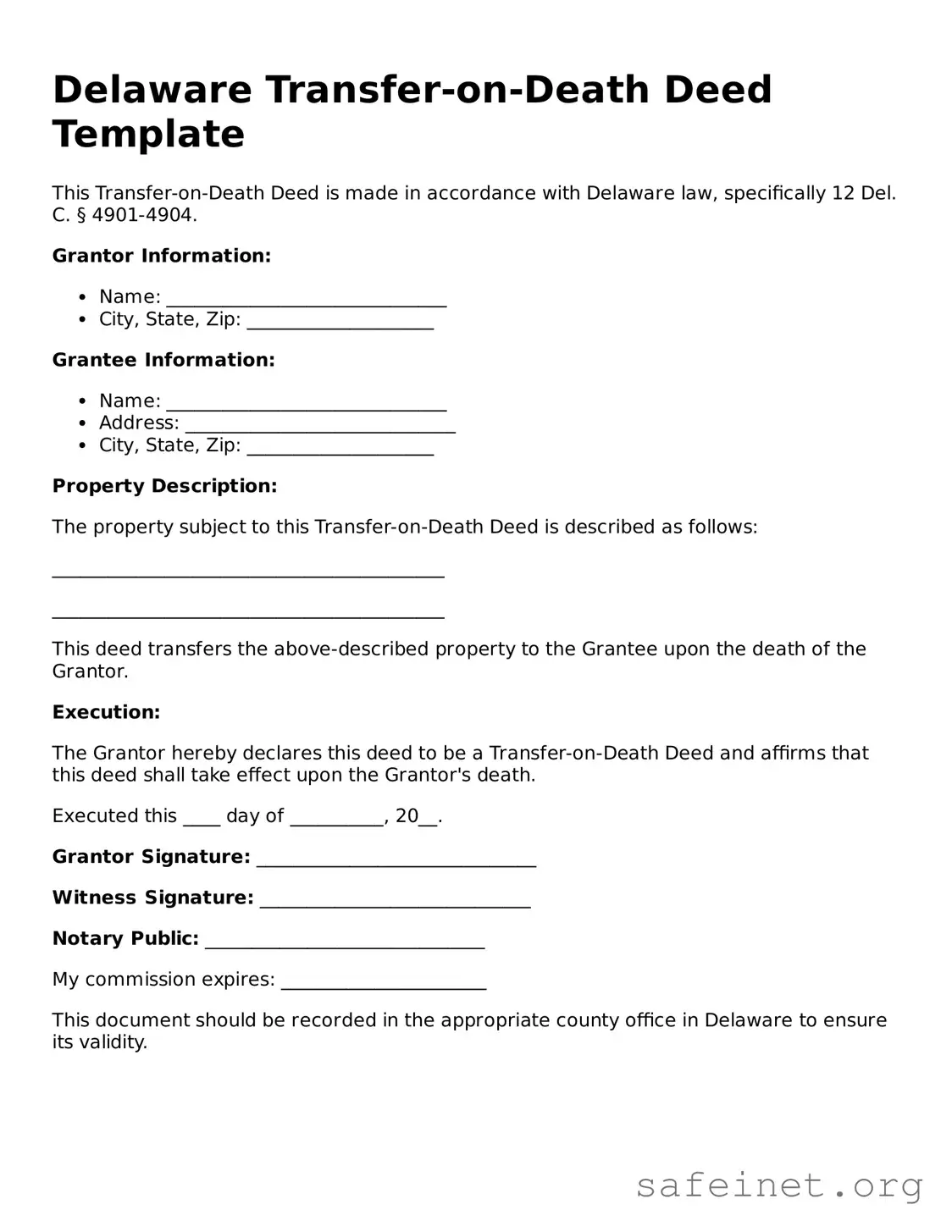
In the realm of estate planning, the Delaware Transfer-on-Death Deed (TOD Deed) stands out as a valuable tool for individuals looking to streamline the transfer of real estate upon their passing. This unique legal document allows property owners to designate beneficiaries who will automatically receive their property without the need for probate, simplifying the process and reducing potential costs for heirs. By filling out the TOD Deed form, you can ensure that your property is transferred directly to your chosen beneficiaries, providing peace of mind and clarity regarding your wishes. Notably, the form requires specific information, such as the property owner's details, a clear description of the property, and the names of the beneficiaries. Furthermore, it must be properly executed and recorded to be effective, making it essential to understand the steps involved in this process. With its straightforward approach, the Delaware Transfer-on-Death Deed empowers individuals to maintain control over their assets while alleviating the burden on loved ones during a challenging time.
Delaware Transfer-on-Death Deed Template
This Transfer-on-Death Deed is made in accordance with Delaware law, specifically 12 Del. C. § 4901-4904.
Grantor Information:
Grantee Information:
Property Description:
The property subject to this Transfer-on-Death Deed is described as follows:
__________________________________________
__________________________________________
This deed transfers the above-described property to the Grantee upon the death of the Grantor.
Execution:
The Grantor hereby declares this deed to be a Transfer-on-Death Deed and affirms that this deed shall take effect upon the Grantor's death.
Executed this ____ day of __________, 20__.
Grantor Signature: ______________________________
Witness Signature: _____________________________
Notary Public: ______________________________
My commission expires: ______________________
This document should be recorded in the appropriate county office in Delaware to ensure its validity.
| Fact Name | Description |
|---|---|
| Definition | A Transfer-on-Death (TOD) Deed allows an individual to transfer real property to a beneficiary upon their death without going through probate. |
| Governing Law | The TOD Deed in Delaware is governed by Title 12, Chapter 6102 of the Delaware Code. |
| Eligibility | Any individual who owns real property in Delaware can create a TOD Deed. |
| Beneficiary Designation | The deed must clearly identify the beneficiary or beneficiaries who will receive the property. |
| Revocation | A Transfer-on-Death Deed can be revoked at any time by the grantor before their death. |
| Execution Requirements | The deed must be signed by the grantor and acknowledged before a notary public. |
| Filing | The completed TOD Deed must be recorded in the appropriate county recorder's office in Delaware. |
| Effect on Creditors | Property transferred via a TOD Deed is subject to the grantor's debts and creditors until the grantor's death. |
| Tax Implications | There may be tax implications for the beneficiary upon the transfer of property, depending on the property's value. |
| Limitations | A TOD Deed cannot be used for certain types of property, such as personal property or property held in joint tenancy. |
After obtaining the Delaware Transfer-on-Death Deed form, you will need to fill it out carefully. This form allows you to designate a beneficiary who will receive your property upon your passing, without going through probate. Follow the steps below to complete the form accurately.
Once you have completed and recorded the form, keep a copy for your records. Inform your beneficiary about the deed to ensure they are aware of their future rights to the property. This proactive step can help prevent confusion later on.
What is a Transfer-on-Death Deed in Delaware?
A Transfer-on-Death Deed (TODD) is a legal document that allows an individual to transfer real estate to a beneficiary upon their death without the need for probate. This means that the property can pass directly to the designated beneficiary, simplifying the process and often reducing costs associated with estate administration. It is a powerful tool for estate planning, providing clarity and ensuring that your wishes are honored after you are gone.
How do I create a Transfer-on-Death Deed in Delaware?
To create a TODD in Delaware, you must complete a specific form that includes details about the property and the beneficiary. It is essential to ensure that the deed is properly executed, which typically involves signing it in the presence of a notary public. Once completed, the deed must be recorded in the county where the property is located. This step is crucial because it makes the deed effective and provides public notice of your intentions regarding the property transfer.
Can I change or revoke a Transfer-on-Death Deed after it has been created?
Yes, you can change or revoke a Transfer-on-Death Deed at any time before your death. To do so, you will need to execute a new TODD or a formal revocation document, which should also be recorded in the same county where the original deed was filed. This flexibility allows you to adapt your estate plan as your circumstances or wishes change, ensuring that your property will be transferred according to your current intentions.
Are there any limitations or restrictions on using a Transfer-on-Death Deed in Delaware?
While a Transfer-on-Death Deed is a useful estate planning tool, there are some limitations to consider. For instance, the property must be real estate, and the deed cannot be used for personal property or other types of assets. Additionally, if the property is subject to a mortgage, the lender's rights must be considered. It is also important to note that a TODD does not provide protection from creditors or affect tax obligations. Consulting with a legal professional can help clarify how a TODD fits into your overall estate plan and any specific restrictions that may apply.
Not including all required information about the property. Ensure that the legal description of the property is complete and accurate.
Failing to properly identify the beneficiary. It’s crucial to provide the full name and address of the person who will inherit the property.
Omitting the signature of the property owner. The deed must be signed by the person transferring the property to be valid.
Not having the deed notarized. A Transfer-on-Death Deed must be notarized to ensure its legality.
Forgetting to record the deed with the appropriate county office. This step is necessary to make the transfer effective upon death.
Using outdated forms. Always check for the most current version of the Transfer-on-Death Deed form.
Neglecting to review local laws and regulations. Each jurisdiction may have specific requirements that need to be followed.
Not considering the implications of the transfer. Understand how this deed affects your estate and any potential tax consequences.
Assuming that the deed is irrevocable. While it is a powerful tool, there are circumstances under which it can be revoked.
The Delaware Transfer-on-Death Deed is a useful tool for transferring property upon death without going through probate. However, several other forms and documents often accompany this deed to ensure a smooth transfer process. Below are some key documents that may be required.
Using these documents in conjunction with the Delaware Transfer-on-Death Deed can facilitate a smoother transition of property ownership. Always ensure that each document is completed accurately to avoid complications during the transfer process.
The Delaware Transfer-on-Death Deed (TOD) allows individuals to transfer property to beneficiaries upon their death without going through probate. This document is similar to a Living Trust. A Living Trust enables a person to place their assets into a trust during their lifetime, allowing for the management and distribution of those assets after death. Both documents avoid probate, but a Living Trust requires more management and can be more complex to set up than a TOD deed.
Another similar document is the Last Will and Testament. A will specifies how a person's assets should be distributed after their death. Unlike a TOD deed, a will must go through probate, which can be a lengthy and public process. However, both documents serve to convey a person's wishes regarding asset distribution, but the TOD deed provides a more streamlined approach.
The Beneficiary Designation form is also comparable to the TOD deed. This form is commonly used for financial accounts, such as bank accounts or retirement plans. It allows account holders to name beneficiaries who will receive the assets directly upon their death, bypassing probate. Both the Beneficiary Designation and the TOD deed facilitate the direct transfer of assets, ensuring that the designated beneficiaries receive what they are entitled to without delays.
A Payable-on-Death (POD) account shares similarities with the TOD deed as well. A POD account allows individuals to name a beneficiary who will receive the funds in the account upon their death. Like the TOD deed, a POD account avoids probate, ensuring a quick transfer to the beneficiary. Both options provide straightforward ways to transfer assets without the need for court involvement.
The Joint Tenancy with Right of Survivorship is another document that parallels the TOD deed. In this arrangement, two or more individuals hold title to a property together, and upon the death of one owner, the surviving owner automatically inherits the property. This method, like the TOD deed, allows for the seamless transfer of property outside of probate, but it requires co-ownership during the owner's lifetime.
A Life Estate Deed also bears resemblance to the TOD deed. This type of deed allows an individual to retain the right to use a property during their lifetime while designating a beneficiary who will inherit the property after their death. Both documents facilitate the transfer of property upon death, but a Life Estate Deed involves more rights and responsibilities for the current owner.
The Family Limited Partnership (FLP) can be compared to the TOD deed in terms of asset transfer. An FLP allows family members to pool their assets for management and distribution purposes. While the FLP can provide tax benefits and protect assets from creditors, the TOD deed offers a simpler method for transferring property upon death without the complexities of partnership agreements.
Lastly, the Irrevocable Trust is similar to the TOD deed in that it allows for the transfer of assets to beneficiaries. Once assets are placed in an irrevocable trust, the grantor cannot change the terms or reclaim the assets. This document provides asset protection and can help with tax planning, but it is generally more complex and less flexible than a TOD deed, which allows for straightforward property transfer upon death.
When filling out the Delaware Transfer-on-Death Deed form, it's important to follow certain guidelines to ensure the process goes smoothly. Here are four things you should do and shouldn't do:
By adhering to these guidelines, you can help prevent delays or issues with the transfer process.
Understanding the Delaware Transfer-on-Death Deed can help clarify its purpose and function. However, several misconceptions often arise. Here are eight common misunderstandings about this legal form:
By understanding these misconceptions, individuals can make more informed decisions regarding estate planning in Delaware. Knowledge of the Transfer-on-Death Deed can lead to smoother transitions for beneficiaries and peace of mind for property owners.
When filling out and using the Delaware Transfer-on-Death Deed form, consider the following key takeaways: