When a loved one passes away, managing their estate can often feel overwhelming, especially during a time of grief. In Delaware, the Small Estate Affidavit offers a streamlined way to handle the affairs of a deceased individual whose estate falls below a certain value threshold. This form allows heirs or beneficiaries to claim property and settle debts without going through the lengthy and costly probate process. To utilize the Small Estate Affidavit, the total value of the estate must not exceed $50,000, excluding real estate. The form requires essential information, including the decedent’s details, a list of assets, and the signatures of all heirs. By completing this affidavit, individuals can gain access to the deceased's assets more quickly, ensuring that the transition is as smooth as possible. Understanding the requirements and implications of this affidavit is crucial for anyone navigating the estate settlement process in Delaware.
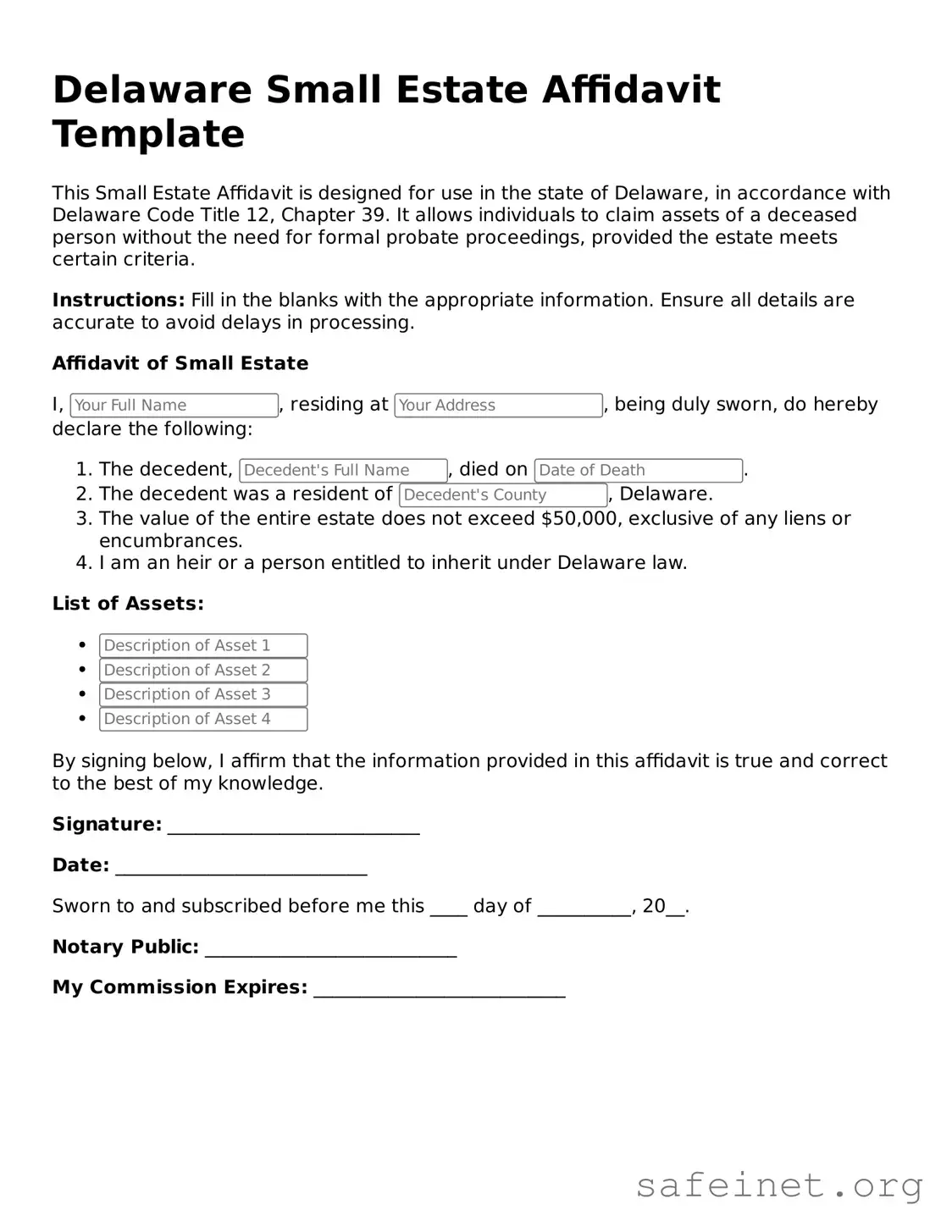
Delaware Small Estate Affidavit Template
This Small Estate Affidavit is designed for use in the state of Delaware, in accordance with Delaware Code Title 12, Chapter 39. It allows individuals to claim assets of a deceased person without the need for formal probate proceedings, provided the estate meets certain criteria.
Instructions: Fill in the blanks with the appropriate information. Ensure all details are accurate to avoid delays in processing.
Affidavit of Small Estate
I, , residing at , being duly sworn, do hereby declare the following:
List of Assets:
By signing below, I affirm that the information provided in this affidavit is true and correct to the best of my knowledge.
Signature: ___________________________
Date: ___________________________
Sworn to and subscribed before me this ____ day of __________, 20__.
Notary Public: ___________________________
My Commission Expires: ___________________________
| Fact Name | Details |
|---|---|
| Definition | The Delaware Small Estate Affidavit is a legal document used to settle the estate of a deceased person when the total value of the estate is below a certain threshold. |
| Governing Law | This form is governed by Delaware Code Title 12, Chapter 3915. |
| Eligibility Threshold | As of 2023, the estate must have a total value of $50,000 or less for an individual or $100,000 or less for a married couple. |
| Purpose | The affidavit allows heirs to claim assets without going through formal probate proceedings. |
| Who Can Use It | Heirs or beneficiaries of the deceased can utilize the Small Estate Affidavit to facilitate the transfer of assets. |
| Required Information | The affidavit must include the decedent's name, date of death, and a list of assets and liabilities. |
| Filing Process | The completed affidavit is typically filed with the Register of Wills in the county where the decedent resided. |
| Notarization | The affidavit must be signed in the presence of a notary public to be considered valid. |
| Impact on Creditors | Using the Small Estate Affidavit does not eliminate the obligation to pay the decedent's debts; creditors may still pursue claims. |
| Limitations | The Small Estate Affidavit cannot be used for estates that include real estate or certain types of assets exceeding the eligibility threshold. |
After gathering the necessary information, you can proceed to fill out the Delaware Small Estate Affidavit form. This document will help facilitate the transfer of a deceased person's assets without going through the probate process, provided the estate qualifies as a small estate under Delaware law.
What is a Delaware Small Estate Affidavit?
The Delaware Small Estate Affidavit is a legal document that allows individuals to claim the assets of a deceased person without going through the lengthy probate process. This form is typically used when the total value of the estate is below a certain threshold, which, as of now, is $50,000 for personal property and $100,000 for real property. By using this affidavit, heirs can efficiently transfer the deceased's assets to themselves or other beneficiaries.
Who is eligible to use the Small Estate Affidavit in Delaware?
To be eligible to use the Small Estate Affidavit, you must be an heir or a beneficiary of the deceased person's estate. Additionally, the total value of the estate must fall below the specified limits. It's essential to ensure that all debts and taxes of the estate are settled before using this affidavit. If the estate exceeds these limits, traditional probate proceedings will be necessary.
How do I complete the Small Estate Affidavit?
Completing the Small Estate Affidavit involves gathering necessary information about the deceased, including their name, date of death, and a list of assets. You will need to provide details on the heirs and beneficiaries, including their relationship to the deceased. The form must be signed in front of a notary public. It's crucial to ensure that all information is accurate and complete to avoid potential delays or complications.
Where do I file the Small Estate Affidavit?
The completed Small Estate Affidavit should be filed with the Register of Wills in the county where the deceased resided at the time of their death. Some counties may have specific requirements or forms, so it is advisable to check with the local Register of Wills office. Once filed, the affidavit serves as proof of your right to claim the assets without going through probate.
What happens after I file the Small Estate Affidavit?
After filing the Small Estate Affidavit, you may begin to collect the assets of the deceased. Financial institutions and other asset holders may require a copy of the affidavit to release funds or transfer property. It is important to keep a record of all transactions and communications related to the estate. If any issues arise, such as disputes among heirs, seeking legal advice may be necessary.
Can I use the Small Estate Affidavit if there is a will?
Yes, you can use the Small Estate Affidavit even if there is a will, provided the estate meets the value limits. However, the will must be valid, and you must be one of the named beneficiaries. If the will specifies a different process for asset distribution, it is advisable to follow those instructions. In some cases, consulting with a legal professional can help clarify the best course of action.
Not Checking Eligibility: Many people forget to confirm if the estate qualifies as a small estate. In Delaware, the total value must be under a specific limit.
Missing Signatures: Signatures are crucial. Failing to have the necessary parties sign the affidavit can lead to delays.
Incorrect Information: Providing wrong details about the deceased, such as their full name or date of death, can cause problems.
Not Including All Assets: Some individuals overlook including certain assets. All property owned by the deceased must be listed.
Ignoring Debts: People often forget to mention any outstanding debts. This information is important for settling the estate.
Improper Notarization: The affidavit must be notarized correctly. Missing this step can invalidate the document.
Not Following Instructions: Each section of the form has specific instructions. Ignoring these can lead to errors.
Submitting the Wrong Version: Using an outdated version of the form can result in rejection. Always check for the latest version.
Neglecting to Keep Copies: After submission, it's wise to keep copies of the completed affidavit. This can help if any issues arise later.
The Delaware Small Estate Affidavit is a useful document for settling the estate of a deceased person when the total value of the estate is below a certain threshold. However, several other forms and documents may be necessary to complete the process effectively. Below is a list of commonly used documents that often accompany the Small Estate Affidavit.
Having these documents ready can streamline the process of settling a small estate in Delaware. Ensuring that all necessary paperwork is in order will help avoid delays and complications during the estate administration process.
The Delaware Small Estate Affidavit is similar to a Last Will and Testament in that both documents address the distribution of a deceased person's assets. A Last Will and Testament outlines how an individual wishes their property and possessions to be distributed after death, while the Small Estate Affidavit provides a streamlined process for transferring assets without the need for formal probate. Both documents serve to clarify the deceased's intentions and ensure that their wishes are honored, although the Small Estate Affidavit is typically used for smaller estates to expedite the process.
Another document comparable to the Small Estate Affidavit is the Letter of Administration. This document is issued by a court to appoint an administrator to manage the estate of someone who has died without a will. While the Letter of Administration is often necessary for larger estates requiring formal probate, the Small Estate Affidavit allows for a quicker resolution for smaller estates. Both documents facilitate the transfer of assets but differ significantly in the complexity and size of the estates they address.
The Affidavit of Heirship also shares similarities with the Small Estate Affidavit. An Affidavit of Heirship is used to establish the rightful heirs of a deceased person, especially when no will exists. Like the Small Estate Affidavit, it simplifies the process of asset transfer by providing a legal declaration of heirship. However, the Small Estate Affidavit specifically pertains to the collection of assets, while the Affidavit of Heirship focuses on identifying heirs, often leading to different legal procedures.
Lastly, the Power of Attorney can be viewed as related to the Small Estate Affidavit in terms of authority and asset management. A Power of Attorney allows an individual to designate someone else to make decisions on their behalf while they are still alive. In contrast, the Small Estate Affidavit is used posthumously to manage and distribute assets. Both documents empower individuals to handle affairs, but they operate at different stages of life and under different circumstances.
Filling out the Delaware Small Estate Affidavit form can seem daunting, but following some simple guidelines can make the process smoother. Here’s a list of things you should and shouldn’t do:
By keeping these tips in mind, you can navigate the process more effectively and ensure that the estate is handled according to Delaware law.
When it comes to the Delaware Small Estate Affidavit, many people hold misconceptions that can lead to confusion and potential legal pitfalls. Here are ten common misunderstandings about this form:
This is not true. The Small Estate Affidavit is designed for estates that fall below a certain value threshold, making it accessible for many individuals, regardless of their overall wealth.
While this form simplifies the process for small estates, it does not completely eliminate probate. It is a streamlined alternative for certain cases, but not all small estates qualify.
Not necessarily. The affidavit allows heirs to claim assets, but they must be aware that outstanding debts may still need to be addressed, depending on the estate's situation.
While heirs typically file this affidavit, personal representatives or other authorized individuals may also be able to do so, depending on the circumstances.
This is a misconception. The affidavit is generally limited to certain types of assets, such as bank accounts or personal property, and may not apply to real estate or other complex assets.
Each estate is unique, and while the Small Estate Affidavit provides a simplified process, specific requirements may vary based on individual circumstances and local regulations.
While it can be faster than traditional probate, there are still steps involved that may take time, such as gathering necessary documentation and ensuring compliance with state laws.
Challenges can occur. Interested parties may contest the affidavit if they believe they have a legitimate claim to the estate, which can complicate matters.
While the process is generally less expensive than full probate, there may still be filing fees or other costs involved that should not be overlooked.
While some individuals may feel comfortable handling the process on their own, seeking legal advice can help navigate complexities and ensure compliance with all legal requirements.
Understanding these misconceptions can empower individuals to make informed decisions regarding the Small Estate Affidavit process in Delaware.
Filling out and using the Delaware Small Estate Affidavit form can be a straightforward process if you understand the key points. Here are some essential takeaways to keep in mind:
Understanding these key points can significantly ease the process of handling a small estate in Delaware. Take action promptly to ensure that the assets are distributed according to the deceased's wishes.