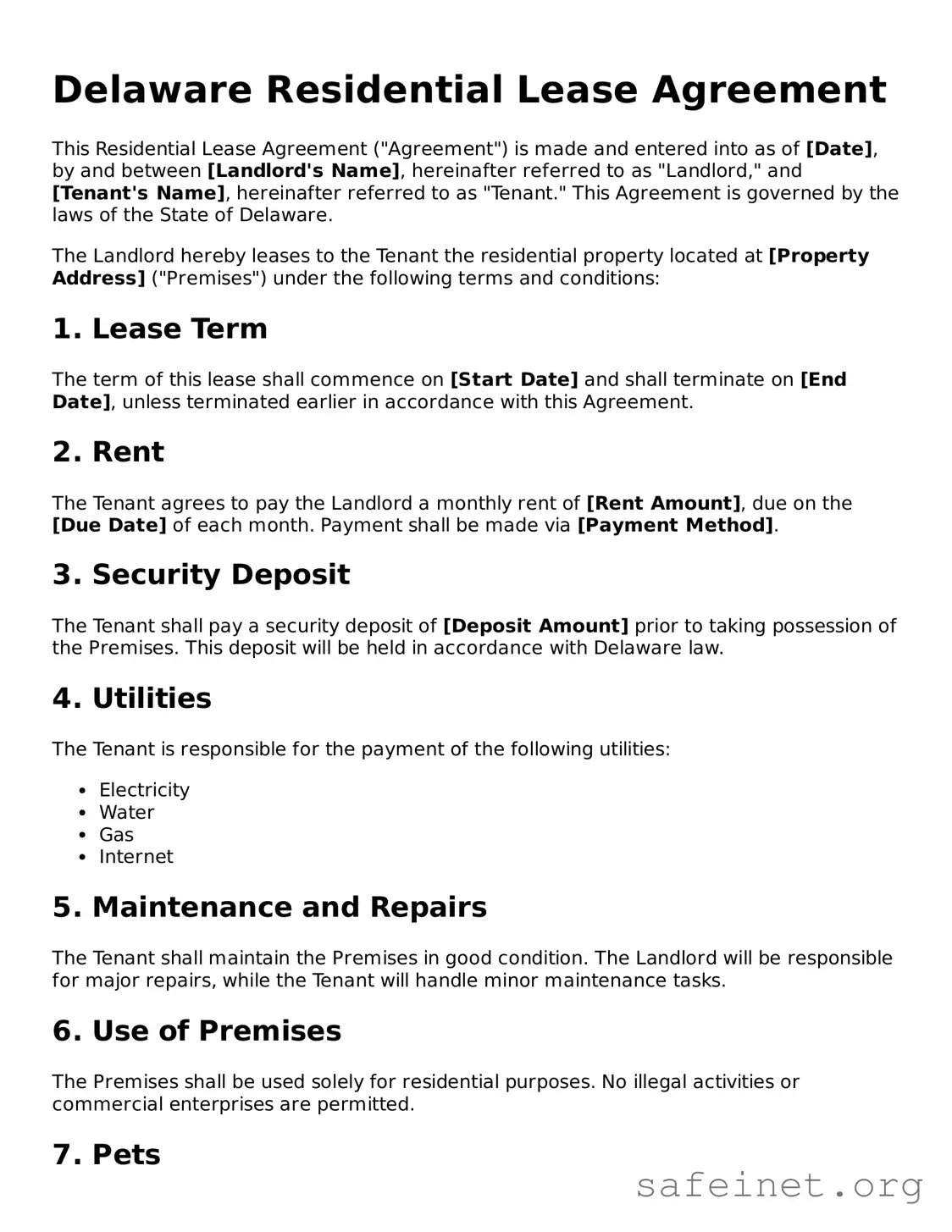
The Delaware Residential Lease Agreement form is a crucial document that outlines the terms and conditions governing the rental of residential properties in the state. This agreement serves as a binding contract between landlords and tenants, detailing essential aspects such as the duration of the lease, the rental amount, and the payment schedule. It also addresses security deposits, maintenance responsibilities, and rules regarding property use. By clearly defining the rights and obligations of both parties, the form helps to prevent misunderstandings and disputes. Additionally, it includes provisions for termination of the lease, ensuring that both landlords and tenants are aware of their options should circumstances change. Understanding this agreement is vital for anyone involved in renting or leasing a residential property in Delaware, as it lays the groundwork for a smooth and transparent rental experience.
Delaware Residential Lease Agreement
This Residential Lease Agreement ("Agreement") is made and entered into as of [Date], by and between [Landlord's Name], hereinafter referred to as "Landlord," and [Tenant's Name], hereinafter referred to as "Tenant." This Agreement is governed by the laws of the State of Delaware.
The Landlord hereby leases to the Tenant the residential property located at [Property Address] ("Premises") under the following terms and conditions:
1. Lease Term
The term of this lease shall commence on [Start Date] and shall terminate on [End Date], unless terminated earlier in accordance with this Agreement.
2. Rent
The Tenant agrees to pay the Landlord a monthly rent of [Rent Amount], due on the [Due Date] of each month. Payment shall be made via [Payment Method].
3. Security Deposit
The Tenant shall pay a security deposit of [Deposit Amount] prior to taking possession of the Premises. This deposit will be held in accordance with Delaware law.
4. Utilities
The Tenant is responsible for the payment of the following utilities:
5. Maintenance and Repairs
The Tenant shall maintain the Premises in good condition. The Landlord will be responsible for major repairs, while the Tenant will handle minor maintenance tasks.
6. Use of Premises
The Premises shall be used solely for residential purposes. No illegal activities or commercial enterprises are permitted.
7. Pets
Pets are [allowed/not allowed] on the Premises. If allowed, the Tenant must pay a non-refundable pet deposit of [Pet Deposit Amount].
8. Termination
Either party may terminate this Agreement by providing written notice of [Notice Period] days. Termination must comply with Delaware law.
9. Governing Law
This Agreement shall be governed by and construed in accordance with the laws of the State of Delaware.
10. Signatures
By signing below, both parties agree to the terms and conditions outlined in this Agreement.
Landlord Signature: ___________________________ Date: _______________
Tenant Signature: ____________________________ Date: _______________
| Fact Name | Description |
|---|---|
| Governing Law | The Delaware Residential Lease Agreement is governed by Title 25, Chapter 530 of the Delaware Code. |
| Parties Involved | The agreement involves a landlord and a tenant, both of whom must be clearly identified. |
| Property Description | The lease must include a detailed description of the rental property, including the address. |
| Lease Term | The document specifies the duration of the lease, which can be month-to-month or for a fixed term. |
| Rent Amount | The agreement must clearly state the amount of rent due, the payment schedule, and acceptable payment methods. |
| Security Deposit | Delaware law limits security deposits to one month's rent, and it must be mentioned in the lease. |
| Maintenance Responsibilities | The lease outlines the responsibilities of both the landlord and tenant regarding property maintenance. |
| Termination Clause | The agreement should include terms for terminating the lease, including notice periods required by law. |
| Utilities | The lease must specify which utilities are included in the rent and which are the tenant's responsibility. |
| Dispute Resolution | The agreement may include provisions for resolving disputes, such as mediation or arbitration options. |
Filling out the Delaware Residential Lease Agreement form requires careful attention to detail. This document is essential for establishing the terms of the rental arrangement between the landlord and tenant. To ensure accuracy and completeness, follow the steps outlined below.
What is a Delaware Residential Lease Agreement?
A Delaware Residential Lease Agreement is a legal document that outlines the terms and conditions of renting a residential property. It serves as a contract between the landlord and the tenant, detailing each party's rights and responsibilities during the lease term.
What key terms should be included in the lease agreement?
Essential terms include the names of the landlord and tenant, the rental property's address, the lease duration, the amount of rent, payment due dates, security deposit details, maintenance responsibilities, and any rules regarding pets or smoking. Clarity on these terms helps prevent misunderstandings.
How long is a typical lease agreement in Delaware?
Most residential leases in Delaware are typically for one year. However, leases can be shorter or longer, depending on the agreement between the landlord and tenant. Always ensure that the lease duration is clearly stated in the document.
What happens if a tenant wants to break the lease early?
If a tenant wishes to break the lease early, they may face penalties as outlined in the lease agreement. This could include forfeiting the security deposit or paying rent until a new tenant is found. It’s advisable to communicate with the landlord to explore options.
Is a security deposit required?
Yes, landlords in Delaware can require a security deposit. The maximum amount is typically one month's rent. This deposit protects the landlord against damages or unpaid rent. The lease should specify the conditions under which the deposit will be returned.
Can a landlord enter the rental property without notice?
Generally, landlords must provide reasonable notice before entering a tenant's property, typically 24 hours. Exceptions may apply in emergencies. The lease should specify the notice requirements to ensure both parties understand their rights.
What are the tenant's rights regarding repairs and maintenance?
Tenants have the right to a habitable living environment. This includes functioning plumbing, heating, and electrical systems. If repairs are needed, tenants should notify the landlord in writing. The lease should outline how quickly repairs must be addressed.
Can a lease agreement be modified?
Yes, a lease agreement can be modified if both the landlord and tenant agree to the changes. Any modifications should be documented in writing and signed by both parties to ensure clarity and enforceability.
What should a tenant do if they feel their rights are being violated?
If a tenant believes their rights are being violated, they should first communicate with the landlord to resolve the issue. If the problem persists, tenants can seek legal advice or contact local housing authorities for assistance.
Failing to include all tenant names: It’s crucial to list every person who will be living in the rental unit. Omitting a name can lead to disputes later on.
Not specifying the lease term: Clearly stating the duration of the lease, whether it’s month-to-month or for a fixed term, is essential. Ambiguity can create confusion about when the lease ends.
Ignoring security deposit details: Many forget to outline the amount of the security deposit and the conditions for its return. This can lead to misunderstandings when moving out.
Leaving out maintenance responsibilities: Clearly defining who is responsible for repairs and maintenance can prevent conflicts. Specify what the landlord covers versus what the tenant is expected to manage.
Not including pet policies: If pets are allowed, this should be clearly stated. If they aren’t, including a clause about pets can help avoid issues later.
Overlooking utility responsibilities: Clearly state which utilities are included in the rent and which are the tenant’s responsibility. This can prevent disputes over bills.
Failing to outline termination conditions: Specify how either party can terminate the lease and the notice period required. This is crucial for both landlords and tenants.
Not reviewing the form for accuracy: Before signing, it’s important to double-check all information for accuracy. Mistakes can lead to legal issues down the road.
When entering into a rental agreement in Delaware, it's important to have a complete set of documents to ensure a smooth leasing process. Here are five essential forms and documents that often accompany the Delaware Residential Lease Agreement.
Having these documents ready can help both landlords and tenants navigate the leasing process more effectively. Clear communication and proper documentation are key to a successful rental experience.
The Delaware Residential Lease Agreement is similar to the Standard Lease Agreement, which is used in many states. Both documents outline the terms and conditions of renting a property, including the duration of the lease, rent amount, and responsibilities of both the landlord and tenant. The Standard Lease Agreement is often more general and can be adapted to various states, while the Delaware version includes specific state laws and regulations that must be followed.
Another similar document is the Month-to-Month Rental Agreement. This type of lease allows tenants to rent a property on a monthly basis without a long-term commitment. Like the Residential Lease Agreement, it specifies rent, security deposits, and other terms. However, it offers more flexibility, as either party can terminate the agreement with proper notice.
The Commercial Lease Agreement also shares similarities with the Residential Lease Agreement. While the former is for business properties, both documents outline the rental terms, including the duration and payment details. Each agreement also typically includes clauses about maintenance responsibilities and the use of the property, although the commercial version may address additional factors like zoning laws and business operations.
The Sublease Agreement is another document that resembles the Residential Lease Agreement. This agreement allows a tenant to rent out their leased property to another person, known as a subtenant. It includes many of the same terms as the original lease, such as rent and duration. However, it often requires approval from the landlord, making it distinct in its purpose and execution.
A Roommate Agreement can also be compared to the Residential Lease Agreement. This document is used when multiple tenants share a rental property. It outlines each roommate's responsibilities, including rent payment and household chores. While it may not replace the main lease, it complements it by clarifying expectations among roommates.
The Lease Option Agreement is similar but includes an option for the tenant to purchase the property at the end of the lease term. Like the Residential Lease Agreement, it details the rental terms, but it also specifies the purchase price and conditions under which the tenant can buy the property. This agreement provides tenants with a potential path to homeownership.
The Rent-to-Own Agreement is closely related as well. This document allows tenants to rent a property with the option to buy it later. Similar to the Lease Option Agreement, it includes terms about rent and purchase conditions. The main difference lies in how payments are structured, as some rent payments may go toward the purchase price in a Rent-to-Own Agreement.
Lastly, the Eviction Notice is another document that connects to the Residential Lease Agreement. While it serves a different purpose, it stems from the lease terms. If a tenant violates the lease, such as failing to pay rent, the landlord may issue an eviction notice. This document outlines the reasons for eviction and the timeline for the tenant to vacate the property, ensuring that both parties adhere to the lease's stipulations.
When filling out the Delaware Residential Lease Agreement form, it’s important to approach the task with care. Here are some key do's and don'ts to keep in mind:
Understanding the Delaware Residential Lease Agreement form is essential for both landlords and tenants. However, several misconceptions can lead to confusion. Below are six common misconceptions explained.
Being informed about these misconceptions can help both landlords and tenants navigate their rights and responsibilities effectively.
When filling out and using the Delaware Residential Lease Agreement form, it is important to consider several key aspects to ensure clarity and compliance. Here are some essential takeaways:
By paying attention to these key points, both landlords and tenants can create a clear and effective lease agreement that serves their needs and protects their rights.