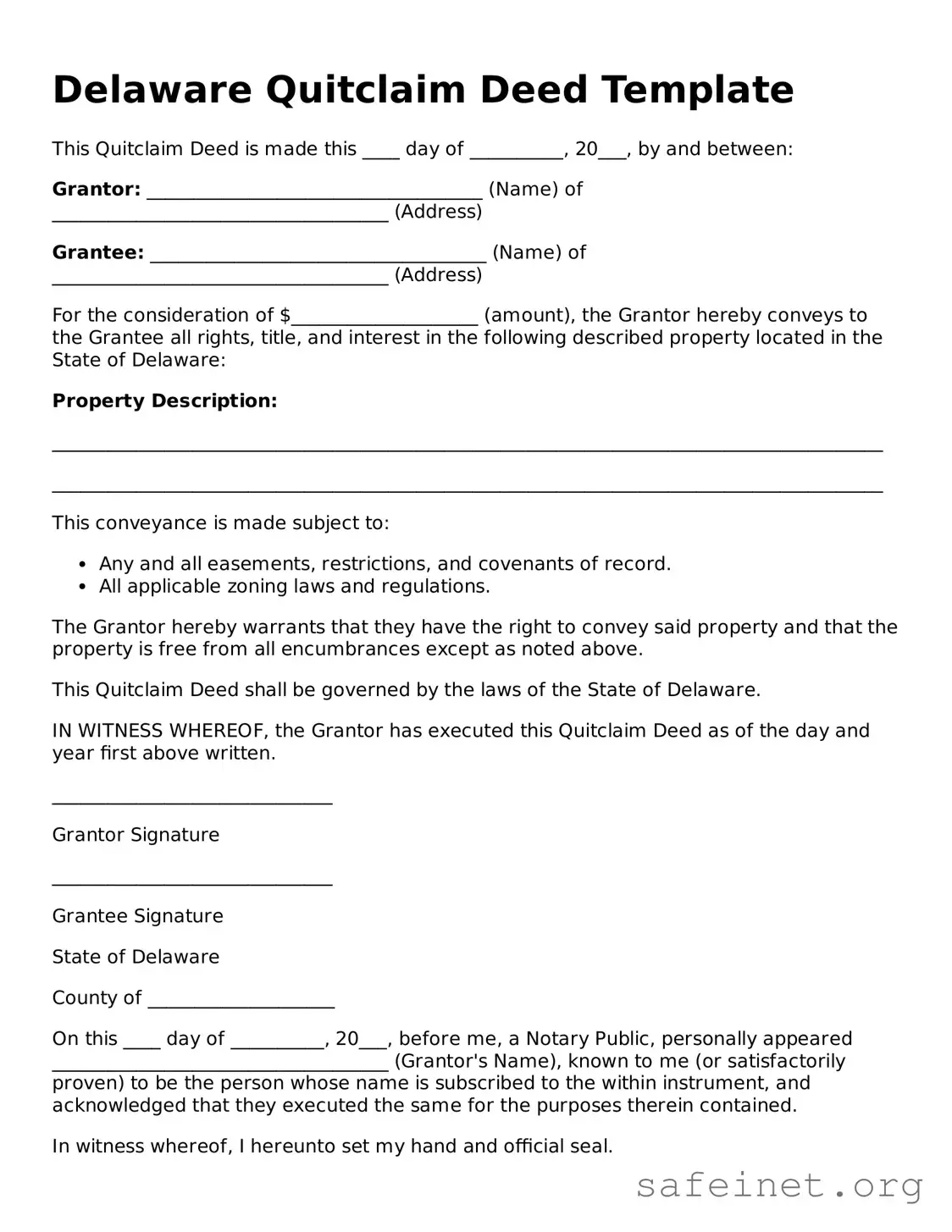
The Delaware Quitclaim Deed is an important legal document used in real estate transactions, specifically for transferring property ownership. This form allows a property owner, known as the grantor, to convey their interest in a property to another party, called the grantee, without making any warranties regarding the title. It is often utilized in situations where the property transfer occurs between family members, in divorce settlements, or when the property is being gifted. The Quitclaim Deed is relatively straightforward, requiring basic information such as the names of the parties involved, a description of the property, and the signatures of the grantor and a notary public. While it is a simple method for transferring property, it is crucial for both parties to understand that the grantor does not guarantee that the title is free from claims or encumbrances. This lack of warranties makes the Quitclaim Deed less secure than other types of deeds, such as warranty deeds, which provide greater protection to the grantee. Understanding the nuances of the Delaware Quitclaim Deed can help individuals navigate the complexities of property transfers effectively.
Delaware Quitclaim Deed Template
This Quitclaim Deed is made this ____ day of __________, 20___, by and between:
Grantor: ____________________________________ (Name) of ____________________________________ (Address)
Grantee: ____________________________________ (Name) of ____________________________________ (Address)
For the consideration of $____________________ (amount), the Grantor hereby conveys to the Grantee all rights, title, and interest in the following described property located in the State of Delaware:
Property Description:
_________________________________________________________________________________________
_________________________________________________________________________________________
This conveyance is made subject to:
The Grantor hereby warrants that they have the right to convey said property and that the property is free from all encumbrances except as noted above.
This Quitclaim Deed shall be governed by the laws of the State of Delaware.
IN WITNESS WHEREOF, the Grantor has executed this Quitclaim Deed as of the day and year first above written.
______________________________
Grantor Signature
______________________________
Grantee Signature
State of Delaware
County of ____________________
On this ____ day of __________, 20___, before me, a Notary Public, personally appeared ____________________________________ (Grantor's Name), known to me (or satisfactorily proven) to be the person whose name is subscribed to the within instrument, and acknowledged that they executed the same for the purposes therein contained.
In witness whereof, I hereunto set my hand and official seal.
______________________________
Notary Public
My Commission Expires: _______________
| Fact Name | Description |
|---|---|
| Definition | A quitclaim deed is a legal document used to transfer ownership of real property without any warranties. |
| Governing Law | The Delaware Quitclaim Deed is governed by Delaware Code Title 25, Chapter 2901. |
| Parties Involved | The form includes a grantor (the person transferring the property) and a grantee (the person receiving the property). |
| No Guarantees | Unlike other types of deeds, a quitclaim deed does not guarantee that the grantor has clear title to the property. |
| Usage | This type of deed is commonly used among family members or in situations where the property title is not in dispute. |
| Recording | To be legally effective against third parties, the quitclaim deed must be recorded in the appropriate county office. |
| Consideration | While consideration (payment) is often included, it is not required for a quitclaim deed to be valid. |
| Form Requirements | The deed must be signed by the grantor and may need to be notarized to ensure validity. |
| Tax Implications | Transfer taxes may apply when a quitclaim deed is executed, depending on the property’s value. |
| Limitations | A quitclaim deed does not extinguish any liens or encumbrances on the property; these remain in effect. |
After obtaining the Delaware Quitclaim Deed form, it’s essential to complete it accurately to ensure a smooth transfer of property. Follow these steps carefully to fill out the form correctly.
What is a Delaware Quitclaim Deed?
A Delaware Quitclaim Deed is a legal document used to transfer ownership of real property from one party to another without making any guarantees about the title. This means that the grantor (the person transferring the property) does not assure the grantee (the person receiving the property) that the title is free of liens or other claims. It is often used among family members or in situations where the parties know each other well, as it provides a quick and straightforward way to transfer property rights.
How do I complete a Delaware Quitclaim Deed?
To complete a Delaware Quitclaim Deed, you will need to gather specific information. This includes the names and addresses of both the grantor and the grantee, a legal description of the property, and the date of the transfer. The form must be signed by the grantor in the presence of a notary public. After signing, the deed should be filed with the Recorder of Deeds in the county where the property is located to make the transfer official.
Are there any fees associated with filing a Quitclaim Deed in Delaware?
Yes, there are fees associated with filing a Quitclaim Deed in Delaware. These fees can vary by county and are typically based on the value of the property being transferred. It is advisable to check with the local Recorder of Deeds for the exact fee schedule. Additionally, there may be other costs involved, such as notary fees or potential transfer taxes, depending on the specifics of the transaction.
Can a Quitclaim Deed be contested after it is filed?
While a Quitclaim Deed is a legal document that transfers property rights, it can potentially be contested. If someone believes that the deed was signed under duress, fraud, or if there are issues with the grantor's ownership rights, they may have grounds to challenge the deed. However, such disputes can be complex and may require legal assistance to resolve. It is crucial to ensure that all parties involved understand the implications of the transfer before proceeding.
Incorrect Property Description: One common mistake is failing to provide a clear and accurate description of the property. It's crucial to include the correct address, parcel number, and any other identifying details. An unclear description can lead to disputes or complications in the future.
Omitting Signatures: Another frequent error is not having the necessary signatures. Both the grantor (the person transferring the property) and the grantee (the person receiving the property) must sign the deed. Without these signatures, the deed is not valid.
Not Notarizing the Document: Many individuals forget that the Quitclaim Deed must be notarized. A notary public verifies the identities of those signing the document, which helps prevent fraud. Without notarization, the deed may not be accepted by the county recorder’s office.
Failing to Record the Deed: After filling out the Quitclaim Deed, some people neglect to record it with the appropriate county office. Recording the deed is essential to ensure that the transfer of ownership is legally recognized. If not recorded, the new owner may face challenges in asserting their rights to the property.
When completing a property transfer in Delaware using a Quitclaim Deed, several other forms and documents may be necessary to ensure a smooth transaction. Each of these documents serves a specific purpose and can help clarify ownership, facilitate the transfer, or meet legal requirements. Below is a list of commonly used documents alongside the Delaware Quitclaim Deed.
Having these documents prepared and organized can significantly streamline the property transfer process. Ensuring all necessary paperwork is in order will help prevent delays and legal complications, allowing for a smoother transition of ownership.
A warranty deed is a common document used in real estate transactions, similar to a quitclaim deed in that it transfers ownership of property. However, the key difference lies in the level of protection it offers to the buyer. A warranty deed guarantees that the seller holds clear title to the property and has the right to sell it. It also provides a warranty against any future claims to the property. In contrast, a quitclaim deed makes no such guarantees, leaving the buyer with less security regarding potential title issues.
A grant deed is another document that shares similarities with a quitclaim deed. Both are used to transfer property ownership, but a grant deed provides more assurance to the buyer. It implies that the seller has not sold the property to anyone else and that there are no undisclosed encumbrances. While a quitclaim deed simply conveys whatever interest the seller has, a grant deed offers a limited warranty, making it a more secure option for buyers.
A special warranty deed is also comparable to a quitclaim deed, but it offers a specific type of protection. This document guarantees that the seller has not caused any issues with the title during their ownership. Unlike a quitclaim deed, which makes no warranties, a special warranty deed assures the buyer that the seller is responsible for any title defects that occurred while they owned the property. This makes it a middle ground between a quitclaim deed and a full warranty deed.
An easement deed is similar in that it transfers rights related to property, but it does not convey ownership. Instead, it grants permission for one party to use a portion of another party’s property for a specific purpose, such as access or utilities. While a quitclaim deed transfers ownership interests, an easement deed focuses on the right to use the property, making it essential for certain real estate transactions.
A title transfer document is another related form, as it serves to officially change the ownership of a property. While a quitclaim deed is one way to execute a title transfer, other documents may be used depending on the situation. A title transfer document can include various forms of deeds, including warranty and grant deeds, but the quitclaim deed remains a straightforward option for transferring interest without the assurances of title validity.
Finally, a deed of trust is similar in that it involves real property but serves a different purpose. It is used primarily in financing arrangements, where the property acts as collateral for a loan. A deed of trust involves three parties: the borrower, the lender, and a trustee. While a quitclaim deed transfers ownership interest, a deed of trust secures a loan by placing a lien on the property, illustrating the diverse functions of real estate documents.
When filling out the Delaware Quitclaim Deed form, it is important to follow certain guidelines to ensure accuracy and compliance. Here is a list of things you should and shouldn't do:
By following these guidelines, you can help ensure that your Quitclaim Deed is filled out correctly and is legally binding.
Understanding the Delaware Quitclaim Deed can be challenging, especially with the various misconceptions that surround it. Here are ten common misunderstandings, clarified for better comprehension.
Many people believe that all quitclaim deeds function identically across states. In reality, each state, including Delaware, has specific rules and requirements that govern how quitclaim deeds are executed and recorded.
Some think that a quitclaim deed guarantees a complete transfer of ownership. However, it only conveys whatever interest the grantor has in the property, which may not be full ownership.
While quitclaim deeds are often used among family members, they can also be employed in various situations, such as transferring property between business partners or in divorce settlements.
It's a common belief that using a quitclaim deed removes all financial liabilities associated with the property. In truth, the new owner may still be responsible for any existing liens or mortgages on the property.
Some individuals mistakenly think quitclaim deeds lack legal standing. In fact, when properly executed and recorded, they are legally binding documents that can be enforced in court.
While quitclaim deeds can transfer interests, they do not guarantee a clear title. If there are title issues, a quitclaim deed may not resolve them.
Many assume that notarization of a quitclaim deed is optional. However, in Delaware, notarization is required for the deed to be valid and enforceable.
People often think quitclaim deeds can only be used for real estate transactions. However, they can also be applied to other types of property, such as vehicles or personal belongings, depending on state laws.
Some believe that once a quitclaim deed is signed, it cannot be modified. While it is true that changes can be complicated, it is possible to create a new deed to amend the previous one.
Lastly, many think that quitclaim deeds are the best choice for all property transfers. However, in some situations, a warranty deed may provide more protection and assurance for the buyer.
By addressing these misconceptions, individuals can make more informed decisions regarding the use of quitclaim deeds in Delaware.
When filling out and using the Delaware Quitclaim Deed form, it is essential to understand the following key points: