When couples contemplate marriage, discussions about financial matters often arise, making a prenuptial agreement an essential consideration. In Delaware, this legal document serves to outline the financial rights and responsibilities of each partner during the marriage and in the event of a divorce. The Delaware Prenuptial Agreement form addresses key aspects such as the division of property, spousal support, and the handling of debts. It provides a framework for transparency, allowing both parties to express their expectations and protect their individual assets. By clearly delineating these terms, the agreement can help prevent misunderstandings and disputes in the future. Furthermore, the form must adhere to specific legal requirements to ensure its enforceability, emphasizing the importance of careful drafting and mutual consent. Engaging in open dialogue about financial matters can ultimately strengthen the relationship, paving the way for a more secure future together.
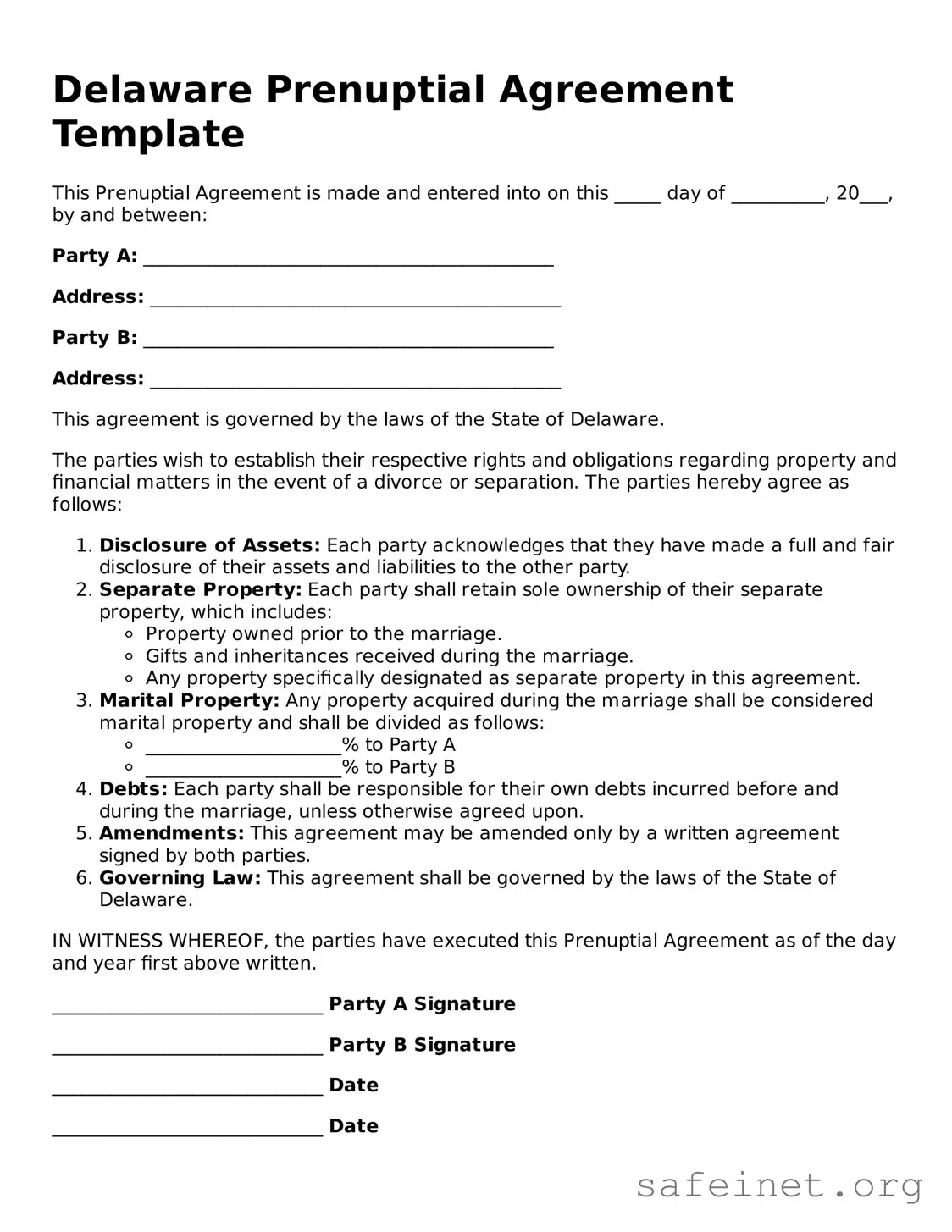
Delaware Prenuptial Agreement Template
This Prenuptial Agreement is made and entered into on this _____ day of __________, 20___, by and between:
Party A: ____________________________________________
Address: ____________________________________________
Party B: ____________________________________________
Address: ____________________________________________
This agreement is governed by the laws of the State of Delaware.
The parties wish to establish their respective rights and obligations regarding property and financial matters in the event of a divorce or separation. The parties hereby agree as follows:
IN WITNESS WHEREOF, the parties have executed this Prenuptial Agreement as of the day and year first above written.
_____________________________ Party A Signature
_____________________________ Party B Signature
_____________________________ Date
_____________________________ Date
| Fact Name | Description |
|---|---|
| Governing Law | Delaware law governs prenuptial agreements under Title 13, Chapter 1513 of the Delaware Code. |
| Enforceability | A prenuptial agreement in Delaware is enforceable if it is in writing and signed by both parties. |
| Full Disclosure | Both parties must provide full and fair disclosure of their financial situations for the agreement to be valid. |
| Legal Representation | While not required, it is highly recommended that both parties seek independent legal counsel to ensure fairness and understanding. |
Filling out the Delaware Prenuptial Agreement form is a straightforward process. Follow these steps carefully to ensure that all necessary information is accurately provided.
After completing the form, make copies for both parties. Each person should keep a copy for their records. It’s advisable to consult with an attorney to confirm that the agreement meets all legal requirements.
What is a prenuptial agreement in Delaware?
A prenuptial agreement, often referred to as a prenup, is a legal contract created by two individuals before they marry. In Delaware, this agreement outlines how assets and debts will be divided in the event of a divorce or separation. It can also address spousal support and other financial matters. The goal is to provide clarity and protection for both parties, ensuring that each person's rights and responsibilities are clearly defined.
Is a prenuptial agreement legally enforceable in Delaware?
Yes, prenuptial agreements are legally enforceable in Delaware, provided they meet certain requirements. Both parties must enter into the agreement voluntarily, and it should be in writing. Additionally, the terms must be fair and reasonable at the time of enforcement. If either party can prove that they were coerced or did not fully understand the agreement, it may be challenged in court.
What should be included in a Delaware prenuptial agreement?
A Delaware prenuptial agreement can include various provisions, such as the division of property, allocation of debts, and spousal support. It may also address how future income and assets will be treated. However, it cannot include provisions related to child custody or child support, as these matters are determined based on the best interests of the child at the time of divorce.
When should I create a prenuptial agreement?
It is advisable to create a prenuptial agreement well before the wedding date. This allows both parties ample time to discuss and negotiate the terms without the pressure of an impending marriage. Ideally, couples should start this process several months in advance to ensure that they can make informed decisions and seek legal advice if necessary.
Do both parties need a lawyer for a prenuptial agreement?
While it is not legally required for both parties to have separate attorneys, it is highly recommended. Having independent legal representation helps ensure that both individuals fully understand the agreement and that their interests are adequately protected. This can also help prevent disputes in the future regarding the validity of the agreement.
Can a prenuptial agreement be changed after marriage?
Yes, a prenuptial agreement can be modified or revoked after marriage. However, any changes must be made in writing and signed by both parties. It is essential to follow the same legal formalities that applied to the original agreement to ensure that the modifications are enforceable.
What happens if we don’t have a prenuptial agreement?
If a couple does not have a prenuptial agreement and later divorces, Delaware's laws will dictate how assets and debts are divided. This may lead to outcomes that one or both parties find unfavorable. Without a prenup, the court will consider various factors, including the length of the marriage and each spouse's financial situation, to make decisions about property division and support.
How do I ensure my prenuptial agreement is valid in Delaware?
To ensure that a prenuptial agreement is valid in Delaware, follow these guidelines: both parties should enter into the agreement voluntarily, it should be in writing, and it must be signed by both parties. Full disclosure of assets and debts is crucial. Consulting with legal professionals can also help ensure that the agreement meets all legal requirements and is enforceable.
Where can I find a Delaware prenuptial agreement form?
Delaware prenuptial agreement forms can be found through various legal websites, law firms, and online legal services. However, it is important to remember that using a generic form may not address the specific needs and circumstances of both parties. It is often best to work with a lawyer who can tailor the agreement to fit your unique situation and ensure compliance with Delaware law.
Not fully understanding the purpose of a prenuptial agreement. Many individuals view it simply as a financial document, but it also addresses personal rights and responsibilities.
Failing to disclose all assets and debts. Transparency is crucial. Omitting any financial information can lead to disputes later on.
Using vague language. Clear and specific terms help avoid confusion. Ambiguities can create problems during enforcement.
Not having the agreement reviewed by a lawyer. While it may seem straightforward, legal advice ensures that the document meets all legal requirements.
Signing the agreement under pressure. Both parties should feel comfortable and agree to the terms willingly. Coercion can render the agreement invalid.
Neglecting to update the agreement after major life changes. Events like the birth of a child or significant financial changes should prompt a review of the prenup.
When preparing for a marriage, many couples consider a prenuptial agreement to protect their individual assets and clarify financial responsibilities. Alongside the Delaware Prenuptial Agreement, several other documents can be crucial in ensuring a comprehensive understanding of both parties' rights and obligations. Below is a list of commonly used forms and documents that complement a prenuptial agreement.
Understanding these documents can enhance the effectiveness of a prenuptial agreement and provide a solid foundation for a couple's financial future. By addressing various aspects of their relationship and assets, couples can work towards a more harmonious partnership.
A Cohabitation Agreement serves as a legal framework for couples who choose to live together without marrying. Much like a prenuptial agreement, it outlines the rights and responsibilities of each partner regarding property, finances, and other matters. This document can be particularly useful for protecting individual assets and clarifying how shared expenses will be managed. Both agreements aim to reduce potential conflicts by establishing clear terms before any disputes arise.
A Postnuptial Agreement is similar to a prenuptial agreement but is executed after the marriage has taken place. Couples may choose this option to address financial matters or property rights that have changed since their wedding. Like a prenuptial agreement, a postnuptial agreement can help define how assets will be divided in the event of a divorce, ensuring that both parties have a clear understanding of their financial landscape.
A Marriage Settlement Agreement is often created during divorce proceedings. It details the terms of the divorce, including asset division, alimony, and child custody arrangements. While it serves a different purpose than a prenuptial agreement, both documents share the goal of clarifying financial and personal responsibilities, thereby reducing the potential for disputes later on.
A Trust Agreement is a legal document that establishes a trust to manage assets for beneficiaries. Similar to a prenuptial agreement, it can specify how assets are to be handled, who will manage them, and the conditions under which beneficiaries will receive their inheritance. Both documents can serve as tools for financial planning and asset protection, ensuring that intentions are clearly laid out and legally enforceable.
An Estate Plan encompasses a range of documents, including wills and trusts, that dictate how an individual’s assets will be distributed upon their death. While it differs from a prenuptial agreement in timing and purpose, both documents are crucial for asset protection. They help ensure that an individual’s wishes are honored and can prevent disputes among heirs, much like how a prenuptial agreement aims to clarify asset division in the event of a divorce.
A Power of Attorney is a document that grants someone authority to make decisions on behalf of another person, particularly in financial or medical matters. While it serves a different purpose than a prenuptial agreement, both documents emphasize the importance of clear communication and understanding between parties. They help ensure that individual wishes are respected, whether in marriage or during incapacitation.
A Living Will outlines an individual's preferences regarding medical treatment in the event they cannot communicate their wishes. While this document focuses on healthcare decisions, it shares a commonality with prenuptial agreements in that both establish clear guidelines for personal matters. By doing so, they help alleviate potential conflicts and ensure that individual desires are honored in challenging situations.
A Non-Disclosure Agreement (NDA) is a contract that protects confidential information shared between parties. In relationships, it can safeguard personal and financial information, similar to how a prenuptial agreement protects assets. Both documents aim to create a secure environment by ensuring that sensitive information remains private, thus fostering trust and open communication between partners.
When filling out the Delaware Prenuptial Agreement form, it is important to follow certain guidelines to ensure accuracy and compliance. Below are five things to do and avoid during this process.
Things You Should Do:
Things You Shouldn't Do:
When it comes to prenuptial agreements in Delaware, there are several misconceptions that can lead to misunderstandings. Here are seven common myths and the truths behind them:
This is not true. Anyone can benefit from a prenuptial agreement, regardless of their financial status. It can help clarify financial responsibilities and protect individual assets.
While prenuptial agreements are often associated with divorce, they can also serve to outline financial expectations during marriage, providing clarity and reducing conflict.
When properly drafted and executed, a prenuptial agreement is legally enforceable in Delaware. It must meet certain requirements to hold up in court.
There are limitations. A prenuptial agreement cannot include provisions related to child custody or child support, as these matters are determined based on the best interests of the child.
It is advisable for both parties to have their own legal representation. This helps ensure that both individuals fully understand the agreement and that it is fair.
Actually, prenuptial agreements can be modified or revoked by mutual consent of both parties. Changes must be documented in writing and signed by both individuals.
This is a common misconception. Many couples view a prenuptial agreement as a proactive step to protect their interests and promote open communication about finances.
Understanding these misconceptions can help couples make informed decisions about prenuptial agreements in Delaware.
When considering a Delaware Prenuptial Agreement, it's essential to understand its purpose and how to properly fill it out. Here are key takeaways to guide you: