When it comes to managing your affairs, having a reliable Power of Attorney (POA) in place can provide peace of mind and ensure that your wishes are honored, even when you are unable to communicate them yourself. In Delaware, the Power of Attorney form is a crucial legal document that allows you to designate someone you trust—often referred to as your agent or attorney-in-fact—to make decisions on your behalf. This authority can encompass a wide range of matters, including financial transactions, healthcare decisions, and property management. The form must be executed with specific requirements to be valid, such as being signed in the presence of a notary public. Additionally, Delaware offers a durable Power of Attorney option, which remains effective even if you become incapacitated. Understanding the nuances of this form is essential for anyone looking to ensure their interests are protected and that their chosen agent can act decisively when needed. Whether you are planning for the future or addressing immediate needs, the Delaware Power of Attorney form serves as a vital tool in your estate planning toolkit.
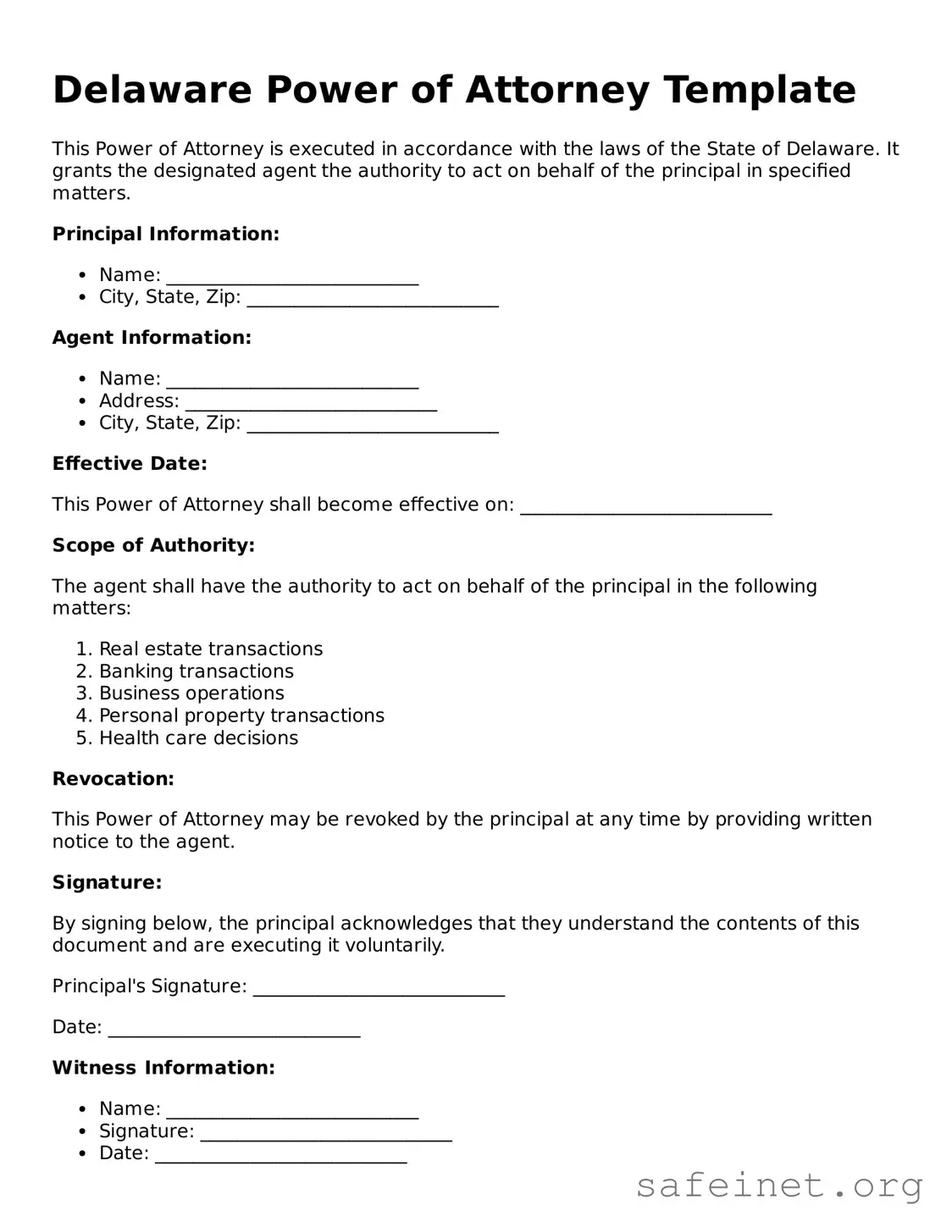
Delaware Power of Attorney Template
This Power of Attorney is executed in accordance with the laws of the State of Delaware. It grants the designated agent the authority to act on behalf of the principal in specified matters.
Principal Information:
Agent Information:
Effective Date:
This Power of Attorney shall become effective on: ___________________________
Scope of Authority:
The agent shall have the authority to act on behalf of the principal in the following matters:
Revocation:
This Power of Attorney may be revoked by the principal at any time by providing written notice to the agent.
Signature:
By signing below, the principal acknowledges that they understand the contents of this document and are executing it voluntarily.
Principal's Signature: ___________________________
Date: ___________________________
Witness Information:
Notary Public:
State of Delaware
County of ___________________________
Subscribed and sworn before me this _____ day of ______________, 20__.
Notary Public Signature: ___________________________
My commission expires: ___________________________
| Fact Name | Description |
|---|---|
| Definition | A Delaware Power of Attorney is a legal document that allows one person to authorize another to act on their behalf in financial or legal matters. |
| Governing Laws | The Delaware Power of Attorney is governed by Title 18, Chapter 170 of the Delaware Code. |
| Types | There are different types of Power of Attorney in Delaware, including General, Limited, and Durable Power of Attorney. |
| Durability | A Durable Power of Attorney remains effective even if the principal becomes incapacitated. |
| Execution Requirements | The document must be signed by the principal and acknowledged before a notary public or signed by two witnesses. |
| Revocation | The principal can revoke a Power of Attorney at any time, as long as they are mentally competent. |
| Agent's Authority | The agent's authority can be broad or limited, depending on what the principal specifies in the document. |
| Agent's Duties | The agent must act in the best interest of the principal and manage their affairs responsibly. |
| Filing Requirements | There is no requirement to file the Power of Attorney with any government agency, but it is advisable to keep it in a safe place. |
After you have gathered all necessary information, you are ready to fill out the Delaware Power of Attorney form. This document will allow you to appoint someone to act on your behalf in various matters. Follow the steps below to complete the form accurately.
After completing these steps, your Power of Attorney will be ready for use. Ensure that your agent understands their responsibilities and keep a copy of the document in a safe place.
What is a Power of Attorney in Delaware?
A Power of Attorney (POA) in Delaware is a legal document that allows one person, known as the principal, to designate another person, called the agent or attorney-in-fact, to make decisions on their behalf. This can include financial matters, healthcare decisions, or other legal actions. The principal can specify the powers granted to the agent, making it a flexible tool for managing personal affairs, especially in situations where the principal may be unable to act on their own due to illness, absence, or incapacity.
What types of Power of Attorney are available in Delaware?
Delaware offers several types of Power of Attorney forms, each serving different purposes. The most common types include: 1. General Power of Attorney: This grants broad powers to the agent to handle various financial and legal matters. 2. Limited Power of Attorney: This restricts the agent's authority to specific tasks or timeframes, such as managing a property sale. 3. Durable Power of Attorney: This remains effective even if the principal becomes incapacitated, ensuring that the agent can continue to act on their behalf. 4. Healthcare Power of Attorney: This specifically allows the agent to make medical decisions for the principal if they are unable to do so themselves. Choosing the right type depends on individual needs and circumstances.
How do I create a Power of Attorney in Delaware?
Creating a Power of Attorney in Delaware involves a few straightforward steps. First, the principal must select a trusted individual to act as their agent. Next, they should complete the appropriate Power of Attorney form, which can be obtained online or through legal resources. It’s essential to ensure that the form complies with Delaware laws, including the necessary signatures. The principal must sign the document in the presence of a notary public, who will then notarize the form. Once completed, the POA should be distributed to relevant parties, such as banks or healthcare providers, to ensure it is recognized when needed.
Can I revoke a Power of Attorney in Delaware?
Yes, a Power of Attorney can be revoked in Delaware as long as the principal is competent to do so. To revoke a POA, the principal must create a written document stating their intention to revoke it. This document should be signed and dated, and it is advisable to notify the agent and any institutions or individuals who were relying on the original Power of Attorney. If the POA was recorded with a county clerk, it is also wise to file the revocation with the same office to ensure clarity and prevent any confusion in the future.
Not specifying the powers granted: Many people forget to clearly outline the specific powers they are granting to their agent. This can lead to confusion about what decisions the agent can make on their behalf.
Failing to date the document: Omitting the date can create issues regarding the validity of the Power of Attorney. Always include the date when the document is signed.
Not having witnesses or notarization: Depending on the situation, the Power of Attorney may need to be witnessed or notarized. Skipping this step can make the document unenforceable.
Using outdated forms: Laws change. Using an outdated version of the Power of Attorney form can lead to complications. Always check for the most current form.
Not discussing the decision with the agent: It’s important to communicate with the person you are appointing. They should understand their responsibilities and your wishes.
Leaving out successor agents: If your primary agent is unable or unwilling to act, having a successor agent can prevent delays. Failing to name one can create problems.
Not reviewing the document regularly: Life changes. Regularly reviewing your Power of Attorney ensures it still reflects your wishes and circumstances.
Assuming all agents have the same authority: Different agents can have different powers. Be specific about what each agent can and cannot do.
Ignoring state-specific requirements: Each state has its own laws regarding Powers of Attorney. Ignoring these can lead to a document that is not valid in Delaware.
The Delaware Power of Attorney form allows an individual to designate another person to manage their financial or legal affairs. It is often used in conjunction with several other documents to ensure comprehensive management of a person's affairs. Below is a list of related forms and documents that may be beneficial to consider.
Considering these additional documents can provide a more complete framework for managing personal and financial affairs. Each serves a specific purpose and can help ensure that an individual's wishes are respected and carried out effectively.
The Delaware Power of Attorney form shares similarities with the General Power of Attorney. Both documents allow an individual, known as the principal, to designate another person, called the agent, to act on their behalf. This can include handling financial transactions, managing property, and making decisions related to the principal’s affairs. The general power of attorney is often used when the principal wants to grant broad authority to the agent, making it a versatile choice for many situations.
Another document that resembles the Delaware Power of Attorney is the Durable Power of Attorney. This form also allows the principal to appoint an agent to manage their affairs. However, the key difference lies in its durability. The Durable Power of Attorney remains in effect even if the principal becomes incapacitated. This feature makes it particularly useful for long-term planning, ensuring that decisions can still be made on the principal's behalf during challenging times.
The Medical Power of Attorney is another related document. While the Delaware Power of Attorney typically focuses on financial matters, the Medical Power of Attorney specifically grants an agent the authority to make healthcare decisions for the principal. This can include choices about medical treatments and end-of-life care. It is vital for individuals who want to ensure their health care preferences are honored when they are unable to communicate those wishes themselves.
The Springing Power of Attorney is similar in that it allows for the appointment of an agent. However, it only becomes effective under specific conditions, usually when the principal becomes incapacitated. This type of power of attorney can provide peace of mind, as it ensures that the agent's authority is limited to situations where the principal cannot act on their own.
The Limited Power of Attorney is another variant that shares similarities with the Delaware Power of Attorney. This document grants the agent authority to act on behalf of the principal for specific tasks or a limited period. For instance, it might be used for a real estate transaction or to manage a particular investment. This focused approach allows the principal to maintain control over their affairs while still delegating certain responsibilities.
Finally, the Financial Power of Attorney is closely related to the Delaware Power of Attorney. Both documents empower an agent to handle financial matters. However, the Financial Power of Attorney is specifically tailored for financial issues, such as managing bank accounts, paying bills, and filing taxes. It is an essential tool for individuals who want to ensure their financial interests are managed appropriately, especially if they are unable to do so themselves.
When filling out the Delaware Power of Attorney form, it is important to follow specific guidelines to ensure the document is valid and effective. Here are four things to do and four things to avoid:
Understanding the Delaware Power of Attorney form is crucial for effective legal planning. However, several misconceptions can lead to confusion. Here are five common misunderstandings:
Many people believe that a Power of Attorney is solely for managing financial affairs. In reality, it can also grant authority over healthcare decisions, property management, and other personal matters.
Some individuals think that a Power of Attorney continues to be effective even after the person who created it passes away. This is incorrect; the authority granted ceases upon the principal's death.
While it is true that most adults can serve as an agent, certain restrictions apply. For instance, the agent cannot be someone who is unable to act in the principal's best interest or has a conflict of interest.
This is a common myth. A Power of Attorney can be revoked at any time, as long as the principal is mentally competent. Proper procedures must be followed to ensure the revocation is valid.
Many people confuse these two documents. A Power of Attorney allows someone to make decisions on your behalf, while a living will specifically outlines your wishes regarding medical treatment if you become incapacitated.
Clarifying these misconceptions can help individuals make informed decisions about their legal documents and ensure their wishes are respected.
When considering the Delaware Power of Attorney form, several important aspects should be kept in mind to ensure it is filled out correctly and used effectively.
Using the Delaware Power of Attorney form effectively can provide peace of mind, knowing that your affairs will be managed according to your wishes, even if you cannot manage them yourself.