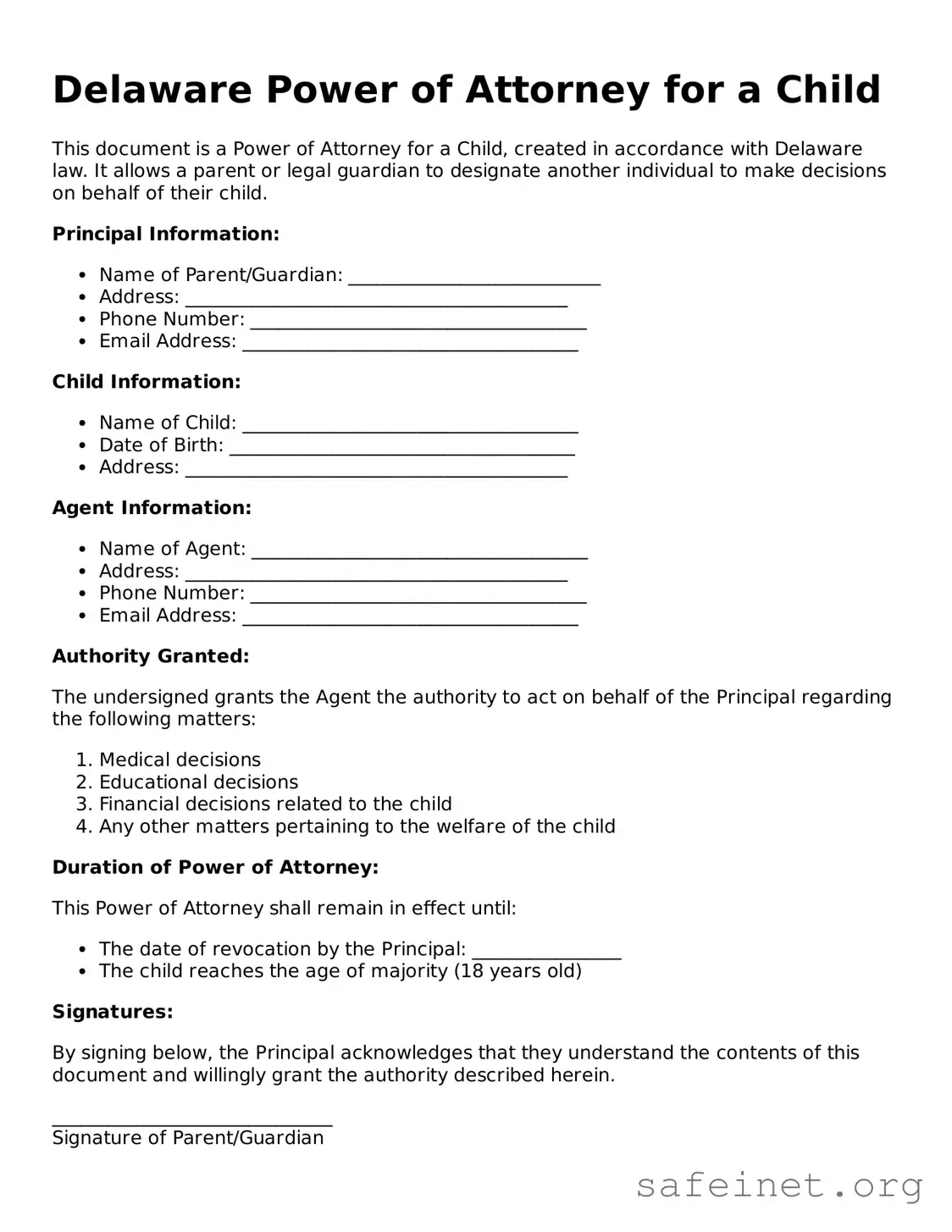
The Delaware Power of Attorney for a Child form serves as a crucial legal document that enables parents or guardians to designate another adult to make decisions on behalf of their child in specific situations. This form is particularly important for parents who may need to be away from their child for an extended period, whether due to work commitments, travel, or other obligations. It outlines the authority granted to the designated adult, often referred to as the agent, which can include making medical decisions, enrolling the child in school, and handling day-to-day care responsibilities. Additionally, the form provides flexibility, allowing parents to specify the duration of the authority and any limitations they wish to impose. Understanding the implications of this document is vital for ensuring that a child's needs are met when parents cannot be present. Parents must complete this form with care, as it plays a significant role in safeguarding their child's welfare and ensuring that trusted individuals are empowered to act in their absence.
Delaware Power of Attorney for a Child
This document is a Power of Attorney for a Child, created in accordance with Delaware law. It allows a parent or legal guardian to designate another individual to make decisions on behalf of their child.
Principal Information:
Child Information:
Agent Information:
Authority Granted:
The undersigned grants the Agent the authority to act on behalf of the Principal regarding the following matters:
Duration of Power of Attorney:
This Power of Attorney shall remain in effect until:
Signatures:
By signing below, the Principal acknowledges that they understand the contents of this document and willingly grant the authority described herein.
______________________________
Signature of Parent/Guardian
______________________________
Date
______________________________
Signature of Agent
______________________________
Date
| Fact Name | Details |
|---|---|
| Purpose | The Delaware Power of Attorney for a Child form allows a parent or guardian to designate another adult to make decisions on behalf of their child. |
| Legal Authority | This form is governed by Delaware Code Title 13, Chapter 707, which outlines the powers and responsibilities of the agent. |
| Duration | The authority granted can be effective immediately or can be set to begin at a future date, depending on the parent's wishes. |
| Revocation | The parent or guardian can revoke the Power of Attorney at any time, provided they notify the agent and any relevant parties. |
After obtaining the Delaware Power of Attorney for a Child form, you will need to complete it accurately. This form allows you to designate someone to make decisions on behalf of your child when you are unavailable. Follow the steps below to fill out the form correctly.
What is a Delaware Power of Attorney for a Child?
A Delaware Power of Attorney for a Child is a legal document that allows a parent or legal guardian to appoint another adult to make decisions on behalf of their child. This document can be useful in situations where the parent is unavailable, such as during travel or medical emergencies. The appointed individual, known as the agent, can handle various responsibilities, including medical decisions and educational needs.
Who can serve as an agent in the Power of Attorney for a Child?
The agent must be an adult, typically over the age of 18. This person can be a family member, friend, or trusted individual who is capable of making decisions in the best interest of the child. It is important to choose someone who understands the responsibilities involved and is willing to act in the child’s best interests.
How long is the Power of Attorney for a Child valid?
The validity of the Power of Attorney for a Child can vary based on the specific terms outlined in the document. Generally, it remains effective until the parent revokes it or until a specified date, which can be included in the document. Parents should review and update the document as necessary, especially if circumstances change.
Do I need to have the Power of Attorney for a Child notarized?
Yes, in Delaware, the Power of Attorney for a Child must be signed in the presence of a notary public. This step ensures that the document is legally binding and helps prevent any disputes regarding its authenticity. It is advisable to keep a copy of the notarized document for your records and to provide copies to the agent and any relevant parties.
Can the Power of Attorney for a Child be revoked?
Yes, a parent or legal guardian can revoke the Power of Attorney for a Child at any time. To do so, the parent should provide written notice to the agent and any relevant parties. It is also recommended to destroy any copies of the original document to avoid confusion. Keeping clear communication with the agent is essential during this process.
Not specifying the duration of the Power of Attorney.
It is crucial to indicate how long the authority will last. If this detail is missing, the document may be deemed ineffective.
Failing to identify the child clearly.
Make sure to include the child's full name, date of birth, and any other identifying information. Incomplete details can lead to confusion.
Overlooking the need for signatures.
Both the parent or guardian and the designated agent must sign the document. Without these signatures, the Power of Attorney is invalid.
Not having the document notarized.
In Delaware, notarization is often required to ensure the document's authenticity. Skipping this step can result in legal challenges.
When preparing a Delaware Power of Attorney for a Child, it's essential to consider other related documents that may be needed. These forms help clarify responsibilities and ensure that the child's best interests are prioritized. Below is a list of common documents that often accompany the Power of Attorney for a Child.
Having these documents ready can help ensure that the designated caregiver has all the necessary authority and information to act in the child's best interest. Each form serves a specific purpose and can facilitate smoother transitions in care and decision-making.
The Delaware Power of Attorney for a Child form is similar to the General Power of Attorney, which grants an individual the authority to act on behalf of another person in various matters. This document can be used for financial decisions, medical care, and other legal matters. Both forms empower someone to make decisions for another individual, but the General Power of Attorney is broader in scope, while the Power of Attorney for a Child specifically focuses on the needs and welfare of a minor.
Another document that shares similarities is the Medical Power of Attorney. This form allows a designated individual to make healthcare decisions on behalf of someone else. Like the Power of Attorney for a Child, the Medical Power of Attorney is crucial when the individual cannot express their wishes due to illness or incapacity. The key difference lies in the focus of the Medical Power of Attorney, which is exclusively on health-related decisions, whereas the Power of Attorney for a Child encompasses a wider range of responsibilities.
The Child Custody Agreement is also comparable, as it outlines the arrangements for the care and control of a child. Both documents emphasize the best interests of the child. However, a Child Custody Agreement is typically established through family court proceedings and addresses living arrangements, visitation, and parental responsibilities, while the Power of Attorney for a Child is a more informal arrangement that allows a designated individual to make decisions without court intervention.
The Guardianship Agreement is another related document. This legal arrangement appoints an individual to take care of a minor when their parents are unable to do so. While both documents serve to protect the child’s welfare, a Guardianship Agreement is usually a more permanent solution and requires court approval. In contrast, the Power of Attorney for a Child is often temporary and can be revoked by the parent at any time.
The Standby Guardian Designation also bears resemblance to the Power of Attorney for a Child. This document allows a parent to designate someone to care for their child in the event of an emergency or unforeseen circumstance. Both documents prioritize the child's safety and well-being. However, the Standby Guardian Designation is specifically intended for situations where the parent is unable to care for the child temporarily, whereas the Power of Attorney for a Child can be used for a variety of circumstances.
Another similar document is the Temporary Custody Agreement. This agreement allows a parent to grant temporary custody of their child to another individual. Like the Power of Attorney for a Child, it is often used in situations where a parent is unable to provide care. The Temporary Custody Agreement typically has a defined time frame, while the Power of Attorney for a Child can remain in effect until revoked or until a specified condition is met.
The Release of Liability Form for Child Activities is also related. This document is often used by parents to acknowledge the risks associated with certain activities and to release the organization from liability. Both documents aim to protect the child, but the Release of Liability Form is specifically focused on activities, while the Power of Attorney for a Child provides broader authority for decision-making in various aspects of the child’s life.
The Consent to Medical Treatment form is another document that bears similarity. This form allows a parent or guardian to give permission for medical treatment for their child. Both documents are essential for ensuring that a child receives necessary care when parents are not available. The key distinction is that the Consent to Medical Treatment form is limited to healthcare decisions, while the Power of Attorney for a Child encompasses a wider range of responsibilities.
Lastly, the Child Travel Consent form is comparable, as it grants permission for a child to travel with someone other than their parent or legal guardian. Both documents prioritize the safety and well-being of the child. However, the Child Travel Consent form is specifically focused on travel arrangements, while the Power of Attorney for a Child can address various aspects of a child's life, including education, health care, and general welfare.
When filling out the Delaware Power of Attorney for a Child form, it’s important to follow certain guidelines to ensure everything is done correctly. Here are five things to keep in mind:
These steps will help ensure that the Power of Attorney for a Child is valid and effective. Take your time and double-check your work to avoid any issues.
Understanding the Delaware Power of Attorney for a Child form is essential for parents and guardians. However, several misconceptions can lead to confusion. Here are ten common misconceptions explained:
Clearing up these misconceptions can help ensure that parents and guardians use the Power of Attorney for a Child effectively and appropriately.
When filling out and using the Delaware Power of Attorney for a Child form, there are several important points to keep in mind: