When starting a business in Delaware, understanding the Delaware Operating Agreement form is essential for ensuring a solid foundation for your company. This form outlines the internal structure and operational guidelines of your business entity, typically a limited liability company (LLC). It addresses key aspects such as the roles and responsibilities of members, decision-making processes, and how profits and losses will be distributed. Additionally, it can specify procedures for adding or removing members and how to handle disputes. Having a well-drafted Operating Agreement can help prevent misunderstandings and conflicts down the line, providing clarity and stability as your business grows. By taking the time to create this important document, you can safeguard your interests and set your company on a path to success.
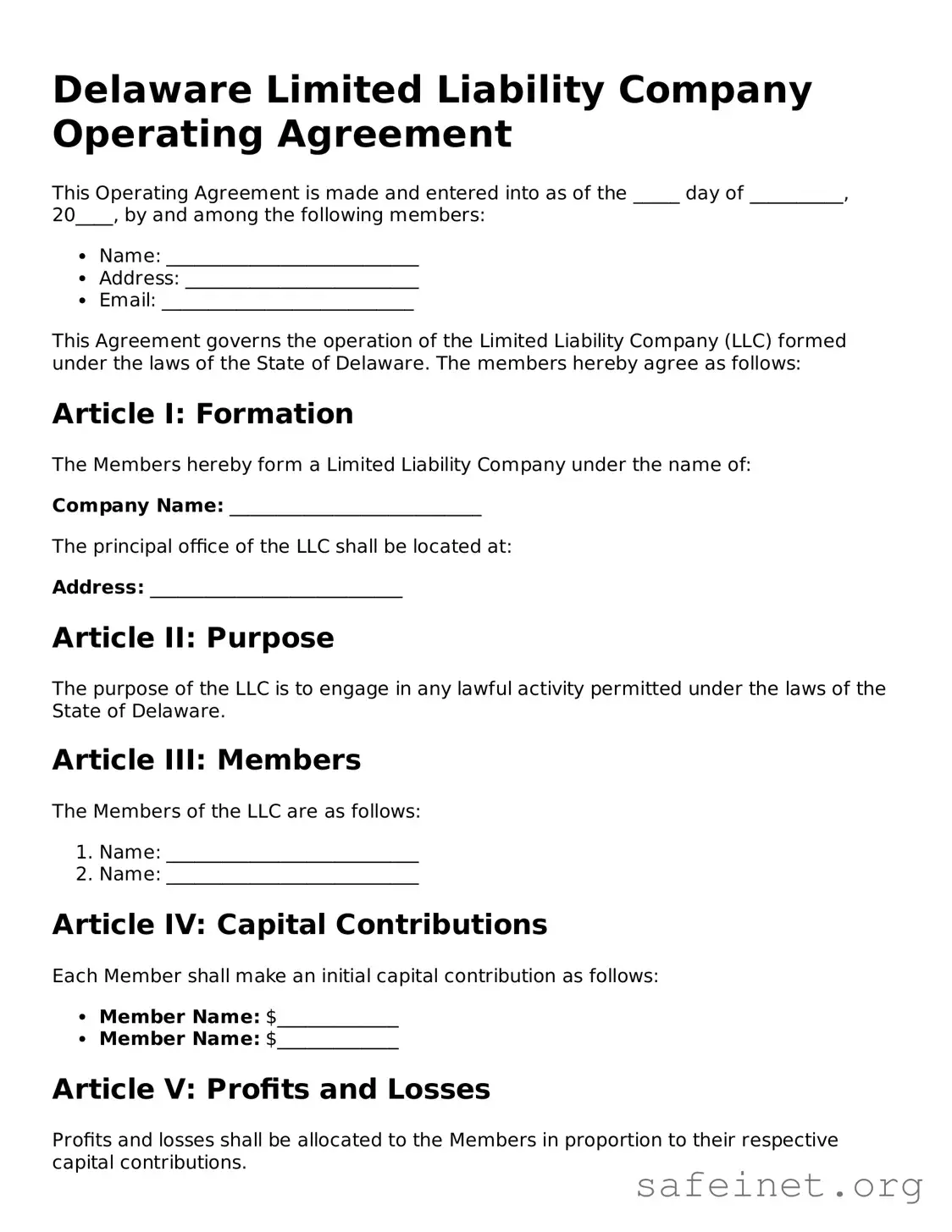
Delaware Limited Liability Company Operating Agreement
This Operating Agreement is made and entered into as of the _____ day of __________, 20____, by and among the following members:
This Agreement governs the operation of the Limited Liability Company (LLC) formed under the laws of the State of Delaware. The members hereby agree as follows:
Article I: Formation
The Members hereby form a Limited Liability Company under the name of:
Company Name: ___________________________
The principal office of the LLC shall be located at:
Address: ___________________________
Article II: Purpose
The purpose of the LLC is to engage in any lawful activity permitted under the laws of the State of Delaware.
Article III: Members
The Members of the LLC are as follows:
Article IV: Capital Contributions
Each Member shall make an initial capital contribution as follows:
Article V: Profits and Losses
Profits and losses shall be allocated to the Members in proportion to their respective capital contributions.
Article VI: Management
The LLC shall be managed by:
If manager-managed, the following individual(s) shall serve as the Manager(s):
Manager Name(s): ___________________________
Article VII: Meetings
Meetings of the Members shall be held at least annually. Special meetings may be called by any Member.
Article VIII: Indemnification
The LLC shall indemnify its Members and Managers to the fullest extent permitted by Delaware law.
Article IX: Amendments
This Agreement may be amended only by a written agreement signed by all Members.
Article X: Governing Law
This Agreement shall be governed by and construed in accordance with the laws of the State of Delaware.
IN WITNESS WHEREOF, the Members have executed this Operating Agreement as of the date first above written.
Member Signature: ___________________________
Member Signature: ___________________________
| Fact Name | Description |
|---|---|
| Governing Law | The Delaware Operating Agreement is governed by the Delaware Limited Liability Company Act. |
| Purpose | This document outlines the management structure and operating procedures of a Delaware LLC. |
| Flexibility | Delaware law allows significant flexibility in how members can structure their agreement. |
| Not Mandatory | While recommended, an Operating Agreement is not legally required for Delaware LLCs. |
Filling out the Delaware Operating Agreement form is a straightforward process. Follow these steps carefully to ensure that all necessary information is provided accurately.
After completing the form, review all entries for accuracy. Ensure that all members have a copy of the signed agreement for their records.
What is a Delaware Operating Agreement?
A Delaware Operating Agreement is a legal document that outlines the ownership and operating procedures of a limited liability company (LLC) formed in Delaware. It sets the rules for how the business will run, including management structure, member responsibilities, and distribution of profits and losses.
Why do I need an Operating Agreement for my LLC?
An Operating Agreement is essential for clarifying the roles and responsibilities of members within your LLC. It helps prevent misunderstandings and disputes among members. Additionally, having this document can protect your limited liability status by showing that your business is a separate entity from its owners.
Is an Operating Agreement required by Delaware law?
No, Delaware does not legally require LLCs to have an Operating Agreement. However, it is highly recommended to have one in place. Without it, your LLC will be governed by default state laws, which may not align with your intentions for your business.
Can I create my own Operating Agreement?
Yes, you can draft your own Operating Agreement. Many business owners choose to create one tailored to their specific needs. However, it’s important to ensure that it complies with Delaware laws and adequately covers all necessary aspects of your business operations.
What should be included in the Operating Agreement?
Your Operating Agreement should include details such as the LLC’s name, purpose, member contributions, management structure, voting rights, and procedures for adding or removing members. You may also want to address how profits and losses will be distributed and the process for dissolving the LLC if necessary.
How can I amend my Operating Agreement?
To amend your Operating Agreement, you will need to follow the process outlined in the original document. Typically, this involves obtaining consent from all members and documenting the changes in writing. Keep a copy of the amended agreement for your records.
Do I need to file my Operating Agreement with the state?
No, you do not need to file your Operating Agreement with the state of Delaware. However, it is important to keep it in a safe place and make it accessible to all members, as it serves as an internal document for your LLC.
Can I use a template for my Operating Agreement?
Using a template can be a good starting point for your Operating Agreement. Many templates are available online, but ensure that any template you choose is customizable and meets your specific needs. It’s wise to review the final document with a legal professional to ensure it’s comprehensive and compliant.
What happens if I don’t have an Operating Agreement?
If you do not have an Operating Agreement, your LLC will be subject to Delaware’s default rules for LLCs. This may lead to unexpected outcomes regarding management and profit distribution. It can also make resolving disputes more complicated. Having an Operating Agreement helps ensure that your business operates according to your wishes.
Neglecting to Define Roles Clearly: One common mistake is failing to specify the roles and responsibilities of each member. Without clear definitions, misunderstandings can arise, leading to conflicts down the line.
Inadequate Capital Contributions: Some individuals overlook the importance of detailing initial capital contributions. This can create confusion about ownership percentages and financial obligations, which are crucial for the business's operation.
Ignoring Voting Rights: Another frequent error is not addressing voting rights adequately. Each member should understand how decisions will be made and what their voting power entails. This oversight can result in significant disputes among members.
Failing to Include Exit Strategies: Many people forget to outline exit strategies for members. Planning for potential departures or the sale of membership interests is vital. Without this, the business may face challenges when a member decides to leave.
When forming a limited liability company (LLC) in Delaware, the Operating Agreement is a crucial document. However, it is often accompanied by several other important forms and documents that help establish the structure and governance of the business. Below is a list of some of these commonly used documents.
Each of these documents plays a significant role in the formation and operation of your LLC. Understanding their purpose can help ensure that your business is set up correctly and is compliant with Delaware laws. Taking the time to prepare these documents thoroughly can save you from potential issues down the road.
The Delaware Limited Liability Company (LLC) Certificate of Formation is a foundational document for establishing an LLC in Delaware. It outlines basic information such as the company name, registered agent, and duration. Similar to the Operating Agreement, it serves as a crucial legal document that helps define the structure and operational guidelines of the LLC, but it focuses more on the formal registration aspects rather than internal governance.
The Partnership Agreement is another document that shares similarities with the Operating Agreement. This agreement outlines the roles, responsibilities, and profit-sharing arrangements among partners in a business partnership. Like the Operating Agreement, it is essential for clarifying expectations and preventing disputes, ensuring that all parties are on the same page regarding their contributions and rights.
The Bylaws of a corporation serve a similar purpose to the Operating Agreement but are specific to corporate entities. Bylaws outline the governance structure, including the roles of directors and officers, meeting procedures, and voting rights. Both documents aim to establish clear operational procedures and decision-making processes, although bylaws are more focused on corporate governance rather than member management.
The Shareholders' Agreement is closely related to the Operating Agreement, particularly for LLCs with multiple members. This agreement details the rights and obligations of shareholders in a corporation. It addresses issues such as transfer of shares, voting rights, and dividend distribution. Like the Operating Agreement, it aims to prevent conflicts and ensure smooth operations among stakeholders.
The Employment Agreement is another document that shares some similarities with the Operating Agreement. This contract outlines the terms of employment for individuals within a company, including job responsibilities, compensation, and termination conditions. Both documents serve to clarify expectations and protect the interests of the parties involved, although the Employment Agreement focuses on individual roles rather than the overall company structure.
The Non-Disclosure Agreement (NDA) is a document that, while not directly related to governance, shares the goal of protecting sensitive information. An NDA establishes confidentiality obligations between parties, similar to how the Operating Agreement may include provisions for protecting company secrets. Both documents are essential for safeguarding the interests of the parties involved, especially in competitive industries.
The Buy-Sell Agreement is relevant for LLCs and corporations with multiple owners. This agreement outlines the procedures for buying out an owner’s interest in the event of death, disability, or voluntary exit. Similar to the Operating Agreement, it ensures that all parties understand their rights and obligations, thus helping to maintain stability within the business.
The Minutes of Meetings document is another important record that complements the Operating Agreement. While the Operating Agreement sets the rules for governance, the minutes provide a written account of decisions made during meetings. Both documents are essential for maintaining transparency and accountability within the organization, ensuring that all members are informed of key decisions and discussions.
The Articles of Incorporation serve as the foundational document for corporations, much like the Certificate of Formation for LLCs. They establish the existence of the corporation and include essential information such as the company name, purpose, and registered agent. While the Articles of Incorporation focus on formal registration, the Operating Agreement provides the internal rules and governance structure necessary for day-to-day operations.
Lastly, the Franchise Agreement is a document that outlines the relationship between a franchisor and a franchisee. While it is specific to franchise operations, it shares the goal of defining roles, responsibilities, and operational guidelines. Both the Franchise Agreement and the Operating Agreement aim to create a clear understanding between parties to facilitate smooth business operations.
When filling out the Delaware Operating Agreement form, it’s important to follow certain guidelines to ensure accuracy and compliance. Here’s a list of things you should and shouldn’t do:
When it comes to forming a Limited Liability Company (LLC) in Delaware, the Operating Agreement is a crucial document. However, many misconceptions surround this form. Here’s a breakdown of some common myths and the truths behind them.
Understanding these misconceptions can help LLC members make informed decisions about their Operating Agreements, ensuring their business operates smoothly and effectively.
When it comes to establishing a Limited Liability Company (LLC) in Delaware, the Operating Agreement is a crucial document. It outlines the management structure and operational guidelines for the business. Here are some key takeaways to consider when filling out and using the Delaware Operating Agreement form:
By keeping these points in mind, members can create a comprehensive Operating Agreement that serves as a solid foundation for their LLC in Delaware. This document not only clarifies roles and responsibilities but also helps prevent misunderstandings in the future.