In the realm of landlord-tenant relationships, clear communication and adherence to legal protocols are essential for maintaining harmony and resolving disputes. The Delaware Notice to Quit form serves as a crucial tool in this context, particularly when a landlord seeks to terminate a lease agreement due to specific reasons such as non-payment of rent or violation of lease terms. This form is not merely a piece of paper; it represents a formal notification to tenants, outlining their obligations and the potential consequences of failing to comply. By providing details such as the reason for termination, the required notice period, and instructions for rectifying the situation, the Notice to Quit establishes a transparent framework for both parties. Understanding the nuances of this form is vital for landlords to ensure compliance with state laws and for tenants to grasp their rights and responsibilities. Ultimately, the effective use of the Delaware Notice to Quit form can facilitate a smoother transition, whether it leads to resolution or the eventual need for eviction proceedings.
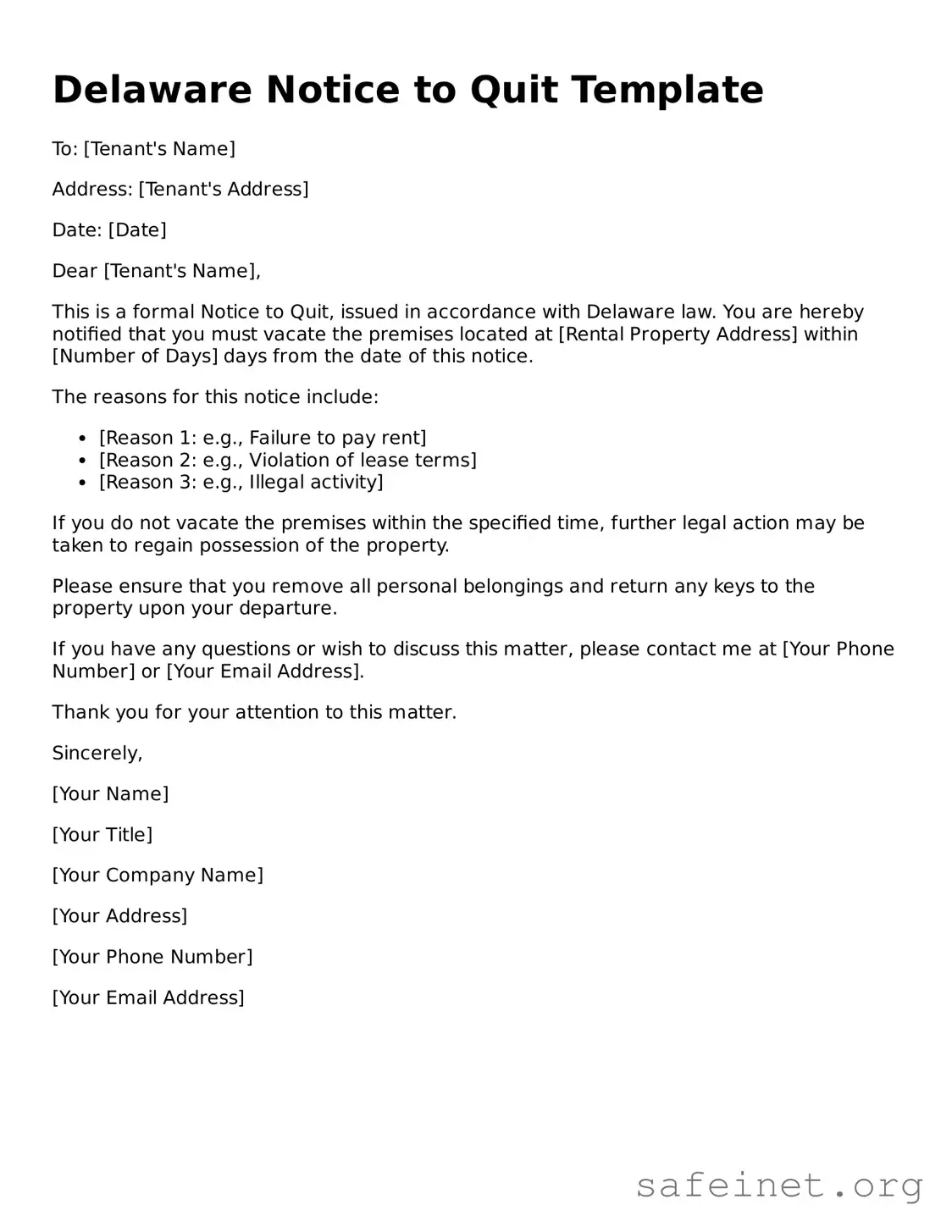
Delaware Notice to Quit Template
To: [Tenant's Name]
Address: [Tenant's Address]
Date: [Date]
Dear [Tenant's Name],
This is a formal Notice to Quit, issued in accordance with Delaware law. You are hereby notified that you must vacate the premises located at [Rental Property Address] within [Number of Days] days from the date of this notice.
The reasons for this notice include:
If you do not vacate the premises within the specified time, further legal action may be taken to regain possession of the property.
Please ensure that you remove all personal belongings and return any keys to the property upon your departure.
If you have any questions or wish to discuss this matter, please contact me at [Your Phone Number] or [Your Email Address].
Thank you for your attention to this matter.
Sincerely,
[Your Name]
[Your Title]
[Your Company Name]
[Your Address]
[Your Phone Number]
[Your Email Address]
| Fact Name | Description |
|---|---|
| Purpose | The Delaware Notice to Quit form is used by landlords to notify tenants of their intent to terminate the rental agreement. |
| Governing Law | The form is governed by Delaware Code, Title 25, Chapter 5501, which outlines the rights and responsibilities of landlords and tenants. |
| Delivery Methods | The notice can be delivered in person, by certified mail, or by posting it on the tenant's door. |
| Notice Period | Landlords must provide tenants with a minimum of 5 days' notice before filing for eviction. |
| Contents Required | The form must include the reason for termination, the date by which the tenant must vacate, and the landlord's contact information. |
| Tenant's Rights | Tenants have the right to contest the eviction in court if they believe the notice is unjustified. |
| Form Accessibility | The Notice to Quit form is available online through the Delaware state government website and can be downloaded for use. |
After completing the Delaware Notice to Quit form, the next step involves delivering it to the tenant. This serves as a formal notification regarding the termination of the rental agreement. Ensure that you follow the appropriate delivery method to maintain compliance with legal requirements.
What is a Delaware Notice to Quit form?
The Delaware Notice to Quit form is a legal document that a landlord uses to inform a tenant that they must vacate the rental property. This notice is typically issued when a tenant has violated the lease agreement, such as failing to pay rent or causing damage to the property. It serves as a formal request to leave the premises and begins the eviction process if the tenant does not comply.
How much notice must a landlord provide with the Notice to Quit?
In Delaware, the amount of notice a landlord must provide depends on the reason for the eviction. Generally, if a tenant fails to pay rent, the landlord must give at least five days' notice. For other lease violations, such as damaging property or violating lease terms, the notice period can vary. It's important for landlords to follow the specific requirements outlined in Delaware law to ensure the notice is valid.
What should be included in a Notice to Quit?
A proper Notice to Quit should include several key elements. First, it should clearly state the date of the notice and the address of the rental property. Next, the reason for the eviction must be specified, whether it's non-payment of rent or another lease violation. Additionally, the notice should indicate the time frame the tenant has to vacate the property. Lastly, the landlord's contact information should be included for any questions or further communication.
What happens if a tenant does not comply with the Notice to Quit?
If a tenant fails to comply with the Notice to Quit and does not vacate the property within the specified time frame, the landlord may proceed with filing an eviction lawsuit in the local court. This legal action can lead to a court hearing, where both the landlord and tenant can present their cases. If the court rules in favor of the landlord, a judgment will be issued, allowing for the tenant's removal from the property. It's crucial for landlords to follow the legal process to avoid complications.
Incorrect Tenant Information: Filling in the tenant's name incorrectly or using nicknames can lead to confusion. Ensure the full legal name is used.
Wrong Property Address: Double-check the property address. An incomplete or incorrect address can invalidate the notice.
Missing Signature: Forgetting to sign the form is a common oversight. A signature is crucial for the notice to be considered valid.
Failure to State the Reason: Not providing a clear reason for the notice can lead to disputes. Clearly state the reason for the eviction.
Improper Delivery Method: Using an incorrect method to deliver the notice can cause delays. Follow the required delivery methods outlined in Delaware law.
Not Providing Sufficient Time: Ensure that the notice provides the tenant with the appropriate amount of time to respond. Check Delaware's regulations for specific time frames.
Omitting Date of Notice: Failing to include the date on which the notice was issued can lead to confusion regarding the timeline.
Using Outdated Forms: Always use the most current version of the Notice to Quit form. Outdated forms may not comply with current laws.
Not Keeping Copies: Failing to keep a copy of the completed notice for your records can create problems later. Always retain a copy.
Ignoring Local Laws: Each municipality may have additional requirements. Be aware of local regulations that may affect the notice.
When dealing with rental agreements and evictions in Delaware, several documents may accompany the Notice to Quit form. Each of these documents serves a specific purpose and helps ensure that the process is handled correctly. Below is a list of commonly used forms and documents.
Understanding these documents can help both landlords and tenants navigate their rights and responsibilities effectively. It is important to keep all paperwork organized and to follow the legal requirements in Delaware when dealing with rental issues.
The Delaware Notice to Quit form is similar to the Eviction Notice, commonly used in various states. Both documents serve as formal notifications to tenants, indicating that they must vacate the rental property. The Eviction Notice typically outlines the reason for the eviction, such as non-payment of rent or lease violations, and provides a specific timeframe for the tenant to leave. Like the Notice to Quit, it is an essential step in the eviction process, allowing landlords to take further legal action if necessary.
Another document that shares similarities is the Lease Termination Letter. This letter is often used by landlords or tenants to formally end a rental agreement. It specifies the date on which the lease will terminate and may include reasons for the termination. Both the Lease Termination Letter and the Notice to Quit provide clear communication about the end of tenancy, ensuring that all parties are aware of their rights and responsibilities.
The 30-Day Notice to Vacate is also akin to the Delaware Notice to Quit. This document is typically issued by landlords to tenants, giving them a full month to prepare for their departure. The Notice to Quit may serve a similar purpose, but it often has specific legal implications depending on the situation. Both documents emphasize the importance of providing adequate notice to vacate, helping to prevent misunderstandings and disputes.
The Notice of Non-Renewal is another comparable document. This notice is used when a landlord decides not to renew a lease agreement at its expiration. It informs the tenant that they must vacate the premises once the lease term ends. Both the Notice of Non-Renewal and the Notice to Quit serve to communicate important changes in the tenancy status, ensuring that tenants are aware of their need to move out.
The Demand for Rent is similar in that it is a formal request from a landlord to a tenant for overdue rent payments. While the Notice to Quit focuses on vacating the property, the Demand for Rent emphasizes the financial obligation of the tenant. Both documents are critical in maintaining clear communication and establishing a timeline for resolving issues related to tenancy.
The Cure or Quit Notice is another related document. This notice is issued when a tenant has violated a term of the lease, such as failing to maintain the property. The Cure or Quit Notice gives the tenant a chance to rectify the issue within a specified timeframe. Like the Notice to Quit, it serves as a precursor to further legal action, highlighting the need for compliance with lease terms.
The Notice to Pay Rent or Quit is closely related as well. This document notifies tenants that they are behind on rent and must either pay the outstanding amount or vacate the property. Both this notice and the Notice to Quit aim to address issues of non-payment, ensuring that tenants understand the consequences of their financial obligations.
The Notice of Lease Violation is another similar document. This notice is issued when a tenant breaches specific terms of the lease agreement. It outlines the violations and may provide a timeframe for the tenant to correct them. Both the Notice of Lease Violation and the Notice to Quit are vital in protecting the rights of landlords while also providing tenants with an opportunity to address issues before further action is taken.
The Summary Process Notice is also comparable. This document initiates the legal process for eviction in some jurisdictions. It informs the tenant of the landlord's intention to pursue legal action if they do not vacate. Both the Summary Process Notice and the Notice to Quit serve as formal warnings, emphasizing the seriousness of the situation and the potential consequences of remaining in the property.
Lastly, the Notice of Intent to Evict is similar in its purpose. This notice informs tenants that the landlord intends to proceed with eviction proceedings if they do not comply with the terms of the lease. Both documents are essential in the eviction process, providing tenants with clear information about their situation and the steps they need to take to avoid eviction.
When filling out the Delaware Notice to Quit form, it’s essential to follow specific guidelines to ensure the process goes smoothly. Here’s a list of things you should and shouldn’t do:
Understanding the Delaware Notice to Quit form is essential for both landlords and tenants. However, several misconceptions can lead to confusion and missteps. Below is a list of common misconceptions regarding this important document.
Addressing these misconceptions can help both landlords and tenants navigate the process more effectively and ensure compliance with Delaware law.
When dealing with the Delaware Notice to Quit form, it is essential to understand its purpose and the correct way to complete it. Below are key takeaways to keep in mind:
Understanding these points can help landlords navigate the eviction process more effectively.