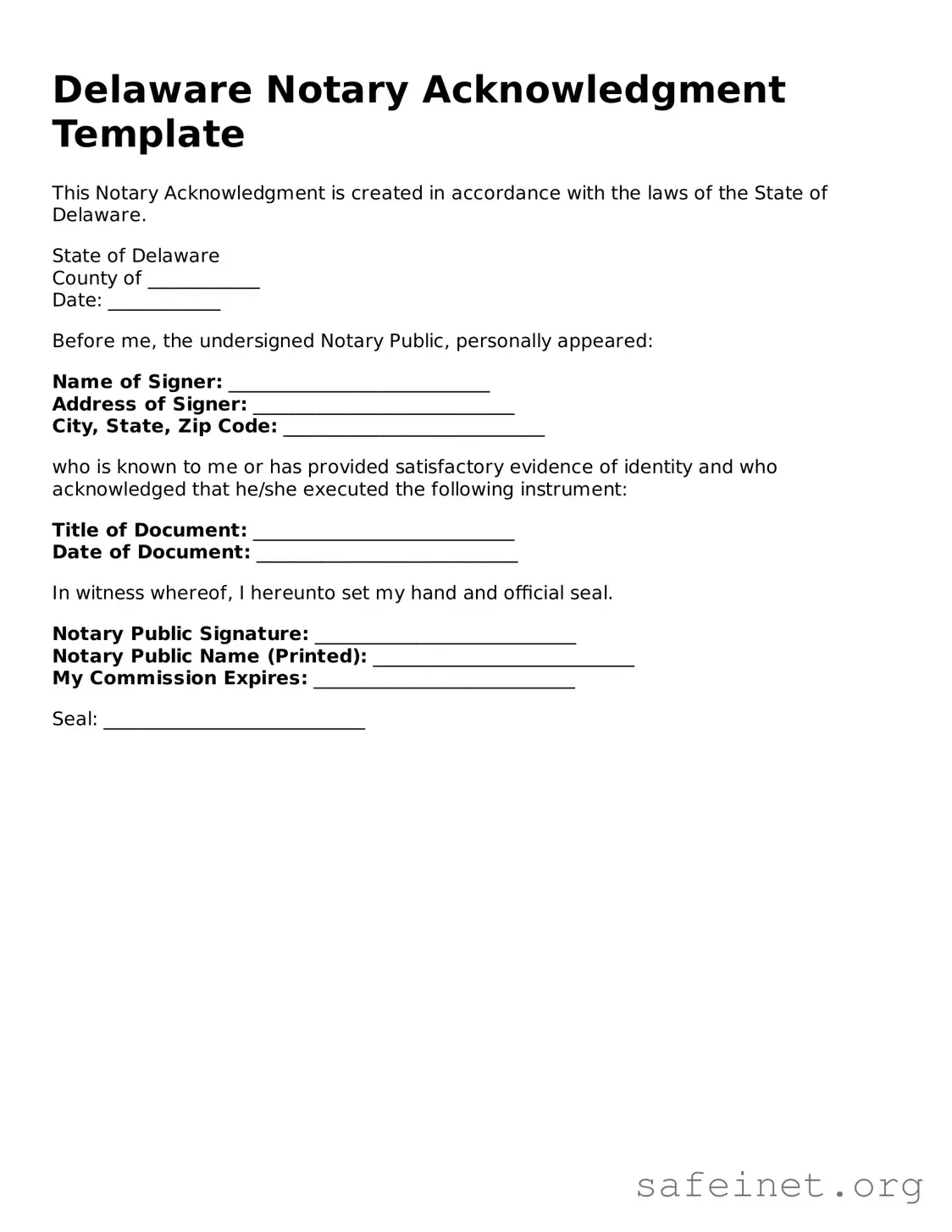
The Delaware Notary Acknowledgement form is an essential document in the realm of notarization, serving as a vital tool for verifying the identity of signers and the authenticity of signatures on various legal documents. This form is particularly important for individuals and businesses looking to ensure that their agreements and transactions are legally binding. Key elements of the form include the name of the individual whose signature is being acknowledged, the date of the acknowledgment, and the notary's official seal. Additionally, the form requires the notary public to certify that they have witnessed the signing of the document, providing an extra layer of protection against fraud. Understanding the intricacies of this form is crucial for anyone involved in legal proceedings or transactions in Delaware, as it helps maintain the integrity of the notarization process. With the right knowledge, individuals can navigate the requirements effectively and ensure that their documents hold up under scrutiny.
Delaware Notary Acknowledgment Template
This Notary Acknowledgment is created in accordance with the laws of the State of Delaware.
State of Delaware
County of ____________
Date: ____________
Before me, the undersigned Notary Public, personally appeared:
Name of Signer: ____________________________
Address of Signer: ____________________________
City, State, Zip Code: ____________________________
who is known to me or has provided satisfactory evidence of identity and who acknowledged that he/she executed the following instrument:
Title of Document: ____________________________
Date of Document: ____________________________
In witness whereof, I hereunto set my hand and official seal.
Notary Public Signature: ____________________________
Notary Public Name (Printed): ____________________________
My Commission Expires: ____________________________
Seal: ____________________________
| Fact Name | Description |
|---|---|
| Purpose | The Delaware Notary Acknowledgement form is used to verify the identity of a signer and their willingness to sign a document. |
| Governing Law | This form is governed by Title 29, Chapter 4320 of the Delaware Code. |
| Signature Requirement | The signer must personally appear before the notary public at the time of the acknowledgment. |
| Identification | The notary must verify the identity of the signer through a government-issued photo ID or other acceptable forms of identification. |
| Document Types | This acknowledgment can be used for various documents, including contracts, deeds, and affidavits. |
| Notary Seal | A notary public must affix their official seal to the acknowledgment form to validate it. |
| Record Keeping | Notaries are required to maintain a record of all acknowledgments performed in their notary journal. |
| Fees | Delaware law permits notaries to charge a fee for their services, which is typically capped at $5 per acknowledgment. |
| Expiration | The acknowledgment does not expire; however, the notary's commission must be active for the acknowledgment to be valid. |
| Legal Importance | An acknowledgment provides legal proof that a document was signed voluntarily and with the proper authority. |
After obtaining the Delaware Notary Acknowledgement form, you will need to complete it accurately to ensure it is valid. Follow these steps carefully to fill out the form correctly.
Once the form is completed, it is ready for submission or filing as required. Ensure that all information is accurate and legible to avoid any issues in the future.
What is a Delaware Notary Acknowledgement form?
The Delaware Notary Acknowledgement form is a legal document used to verify the identity of individuals signing a document. This form serves as a certification by a notary public that the signer appeared before them, acknowledged that they signed the document willingly, and understood its contents. It adds a layer of authenticity to various legal documents, such as contracts, deeds, and affidavits.
When do I need to use a Notary Acknowledgement form?
You typically need to use a Notary Acknowledgement form when executing important legal documents that require verification of signatures. This includes real estate transactions, powers of attorney, and any situation where the authenticity of the signature is crucial. Many institutions, such as banks and courts, may require notarized documents to ensure their validity.
Who can act as a notary public in Delaware?
In Delaware, a notary public must be at least 18 years old, a resident of the state, or a resident of a neighboring state who is employed in Delaware. They must also be appointed by the Secretary of State. Notaries are responsible for verifying identities and ensuring that signers are acting voluntarily and with a sound mind.
How do I complete the Notary Acknowledgement form?
To complete the Notary Acknowledgement form, you will need to follow a few steps. First, ensure that the signer is present before the notary. The notary will ask the signer to provide valid identification to confirm their identity. After the signer acknowledges their signature, the notary will fill out the form, including details such as the date, location, and their official seal. Both the notary and the signer will then sign the form.
Is there a fee for notarization in Delaware?
Yes, notaries in Delaware are allowed to charge a fee for their services. The maximum fee for most notarial acts is $5. However, some notaries may charge more for additional services or travel expenses. It is always a good idea to confirm the fee with the notary before proceeding with the notarization.
How long is a Notary Acknowledgement form valid?
The validity of a Notary Acknowledgement form does not have a specific expiration date; it remains valid as long as the document it accompanies is valid. However, it is important to remember that the legal significance of the document may depend on the context in which it is used. For example, certain documents may have their own expiration dates or conditions for validity.
Incorrect Signatory Information: One common mistake is failing to provide the correct name of the person signing the document. It is essential that the name matches exactly as it appears on their identification.
Missing Date: Some individuals forget to include the date on which the acknowledgment is being made. This can lead to confusion about when the document was notarized.
Improper Notary Seal: The notary's seal must be clear and legible. If it is smudged or partially missing, the acknowledgment may be deemed invalid.
Notary Signature Issues: The notary must sign the form in the designated area. Skipping this step or signing in the wrong place can result in the form being rejected.
Failure to Verify Identification: A notary must verify the identity of the signer. If the notary does not check the appropriate identification or fails to document it properly, it can lead to legal complications.
When engaging in legal transactions or formal agreements in Delaware, several documents often accompany the Notary Acknowledgement form. Each of these documents serves a specific purpose and contributes to the overall validity and enforceability of the agreements being executed. Below is a list of common forms and documents that are frequently used alongside the Notary Acknowledgement form.
Understanding these documents can significantly enhance the clarity and effectiveness of legal transactions. Each form plays a crucial role in ensuring that agreements are properly executed and legally binding, thereby protecting the interests of all parties involved.
The Delaware Notary Acknowledgment form is similar to the Affidavit of Identity. Both documents serve to confirm the identity of a signer. In an Affidavit of Identity, a person swears to their identity in front of a notary, providing assurance that the individual presenting the document is indeed who they claim to be. This is crucial in legal situations where identity verification is necessary to prevent fraud or misrepresentation.
Another document that shares similarities is the Power of Attorney. Like the Notary Acknowledgment, a Power of Attorney requires a notary to verify the identity of the individual granting authority. This ensures that the person signing the document is doing so willingly and understands the implications of granting someone else the power to act on their behalf. Both documents protect against unauthorized actions and help maintain the integrity of legal transactions.
The Affidavit is also comparable to the Delaware Notary Acknowledgment form. An Affidavit is a written statement confirmed by oath or affirmation, often used in legal proceedings. When a notary acknowledges an Affidavit, they verify that the person making the statement is doing so under oath, which adds a layer of credibility. This process is similar to the acknowledgment, where the notary confirms the identity of the signer and the voluntary nature of their signature.
Another related document is the Deed. A property deed often requires a notary acknowledgment to ensure that the person transferring the property is doing so willingly and with full understanding. This is similar to the Delaware Notary Acknowledgment form, which serves to validate the signature and the intent behind the document. Both processes are essential in real estate transactions to protect the interests of all parties involved.
The Certificate of Acknowledgment is closely related as well. This document is specifically designed to confirm that a notary has verified the identity of a signer. In both cases, the notary's role is to ensure that the person signing the document is present and understands what they are signing. This serves as a safeguard against potential disputes over the authenticity of signatures.
Similar to these documents is the Bill of Sale. A Bill of Sale may require a notary acknowledgment to validate the transfer of ownership of personal property. The notary's role is to confirm the identities of the parties involved and ensure that the transaction is legitimate. This process mirrors the Delaware Notary Acknowledgment form in its focus on verifying identity and intent.
The Will also shares similarities with the Notary Acknowledgment form. While not all Wills require notarization, having a notary acknowledge the signature can help validate the document and confirm that the testator was of sound mind and acting voluntarily. This adds a layer of protection against challenges to the Will, much like the acknowledgment process helps ensure the integrity of other legal documents.
The Trust Agreement is another document that can be similar to the Delaware Notary Acknowledgment form. A Trust Agreement often requires notarization to confirm the identities of the parties involved and the voluntary nature of their agreement. The notary's acknowledgment helps ensure that all parties understand their roles and responsibilities, similar to the assurance provided by the Notary Acknowledgment form.
Lastly, the Consent to Travel document is comparable. This form often requires notarization to confirm that a parent or guardian consents to a child traveling with another adult. The notary's role is to verify the identity of the consenting party, ensuring that the consent is legitimate and voluntary. This parallels the purpose of the Delaware Notary Acknowledgment, which is to affirm the identity of the signer and the authenticity of their intent.
When filling out the Delaware Notary Acknowledgement form, it is important to follow certain guidelines to ensure accuracy and compliance. Here are four things you should and shouldn't do:
Understanding the Delaware Notary Acknowledgement form is essential for anyone involved in notarization. However, several misconceptions can lead to confusion. Here are six common misunderstandings:
Notary Acknowledgements are only for real estate transactions. Many people believe that these forms are solely used in real estate dealings. In reality, they can be used for various documents, including contracts, powers of attorney, and more.
All notaries can perform any type of notarization. While notaries have a broad range of powers, they must adhere to state-specific guidelines. Some documents may require additional qualifications or certifications that not all notaries possess.
Signatures must be made in front of the notary. This is a common belief, but it is not entirely accurate. The signer must appear before the notary, but they can sign the document in advance as long as the notary witnesses the signing process.
A notary can provide legal advice. Many assume that notaries can explain the legal implications of the documents they are notarizing. However, notaries are prohibited from offering legal advice or interpreting the content of documents.
Notarization guarantees the authenticity of a document. While notarization serves to verify the identity of the signer, it does not guarantee the validity or accuracy of the content within the document itself.
Once notarized, a document cannot be changed. Some individuals think that once a document has been notarized, it is set in stone. In fact, documents can be amended after notarization, but any changes may require re-notarization to ensure validity.
By addressing these misconceptions, individuals can navigate the notarization process with greater clarity and confidence.
When filling out and using the Delaware Notary Acknowledgement form, it is important to understand its purpose and requirements. Below are key takeaways to consider:
Understanding these aspects can help ensure that the notarial process is conducted smoothly and effectively.