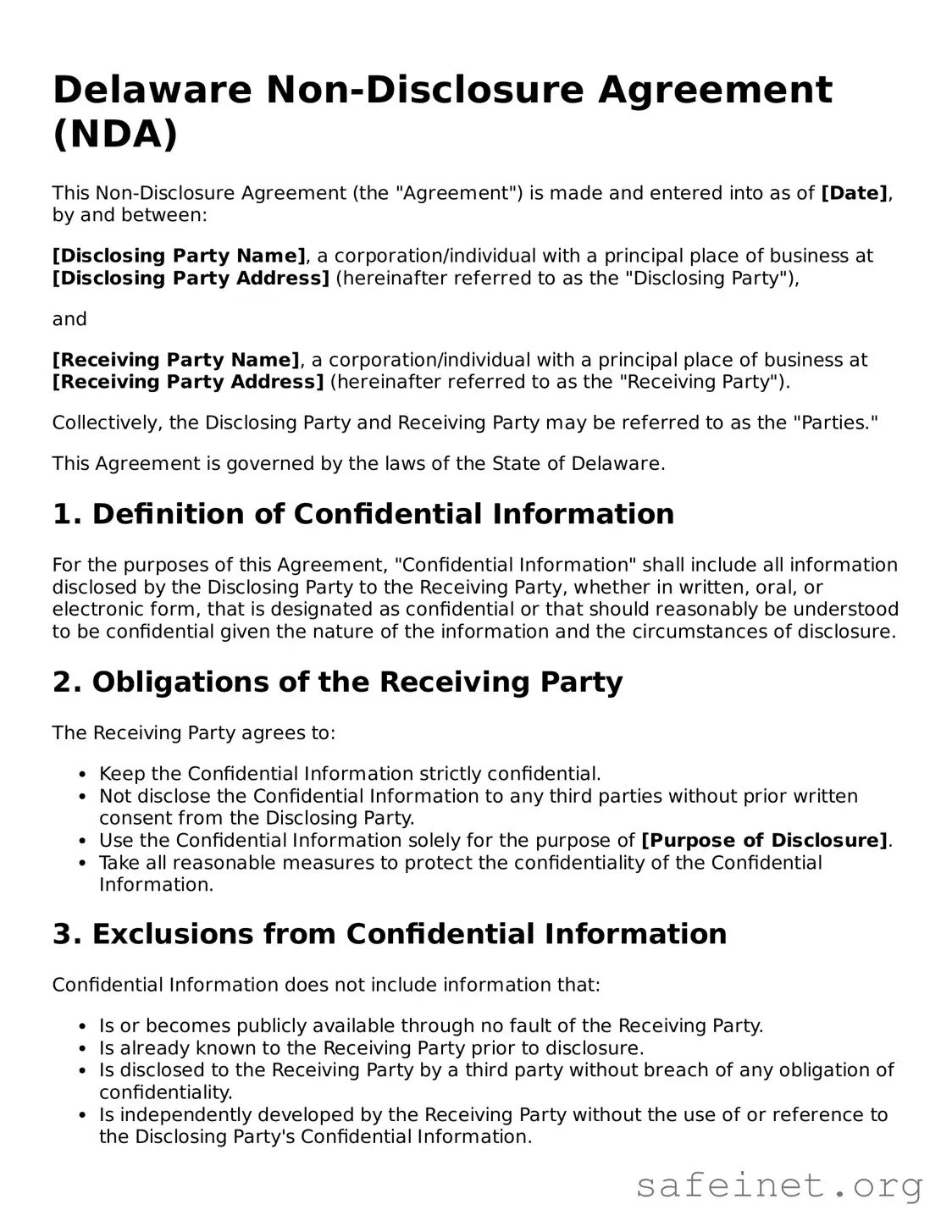
In the world of business, confidentiality is paramount. A Delaware Non-disclosure Agreement (NDA) serves as a crucial tool for protecting sensitive information shared between parties. This legal document outlines the terms under which confidential information can be disclosed and establishes the obligations of each party to maintain that confidentiality. Key aspects of the NDA include the definition of what constitutes confidential information, the duration of the confidentiality obligation, and the consequences of breaching the agreement. Additionally, the form typically specifies the permitted uses of the disclosed information and any exclusions that may apply. By clearly delineating these terms, a Delaware NDA helps foster trust between businesses, encouraging open communication while safeguarding proprietary information. Understanding the intricacies of this form is essential for anyone looking to engage in partnerships, collaborations, or any situation where sensitive information is exchanged.
Delaware Non-Disclosure Agreement (NDA)
This Non-Disclosure Agreement (the "Agreement") is made and entered into as of [Date], by and between:
[Disclosing Party Name], a corporation/individual with a principal place of business at [Disclosing Party Address] (hereinafter referred to as the "Disclosing Party"),
and
[Receiving Party Name], a corporation/individual with a principal place of business at [Receiving Party Address] (hereinafter referred to as the "Receiving Party").
Collectively, the Disclosing Party and Receiving Party may be referred to as the "Parties."
This Agreement is governed by the laws of the State of Delaware.
1. Definition of Confidential Information
For the purposes of this Agreement, "Confidential Information" shall include all information disclosed by the Disclosing Party to the Receiving Party, whether in written, oral, or electronic form, that is designated as confidential or that should reasonably be understood to be confidential given the nature of the information and the circumstances of disclosure.
2. Obligations of the Receiving Party
The Receiving Party agrees to:
3. Exclusions from Confidential Information
Confidential Information does not include information that:
4. Term
This Agreement shall commence on the date first written above and shall continue for a period of [Duration] unless terminated earlier by either Party with [Notice Period] written notice to the other Party.
5. Return of Materials
Upon termination of this Agreement, the Receiving Party shall promptly return or destroy all materials containing Confidential Information, including any copies thereof.
6. No License
Nothing in this Agreement shall be construed as granting any rights to the Receiving Party in or to the Confidential Information, except as expressly set forth herein.
7. Governing Law
This Agreement shall be governed by and construed in accordance with the laws of the State of Delaware.
8. Entire Agreement
This Agreement constitutes the entire understanding between the Parties regarding the subject matter hereof and supersedes all prior agreements and understandings, whether written or oral, relating to such subject matter.
IN WITNESS WHEREOF, the Parties hereto have executed this Non-Disclosure Agreement as of the date first above written.
Disclosing Party: ___________________________
Name: [Name]
Title: [Title]
Date: [Date]
Receiving Party: ___________________________
Name: [Name]
Title: [Title]
Date: [Date]
| Fact Name | Details |
|---|---|
| Purpose | A Delaware Non-disclosure Agreement (NDA) is designed to protect confidential information shared between parties. |
| Parties Involved | The NDA typically involves at least two parties: the disclosing party and the receiving party. |
| Duration of Confidentiality | NDAs can specify a duration for which the information must remain confidential, often ranging from 1 to 5 years. |
| Governing Law | Delaware law governs the interpretation and enforcement of NDAs executed in the state. |
| Exclusions | Common exclusions from confidentiality include information that is publicly available or independently developed. |
| Enforcement | If a breach occurs, the injured party may seek legal remedies, including injunctions and monetary damages. |
Completing the Delaware Non-disclosure Agreement form requires careful attention to detail. This document serves as a formal mechanism to protect sensitive information shared between parties. Following the steps outlined below will ensure that the form is filled out correctly, facilitating a smooth process for both parties involved.
What is a Delaware Non-disclosure Agreement (NDA)?
A Delaware Non-disclosure Agreement is a legal contract that protects sensitive information shared between parties. It ensures that the recipient of the information does not disclose it to others. NDAs are commonly used in business settings to safeguard trade secrets, proprietary information, and other confidential data.
Who typically uses a Delaware NDA?
Businesses, entrepreneurs, and individuals often use Delaware NDAs. They are particularly common in situations where companies need to share confidential information with potential partners, investors, or employees. Anyone looking to protect their sensitive information can benefit from this type of agreement.
What information can be protected by a Delaware NDA?
A Delaware NDA can protect a wide range of information, including business plans, customer lists, financial data, marketing strategies, and technical specifications. Essentially, any information that is not publicly available and gives a business a competitive edge can be covered under an NDA.
How long does a Delaware NDA last?
The duration of a Delaware NDA can vary based on the agreement between the parties involved. Typically, NDAs specify a time frame during which the information must remain confidential. This duration can range from a few years to indefinitely, depending on the nature of the information and the agreement terms.
What happens if someone breaches a Delaware NDA?
If a party breaches a Delaware NDA, the injured party may seek legal remedies. This could include monetary damages or injunctive relief to prevent further disclosure of the confidential information. The specific consequences depend on the terms outlined in the NDA and the severity of the breach.
Is a Delaware NDA enforceable in other states?
Generally, a Delaware NDA can be enforceable in other states, but it may depend on the specific laws of those states. Courts typically respect the terms of an NDA as long as they do not violate public policy. However, it's always wise to consult with a legal professional to understand how enforceability may vary across jurisdictions.
Can a Delaware NDA be modified?
Yes, a Delaware NDA can be modified if both parties agree to the changes. Any modifications should be documented in writing and signed by both parties to ensure clarity and enforceability. It’s essential to keep records of any amendments to avoid confusion in the future.
Do I need a lawyer to create a Delaware NDA?
While it is possible to create a Delaware NDA without a lawyer, consulting with one is highly recommended. A legal professional can help ensure that the NDA is comprehensive, complies with Delaware law, and adequately protects your interests. This is especially important for businesses dealing with sensitive information.
Incomplete Information: One of the most common mistakes is failing to provide all required information. This includes names, addresses, and any specific details relevant to the agreement. Omitting even a single piece of information can lead to confusion or disputes later on.
Not Defining Confidential Information: Another frequent error is not clearly defining what constitutes confidential information. Without a clear definition, parties may have different interpretations of what should be protected, leading to potential breaches.
Ignoring the Duration of the Agreement: Some individuals overlook specifying how long the non-disclosure obligation lasts. It’s essential to outline the duration to avoid misunderstandings about when the information can be disclosed or used.
Failure to Include Signatures: Lastly, neglecting to obtain signatures from all parties involved can render the agreement unenforceable. A non-disclosure agreement is only valid when all parties have acknowledged and agreed to its terms.
A Delaware Non-disclosure Agreement (NDA) is a crucial document for protecting sensitive information shared between parties. When entering into a business relationship or collaboration, various other forms and documents often accompany the NDA to ensure comprehensive protection and clarity in the agreement. Below is a list of commonly used documents that work alongside a Delaware NDA.
These documents help create a robust framework for protecting sensitive information and ensuring that all parties understand their responsibilities. Utilizing these forms alongside a Delaware Non-disclosure Agreement can significantly enhance the security of confidential information in any business relationship.
A Mutual Non-Disclosure Agreement (MNDA) is similar to the Delaware Non-Disclosure Agreement in that it protects confidential information shared between two parties. In an MNDA, both parties agree to keep each other's information private, fostering a collaborative environment while safeguarding sensitive data. This type of agreement is often used in business partnerships, joint ventures, and negotiations, ensuring that both sides are equally protected.
A Unilateral Non-Disclosure Agreement is another document that shares similarities with the Delaware Non-Disclosure Agreement. In this case, only one party discloses confidential information, and the other party is obligated to keep that information confidential. This type of agreement is commonly used when one party seeks to share trade secrets or proprietary information without the risk of exposure.
A Non-Circumvention Agreement is akin to the Delaware Non-Disclosure Agreement, as it also aims to protect sensitive information. However, it specifically prevents one party from bypassing the other to engage in direct business transactions with a third party. This document is often utilized in business relationships where one party introduces another to potential clients or partners, ensuring that the introducer receives credit for their connections.
A Confidentiality Agreement is similar to the Delaware Non-Disclosure Agreement in its primary purpose of protecting sensitive information. This document can be used in various contexts, including employment relationships, business negotiations, and partnerships. It establishes clear guidelines on what constitutes confidential information and the obligations of the parties involved in safeguarding that information.
A Proprietary Information Agreement is closely related to the Delaware Non-Disclosure Agreement. This document specifically addresses the protection of proprietary information, which includes trade secrets, processes, and other valuable business data. It outlines the responsibilities of the receiving party to maintain confidentiality and restricts the use of proprietary information to authorized purposes only.
An Employment Non-Disclosure Agreement is another document that shares characteristics with the Delaware Non-Disclosure Agreement. This type of agreement is often signed by employees when they join a company. It ensures that employees do not disclose the company's confidential information, trade secrets, or sensitive data during and after their employment, thereby protecting the employer's interests.
A Non-Disclosure Agreement for Investors is similar to the Delaware Non-Disclosure Agreement in that it safeguards sensitive information shared with potential investors. This document ensures that investors do not disclose or misuse the information provided to them while evaluating investment opportunities. It is critical for startups and businesses seeking funding to protect their proprietary information during discussions with investors.
A Licensing Agreement may also bear similarities to the Delaware Non-Disclosure Agreement, especially when it includes confidentiality clauses. This document governs the terms under which one party can use another party's intellectual property. The confidentiality provisions ensure that any sensitive information exchanged during the licensing process remains protected from unauthorized disclosure.
Lastly, a Term Sheet may include elements similar to the Delaware Non-Disclosure Agreement, particularly in its confidentiality provisions. A term sheet outlines the basic terms and conditions of a proposed agreement between parties. While it is not a binding contract, it often includes clauses that require parties to keep the details of the negotiations and any shared information confidential, thereby protecting the interests of all parties involved.
When filling out a Delaware Non-disclosure Agreement (NDA), it is essential to approach the process with care. Here are some important do's and don'ts to consider:
When it comes to Non-disclosure Agreements (NDAs), particularly those based in Delaware, several misconceptions can lead to confusion. Here are eight common myths surrounding these legal documents, along with clarifications to help you understand their true nature.
Understanding these misconceptions can help you navigate the complexities of Non-disclosure Agreements more effectively. It’s essential to approach NDAs with a clear understanding of their purpose and limitations.
When dealing with sensitive information, a Non-disclosure Agreement (NDA) can be an essential tool. Below are key takeaways for filling out and using the Delaware Non-disclosure Agreement form.
Understanding these points can help individuals and businesses effectively use the Delaware Non-disclosure Agreement form to protect their sensitive information.