In the competitive landscape of business, protecting proprietary information and maintaining a loyal workforce are paramount concerns for employers. One tool often utilized to address these issues is the Delaware Non-compete Agreement form. This legal document serves to restrict employees from engaging in certain activities that could harm their employer's interests after leaving the company. Typically, the form outlines the specific activities that are prohibited, the duration of the restrictions, and the geographic area in which these restrictions apply. It is essential for both employers and employees to understand the implications of such agreements, as they can significantly impact career opportunities and business operations. By clearly defining the terms and conditions, the Delaware Non-compete Agreement aims to strike a balance between protecting a business's trade secrets and allowing individuals the freedom to pursue their careers. Furthermore, it is important to note that enforceability can vary based on the specifics of the agreement and the circumstances surrounding its execution, making it crucial for parties involved to seek clarity and ensure compliance with state laws.
Delaware Non-Compete Agreement
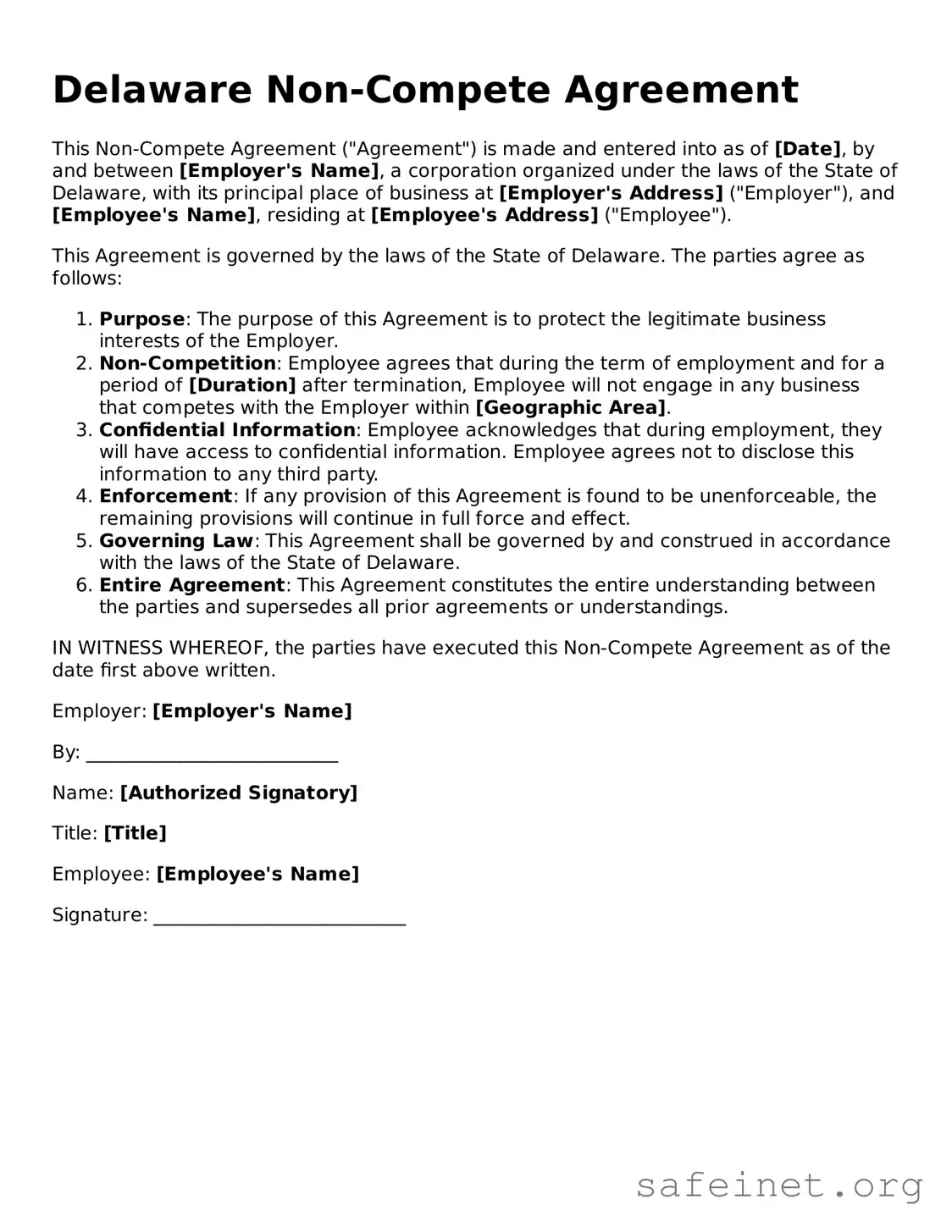
This Non-Compete Agreement ("Agreement") is made and entered into as of [Date], by and between [Employer's Name], a corporation organized under the laws of the State of Delaware, with its principal place of business at [Employer's Address] ("Employer"), and [Employee's Name], residing at [Employee's Address] ("Employee").
This Agreement is governed by the laws of the State of Delaware. The parties agree as follows:
IN WITNESS WHEREOF, the parties have executed this Non-Compete Agreement as of the date first above written.
Employer: [Employer's Name]
By: ___________________________
Name: [Authorized Signatory]
Title: [Title]
Employee: [Employee's Name]
Signature: ___________________________
| Fact Name | Description |
|---|---|
| Definition | A Delaware Non-compete Agreement is a contract that restricts an employee from working for competitors after leaving a job. |
| Governing Law | Non-compete agreements in Delaware are governed by Delaware law, particularly under Title 19 of the Delaware Code. |
| Enforceability | Delaware courts enforce non-compete agreements only if they are reasonable in scope, duration, and geographic area. |
| Consideration | For a non-compete agreement to be valid, there must be consideration, such as a job offer or a promotion. |
| Limitations | Delaware law limits the enforceability of non-compete clauses for low-wage workers, ensuring they can find new employment easily. |
Filling out a Delaware Non-compete Agreement form is a straightforward process. By following these steps, you can ensure that the form is completed accurately and efficiently.
Once you have filled out the form, it’s important to review it for any errors or omissions. A well-completed form can help protect both your interests and those of your employer.
What is a Delaware Non-compete Agreement?
A Delaware Non-compete Agreement is a legal document that restricts an employee from engaging in certain competitive activities after leaving a job. It aims to protect a company's trade secrets and business interests by preventing former employees from working for competitors or starting similar businesses within a specified timeframe and geographic area.
Are Non-compete Agreements enforceable in Delaware?
Yes, Non-compete Agreements are enforceable in Delaware, but they must meet specific criteria. The agreement should be reasonable in scope, duration, and geographic area. Courts will evaluate these factors to determine if the agreement serves a legitimate business interest.
What factors determine the reasonableness of a Non-compete Agreement?
Several factors affect the reasonableness of a Non-compete Agreement. These include the length of time the restriction lasts, the geographic area covered, and the nature of the work being restricted. An agreement that is too broad or lengthy may be deemed unenforceable.
How long can a Non-compete Agreement last in Delaware?
In Delaware, there is no strict limit on the duration of a Non-compete Agreement. However, agreements lasting one to two years are generally considered reasonable. The specific circumstances of each case will influence what is deemed acceptable.
Can I negotiate the terms of a Non-compete Agreement?
Yes, employees can negotiate the terms of a Non-compete Agreement before signing it. It is advisable to discuss any concerns with the employer and seek modifications that make the agreement more favorable or reasonable.
What happens if I violate a Non-compete Agreement?
If you violate a Non-compete Agreement, the employer may take legal action against you. This could include seeking an injunction to prevent you from working for a competitor or pursuing damages for any losses incurred due to the violation.
Are there any exceptions to Non-compete Agreements in Delaware?
Yes, certain exceptions may apply. For instance, if the agreement is overly broad or if it restricts a person's ability to earn a living, a court may find it unenforceable. Additionally, employees may be exempt if they were terminated without cause.
Do Non-compete Agreements apply to independent contractors?
Non-compete Agreements can apply to independent contractors in Delaware. However, the terms must still be reasonable and clearly defined. The nature of the contractor's work and the relationship with the company will influence enforceability.
Can I still work in my industry if I sign a Non-compete Agreement?
Signing a Non-compete Agreement may limit your ability to work in your industry, but it does not completely prohibit it. You may still pursue opportunities outside the defined restrictions of the agreement. Understanding the specific terms is crucial.
Should I consult a lawyer before signing a Non-compete Agreement?
Yes, it is wise to consult a lawyer before signing a Non-compete Agreement. An attorney can help you understand the implications of the agreement, identify any unreasonable terms, and provide guidance on negotiating better conditions.
Failing to clearly define the scope of the restrictions. It's important to specify what activities are prohibited. Vague language can lead to confusion and potential legal issues.
Not specifying the duration of the non-compete. The agreement should clearly state how long the restrictions will last. An indefinite duration may not be enforceable.
Overlooking the geographic area covered by the agreement. It’s essential to define where the non-compete applies. A broad geographic scope may be challenged in court.
Neglecting to include consideration for the agreement. There must be something of value exchanged for the non-compete to be valid. This could be a job offer, training, or other benefits.
A Delaware Non-compete Agreement is often accompanied by several other important documents. Each of these forms serves a specific purpose and helps clarify the terms of the agreement. Below is a list of commonly used documents that complement the Non-compete Agreement.
Understanding these documents can help you navigate the complexities of employment relationships. Each form plays a critical role in protecting both the employer's interests and the employee's rights. Always consider consulting a legal professional to ensure that all agreements are clear and enforceable.
A Non-disclosure Agreement (NDA) is similar to a Non-compete Agreement in that both documents protect sensitive information. An NDA ensures that parties involved do not share confidential information with outsiders. While a Non-compete Agreement restricts an individual from working with competitors, an NDA focuses on preventing the disclosure of proprietary information. Both agreements are essential in safeguarding business interests and maintaining competitive advantage.
A Non-solicitation Agreement is another document that shares similarities with a Non-compete Agreement. This type of agreement prohibits an individual from soliciting clients or employees from their former employer. While a Non-compete Agreement restricts where a person can work, a Non-solicitation Agreement restricts what they can do in terms of client and employee interactions. Both aim to protect a business's relationships and resources.
An Employment Agreement often includes elements found in a Non-compete Agreement. This document outlines the terms of employment, including job responsibilities, compensation, and any restrictions on post-employment activities. Employers may incorporate a Non-compete clause within the Employment Agreement to ensure that employees do not take sensitive information or client relationships to competitors after leaving the company.
A Confidentiality Agreement is closely related to a Non-compete Agreement as it also deals with the protection of sensitive information. While a Non-compete Agreement restricts employment opportunities with competitors, a Confidentiality Agreement ensures that the information shared during the course of employment remains private. Both agreements are crucial in maintaining a company's competitive edge and protecting intellectual property.
A Separation Agreement may also contain provisions similar to those in a Non-compete Agreement. When an employee leaves a company, a Separation Agreement outlines the terms of their departure, including any restrictions on future employment. This document may include a Non-compete clause to ensure the departing employee does not join a competitor, thus protecting the company's interests.
A Business Partnership Agreement can reflect elements of a Non-compete Agreement when partners agree to restrictions on competing with one another. This document outlines the roles and responsibilities of each partner, and it may include clauses that prevent partners from starting a competing business during and after the partnership. Such agreements help maintain harmony and protect each partner's investment.
A Franchise Agreement often includes a Non-compete clause to protect the franchisor's brand and business model. This document establishes the relationship between the franchisor and franchisee, detailing the rights and obligations of both parties. The Non-compete clause ensures that franchisees do not operate competing businesses, thereby maintaining brand integrity and market share.
A Licensing Agreement can also incorporate a Non-compete provision. This document allows one party to use another party's intellectual property under specific conditions. A Non-compete clause in a Licensing Agreement may restrict the licensee from using the licensed material to compete against the licensor. This ensures that the original creator's interests are protected while allowing for the use of their intellectual property.
When filling out a Delaware Non-compete Agreement form, it is essential to approach the task with care and attention to detail. Here are ten things you should and shouldn't do:
Non-compete agreements are often misunderstood. Here are eight common misconceptions about the Delaware Non-compete Agreement form:
Understanding these misconceptions can help individuals navigate the complexities of non-compete agreements more effectively.
When filling out and using the Delaware Non-compete Agreement form, consider the following key takeaways: