The Delaware Motor Vehicle Power of Attorney form serves as a crucial legal document that empowers an individual, known as the agent, to handle specific motor vehicle-related transactions on behalf of another person, referred to as the principal. This form is particularly useful when the principal is unable to be present for certain tasks, such as transferring vehicle ownership, registering a vehicle, or obtaining title documents. By designating an agent through this form, the principal can ensure that their interests are represented effectively, even in their absence. The document outlines the scope of authority granted to the agent, which can be tailored to meet the specific needs of the principal. Additionally, it requires signatures from both parties and may need to be notarized to ensure its validity. Understanding the nuances of this form can empower vehicle owners to navigate the complexities of motor vehicle transactions with confidence.
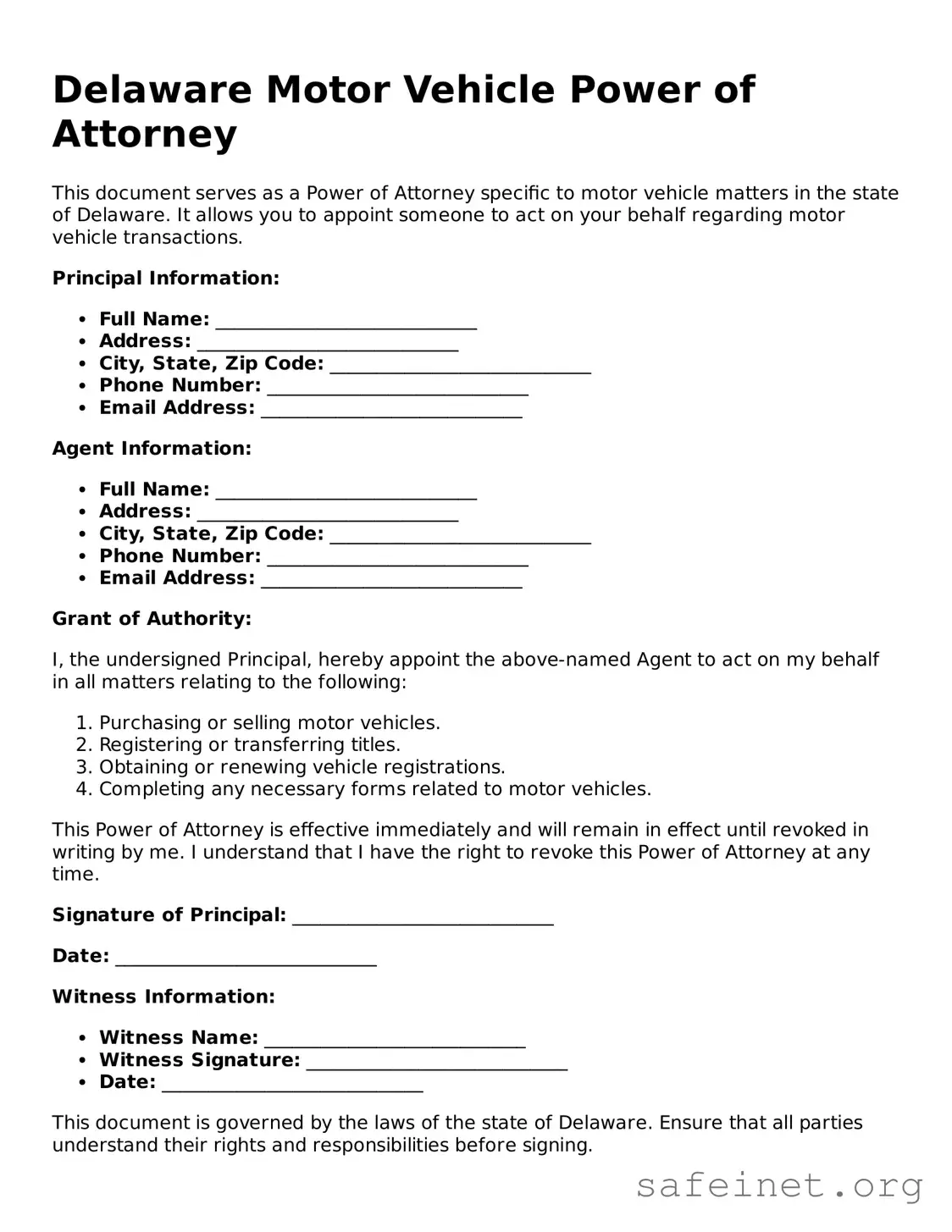
Delaware Motor Vehicle Power of Attorney
This document serves as a Power of Attorney specific to motor vehicle matters in the state of Delaware. It allows you to appoint someone to act on your behalf regarding motor vehicle transactions.
Principal Information:
Agent Information:
Grant of Authority:
I, the undersigned Principal, hereby appoint the above-named Agent to act on my behalf in all matters relating to the following:
This Power of Attorney is effective immediately and will remain in effect until revoked in writing by me. I understand that I have the right to revoke this Power of Attorney at any time.
Signature of Principal: ____________________________
Date: ____________________________
Witness Information:
This document is governed by the laws of the state of Delaware. Ensure that all parties understand their rights and responsibilities before signing.
| Fact Name | Description |
|---|---|
| Purpose | The Delaware Motor Vehicle Power of Attorney form allows an individual to designate another person to handle specific motor vehicle-related transactions on their behalf. |
| Governing Law | This form is governed by the Delaware Code, Title 21, Chapter 2301, which outlines the powers granted and the requirements for validity. |
| Signature Requirement | The form must be signed by the person granting the power of attorney, also known as the principal, in the presence of a notary public to ensure authenticity. |
| Scope of Authority | The designated agent can perform various tasks, such as transferring vehicle titles, registering vehicles, and obtaining license plates. |
| Duration | The power granted can be effective immediately or set to begin at a future date, as specified in the form. |
| Revocation | The principal can revoke the power of attorney at any time, provided they notify the agent and any relevant parties in writing. |
After obtaining the Delaware Motor Vehicle Power of Attorney form, you will need to complete it accurately to ensure it serves its purpose. Follow these steps to fill out the form correctly.
Once you have completed the form, keep a copy for your records. Then, provide the original to the attorney-in-fact, so they can act on your behalf regarding the specified vehicle matters.
What is the Delaware Motor Vehicle Power of Attorney form?
The Delaware Motor Vehicle Power of Attorney form is a legal document that allows an individual, known as the principal, to designate another person, referred to as the agent, to act on their behalf regarding motor vehicle matters. This can include tasks such as transferring ownership of a vehicle, registering a vehicle, or handling other transactions related to motor vehicles. This form is particularly useful when the principal is unable to be present to complete these actions personally, whether due to distance, time constraints, or other reasons.
Who can be designated as an agent in the Power of Attorney?
In Delaware, any competent adult can be designated as an agent in the Motor Vehicle Power of Attorney form. This means the person you choose must be at least 18 years old and capable of understanding the responsibilities that come with the role. Many individuals select trusted family members, friends, or legal professionals to serve as their agents. It is essential to choose someone who is reliable and will act in your best interest when managing your vehicle-related affairs.
How do I complete and submit the Motor Vehicle Power of Attorney form?
To complete the Delaware Motor Vehicle Power of Attorney form, you will need to fill in specific details, including the names and addresses of both the principal and the agent, as well as a description of the powers granted. After filling out the form, it must be signed by the principal. In some cases, notarization may be required to ensure the document's validity. Once completed, the form should be submitted to the Delaware Division of Motor Vehicles or the appropriate agency handling motor vehicle transactions. Keep a copy for your records.
Can the Power of Attorney be revoked?
Yes, the Delaware Motor Vehicle Power of Attorney can be revoked at any time by the principal, as long as they are competent to do so. To revoke the Power of Attorney, the principal should provide a written notice of revocation to the agent and any relevant parties, such as the Division of Motor Vehicles. It is advisable to also destroy any copies of the original Power of Attorney form to prevent any unauthorized use. This ensures that the agent no longer has the authority to act on your behalf regarding motor vehicle matters.
Failing to include the principal's name and address accurately. This information is crucial for identifying the person granting authority.
Not specifying the agent's name clearly. The agent must be identifiable to ensure they can act on behalf of the principal.
Omitting the vehicle information. This includes the make, model, year, and VIN. Such details are necessary for the power of attorney to be effective.
Neglecting to sign the form. A signature is essential; without it, the document lacks validity.
Not dating the form. Including the date of signing is important for establishing when the authority takes effect.
Using an outdated version of the form. Always ensure the most current version is used to avoid issues.
Failing to provide necessary identification. Some forms may require a copy of the principal's ID to verify their identity.
Not understanding the scope of authority granted. Clearly defining what the agent can and cannot do is essential to avoid misunderstandings.
Forgetting to notarize the document if required. Some situations may require notarization for the power of attorney to be legally binding.
Not keeping a copy of the completed form. Retaining a copy is important for both the principal and the agent for future reference.
The Delaware Motor Vehicle Power of Attorney form allows an individual to designate another person to handle specific vehicle-related transactions on their behalf. When dealing with motor vehicle matters, several other forms and documents may be necessary to ensure a smooth process. Here are five commonly used documents that often accompany the Motor Vehicle Power of Attorney form.
Each of these documents plays a vital role in the process of managing vehicle ownership and transactions in Delaware. Having them prepared and organized can facilitate a smoother experience when dealing with motor vehicle matters.
The Delaware Motor Vehicle Power of Attorney form is quite similar to the General Power of Attorney. Both documents allow an individual to appoint someone else to act on their behalf. This could include making decisions about financial matters or handling property. The primary difference lies in the scope; while the General Power of Attorney covers a wide range of issues, the Motor Vehicle Power of Attorney is specifically tailored for matters related to motor vehicles, such as registration and title transfers.
Another document that bears resemblance is the Limited Power of Attorney. Like the Motor Vehicle Power of Attorney, this form grants specific powers to an agent, but it can apply to various situations beyond motor vehicles. For instance, a Limited Power of Attorney might allow someone to manage real estate transactions or conduct business on behalf of another person. The key similarity is the focus on specific tasks rather than broad authority.
The Durable Power of Attorney also shares characteristics with the Motor Vehicle Power of Attorney. This document remains effective even if the person who created it becomes incapacitated. While the Motor Vehicle Power of Attorney is often used for specific vehicle-related tasks, the Durable Power of Attorney can cover a wide range of decisions, ensuring that someone can act on behalf of the individual regardless of their health status.
Next, consider the Medical Power of Attorney. This document allows someone to make healthcare decisions for another person if they are unable to do so themselves. While it focuses on medical matters, the underlying principle of appointing an agent to make decisions is similar to the Motor Vehicle Power of Attorney. Both empower someone to act in the best interest of another individual.
The Revocable Living Trust is another document that can be compared to the Motor Vehicle Power of Attorney. While a trust is primarily used for estate planning, it allows a person to designate a trustee to manage their assets, including vehicles. The trust can be altered or revoked during the person’s lifetime, much like how the Motor Vehicle Power of Attorney can be revoked at any time, reflecting a person’s changing needs.
The Bill of Sale for vehicles also has similarities. While not a power of attorney, it serves as a legal document that transfers ownership from one party to another. Both documents are essential in vehicle transactions, but the Bill of Sale acts as a record of the transaction, whereas the Motor Vehicle Power of Attorney facilitates the process by allowing someone else to handle the transfer on behalf of the owner.
The Vehicle Registration Application can be likened to the Motor Vehicle Power of Attorney in that both are crucial in the process of vehicle ownership. The registration application is necessary to legally register a vehicle, while the power of attorney allows someone to complete that application on behalf of the owner. Both are integral to ensuring that vehicle ownership is properly documented and recognized by the state.
The Title Transfer Form is another document that aligns with the Motor Vehicle Power of Attorney. When a vehicle changes ownership, the title transfer form is essential. The power of attorney allows an individual to authorize someone else to complete this form and submit it to the appropriate authorities. Both documents ensure that the transfer of ownership is executed legally and efficiently.
Lastly, the Consent to Transfer Vehicle Ownership form is similar in that it provides the necessary approval for someone else to take over ownership of a vehicle. Like the Motor Vehicle Power of Attorney, this form is used to facilitate the transfer process. It ensures that the original owner’s consent is documented, making the transaction smoother and legally binding.
When filling out the Delaware Motor Vehicle Power of Attorney form, it is important to follow certain guidelines to ensure accuracy and compliance. Here are seven things to do and avoid:
Many people have misunderstandings about the Delaware Motor Vehicle Power of Attorney form. Here are some common misconceptions:
Understanding these misconceptions can help you navigate the process more confidently and effectively.
Filling out the Delaware Motor Vehicle Power of Attorney form can be straightforward if you keep a few key points in mind. Here are some important takeaways:
By following these tips, you can confidently fill out and use the Delaware Motor Vehicle Power of Attorney form.