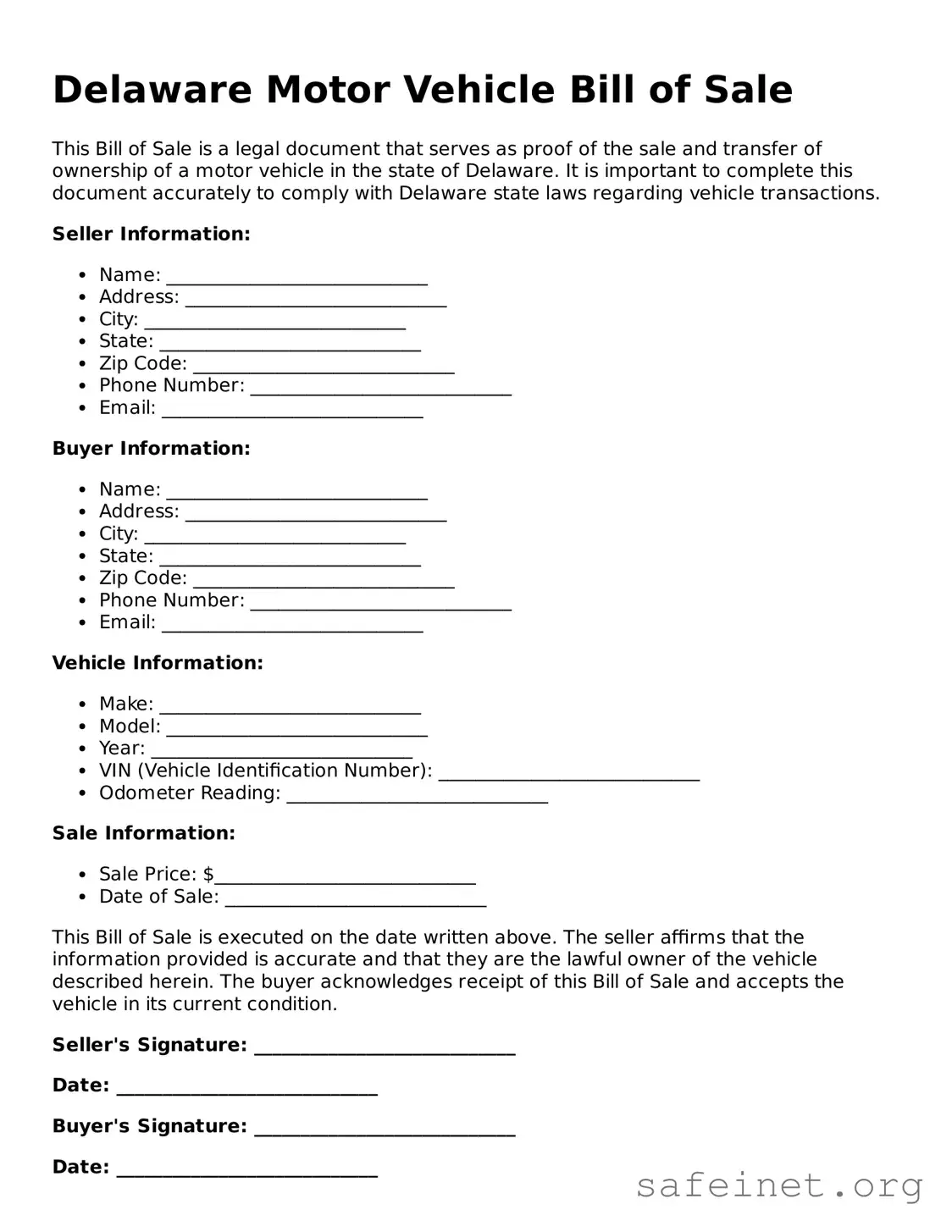
The Delaware Motor Vehicle Bill of Sale form serves as a crucial document in the process of buying or selling a vehicle in the state. This form captures essential details about the transaction, including the buyer's and seller's names, addresses, and contact information. It also outlines key vehicle information such as the make, model, year, and Vehicle Identification Number (VIN). By documenting the sale price and the date of the transaction, the form provides a clear record that can help protect both parties in case of future disputes. Additionally, it may include space for the seller's signature, which confirms the transfer of ownership. Understanding this form is vital for ensuring a smooth and legally binding vehicle transfer in Delaware.
Delaware Motor Vehicle Bill of Sale
This Bill of Sale is a legal document that serves as proof of the sale and transfer of ownership of a motor vehicle in the state of Delaware. It is important to complete this document accurately to comply with Delaware state laws regarding vehicle transactions.
Seller Information:
Buyer Information:
Vehicle Information:
Sale Information:
This Bill of Sale is executed on the date written above. The seller affirms that the information provided is accurate and that they are the lawful owner of the vehicle described herein. The buyer acknowledges receipt of this Bill of Sale and accepts the vehicle in its current condition.
Seller's Signature: ____________________________
Date: ____________________________
Buyer's Signature: ____________________________
Date: ____________________________
This document serves as a record of the transaction and should be kept by both the seller and the buyer for their personal records.
| Fact Name | Details |
|---|---|
| Purpose | The Delaware Motor Vehicle Bill of Sale form serves as a legal document that records the sale of a vehicle between a buyer and a seller. |
| Governing Law | This form is governed by the Delaware Code Title 21, specifically the sections related to motor vehicles and their sale. |
| Identification | It includes crucial details such as the vehicle identification number (VIN), make, model, and year of the vehicle. |
| Seller Information | The form requires the seller’s name, address, and signature to validate the transaction. |
| Buyer Information | Buyers must also provide their name, address, and signature, confirming their acceptance of the vehicle. |
| Sale Price | The agreed-upon sale price must be clearly stated to ensure transparency in the transaction. |
| Date of Sale | The date when the sale occurs should be included to establish a timeline for ownership transfer. |
| Notarization | While notarization is not mandatory, having the document notarized can provide additional legal protection. |
| Record Keeping | Both the buyer and seller should keep a copy of the completed Bill of Sale for their records, as it may be needed for future reference. |
After you have gathered all necessary information, you are ready to fill out the Delaware Motor Vehicle Bill of Sale form. This document is essential for transferring ownership of a vehicle. Ensure that all details are accurate to avoid any issues in the future.
What is a Delaware Motor Vehicle Bill of Sale?
A Delaware Motor Vehicle Bill of Sale is a legal document that serves as a record of the sale or transfer of ownership of a vehicle in the state of Delaware. This form includes essential details about the vehicle, such as its make, model, year, and Vehicle Identification Number (VIN), as well as information about the buyer and seller. It acts as proof of the transaction and can be crucial for both parties involved in the sale.
Do I need a Bill of Sale to sell a vehicle in Delaware?
While a Bill of Sale is not legally required to sell a vehicle in Delaware, it is highly recommended. This document protects both the seller and the buyer by providing a written record of the transaction. It can help resolve any disputes that may arise after the sale and is often requested by the Delaware Division of Motor Vehicles (DMV) when registering the vehicle under the new owner's name.
What information should be included in the Bill of Sale?
A comprehensive Bill of Sale should include the following information: the full names and addresses of both the buyer and seller, the date of the sale, the purchase price, and detailed vehicle information (make, model, year, VIN, and odometer reading). Additionally, both parties should sign the document to validate the transaction.
Is the Bill of Sale required for vehicle registration in Delaware?
When registering a vehicle in Delaware, the DMV typically requires a Bill of Sale, especially if the vehicle is purchased from a private seller. This document serves as proof of ownership and is necessary for the new owner to obtain a title and registration for the vehicle. Always check with the DMV for the most current requirements.
Can I create my own Bill of Sale?
Yes, you can create your own Bill of Sale as long as it includes all the necessary information and is signed by both parties. There are also templates available online that can help guide you in creating a legally sound document. Ensure that it meets the requirements set by the Delaware DMV to avoid any issues during the registration process.
What if the vehicle has a lien on it?
If the vehicle has a lien, it is essential to disclose this information in the Bill of Sale. The seller should ensure that the lien is satisfied before completing the sale. Buyers should be cautious and verify that the lien has been released to avoid any complications in the future. It is advisable to check with the lienholder for specific instructions on how to proceed with the sale.
How do I obtain a Bill of Sale form in Delaware?
Delaware does not have a specific state-issued Bill of Sale form, but you can find templates online or create your own. Various websites offer downloadable forms that comply with state requirements. Just ensure that the template you choose includes all necessary details and follows the guidelines set by the Delaware DMV.
What should I do after completing the Bill of Sale?
Once the Bill of Sale is completed and signed by both parties, the seller should keep a copy for their records. The buyer should also retain a copy to present to the DMV when registering the vehicle. It is wise for both parties to keep a record of the transaction for future reference, especially in case of any disputes or questions that may arise later.
Can I use a Bill of Sale for a vehicle purchased out of state?
Yes, a Bill of Sale can be used for a vehicle purchased out of state. However, it is important to ensure that the document meets the requirements of both the state where the vehicle was purchased and Delaware's regulations. When registering the vehicle in Delaware, be prepared to provide additional documentation, such as the original title and proof of identification.
Failing to include the date of sale. This is crucial for establishing when the transaction occurred.
Not providing complete vehicle information. Omitting details like the VIN, make, model, and year can lead to confusion.
Forgetting to include the buyer and seller information. Names and addresses must be clear and accurate.
Neglecting to sign the form. Both parties need to sign to validate the transaction.
Using incorrect purchase price. Ensure that the amount reflects the agreed-upon sale price.
Not indicating if the vehicle is sold as-is. This can affect buyer expectations and rights.
Leaving out the odometer reading. This is important for tracking the vehicle's mileage.
Failing to provide any necessary disclosures. If there are known issues with the vehicle, they should be noted.
Not keeping a copy of the completed form. Both parties should retain a copy for their records.
Overlooking state-specific requirements. Each state may have additional rules that must be followed.
The Delaware Motor Vehicle Bill of Sale form serves as a crucial document in the transfer of vehicle ownership. However, several other forms and documents are often needed to ensure a smooth transaction. Below is a list of commonly associated documents that may be required or beneficial during the sale or purchase of a vehicle in Delaware.
Having these documents ready can facilitate a smoother transaction, ensuring that both parties are protected and all legal requirements are met. It is advisable to consult with local authorities or legal professionals to ensure compliance with Delaware laws during the vehicle sale process.
The Delaware Motor Vehicle Bill of Sale form shares similarities with the general Bill of Sale. A Bill of Sale is a document that transfers ownership of personal property from one person to another. Just like the Delaware form, a general Bill of Sale includes details about the item being sold, the buyer, and the seller. Both documents serve as proof of the transaction and can help resolve disputes regarding ownership in the future.
Another document similar to the Delaware Motor Vehicle Bill of Sale is the Vehicle Title. The Vehicle Title acts as the legal proof of ownership for a vehicle. When a car is sold, the title must be signed over to the new owner. This process is similar to the Bill of Sale, as both documents are essential for transferring ownership legally. The title often accompanies the Bill of Sale in vehicle transactions.
The Purchase Agreement is also comparable to the Delaware Motor Vehicle Bill of Sale. This document outlines the terms of the sale, including the price, payment method, and any warranties or conditions. Like the Bill of Sale, the Purchase Agreement protects both the buyer and seller by clearly stating the expectations of the transaction. It ensures that both parties understand their rights and obligations.
The Lease Agreement can be likened to the Delaware Motor Vehicle Bill of Sale in the context of vehicle leasing. While a Bill of Sale transfers ownership, a Lease Agreement outlines the terms for using a vehicle without purchasing it. Both documents require the parties' signatures and include details about the vehicle, such as make, model, and identification numbers. They also serve as legal evidence of the arrangement between the parties.
The Affidavit of Ownership is another document that bears similarity to the Delaware Motor Vehicle Bill of Sale. This affidavit is often used when the seller cannot provide a title for the vehicle. It serves as a sworn statement confirming the seller's ownership. Like the Bill of Sale, it is used to establish the legitimacy of the transaction and can protect the buyer from future ownership disputes.
The Odometer Disclosure Statement is closely related to the Delaware Motor Vehicle Bill of Sale. This document is required by law when transferring ownership of a vehicle. It records the vehicle's mileage at the time of sale, ensuring transparency between the buyer and seller. Both documents aim to protect the buyer by providing accurate information about the vehicle's condition and history.
The Release of Liability form is another important document in vehicle transactions. This form releases the seller from any future liability related to the vehicle after the sale. While the Delaware Motor Vehicle Bill of Sale confirms the transfer of ownership, the Release of Liability ensures that the seller is no longer responsible for the vehicle once it has been sold. Both documents work together to protect the interests of both parties.
The Certificate of Title Application is similar to the Delaware Motor Vehicle Bill of Sale in that it is often used during the transfer of vehicle ownership. This application is submitted to the state to obtain a new title in the buyer's name. Like the Bill of Sale, it requires information about the vehicle and the parties involved in the transaction. It is a crucial step in ensuring that the new owner is legally recognized.
The Insurance Policy can also be compared to the Delaware Motor Vehicle Bill of Sale. While the Bill of Sale documents the transfer of ownership, the Insurance Policy provides coverage for the vehicle. When a vehicle is sold, the buyer typically needs to secure insurance, which protects against potential damages or liabilities. Both documents are essential for responsible vehicle ownership and usage.
Lastly, the DMV Registration form is similar to the Delaware Motor Vehicle Bill of Sale in that it is necessary for legal vehicle operation. After purchasing a vehicle, the new owner must register it with the Department of Motor Vehicles. The Bill of Sale serves as proof of ownership needed for this registration process. Both documents are integral to ensuring that the vehicle is legally recognized and compliant with state laws.
When filling out the Delaware Motor Vehicle Bill of Sale form, it's important to get it right. Here are some do's and don'ts to keep in mind:
When it comes to the Delaware Motor Vehicle Bill of Sale form, several misconceptions can lead to confusion for individuals involved in vehicle transactions. Understanding these misconceptions is crucial for ensuring a smooth and legally sound process. Here are four common misunderstandings:
By addressing these misconceptions, individuals can navigate the process of buying or selling a vehicle in Delaware with greater confidence and clarity.
When engaging in the process of buying or selling a motor vehicle in Delaware, it is essential to understand the significance of the Motor Vehicle Bill of Sale form. This document serves as a crucial record of the transaction and provides both parties with important protections. Here are key takeaways to consider:
By keeping these key points in mind, individuals can navigate the complexities of motor vehicle transactions with greater confidence and clarity.