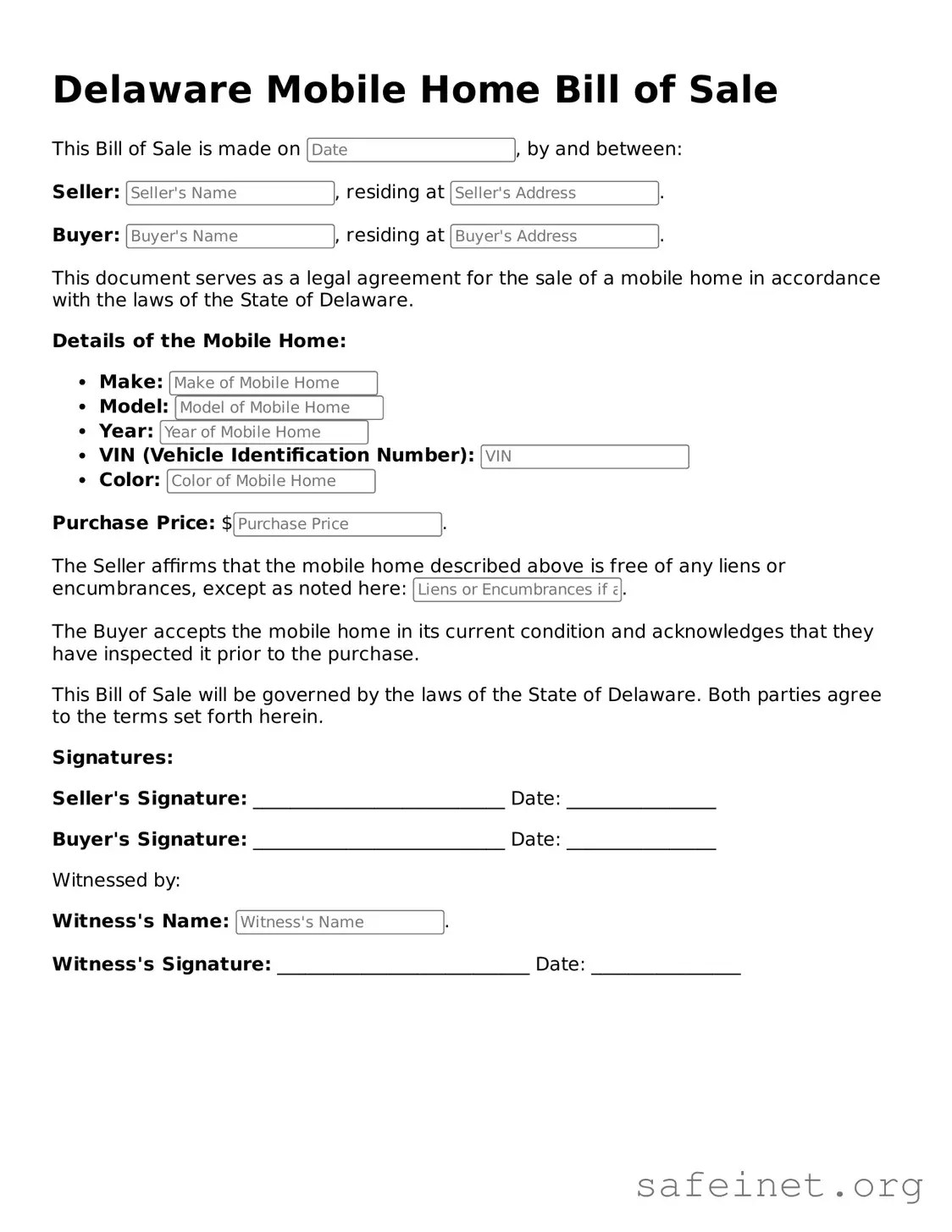
The Delaware Mobile Home Bill of Sale form serves as a crucial document in the transfer of ownership for mobile homes within the state. This form outlines essential details such as the names and addresses of both the seller and buyer, the mobile home’s identification number, and a description of the unit itself. It also includes the sale price and any terms related to the transaction. By providing a clear record of the sale, this form helps protect the interests of both parties involved. Additionally, it may require signatures from both the seller and buyer, ensuring that the transaction is legally binding. Understanding the importance of this document is key for anyone looking to buy or sell a mobile home in Delaware.
Delaware Mobile Home Bill of Sale
This Bill of Sale is made on , by and between:
Seller: , residing at .
Buyer: , residing at .
This document serves as a legal agreement for the sale of a mobile home in accordance with the laws of the State of Delaware.
Details of the Mobile Home:
Purchase Price: $.
The Seller affirms that the mobile home described above is free of any liens or encumbrances, except as noted here: .
The Buyer accepts the mobile home in its current condition and acknowledges that they have inspected it prior to the purchase.
This Bill of Sale will be governed by the laws of the State of Delaware. Both parties agree to the terms set forth herein.
Signatures:
Seller's Signature: ___________________________ Date: ________________
Buyer's Signature: ___________________________ Date: ________________
Witnessed by:
Witness's Name: .
Witness's Signature: ___________________________ Date: ________________
| Fact Name | Description |
|---|---|
| Purpose | The Delaware Mobile Home Bill of Sale form is used to document the sale of a mobile home from one party to another. |
| Governing Law | This form is governed by Delaware state laws, specifically Title 25, Chapter 70 of the Delaware Code, which pertains to mobile homes. |
| Parties Involved | The form requires information about both the seller and the buyer, ensuring clarity in the transaction. |
| Details Required | It includes essential details such as the mobile home's make, model, year, and Vehicle Identification Number (VIN). |
| Signatures | Both parties must sign the document to validate the sale, confirming their agreement to the terms. |
| Notarization | While notarization is not always required, having the document notarized can provide additional legal protection for both parties. |
Once you have the Delaware Mobile Home Bill of Sale form in hand, you will need to fill it out carefully. This form is essential for documenting the sale of a mobile home. After completing the form, you will be able to finalize the sale and transfer ownership properly.
What is a Delaware Mobile Home Bill of Sale form?
The Delaware Mobile Home Bill of Sale form is a legal document used to transfer ownership of a mobile home from one party to another. This form outlines the details of the transaction, including the buyer and seller's information, the mobile home’s description, and the sale price. It serves as proof of the sale and can be essential for registration and title transfer purposes.
Why do I need a Bill of Sale for a mobile home?
A Bill of Sale is important because it provides a written record of the transaction. This document protects both the buyer and the seller by detailing the terms of the sale. It can help prevent disputes in the future and is often required by the state for registering the mobile home in the new owner's name.
What information is required on the form?
The form typically requires the names and addresses of both the buyer and seller, a description of the mobile home (including its make, model, year, and VIN), the sale price, and the date of the transaction. Both parties should sign the document to validate the sale.
Is the Bill of Sale form the same as the title?
No, the Bill of Sale is not the same as the title. The title is an official document that proves ownership of the mobile home. The Bill of Sale is a record of the transaction. After the sale, the seller should provide the title to the buyer, who will then need to transfer it to their name.
Do I need a notary for the Bill of Sale?
Can I use a generic Bill of Sale form?
You can use a generic Bill of Sale form, but it is advisable to use one specifically designed for mobile homes in Delaware. This ensures that all necessary information is included and complies with state laws, making the transfer process smoother.
What happens if the mobile home has a lien on it?
If there is a lien on the mobile home, it is important to address this before completing the sale. The seller must pay off the lien or obtain written consent from the lienholder to transfer ownership. Failing to do so can result in complications for the buyer, as they may inherit the debt associated with the mobile home.
How do I register the mobile home after the sale?
After the sale, the new owner must register the mobile home with the Delaware Division of Motor Vehicles (DMV). This usually involves submitting the signed Bill of Sale, the title, and any other required documents. There may also be fees associated with the registration process.
What if the mobile home is sold “as-is”?
If the mobile home is sold “as-is,” this means that the buyer accepts the property in its current condition, and the seller is not responsible for any repairs or issues that may arise after the sale. It is important to clearly state this in the Bill of Sale to avoid misunderstandings.
Where can I obtain a Delaware Mobile Home Bill of Sale form?
You can obtain a Delaware Mobile Home Bill of Sale form from various sources, including online legal document providers, local government offices, or legal stationery stores. Ensure that the form you choose is compliant with Delaware laws to facilitate a smooth transaction.
Failing to include all required information. Every section of the form must be completed to ensure the sale is valid.
Not providing accurate vehicle identification numbers (VIN). Double-check the VIN to avoid errors that could complicate ownership transfer.
Omitting the purchase price. This detail is crucial for tax purposes and must be clearly stated.
Not signing the document. Both the seller and buyer must sign the form to make it legally binding.
Using incorrect dates. Ensure that the sale date is accurate and clearly written to prevent disputes later.
Neglecting to include contact information. Both parties should provide their current addresses and phone numbers.
Forgetting to indicate the condition of the mobile home. A clear description helps manage expectations and protects both parties.
Not keeping a copy of the completed form. Both the buyer and seller should retain a copy for their records.
Ignoring local regulations. Always check for any additional requirements specific to your county or municipality.
The Delaware Mobile Home Bill of Sale form serves as a crucial document in the transaction of mobile homes, ensuring that ownership is properly transferred from one party to another. However, several other forms and documents are often utilized in conjunction with this bill of sale to facilitate a smooth transaction and ensure compliance with state regulations. Below is a list of five such documents, each playing an important role in the process.
Utilizing these documents alongside the Delaware Mobile Home Bill of Sale form can enhance the legitimacy of the transaction and provide necessary protections for both buyers and sellers. Ensuring that all relevant paperwork is completed accurately is vital to a successful transfer of ownership.
The Delaware Vehicle Bill of Sale is a document that serves a similar purpose as the Mobile Home Bill of Sale. Both documents facilitate the transfer of ownership of a property. The Vehicle Bill of Sale includes details such as the buyer and seller’s information, vehicle identification number, and sale price. This ensures that both parties have a clear understanding of the transaction, much like the Mobile Home Bill of Sale does for mobile homes.
The Boat Bill of Sale is another document that shares similarities with the Mobile Home Bill of Sale. This form is used to record the sale of a boat, providing essential details such as the hull identification number, make, model, and sale price. Just as the Mobile Home Bill of Sale protects the interests of both the buyer and seller, the Boat Bill of Sale serves to formalize the transaction and establish ownership.
The Trailer Bill of Sale is also comparable to the Mobile Home Bill of Sale. This document is used when transferring ownership of a trailer, whether it is a utility trailer, travel trailer, or another type. It includes information about the trailer, such as its VIN, description, and the agreed-upon sale price. Both documents aim to provide a clear record of the transaction and protect the rights of the involved parties.
When filling out the Delaware Mobile Home Bill of Sale form, it is important to adhere to specific guidelines to ensure accuracy and compliance. Below is a list of things you should and shouldn't do during this process.
Following these guidelines will help ensure that the bill of sale is processed smoothly and legally. Always double-check the completed form before submission to avoid any potential issues.
The Delaware Mobile Home Bill of Sale form is an essential document for anyone involved in the sale or purchase of a mobile home in Delaware. However, several misconceptions can lead to confusion. Here are ten common misunderstandings:
This is incorrect. The Bill of Sale is required for both new and used mobile homes to ensure a legal transfer of ownership.
While a verbal agreement may seem sufficient, it lacks legal standing. A written Bill of Sale provides clear evidence of the transaction.
In Delaware, the seller must provide a title for the mobile home. Without it, the buyer cannot legally register the home.
This is a misconception. The Bill of Sale should be completed and signed at the time of the transaction to ensure both parties have a record.
Both the buyer and seller should sign the Bill of Sale. This protects the rights of both parties involved in the transaction.
On the contrary, a properly completed and signed Bill of Sale is legally binding and can be enforced in court if necessary.
While not always required, having a witness can add an extra layer of protection and validity to the transaction.
This is misleading. The Bill of Sale is also applicable for transactions involving dealers or brokers.
Using an unofficial template can lead to issues. It's best to use the official Delaware form to ensure compliance with state laws.
While signing the form is a significant step, buyers must also ensure that the title is transferred and registered in their name.
Understanding these misconceptions can help both buyers and sellers navigate the process more smoothly and ensure a successful transaction.
When filling out and using the Delaware Mobile Home Bill of Sale form, there are several important points to keep in mind. This document serves as a legal record of the sale and transfer of ownership of a mobile home.
By paying attention to these key takeaways, both buyers and sellers can facilitate a smoother transaction and protect their interests in the sale of a mobile home in Delaware.