When it comes to planning for your healthcare decisions, having a Medical Power of Attorney (MPOA) in Delaware is an essential step. This legal document allows you to appoint someone you trust to make medical decisions on your behalf if you become unable to do so. Choosing the right person is crucial, as they will have the authority to speak with healthcare providers and make choices about your treatment. The MPOA form in Delaware outlines specific powers granted to your agent, ensuring they can act in your best interest. Additionally, it is important to understand the requirements for signing and witnessing the document, as these can affect its validity. By setting up a Medical Power of Attorney, you not only provide clarity about your healthcare preferences but also relieve your loved ones from the burden of making difficult decisions during stressful times.
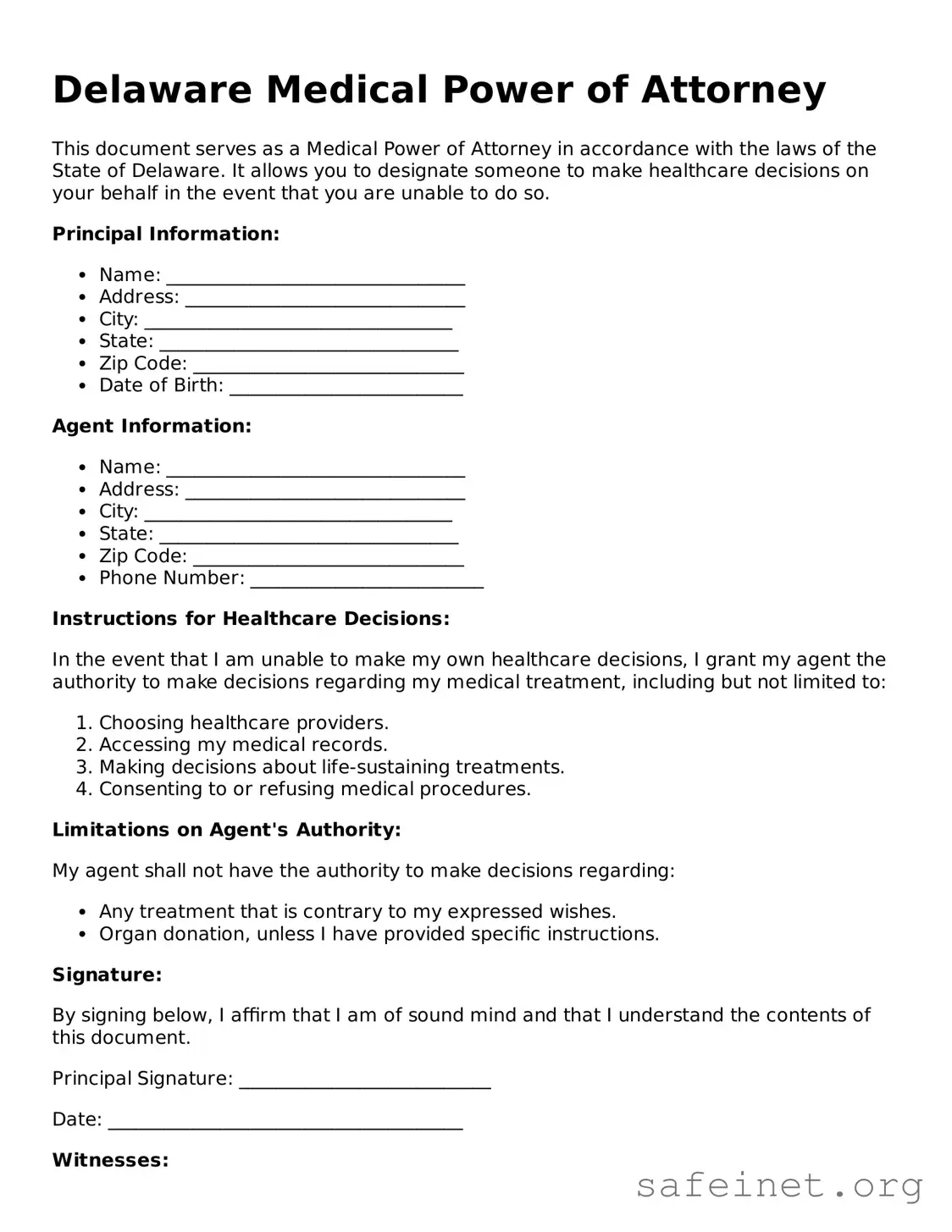
Delaware Medical Power of Attorney
This document serves as a Medical Power of Attorney in accordance with the laws of the State of Delaware. It allows you to designate someone to make healthcare decisions on your behalf in the event that you are unable to do so.
Principal Information:
Agent Information:
Instructions for Healthcare Decisions:
In the event that I am unable to make my own healthcare decisions, I grant my agent the authority to make decisions regarding my medical treatment, including but not limited to:
Limitations on Agent's Authority:
My agent shall not have the authority to make decisions regarding:
Signature:
By signing below, I affirm that I am of sound mind and that I understand the contents of this document.
Principal Signature: ___________________________
Date: ______________________________________
Witnesses:
Two witnesses are required to sign below. They must be at least 18 years old and cannot be named as agents in this document.
Witness 1 Signature: ___________________________
Date: ______________________________________
Witness 2 Signature: ___________________________
Date: ______________________________________
Notary Public:
This document should be notarized to ensure its validity.
Notary Signature: _____________________________
Date: ______________________________________
| Fact Name | Description |
|---|---|
| Purpose | The Delaware Medical Power of Attorney form allows individuals to appoint someone to make healthcare decisions on their behalf if they become unable to do so. |
| Governing Law | This form is governed by the Delaware Code, Title 16, Chapter 2501, which outlines the legal framework for advance healthcare directives. |
| Requirements | To be valid, the form must be signed by the principal (the person granting authority) and witnessed by two adults who are not related to the principal. |
| Revocation | The principal can revoke the Medical Power of Attorney at any time, as long as they are mentally competent to do so. |
| Durability | This form remains effective even if the principal becomes incapacitated, ensuring that their healthcare wishes are honored. |
Filling out the Delaware Medical Power of Attorney form is an important step in ensuring your healthcare preferences are respected. This document allows you to designate someone to make medical decisions on your behalf if you become unable to do so. Follow these steps carefully to complete the form.
What is a Medical Power of Attorney in Delaware?
A Medical Power of Attorney is a legal document that allows you to appoint someone to make healthcare decisions on your behalf if you become unable to do so. This person, known as your agent or proxy, will have the authority to make medical choices based on your preferences and values. It’s an essential tool for ensuring that your healthcare wishes are respected when you cannot communicate them yourself.
Who can be appointed as my agent in a Medical Power of Attorney?
You can choose anyone you trust to be your agent, as long as they are at least 18 years old and mentally competent. Common choices include family members, close friends, or a trusted advisor. It’s important to have an open conversation with your chosen agent about your healthcare preferences and values so they can make informed decisions on your behalf.
Do I need a lawyer to create a Medical Power of Attorney in Delaware?
No, you do not need a lawyer to create a Medical Power of Attorney in Delaware. However, it can be beneficial to consult with a legal professional to ensure that the document meets all legal requirements and accurately reflects your wishes. Many online resources and templates are available to help you draft the document on your own.
How do I ensure my Medical Power of Attorney is valid?
To ensure your Medical Power of Attorney is valid in Delaware, you must sign the document in the presence of two witnesses or have it notarized. The witnesses cannot be your agent, a family member, or someone who would benefit from your estate. Once signed, make copies of the document to share with your agent and healthcare providers.
Can I revoke or change my Medical Power of Attorney?
Yes, you can revoke or change your Medical Power of Attorney at any time as long as you are mentally competent. To revoke it, you should notify your agent and any healthcare providers who have a copy of the document. You may also want to create a new Medical Power of Attorney if you decide to appoint someone else or change your preferences.
What happens if I don’t have a Medical Power of Attorney?
If you do not have a Medical Power of Attorney and become unable to make your own healthcare decisions, your family members may have to go through a legal process to determine who can make those decisions for you. This can lead to conflicts and delays, which is why it’s advisable to have a Medical Power of Attorney in place to ensure your wishes are followed without complications.
Not Designating an Alternate Agent: Many individuals fail to name an alternate agent. If the primary agent is unavailable or unable to act, this can lead to complications in decision-making.
Leaving Sections Blank: Some people leave important sections blank, such as specific medical preferences or limitations on the agent's authority. This can result in confusion or decisions that do not align with the individual's wishes.
Not Signing or Dating the Form: A common oversight is neglecting to sign or date the form. Without a signature, the document may not be considered valid, rendering it ineffective when needed.
Failing to Notify the Agent: It is crucial to inform the designated agent about their role. Without proper communication, the agent may be unaware of their responsibilities and the individual's wishes.
Ignoring State-Specific Requirements: Each state has unique requirements for a Medical Power of Attorney. Ignoring Delaware's specific rules can lead to the document being invalid or challenged.
When preparing a Delaware Medical Power of Attorney, it is often beneficial to consider additional documents that can complement this important legal form. Each of these documents serves a unique purpose and can help ensure that your healthcare preferences are honored. Below is a list of commonly used forms that may be relevant.
Incorporating these documents with your Delaware Medical Power of Attorney can provide a comprehensive approach to managing your healthcare decisions. Each form plays a vital role in ensuring that your wishes are clearly communicated and followed, giving you peace of mind regarding your medical care.
The Delaware Medical Power of Attorney form is similar to the Durable Power of Attorney. While the Medical Power of Attorney specifically focuses on healthcare decisions, the Durable Power of Attorney grants an agent the authority to make a wide range of decisions on behalf of the principal, including financial and legal matters. Both documents empower someone to act on behalf of another, ensuring that the principal’s wishes are respected even when they cannot express them directly.
Another related document is the Living Will. This document complements the Medical Power of Attorney by outlining an individual's preferences regarding end-of-life medical treatment. While the Medical Power of Attorney designates someone to make decisions, the Living Will provides specific instructions about what kind of medical interventions should or should not be performed. Together, they create a comprehensive approach to medical decision-making.
The Healthcare Proxy is also similar to the Medical Power of Attorney. This document appoints a specific person to make healthcare decisions for someone who is unable to do so. While the terms may vary by state, both documents serve the same purpose of ensuring that a trusted individual is in charge of making critical health-related choices when necessary.
A Do Not Resuscitate (DNR) order shares some similarities with the Medical Power of Attorney, particularly in the context of end-of-life care. A DNR order specifically instructs medical personnel not to perform CPR if a person’s heart stops or they stop breathing. While the Medical Power of Attorney allows for broader healthcare decisions, a DNR focuses on a particular aspect of care, emphasizing the importance of individual preferences in medical treatment.
The Advance Healthcare Directive is another document that aligns closely with the Medical Power of Attorney. This directive combines elements of both the Medical Power of Attorney and the Living Will. It allows individuals to appoint a healthcare agent while also providing specific instructions about their medical treatment preferences. This comprehensive approach ensures that both the agent and the individual's wishes are clearly understood.
The Guardianship document is similar in that it involves the appointment of an individual to make decisions on behalf of another person. However, guardianship typically arises when an individual is deemed unable to manage their own affairs due to incapacity. In contrast, the Medical Power of Attorney is proactive, allowing individuals to designate their preferred decision-maker before any incapacity occurs.
The Revocable Trust can also be compared to the Medical Power of Attorney, though it primarily deals with financial matters. A Revocable Trust allows individuals to manage their assets during their lifetime and specifies how those assets should be distributed after death. While the focus is different, both documents are tools for planning and ensuring that one’s wishes are honored, whether regarding health or financial affairs.
Lastly, the HIPAA Release form is relevant when discussing medical decision-making. This document allows individuals to authorize specific persons to access their medical records and health information. While the Medical Power of Attorney grants decision-making authority, the HIPAA Release ensures that the appointed agent has the necessary information to make informed decisions about the individual’s healthcare.
When filling out the Delaware Medical Power of Attorney form, it’s crucial to ensure that you do it correctly. Here’s a list of dos and don’ts to guide you through the process.
By following these guidelines, you can ensure that your Medical Power of Attorney accurately reflects your wishes and provides peace of mind for you and your loved ones.
Understanding the Delaware Medical Power of Attorney form is crucial for making informed decisions about healthcare. However, several misconceptions can lead to confusion. Here are ten common misunderstandings:
This is not true. A Medical Power of Attorney can be used for a variety of healthcare decisions, not just those related to end-of-life care.
While notarization can add an extra layer of authenticity, it is not a requirement for the Medical Power of Attorney to be legally valid in Delaware.
This is misleading. The person you appoint must be at least 18 years old and capable of making healthcare decisions.
A Medical Power of Attorney and a Living Will serve different purposes. The former designates someone to make decisions on your behalf, while the latter outlines your wishes regarding specific medical treatments.
This is incorrect. While many states recognize a Delaware Medical Power of Attorney, it’s essential to check each state’s laws if you are traveling or relocating.
This is a misconception. You can revoke or amend your Medical Power of Attorney at any time, as long as you follow the proper procedures.
This is not always the case. You can choose for it to take effect immediately or only when you are unable to make decisions yourself.
Each Medical Power of Attorney can be customized to fit your specific needs and preferences, making it a highly personal document.
This is a common error. It is your responsibility to inform your healthcare provider and ensure they have a copy of the document.
This is misleading. Anyone over the age of 18 should consider having a Medical Power of Attorney, as unexpected medical situations can arise at any age.
Clearing up these misconceptions can help ensure that your healthcare wishes are respected. It’s important to stay informed and proactive about your medical decisions.
Filling out and using a Delaware Medical Power of Attorney form is an important step in ensuring your healthcare wishes are respected. Here are some key takeaways to consider:
By keeping these points in mind, you can create a Medical Power of Attorney that effectively communicates your healthcare wishes and provides peace of mind for you and your loved ones.