In Delaware, families choosing to homeschool their children must submit a Homeschool Letter of Intent to the Department of Education. This form serves as a formal notification of the intent to provide home-based education and outlines essential details about the educational plan. Parents or guardians are required to include information such as the names and ages of the children being homeschooled, as well as the educational curriculum they plan to use. Additionally, the letter must indicate the anticipated duration of homeschooling, ensuring that the state is informed of the family's educational intentions. By completing this form, parents take an important step in establishing their commitment to their children's education while adhering to state regulations. Understanding the requirements and process for submitting the Homeschool Letter of Intent is crucial for families embarking on this educational journey.
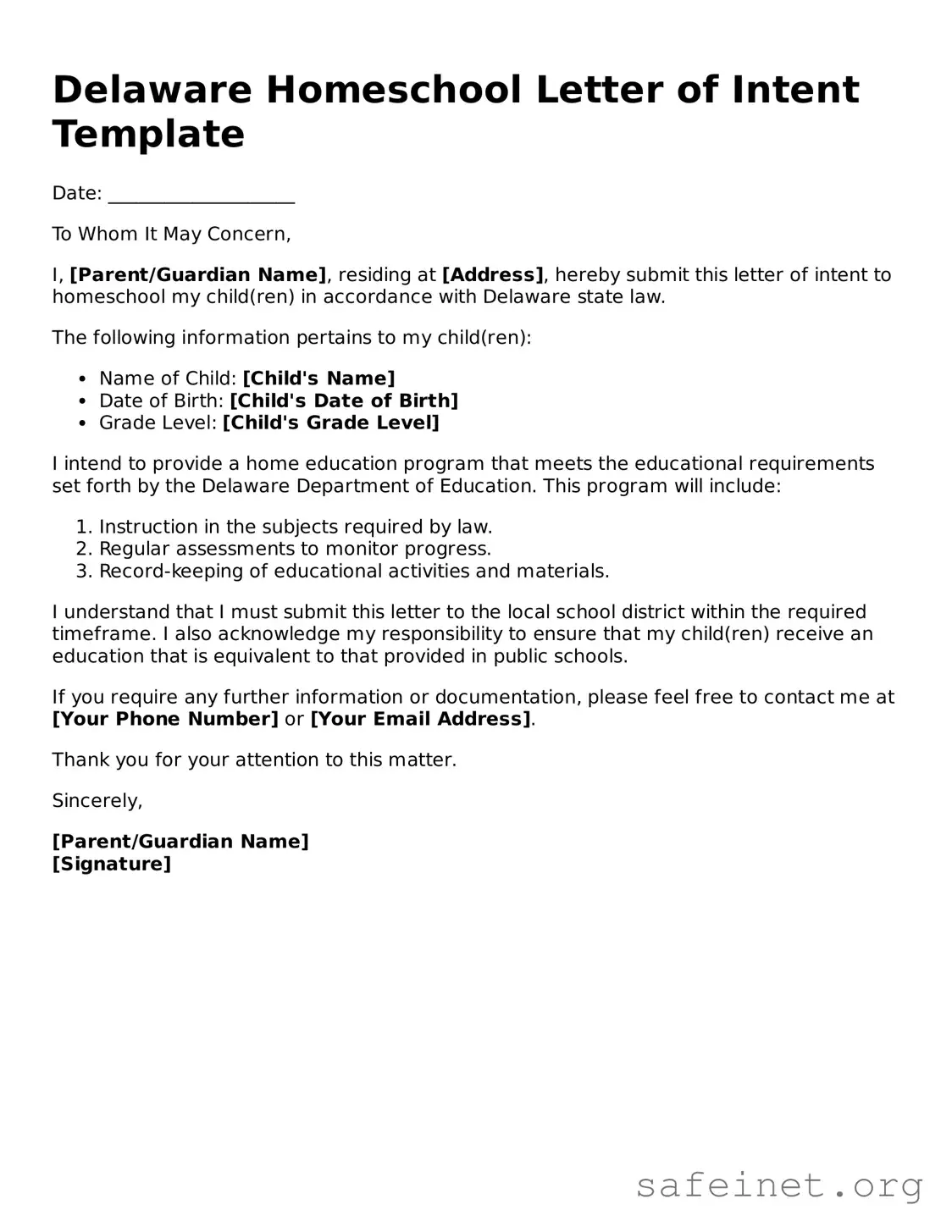
Delaware Homeschool Letter of Intent Template
Date: ____________________
To Whom It May Concern,
I, [Parent/Guardian Name], residing at [Address], hereby submit this letter of intent to homeschool my child(ren) in accordance with Delaware state law.
The following information pertains to my child(ren):
I intend to provide a home education program that meets the educational requirements set forth by the Delaware Department of Education. This program will include:
I understand that I must submit this letter to the local school district within the required timeframe. I also acknowledge my responsibility to ensure that my child(ren) receive an education that is equivalent to that provided in public schools.
If you require any further information or documentation, please feel free to contact me at [Your Phone Number] or [Your Email Address].
Thank you for your attention to this matter.
Sincerely,
[Parent/Guardian Name]
[Signature]
| Fact Name | Details |
|---|---|
| Purpose | The Delaware Homeschool Letter of Intent form is used to officially notify the state of a parent's intent to homeschool their child. |
| Governing Law | The form is governed by Title 14, Chapter 270 of the Delaware Code, which outlines the requirements for homeschooling in the state. |
| Submission Timeline | Parents must submit the Letter of Intent at least 10 days prior to the start of the homeschooling program. |
| Required Information | The form requires the child's name, age, and the address of the homeschooling location. |
| Annual Renewal | The Letter of Intent must be renewed annually, ensuring continued compliance with state regulations. |
| Record Keeping | Parents are advised to keep a copy of the submitted Letter of Intent for their records. |
| State Review | The state may review the homeschooling program to ensure it meets educational standards. |
| Contact Information | For questions or assistance, parents can contact the Delaware Department of Education. |
Once you have decided to homeschool your child in Delaware, the next step involves submitting a Homeschool Letter of Intent. This form notifies the state of your intention to educate your child at home. Completing it accurately ensures that you fulfill your legal obligations as a homeschooling parent.
What is the Delaware Homeschool Letter of Intent form?
The Delaware Homeschool Letter of Intent is a formal document that parents or guardians must submit to the local school district when they decide to homeschool their child. This letter serves as notification to the school district of the intent to provide home education. It is an essential first step in the homeschooling process in Delaware.
What information is required on the form?
The form typically requires basic information about the child, including their name, date of birth, and address. Additionally, parents must provide their contact information and may need to outline the educational plan they intend to follow. While the specifics can vary, clarity and completeness are crucial for ensuring acceptance by the school district.
Is there a deadline for submitting the Letter of Intent?
What happens after I submit the Letter of Intent?
After submitting the Letter of Intent, the school district will review the document. If everything is in order, you will receive confirmation of your homeschooling status. It's important to keep a copy of the letter for your records. You may also be required to submit an educational plan or progress reports periodically, depending on the district's requirements.
Incomplete Information: One of the most common mistakes is failing to provide all required information. Ensure that every section is filled out completely, including the names and addresses of all children being homeschooled.
Incorrect Age Range: Parents sometimes miscalculate the age of their children. The Delaware law requires specific ages for homeschooling, so double-check the ages to avoid issues.
Missing Signatures: Forgetting to sign the form can lead to delays or rejections. Always remember to sign and date the letter before submission.
Not Submitting on Time: Each state has its own deadlines for submitting the Letter of Intent. Late submissions can result in complications, so keep track of deadlines.
Failure to Update Information: If there are changes, such as moving to a new address or changes in the curriculum, these should be reported. Not updating this information can lead to misunderstandings.
Neglecting to Include Contact Information: Some parents forget to provide their own contact details. Including a phone number or email address is essential for communication with the state.
Ignoring State Guidelines: Each state has specific guidelines for homeschooling. Failing to follow Delaware's regulations can lead to complications. Review the guidelines carefully before submitting the form.
When families decide to homeschool in Delaware, they often use the Homeschool Letter of Intent form as a foundational document. However, several other forms and documents may also be necessary to ensure compliance with state regulations and to facilitate the homeschooling process. Below is a list of common documents that may accompany the Homeschool Letter of Intent.
These documents, when used in conjunction with the Homeschool Letter of Intent form, can help ensure a smooth homeschooling experience while meeting Delaware's educational requirements. Families are encouraged to keep thorough records and maintain open communication with local education authorities as needed.
The Delaware Homeschool Letter of Intent form shares similarities with the IEP (Individualized Education Program) document. Both serve as formal notices that outline educational plans tailored to meet specific needs. An IEP is created for students with disabilities, detailing the special services they will receive. Similarly, the Letter of Intent outlines the educational approach a parent intends to take while homeschooling, ensuring that the child’s educational needs are addressed. Both documents require careful consideration of the child's unique circumstances and educational goals.
Another document comparable to the Homeschool Letter of Intent is the Private School Affidavit. This affidavit is filed by parents who choose to enroll their children in private schools rather than public ones. Like the Letter of Intent, it serves as a declaration of educational choice and commitment. Both documents require parents to affirm that they are taking responsibility for their child’s education, ensuring compliance with state regulations. They both emphasize parental involvement and the importance of educational standards.
The Educational Plan form used in some states also resembles the Delaware Homeschool Letter of Intent. This document outlines the curriculum and educational strategies a parent plans to implement. It includes details about subjects to be taught and methods of assessment. Just as the Letter of Intent provides a framework for homeschooling, the Educational Plan serves as a roadmap for parents to follow, ensuring that they cover essential educational content throughout the year.
Finally, the Notification of Intent to Homeschool form found in other states is similar to the Delaware Homeschool Letter of Intent. This notification serves as a formal communication to local education authorities, indicating a parent’s intention to homeschool their child. Both documents require basic information about the child and the educational approach. They are crucial for establishing legal compliance and ensuring that the child’s educational path is recognized by the state.
When filling out the Delaware Homeschool Letter of Intent form, it’s important to follow certain guidelines to ensure a smooth process. Here are six things to consider.
Following these guidelines can help make the process easier and more efficient.
Many people have misunderstandings about the Delaware Homeschool Letter of Intent form. Here are ten common misconceptions, along with clarifications:
This is not true. Parents do not need a special license to homeschool their children in Delaware. They simply need to submit a Letter of Intent to the Department of Education.
While it is required to submit a Letter of Intent when starting to homeschool, it does not need to be resubmitted annually unless there are changes in the educational plan or the family moves.
Delaware does not mandate a specific curriculum. Parents have the freedom to choose their educational materials and methods that best fit their children’s needs.
This is a common misconception. In Delaware, there are no educational requirements for parents who wish to homeschool their children.
Homeschooling is available for all grade levels in Delaware, from kindergarten through high school.
While the Letter of Intent is a necessary step, approval is generally assumed unless the Department of Education has specific concerns.
In Delaware, homeschooled students are allowed to participate in extracurricular activities at their local public schools, including sports and clubs.
Delaware does not impose strict regulations on record-keeping for homeschooling. However, it is advisable for parents to maintain records of their child’s progress.
Homeschooling appeals to a diverse range of families for various reasons, including educational philosophy, personal preferences, and special needs considerations.
While it is beneficial to have a plan, Delaware does not require a detailed educational plan to accompany the Letter of Intent.
Filling out and using the Delaware Homeschool Letter of Intent form is an important step for parents choosing to homeschool their children. Here are some key takeaways to consider: