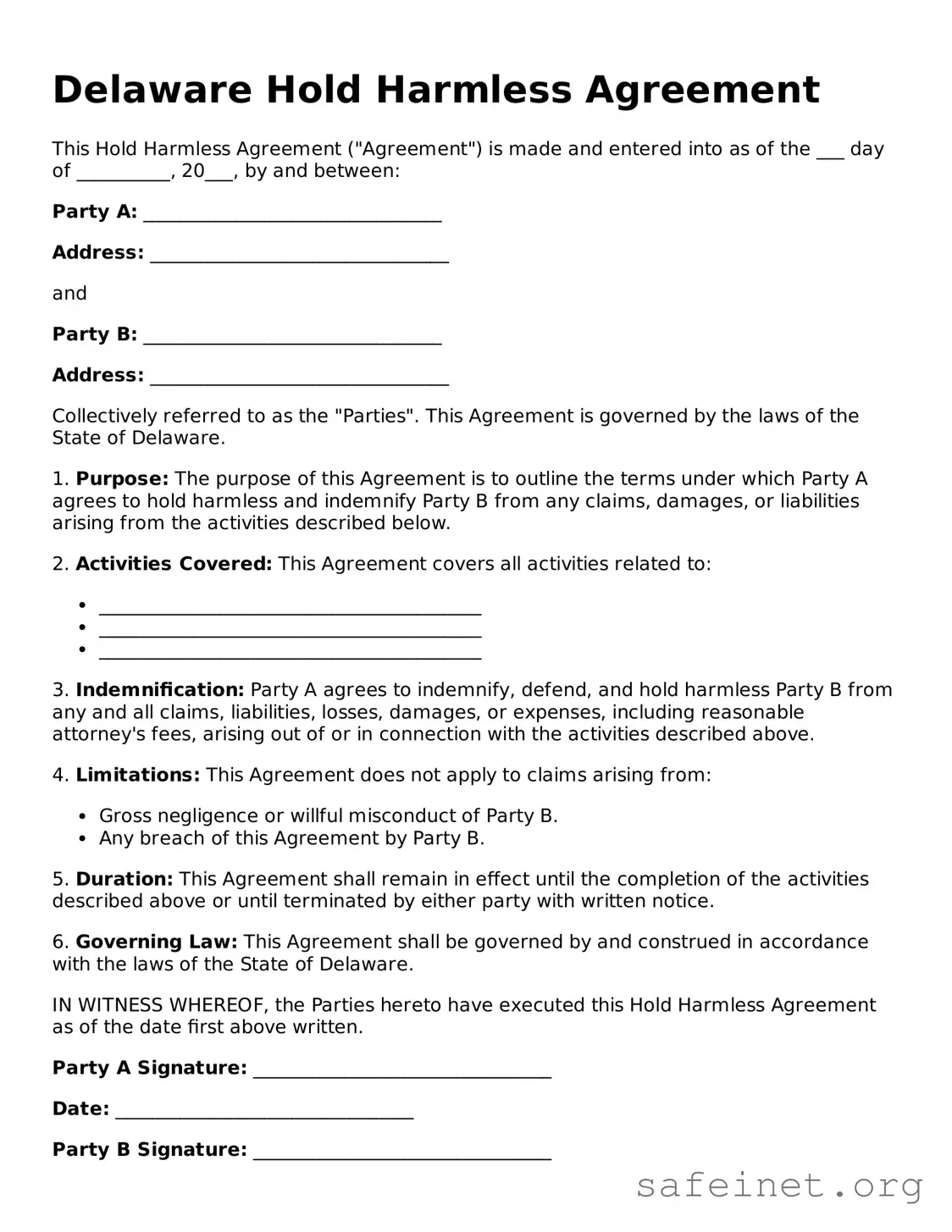
In the realm of legal agreements, the Delaware Hold Harmless Agreement stands out as a crucial document designed to protect parties from liability in various situations. This form is often utilized in contracts related to real estate transactions, construction projects, and other business dealings where risks may arise. By signing this agreement, one party agrees to assume responsibility for any damages or injuries that may occur, thereby shielding the other party from potential legal claims. The agreement typically outlines the scope of liability, specifying the circumstances under which one party will hold the other harmless. Additionally, it may include provisions for indemnification, where one party agrees to cover legal costs and expenses incurred due to claims made against the other. Understanding the nuances of this agreement is essential for anyone engaging in activities that could expose them to risk, as it serves not only as a protective measure but also as a foundation for trust and cooperation between involved parties.
Delaware Hold Harmless Agreement
This Hold Harmless Agreement ("Agreement") is made and entered into as of the ___ day of __________, 20___, by and between:
Party A: ________________________________
Address: ________________________________
and
Party B: ________________________________
Address: ________________________________
Collectively referred to as the "Parties". This Agreement is governed by the laws of the State of Delaware.
1. Purpose: The purpose of this Agreement is to outline the terms under which Party A agrees to hold harmless and indemnify Party B from any claims, damages, or liabilities arising from the activities described below.
2. Activities Covered: This Agreement covers all activities related to:
3. Indemnification: Party A agrees to indemnify, defend, and hold harmless Party B from any and all claims, liabilities, losses, damages, or expenses, including reasonable attorney's fees, arising out of or in connection with the activities described above.
4. Limitations: This Agreement does not apply to claims arising from:
5. Duration: This Agreement shall remain in effect until the completion of the activities described above or until terminated by either party with written notice.
6. Governing Law: This Agreement shall be governed by and construed in accordance with the laws of the State of Delaware.
IN WITNESS WHEREOF, the Parties hereto have executed this Hold Harmless Agreement as of the date first above written.
Party A Signature: ________________________________
Date: ________________________________
Party B Signature: ________________________________
Date: ________________________________
| Fact Name | Description |
|---|---|
| Purpose | The Delaware Hold Harmless Agreement is designed to protect one party from liability for any damages or injuries that may occur during an activity or event. |
| Governing Law | This agreement is governed by the laws of the State of Delaware, ensuring that any disputes will be resolved under Delaware law. |
| Parties Involved | Typically, the agreement involves at least two parties: the indemnitor (the party assuming the risk) and the indemnitee (the party being protected). |
| Limitations | While the agreement provides protection, it may not cover all types of liability, especially those arising from gross negligence or intentional misconduct. |
| Enforceability | For the agreement to be enforceable, it must be clear, specific, and voluntarily signed by both parties, ensuring mutual understanding of the terms. |
To complete the Delaware Hold Harmless Agreement form, gather all necessary information and follow the steps outlined below. Once the form is filled out, it will be ready for submission or distribution as required.
What is a Delaware Hold Harmless Agreement?
A Delaware Hold Harmless Agreement is a legal document that protects one party from liability for any damages or injuries that may occur during a specific activity or event. This agreement is often used in situations where one party agrees to assume the risk of loss or injury, thereby shielding another party from legal claims or financial responsibility.
Who typically uses a Hold Harmless Agreement in Delaware?
This type of agreement is commonly used by businesses, contractors, event organizers, and property owners. It is especially relevant in scenarios involving construction projects, rental agreements, or events where participants may be exposed to risks. The parties involved can be individuals, companies, or organizations.
What are the key components of a Hold Harmless Agreement?
A typical Hold Harmless Agreement includes several important elements: the names of the parties involved, a clear description of the activity or event, the specific risks being assumed, and the duration of the agreement. Additionally, it may outline any limitations on liability and the governing law that applies to the agreement.
Is a Hold Harmless Agreement enforceable in Delaware?
Yes, Hold Harmless Agreements are generally enforceable in Delaware, provided they meet certain legal requirements. The agreement must be clear, voluntary, and not against public policy. Courts will typically uphold these agreements unless they are deemed unreasonable or overly broad.
Can a Hold Harmless Agreement protect against gross negligence?
Typically, Hold Harmless Agreements do not protect against gross negligence or willful misconduct. Courts may invalidate clauses that attempt to waive liability for such actions. It is important for parties to clearly define the scope of the agreement and understand the limits of liability.
How should a Hold Harmless Agreement be executed?
To execute a Hold Harmless Agreement, both parties should review the document thoroughly. Once they agree to the terms, they should sign and date the agreement. It is advisable to have the document notarized or witnessed to enhance its enforceability, though this is not always required.
Where can I find a template for a Delaware Hold Harmless Agreement?
Templates for Hold Harmless Agreements can often be found online through legal document services or state government websites. However, it is recommended to consult with a legal professional to ensure that the agreement meets specific needs and complies with Delaware law.
Incomplete Information: Individuals often forget to fill in all required fields. Missing details can lead to delays or rejection of the agreement.
Incorrect Dates: Entering the wrong date can create confusion regarding the duration of the agreement. Always double-check the dates before submission.
Improper Signatures: Failing to sign the document or having it signed by someone who is not authorized can invalidate the agreement. Ensure that the correct parties sign.
Not Reading the Terms: Some individuals skip reading the terms and conditions. Understanding the implications of the agreement is crucial before signing.
Using Incorrect Names: Mistakes in names can lead to legal complications. Verify that all names are spelled correctly and match official documents.
Failing to Include Necessary Attachments: Certain situations may require additional documentation. Ensure all necessary attachments are included with the form.
Not Keeping a Copy: After submission, individuals often forget to keep a copy of the signed agreement. Retaining a copy is essential for future reference.
Ignoring State-Specific Requirements: Different states may have unique requirements for Hold Harmless Agreements. Familiarize yourself with Delaware's specific rules.
When entering into agreements, especially those that involve liability and risk, it’s essential to have a variety of supporting documents. A Delaware Hold Harmless Agreement is often used in conjunction with other forms to ensure clarity and protection for all parties involved. Below is a list of documents that are commonly associated with the Hold Harmless Agreement.
Understanding these documents and their purposes is essential for anyone involved in agreements that carry potential risks. They work together to create a comprehensive framework that protects all parties and clarifies responsibilities. Always consider consulting with a professional to ensure that all necessary forms are properly completed and tailored to your specific situation.
The Delaware Hold Harmless Agreement is similar to a Release of Liability form. Both documents serve to protect one party from legal claims or damages that may arise from specific activities or events. In essence, a Release of Liability acknowledges that one party agrees not to hold the other responsible for any injuries or damages incurred, effectively shifting the risk away from the released party. This type of agreement is commonly used in recreational activities, where participants acknowledge the risks involved and agree to waive their right to sue for any accidents that may occur.
Another document that resembles the Hold Harmless Agreement is the Indemnity Agreement. While both agreements aim to protect one party from financial loss due to claims made by third parties, the Indemnity Agreement specifically requires one party to compensate the other for any losses incurred. This means that if a claim arises, the indemnifying party is obligated to cover costs such as legal fees or settlements, ensuring that the other party is not left to bear the financial burden.
The Waiver of Claims document is also similar in nature. This document serves to prevent individuals from pursuing legal action against another party for any potential claims that may arise from a specific event or activity. By signing a Waiver of Claims, participants acknowledge the risks involved and agree to forfeit their right to seek compensation for any injuries or damages, similar to the Hold Harmless Agreement. Both documents emphasize the importance of informed consent and personal responsibility.
A Liability Waiver is yet another document that shares similarities with the Hold Harmless Agreement. Like the Hold Harmless Agreement, a Liability Waiver is often used in situations where individuals participate in activities that carry inherent risks, such as sports or adventure activities. By signing this document, participants agree to waive their right to sue for injuries or damages, thereby protecting the organization or individual hosting the activity from potential legal claims.
The Service Agreement often includes provisions similar to those found in a Hold Harmless Agreement. In this context, the service provider may seek to limit their liability for any damages or losses incurred during the course of their services. By including a Hold Harmless clause, the service provider is protected from claims arising from the actions or negligence of the client, ensuring that both parties understand their responsibilities and liabilities.
The Contractor Agreement can also contain elements akin to a Hold Harmless Agreement. In construction or service industries, contractors often include indemnification clauses that require clients to hold them harmless for any claims arising from the work performed. This protects contractors from liability related to accidents or damages that may occur on the job site, emphasizing the importance of clear communication regarding responsibilities and risks.
Finally, the Partnership Agreement may incorporate hold harmless provisions. When two or more parties enter into a partnership, they may agree to indemnify each other against certain liabilities. This ensures that if one partner faces a legal claim due to the partnership’s activities, the other partners will not be held responsible, fostering a sense of trust and collaboration while clearly delineating each partner's responsibilities.
When filling out a Delaware Hold Harmless Agreement form, it’s essential to approach the process with care. Here’s a list of things you should and shouldn’t do to ensure the agreement is effective and legally sound.
Many people have misunderstandings about the Delaware Hold Harmless Agreement form. Here are five common misconceptions:
A Hold Harmless Agreement does not completely remove liability. It typically protects one party from being held responsible for certain risks, but it does not cover all situations or negligence.
Individuals can also use Hold Harmless Agreements. They are useful in various situations, such as when renting equipment or participating in recreational activities.
While notarization can add an extra layer of authenticity, it is not a requirement for a Hold Harmless Agreement to be legally binding in Delaware.
Each Hold Harmless Agreement should be tailored to the specific situation. The terms can vary significantly based on the parties involved and the nature of the activity.
Signing a Hold Harmless Agreement indicates that you acknowledge certain risks, but it does not mean you waive all rights or accept liability for gross negligence or willful misconduct.
When considering the Delaware Hold Harmless Agreement form, it is essential to understand its purpose and the implications it carries. Here are some key takeaways to keep in mind: