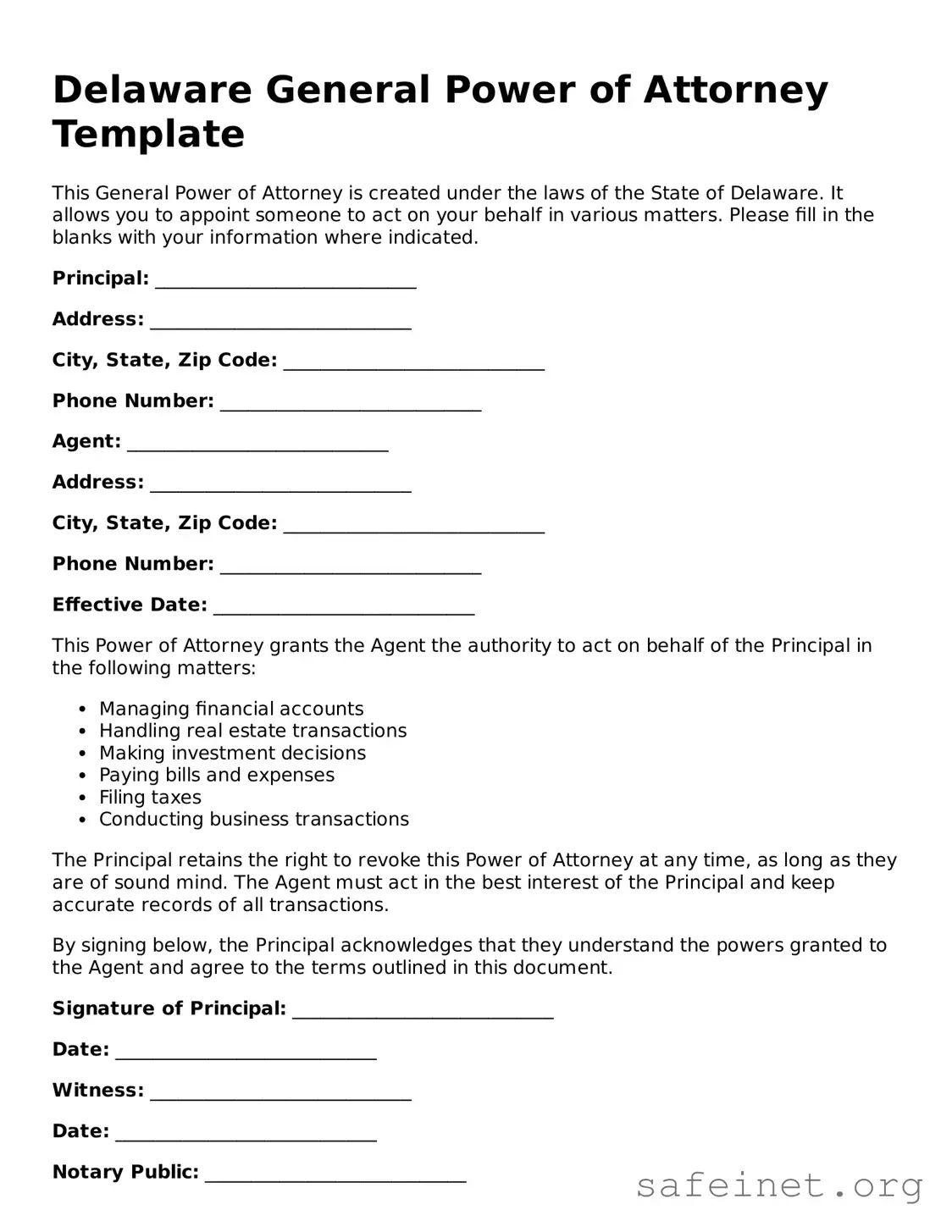
The Delaware General Power of Attorney form serves as a crucial legal document that grants an individual, known as the agent or attorney-in-fact, the authority to make decisions on behalf of another person, referred to as the principal. This form can cover a wide range of powers, including managing financial affairs, handling real estate transactions, and making healthcare decisions. It is designed to be flexible, allowing the principal to specify which powers are granted and under what circumstances they can be exercised. The document can be effective immediately or can be set to activate only upon the principal’s incapacity. One of the key aspects of this form is its ability to provide peace of mind, ensuring that someone the principal trusts will be able to act in their best interests when they are unable to do so themselves. Additionally, the Delaware General Power of Attorney includes provisions for revocation, allowing the principal to terminate the agent's authority at any time, provided they are mentally competent. Understanding the intricacies of this form is essential for anyone considering establishing a power of attorney, as it not only affects personal and financial matters but also impacts family dynamics and future planning.
Delaware General Power of Attorney Template
This General Power of Attorney is created under the laws of the State of Delaware. It allows you to appoint someone to act on your behalf in various matters. Please fill in the blanks with your information where indicated.
Principal: ____________________________
Address: ____________________________
City, State, Zip Code: ____________________________
Phone Number: ____________________________
Agent: ____________________________
Address: ____________________________
City, State, Zip Code: ____________________________
Phone Number: ____________________________
Effective Date: ____________________________
This Power of Attorney grants the Agent the authority to act on behalf of the Principal in the following matters:
The Principal retains the right to revoke this Power of Attorney at any time, as long as they are of sound mind. The Agent must act in the best interest of the Principal and keep accurate records of all transactions.
By signing below, the Principal acknowledges that they understand the powers granted to the Agent and agree to the terms outlined in this document.
Signature of Principal: ____________________________
Date: ____________________________
Witness: ____________________________
Date: ____________________________
Notary Public: ____________________________
Date: ____________________________
| Fact Name | Description |
|---|---|
| Definition | The Delaware General Power of Attorney form allows an individual to designate another person to make financial decisions on their behalf. |
| Governing Law | This form is governed by the Delaware Uniform Power of Attorney Act, found in Title 12, Chapter 49 of the Delaware Code. |
| Durability | The power of attorney can be made durable, meaning it remains effective even if the principal becomes incapacitated. |
| Agent's Authority | The agent can perform a wide range of financial tasks, including managing bank accounts, paying bills, and handling investments. |
| Revocation | The principal can revoke the power of attorney at any time, as long as they are mentally competent. |
| Witness Requirements | The form must be signed in the presence of a notary public and can also require one or two witnesses, depending on specific circumstances. |
Filling out the Delaware General Power of Attorney form is a straightforward process that allows you to designate someone to act on your behalf in various matters. Once you complete the form, ensure you keep a copy for your records and provide a signed copy to the person you are appointing.
What is a Delaware General Power of Attorney?
A Delaware General Power of Attorney is a legal document that allows one person, known as the principal, to grant another person, called the agent or attorney-in-fact, the authority to act on their behalf. This authority can cover a wide range of financial and legal matters, making it a versatile tool for managing personal affairs, especially in the event of incapacity or absence.
Who can create a General Power of Attorney in Delaware?
Any adult who is mentally competent can create a General Power of Attorney in Delaware. This means that the individual must understand the nature and consequences of the document they are signing. It is important to ensure that the principal is capable of making informed decisions at the time of execution.
What powers can be granted through a General Power of Attorney?
The powers granted can be broad or limited. Generally, a General Power of Attorney allows the agent to handle financial transactions, manage real estate, pay bills, make investments, and conduct business on behalf of the principal. However, the principal can specify any limitations or restrictions in the document itself.
Does a General Power of Attorney need to be notarized in Delaware?
Yes, in Delaware, a General Power of Attorney must be notarized to be considered valid. Notarization serves as a safeguard, ensuring that the principal's signature is authentic and that they are signing the document voluntarily. In some cases, witnesses may also be required.
Can a General Power of Attorney be revoked?
Absolutely. The principal has the right to revoke a General Power of Attorney at any time, as long as they are mentally competent. Revocation should be done in writing and communicated to the agent and any relevant third parties to avoid confusion. It's advisable to formally notify the agent and possibly record the revocation with the county recorder's office.
What happens if the principal becomes incapacitated?
In the event that the principal becomes incapacitated, the General Power of Attorney remains in effect, allowing the agent to continue managing the principal's affairs. This is one of the primary reasons individuals create this document. However, if the principal has not designated a durable power of attorney, the authority may cease if the principal loses mental capacity.
Can an agent under a General Power of Attorney make healthcare decisions?
No, a General Power of Attorney typically does not grant the agent authority to make healthcare decisions unless specifically stated. For healthcare matters, a separate document known as an Advance Healthcare Directive or a Medical Power of Attorney should be created. This ensures that medical decisions align with the principal's wishes.
Is a General Power of Attorney effective immediately upon signing?
Yes, a General Power of Attorney is generally effective immediately upon signing unless the principal specifies a different effective date. This means the agent can start acting on behalf of the principal right away, which can be particularly useful in urgent situations.
What should I consider before granting someone a General Power of Attorney?
Before granting someone a General Power of Attorney, consider their trustworthiness and ability to act in your best interest. It's also essential to discuss your wishes and expectations with the person you intend to appoint. Additionally, think about the scope of authority you want to grant and whether any limitations should be included in the document.
Failing to specify the powers granted. It's essential to clearly outline what authority is being given to the agent. Without specific powers, there may be confusion or limitations in what the agent can do.
Not naming a successor agent. In case the primary agent is unable or unwilling to act, it's wise to designate a backup. Omitting this step can lead to complications in decision-making.
Overlooking the need for signatures. Both the principal and the agent must sign the document. Neglecting this crucial step can render the form invalid.
Ignoring state-specific requirements. Each state has its own rules regarding power of attorney forms. Failing to adhere to Delaware's specific requirements can lead to issues with the document's acceptance.
Using outdated forms. Laws can change, and using an old version of the power of attorney form may result in non-compliance. Always ensure that the most current form is being utilized.
Not having the document notarized. While notarization is not always required, it can add an extra layer of validation. Skipping this step may lead to disputes regarding the authenticity of the document.
Failing to discuss the arrangement with the agent. Open communication about the responsibilities and expectations can prevent misunderstandings later. Not having this conversation can lead to conflict.
Neglecting to update the document. Life changes such as marriage, divorce, or the death of an agent can necessitate updates to the power of attorney. Failing to revise the document accordingly can create legal complications.
Not considering the implications of granting broad powers. While it may seem convenient to give wide-ranging authority, it’s important to understand the potential risks involved. Carefully consider the level of control being granted.
When setting up a Delaware General Power of Attorney, it’s essential to consider additional documents that can complement your estate planning. These forms help ensure that your wishes are carried out effectively and that your financial and medical decisions are managed according to your preferences.
By considering these additional forms, you can create a comprehensive plan that addresses your financial and healthcare needs. Each document serves a unique purpose, ensuring that your wishes are respected and that your loved ones are prepared to act on your behalf when necessary.
The Delaware General Power of Attorney form is similar to the Durable Power of Attorney. Both documents allow an individual to designate someone else to make decisions on their behalf. However, the key difference lies in the durability of the authority granted. While a General Power of Attorney may become invalid if the principal becomes incapacitated, a Durable Power of Attorney remains effective even if the principal is unable to make decisions due to health issues. This makes the Durable Power of Attorney a preferred choice for long-term planning, especially for those concerned about future incapacity.
Another document that shares similarities with the General Power of Attorney is the Limited Power of Attorney. Like the General version, the Limited Power of Attorney enables one person to act on behalf of another. The distinction lies in the scope of authority granted. A Limited Power of Attorney is tailored for specific tasks or time periods, such as selling a car or managing a real estate transaction. This specificity can provide peace of mind, as the agent's powers are clearly defined and restricted to particular actions.
The Healthcare Power of Attorney is also comparable to the General Power of Attorney, but it focuses solely on medical decisions. This document allows an individual to appoint someone to make healthcare choices if they become unable to communicate their wishes. While a General Power of Attorney can cover a wide range of financial and legal matters, the Healthcare Power of Attorney is specifically designed for situations involving medical treatment and end-of-life decisions, ensuring that personal health preferences are respected.
Lastly, the Financial Power of Attorney shares similarities with the General Power of Attorney, primarily in its focus on financial matters. Both documents empower an agent to handle financial transactions, such as managing bank accounts or paying bills. However, a Financial Power of Attorney may be more narrowly focused on financial issues, without extending authority into other areas like healthcare or legal matters. This can be advantageous for individuals who want to keep their financial affairs separate from other types of decision-making authority.
When filling out the Delaware General Power of Attorney form, it is essential to approach the task with care. Here’s a list of six important dos and don’ts to ensure that the document is completed accurately and effectively.
By following these guidelines, you can help ensure that your Delaware General Power of Attorney form is filled out correctly and serves its intended purpose.
When it comes to the Delaware General Power of Attorney form, there are several misconceptions that can lead to confusion. Here are nine common misunderstandings:
Understanding these misconceptions can help individuals make informed decisions about their legal documents and ensure that their wishes are honored.
When filling out and utilizing the Delaware General Power of Attorney form, several key points should be considered to ensure clarity and effectiveness.