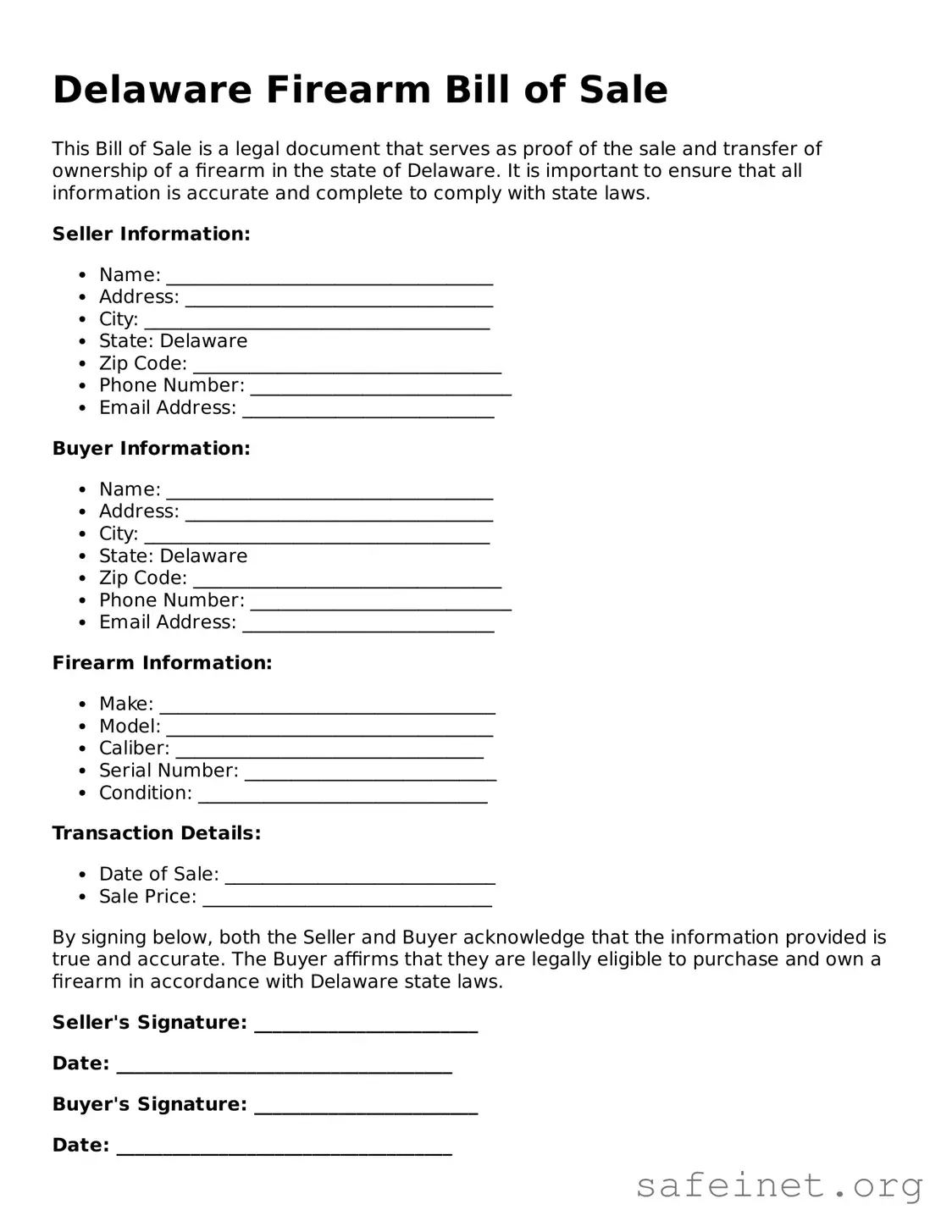
The Delaware Firearm Bill of Sale form serves as an essential document for individuals engaged in the private sale or transfer of firearms within the state. This form outlines the details of the transaction, including the buyer's and seller's information, the description of the firearm being sold, and the date of the sale. It also provides space for both parties to sign, thereby acknowledging the transfer of ownership. Importantly, the form helps ensure compliance with state regulations, protecting both the buyer and seller by documenting the transaction. By utilizing this form, individuals can establish a clear record of the sale, which may be beneficial for future reference or legal purposes. Furthermore, the form emphasizes the importance of responsible firearm ownership and transfer, promoting safety and accountability in the community.
Delaware Firearm Bill of Sale
This Bill of Sale is a legal document that serves as proof of the sale and transfer of ownership of a firearm in the state of Delaware. It is important to ensure that all information is accurate and complete to comply with state laws.
Seller Information:
Buyer Information:
Firearm Information:
Transaction Details:
By signing below, both the Seller and Buyer acknowledge that the information provided is true and accurate. The Buyer affirms that they are legally eligible to purchase and own a firearm in accordance with Delaware state laws.
Seller's Signature: ________________________
Date: ____________________________________
Buyer's Signature: ________________________
Date: ____________________________________
This Bill of Sale is intended to comply with all applicable laws in the state of Delaware. Both parties should retain a copy for their records.
| Fact Name | Description |
|---|---|
| Purpose | The Delaware Firearm Bill of Sale form serves as a legal document to record the sale of a firearm between two parties. |
| Governing Law | This form is governed by Delaware Code Title 11, Chapter 144, which outlines firearm regulations. |
| Identification Requirements | Both the buyer and seller must provide valid identification to complete the transaction legally. |
| Transfer of Ownership | Completion of this form signifies the official transfer of ownership from the seller to the buyer. |
| Record Keeping | It is recommended that both parties retain a copy of the completed Bill of Sale for their records. |
| Legal Age | Buyers must be at least 18 years old to purchase a firearm in Delaware. |
| Background Checks | While the Bill of Sale does not require a background check, it is advised to verify the buyer’s eligibility to own a firearm. |
| Notarization | The form does not require notarization, but having it notarized can add an extra layer of legitimacy. |
| Filling Out the Form | Both parties must fill out the form completely, including details about the firearm being sold. |
| Consequences of Non-Compliance | Failure to properly document the sale can lead to legal issues for both the buyer and seller. |
Once you have the Delaware Firearm Bill of Sale form, you are ready to begin the process of completing it. This document serves as a record of the sale and transfer of ownership of a firearm. It is important to fill it out accurately to ensure that both the seller and buyer have a clear understanding of the transaction.
What is a Delaware Firearm Bill of Sale form?
A Delaware Firearm Bill of Sale form is a legal document that records the sale or transfer of a firearm between two parties in the state of Delaware. This form serves as proof of the transaction and includes important details about the firearm, the buyer, and the seller.
Is a Bill of Sale required for private firearm sales in Delaware?
While a Bill of Sale is not legally required for private firearm sales in Delaware, it is highly recommended. Having a written record can protect both the buyer and seller in case of disputes or legal issues that may arise in the future.
What information should be included in the Bill of Sale?
The Bill of Sale should include the names and addresses of both the buyer and seller, a description of the firearm (including make, model, and serial number), the date of the sale, and the purchase price. Additionally, both parties should sign and date the document to validate the transaction.
Can I create my own Bill of Sale for firearms?
Yes, you can create your own Bill of Sale for firearms in Delaware. However, it is important to ensure that all necessary information is included and that the document is clear and unambiguous. Templates are often available online to assist you in drafting a proper form.
Do I need to have the Bill of Sale notarized?
No, notarization is not required for a Bill of Sale in Delaware. However, having the document notarized can add an extra layer of authenticity and may be beneficial if any legal issues arise later.
What should I do if I lose my Bill of Sale?
If you lose your Bill of Sale, it is advisable to try to obtain a copy from the other party involved in the transaction. If that is not possible, you may consider creating a new Bill of Sale and having both parties sign it again, documenting the circumstances of the loss.
Are there any restrictions on who can buy or sell firearms in Delaware?
Yes, there are restrictions. Individuals who are prohibited from owning firearms, such as felons or those with certain mental health issues, cannot legally purchase or possess firearms. It is important to ensure that both the buyer and seller comply with these regulations during the transaction.
What happens if the firearm is used in a crime after the sale?
If a firearm sold through a Bill of Sale is later used in a crime, the seller may be contacted by law enforcement for information. Having a Bill of Sale can help demonstrate that the seller no longer owns the firearm, which may protect them from legal liability.
Is there a specific format for the Delaware Firearm Bill of Sale?
There is no specific state-mandated format for the Bill of Sale, but it should be clear and include all relevant information. A well-structured document will help ensure that both parties understand the terms of the sale and can refer back to it if needed.
Can I sell a firearm to someone from another state using this Bill of Sale?
Selling a firearm to someone from another state involves additional legal considerations. Federal laws and the laws of the buyer's state must be followed. It is advisable to research these regulations or consult with a legal expert to ensure compliance before proceeding with the sale.
Incomplete Information: One of the most common mistakes is failing to fill out all required fields. Each section of the form must be completed to ensure the sale is valid. Missing information can lead to confusion or even legal issues down the line.
Incorrect Identification: Buyers and sellers often overlook the importance of providing accurate identification details. Using the wrong driver's license number or failing to include a Social Security number can invalidate the sale.
Not Including the Firearm's Details: It's crucial to specify the firearm's make, model, and serial number. Omitting these details can create ambiguity about the item being sold and may lead to disputes later.
Forgetting Signatures: Both parties must sign the document for it to be legally binding. Neglecting to include signatures can render the bill of sale ineffective.
Failing to Date the Document: A common oversight is not dating the bill of sale. The date is essential as it marks the official transfer of ownership. Without it, establishing a timeline for ownership can become complicated.
Not Keeping Copies: After completing the form, many individuals forget to make copies for their records. Retaining a copy is vital for both the buyer and seller in case any issues arise in the future.
When engaging in the sale or transfer of firearms in Delaware, it's essential to have the right documentation in place. Along with the Delaware Firearm Bill of Sale form, several other documents can help ensure that the transaction is legal and transparent. Here are four important forms often used in conjunction with the Bill of Sale:
Having these documents in place not only helps facilitate a smooth transaction but also protects both the buyer and seller. Proper documentation is vital in ensuring compliance with state laws and promoting responsible firearm ownership.
The Delaware Firearm Bill of Sale form shares similarities with the general Bill of Sale, which is a document used to transfer ownership of personal property from one individual to another. Like the firearm-specific version, a general Bill of Sale includes details such as the names of the buyer and seller, a description of the item, and the sale price. This document serves as a legal record of the transaction, providing proof of ownership and protecting both parties in case of disputes.
Another document akin to the Delaware Firearm Bill of Sale is the Vehicle Bill of Sale. This form is used when transferring ownership of a motor vehicle. It contains similar elements, including the vehicle identification number (VIN), make, model, and year of the vehicle, along with the buyer's and seller's information. Both documents aim to formalize the transfer of ownership and provide a written record that can be referenced in the future.
The Lease Agreement resembles the Firearm Bill of Sale in that it establishes a legal relationship between parties regarding the use of property. While the Firearm Bill of Sale transfers ownership, a Lease Agreement outlines the terms under which one party can use another's property, typically for a specified period. Both documents require clear identification of the parties involved and a detailed description of the property in question.
Similar to the Firearm Bill of Sale, the Rental Agreement is used to document the rental of personal property, such as equipment or furniture. This agreement specifies the terms of the rental, including duration, payment, and responsibilities of both the renter and the owner. Like the Firearm Bill of Sale, it serves to protect both parties by providing a clear record of the transaction and expectations.
The Promissory Note is another document that parallels the Firearm Bill of Sale. This legal instrument outlines a borrower's promise to repay a loan to a lender. While it does not transfer ownership of an item, it includes essential details such as the amount borrowed, interest rate, and repayment schedule. Both documents establish a formal agreement between parties, ensuring clarity and accountability in the transaction.
The Power of Attorney document shares similarities with the Firearm Bill of Sale in that it grants authority to one person to act on behalf of another. This form is crucial when the original owner cannot be present for a transaction, such as the sale of a firearm. Both documents require clear identification of the parties and a description of the property or authority being transferred.
Another related document is the Warranty Deed, which is used to transfer real estate ownership. Like the Firearm Bill of Sale, it provides a legal record of ownership transfer, detailing the property description and the parties involved. Both documents are essential for establishing clear ownership rights and protecting against future claims.
The Affidavit of Title is similar to the Firearm Bill of Sale in that it serves as a sworn statement regarding the ownership of an item, often used in the context of vehicles. This document verifies that the seller has the legal right to sell the property. Both documents aim to ensure that the buyer receives clear title and ownership, reducing the risk of future disputes.
Finally, the Transfer of Ownership form used for businesses or partnerships is akin to the Firearm Bill of Sale. This document formalizes the transfer of ownership interests in a business entity. It includes the names of the parties involved and a description of the ownership being transferred, similar to how the Firearm Bill of Sale details the firearm being sold. Both documents are essential for maintaining accurate records of ownership and ensuring legal compliance.
When filling out the Delaware Firearm Bill of Sale form, it's important to get it right. Here’s a helpful list of things to do and avoid:
Following these guidelines will help ensure that your Bill of Sale is completed correctly and is legally binding.
Understanding the Delaware Firearm Bill of Sale form is essential for anyone involved in the sale or transfer of firearms. However, several misconceptions can lead to confusion. Below is a list of common misunderstandings about this form.
Clarifying these misconceptions can help individuals navigate the process of firearm sales more effectively and responsibly.
When dealing with the Delaware Firearm Bill of Sale form, it is essential to understand the process and requirements involved. Here are some key takeaways to consider:
By following these guidelines, individuals can navigate the process of filling out and using the Delaware Firearm Bill of Sale form effectively.