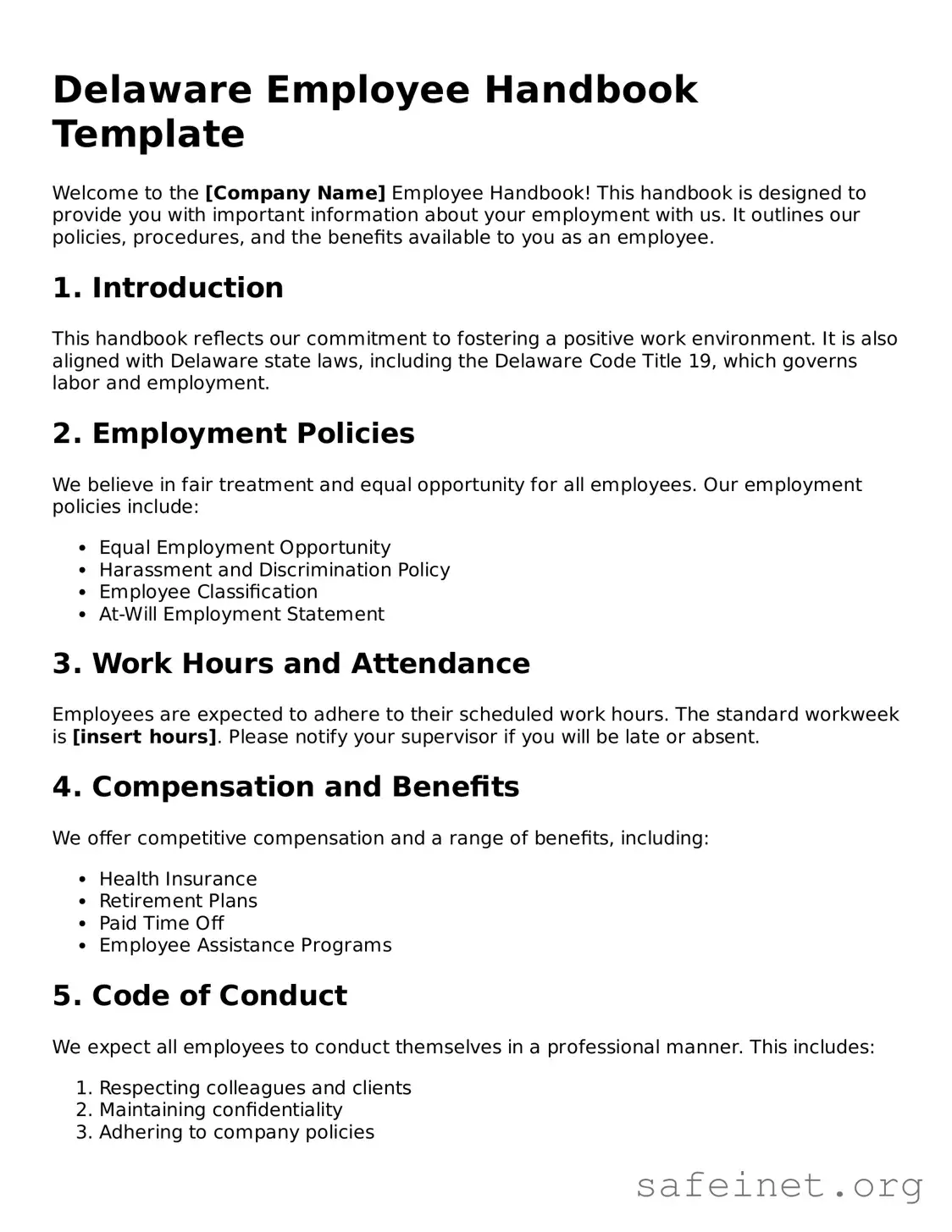
The Delaware Employee Handbook form serves as a crucial resource for both employers and employees, outlining essential workplace policies and expectations. This document typically includes sections on company culture, employee rights, and responsibilities, as well as guidelines for conduct and performance evaluations. It addresses important topics such as anti-discrimination policies, workplace safety, and benefits information. Additionally, the handbook often covers procedures for reporting grievances and outlines disciplinary measures for violations. By providing clear and concise information, the Delaware Employee Handbook form helps foster a positive work environment and ensures compliance with state and federal regulations. This form is not just a legal requirement; it is a tool for communication that can enhance employee understanding and engagement within the organization.
Delaware Employee Handbook Template
Welcome to the [Company Name] Employee Handbook! This handbook is designed to provide you with important information about your employment with us. It outlines our policies, procedures, and the benefits available to you as an employee.
1. Introduction
This handbook reflects our commitment to fostering a positive work environment. It is also aligned with Delaware state laws, including the Delaware Code Title 19, which governs labor and employment.
2. Employment Policies
We believe in fair treatment and equal opportunity for all employees. Our employment policies include:
3. Work Hours and Attendance
Employees are expected to adhere to their scheduled work hours. The standard workweek is [insert hours]. Please notify your supervisor if you will be late or absent.
4. Compensation and Benefits
We offer competitive compensation and a range of benefits, including:
5. Code of Conduct
We expect all employees to conduct themselves in a professional manner. This includes:
6. Safety and Health
Your safety is our priority. We comply with the Occupational Safety and Health Administration (OSHA) regulations and encourage you to report any unsafe conditions.
7. Employee Acknowledgment
By signing below, you acknowledge that you have received, read, and understood the [Company Name] Employee Handbook.
Employee Name: ________________________
Signature: ______________________________
Date: __________________________________
8. Contact Information
If you have any questions about this handbook or your employment, please contact:
[HR Contact Name]
[Company Name]
[Phone Number]
[Email Address]
Thank you for being a valued member of our team!
| Fact Name | Details |
|---|---|
| Purpose | The Delaware Employee Handbook serves as a guide for employees, outlining company policies and procedures. |
| Governing Law | Delaware law governs the contents and requirements of the employee handbook. |
| Mandatory Policies | Employers must include certain policies, such as anti-discrimination and harassment policies. |
| Employee Acknowledgment | Employees should sign an acknowledgment form to confirm they have received and understood the handbook. |
| Review and Updates | The handbook should be reviewed regularly and updated as necessary to reflect changes in laws or company policies. |
| Accessibility | Employers must ensure that the handbook is accessible to all employees, including those with disabilities. |
Once you have the Delaware Employee Handbook form in front of you, it is important to ensure that all required sections are filled out accurately. This process will help establish clear policies and guidelines for employees. Follow the steps below to complete the form efficiently.
After completing these steps, you will be ready to distribute the handbook to your employees. This ensures that everyone is aware of the policies and procedures that govern the workplace.
What is the Delaware Employee Handbook form?
The Delaware Employee Handbook form is a document that outlines the policies, procedures, and expectations for employees working in Delaware. It serves as a comprehensive guide for both employers and employees, ensuring that everyone is aware of their rights and responsibilities within the workplace. The handbook can cover topics such as company culture, workplace conduct, benefits, and disciplinary procedures, making it an essential resource for maintaining a positive work environment.
Why is it important to have an Employee Handbook?
Having an Employee Handbook is crucial for several reasons. First, it helps to establish clear guidelines and expectations for employees, reducing the likelihood of misunderstandings and conflicts. Second, it serves as a legal safeguard for employers, demonstrating that they have communicated policies effectively. This can be particularly important in cases of disputes or grievances. Lastly, a well-crafted handbook can enhance employee morale by fostering a sense of transparency and fairness within the organization.
What should be included in the Delaware Employee Handbook?
While the specific content may vary based on the company and its industry, several key elements should typically be included. These may encompass an introduction to the company, an overview of employment policies, a description of employee benefits, guidelines on workplace behavior, and procedures for reporting grievances. Additionally, it may address compliance with state and federal laws, such as anti-discrimination policies and workplace safety regulations. Tailoring the handbook to the unique culture and needs of the organization is also beneficial.
How often should the Employee Handbook be updated?
Regular updates to the Employee Handbook are essential to ensure that it remains relevant and compliant with current laws and regulations. A good practice is to review the handbook at least once a year. However, updates should also occur whenever there are significant changes in company policies, employment laws, or other relevant circumstances. Keeping the handbook current helps to minimize legal risks and reinforces the company’s commitment to maintaining an informed workforce.
Can employees provide input on the Employee Handbook?
Yes, involving employees in the creation or revision of the Employee Handbook can be beneficial. Soliciting feedback allows employees to feel valued and heard, fostering a collaborative workplace culture. Their insights can help identify areas that may need clarification or additional detail. However, while employee input is important, the final decision regarding the content of the handbook typically rests with management, ensuring that the company’s goals and legal obligations are met.
Failing to read the entire handbook thoroughly.
Many individuals overlook key sections that outline important policies and procedures. This can lead to misunderstandings about workplace expectations.
Not updating personal information.
When employees do not provide accurate and current contact details, it can create communication issues. This includes changes in address, phone number, or emergency contacts.
Ignoring the acknowledgment section.
Some individuals skip the part where they must confirm they have read and understood the handbook. This acknowledgment is often required for compliance purposes.
Misunderstanding the reporting procedures.
Employees may not grasp how to properly report issues or concerns. Not following the outlined procedures can lead to delays in resolution or escalation of problems.
When creating an employee handbook in Delaware, several other forms and documents may be necessary to ensure compliance with state and federal laws. These documents help clarify policies, protect the organization, and foster a positive workplace culture. Below is a list of important forms and documents often used alongside the Delaware Employee Handbook.
Utilizing these forms and documents alongside the Delaware Employee Handbook can help create a well-structured and legally compliant workplace. They not only protect the organization but also foster clear communication and mutual understanding between employers and employees.
The Delaware Employee Handbook form is similar to the Employee Manual. Both documents outline company policies, procedures, and expectations for employees. They serve as a guide for employees to understand their rights and responsibilities within the organization. The Employee Manual often includes sections on workplace conduct, dress code, and attendance policies, much like the Delaware Employee Handbook.
Another similar document is the Orientation Guide. This guide is typically provided to new employees during their onboarding process. It offers an overview of the company culture, mission, and values. Like the Delaware Employee Handbook, the Orientation Guide aims to help employees acclimate to their new work environment and understand what is expected of them.
The Workplace Safety Manual also shares similarities with the Delaware Employee Handbook. Both documents emphasize the importance of safety in the workplace. They outline safety protocols, emergency procedures, and reporting mechanisms for incidents. Employees can refer to both documents to ensure they are following safety guidelines and contributing to a safe work environment.
The Code of Conduct is another document that aligns closely with the Delaware Employee Handbook. It sets clear expectations for employee behavior and ethical standards. Both documents address issues such as harassment, discrimination, and conflict of interest, providing employees with guidance on how to navigate these situations in the workplace.
The Benefits Summary document is also similar in purpose to the Delaware Employee Handbook. It details the benefits offered by the employer, such as health insurance, retirement plans, and paid time off. While the Employee Handbook may touch on these topics, the Benefits Summary provides a more focused look at the specific benefits available to employees.
The Performance Review Policy document shares common ground with the Delaware Employee Handbook as well. Both documents outline the processes for evaluating employee performance. They provide information on how performance is assessed, the frequency of reviews, and the criteria used for evaluations, helping employees understand how their contributions are measured.
The Training and Development Policy is another document that complements the Delaware Employee Handbook. It outlines opportunities for employee growth and skill enhancement. Both documents emphasize the importance of continuous learning and provide resources for employees to pursue professional development within the company.
The Leave of Absence Policy is similar to the Delaware Employee Handbook in that it explains the procedures for taking time off work. This document details the types of leave available, such as medical leave or family leave, and the process for requesting time off. Employees can reference both documents to understand their rights regarding leave and the necessary steps to take.
The Employee Grievance Procedure document aligns with the Delaware Employee Handbook by providing a framework for addressing workplace issues. Both documents outline the steps employees can take if they have concerns or complaints. This ensures that employees know how to voice their issues and seek resolution in a constructive manner.
Lastly, the Remote Work Policy is similar to the Delaware Employee Handbook, especially in today's evolving work environment. It outlines the expectations and guidelines for employees who work remotely. Both documents help employees understand their responsibilities, communication protocols, and performance expectations while working outside the traditional office setting.
When filling out the Delaware Employee Handbook form, it is important to follow specific guidelines to ensure accuracy and compliance. Below is a list of things you should and shouldn't do.
Understanding the Delaware Employee Handbook form is essential for both employers and employees. However, several misconceptions often arise regarding its purpose and requirements. Below is a list of common misconceptions, along with explanations to clarify each one.
While not legally required, having an Employee Handbook is highly recommended for all businesses. It provides clarity on policies and procedures, helping to prevent misunderstandings.
A concise handbook can be just as effective as a lengthy one. The key is to cover essential policies clearly and comprehensively.
Each handbook can be tailored to fit the specific needs and culture of a business. Policies may vary based on the industry and company values.
Regular updates are necessary to reflect changes in laws, company policies, or operational procedures. An outdated handbook can lead to confusion.
Employers should encourage employees to read the handbook and may require a signed acknowledgment of receipt. Understanding the policies is crucial for compliance.
While it can address many situations, it is impossible to cover every potential issue. Employers should remain flexible and open to addressing unique situations as they arise.
While a well-written handbook can help mitigate legal risks, it does not provide absolute protection. Employers must also comply with laws and regulations.
Input from various departments can enhance the handbook's effectiveness. Collaboration ensures that the policies reflect the entire organization's needs.
The handbook is not a contract. It outlines policies and procedures but does not create binding obligations between the employer and employee.
The handbook remains a living document that should be referenced regularly. Employees should be encouraged to revisit it for updates and clarifications.
Creating and using a Delaware Employee Handbook is an essential task for employers. Here are six key takeaways to consider when filling out and utilizing the handbook form:
By following these guidelines, employers can create a comprehensive and effective employee handbook that supports a positive workplace environment.