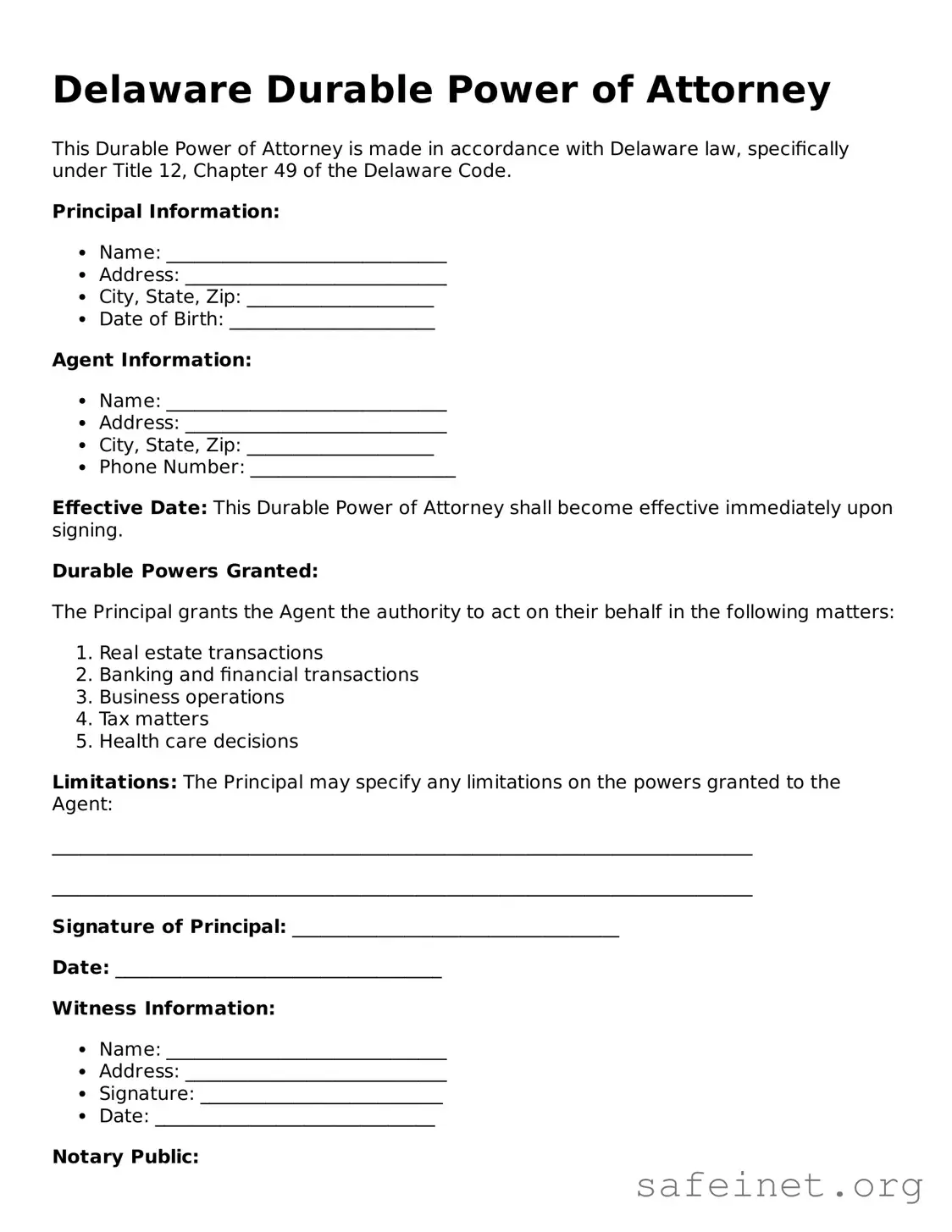
In the realm of estate planning, the Delaware Durable Power of Attorney form plays a crucial role in ensuring that individuals can maintain control over their financial and legal affairs, even in the event of incapacitation. This powerful document allows a person, known as the principal, to designate a trusted individual—often referred to as an agent or attorney-in-fact—to make decisions on their behalf. The form is designed to remain effective even if the principal becomes unable to manage their own affairs due to illness or injury, thus providing peace of mind and continuity in decision-making. Key elements of the form include the scope of authority granted to the agent, which can be tailored to encompass a wide range of financial matters, from managing bank accounts to handling real estate transactions. Additionally, the Delaware Durable Power of Attorney form requires the principal's signature, and it may also necessitate notarization or witnesses, depending on specific circumstances. Understanding the importance of this document is essential for anyone looking to safeguard their interests and ensure that their wishes are honored during challenging times.
Delaware Durable Power of Attorney
This Durable Power of Attorney is made in accordance with Delaware law, specifically under Title 12, Chapter 49 of the Delaware Code.
Principal Information:
Agent Information:
Effective Date: This Durable Power of Attorney shall become effective immediately upon signing.
Durable Powers Granted:
The Principal grants the Agent the authority to act on their behalf in the following matters:
Limitations: The Principal may specify any limitations on the powers granted to the Agent:
___________________________________________________________________________
___________________________________________________________________________
Signature of Principal: ___________________________________
Date: ___________________________________
Witness Information:
Notary Public:
State of Delaware
County of ____________________________
On this ____ day of ____________, 20__, before me, a Notary Public, personally appeared __________________________, known to me to be the person who executed the foregoing instrument.
In witness whereof, I have hereunto set my hand and official seal.
____________________________________
Notary Public
My Commission Expires: _______________
| Fact Name | Description |
|---|---|
| Definition | A Delaware Durable Power of Attorney is a legal document that allows an individual to appoint someone else to make decisions on their behalf, even if they become incapacitated. |
| Governing Law | This document is governed by the Delaware Uniform Power of Attorney Act, which outlines the rules and requirements for creating and using a power of attorney in Delaware. |
| Durability | The term "durable" means that the authority granted to the agent remains in effect even if the principal becomes mentally incapacitated. |
| Agent's Authority | The agent can be given broad or limited powers, including handling financial matters, making healthcare decisions, or managing real estate. |
| Execution Requirements | To be valid, the form must be signed by the principal in the presence of a notary public and at least one witness. |
| Revocation | The principal can revoke the Durable Power of Attorney at any time, as long as they are mentally competent to do so. |
Filling out the Delaware Durable Power of Attorney form is an important step in designating someone to make decisions on your behalf. After completing the form, you will need to ensure it is properly signed and witnessed to be legally effective.
What is a Delaware Durable Power of Attorney?
A Delaware Durable Power of Attorney is a legal document that allows an individual, known as the principal, to appoint someone else, called the agent or attorney-in-fact, to make decisions on their behalf. This document remains effective even if the principal becomes incapacitated, ensuring that their financial and legal matters can still be managed according to their wishes.
Why should I consider creating a Durable Power of Attorney?
Creating a Durable Power of Attorney can provide peace of mind. It ensures that someone you trust will handle your affairs if you become unable to do so. This can help avoid potential disputes among family members and prevent the need for court-appointed guardianship, which can be time-consuming and costly.
What types of decisions can my agent make on my behalf?
Your agent can make a wide range of decisions, including managing your financial accounts, paying bills, filing taxes, and making investment choices. You can specify the powers you wish to grant in the document, allowing you to tailor the authority to fit your needs.
How do I choose an agent for my Durable Power of Attorney?
Selecting an agent is a crucial decision. Choose someone you trust implicitly, as they will have significant control over your financial and legal matters. Consider their ability to handle such responsibilities and their willingness to act in your best interest. It’s also wise to discuss your wishes with them before formalizing the document.
Do I need a lawyer to create a Durable Power of Attorney in Delaware?
While it is not legally required to have a lawyer draft your Durable Power of Attorney, consulting with one can be beneficial. A lawyer can help ensure that the document complies with Delaware laws and accurately reflects your intentions. This can prevent potential issues down the line.
Can I revoke or change my Durable Power of Attorney once it is created?
Yes, you can revoke or change your Durable Power of Attorney at any time, as long as you are mentally competent. To revoke it, you should notify your agent and any institutions or individuals who may have a copy of the document. It’s advisable to create a new document if you want to appoint a different agent or change the powers granted.
What happens if I do not have a Durable Power of Attorney?
If you do not have a Durable Power of Attorney and become incapacitated, your family may need to go through the court system to obtain guardianship or conservatorship. This process can be lengthy and emotionally taxing for your loved ones. Having a Durable Power of Attorney in place can help avoid this situation and provide clear guidance on your preferences.
Failing to Specify Powers Clearly: Many individuals do not clearly outline the specific powers they wish to grant. This can lead to confusion and disputes later on. It is essential to be precise about what decisions the agent can make on your behalf.
Not Signing in Front of Witnesses: Some people overlook the requirement for signatures. In Delaware, the form must be signed in the presence of a notary or witnesses. Neglecting this step can render the document invalid.
Choosing the Wrong Agent: Selecting an untrustworthy or unqualified person as an agent is a common mistake. It is crucial to choose someone who is responsible and understands your wishes.
Ignoring Updates: Life circumstances change, and so should your Durable Power of Attorney. Failing to update the document after significant life events, such as marriage or divorce, can lead to complications.
A Delaware Durable Power of Attorney is a crucial document that allows someone to make decisions on your behalf if you become unable to do so. However, it often works best in conjunction with other forms and documents. Here’s a list of related documents that you might consider when preparing your estate planning strategy.
Each of these documents serves a specific purpose and can work together to create a comprehensive plan for your future. Consider consulting with a legal professional to ensure that all documents align with your wishes and comply with Delaware law.
The Delaware Durable Power of Attorney form shares similarities with the General Power of Attorney. Both documents allow one person to appoint another to act on their behalf in financial or legal matters. However, the General Power of Attorney typically becomes invalid if the principal becomes incapacitated, while the Durable Power of Attorney remains effective even in such circumstances. This makes the Durable version particularly useful for long-term planning and ensuring that decisions can still be made when the principal is unable to do so themselves.
Another related document is the Medical Power of Attorney, which specifically grants authority to make healthcare decisions for someone who is unable to communicate their wishes. Like the Durable Power of Attorney, the Medical Power of Attorney remains in effect even if the individual becomes incapacitated. This document is crucial for ensuring that medical decisions align with the individual's preferences, especially during critical health situations.
The Living Will is also comparable to the Durable Power of Attorney, although it serves a different purpose. A Living Will outlines an individual's wishes regarding medical treatment in scenarios where they cannot express their desires. While the Durable Power of Attorney allows someone to make decisions on behalf of the principal, the Living Will provides explicit instructions about the types of medical interventions the individual does or does not want. Both documents work together to ensure that a person's healthcare preferences are respected.
The Revocable Trust is another document that shares some characteristics with the Durable Power of Attorney. A Revocable Trust allows individuals to manage their assets during their lifetime and dictate how those assets will be distributed after their death. Unlike the Durable Power of Attorney, which grants authority to another person, a Revocable Trust allows individuals to maintain control over their assets while also providing a mechanism for asset management should they become incapacitated.
The Guardianship form is similar in that it involves decision-making authority, but it differs significantly in its approach. Guardianship is typically established through court proceedings when an individual is deemed incapable of managing their own affairs. This process can be lengthy and requires oversight from the court, whereas a Durable Power of Attorney allows individuals to designate their own agents without the need for court intervention, providing a more streamlined approach to managing personal and financial matters.
Lastly, the Advanced Healthcare Directive combines elements of both the Medical Power of Attorney and the Living Will. This document allows individuals to appoint a healthcare agent while also providing instructions about their medical care preferences. Similar to the Durable Power of Attorney, it remains effective during periods of incapacity. The Advanced Healthcare Directive ensures that both the appointment of a decision-maker and specific healthcare wishes are clearly articulated, offering comprehensive guidance for medical situations.
When filling out a Delaware Durable Power of Attorney form, it is essential to approach the task with care and attention to detail. Here is a list of things you should and shouldn't do:
Understanding the Delaware Durable Power of Attorney form is essential for individuals looking to designate someone to manage their financial and legal affairs. However, several misconceptions surround this important document. Below is a list of ten common misunderstandings, along with clarifications to help demystify the subject.
By addressing these misconceptions, individuals can better understand the importance and functionality of the Delaware Durable Power of Attorney form. Proper knowledge empowers individuals to make informed decisions regarding their legal and financial affairs.
Filling out and using a Delaware Durable Power of Attorney form is an important step in ensuring that your financial and legal matters are managed according to your wishes. Here are some key takeaways to consider: