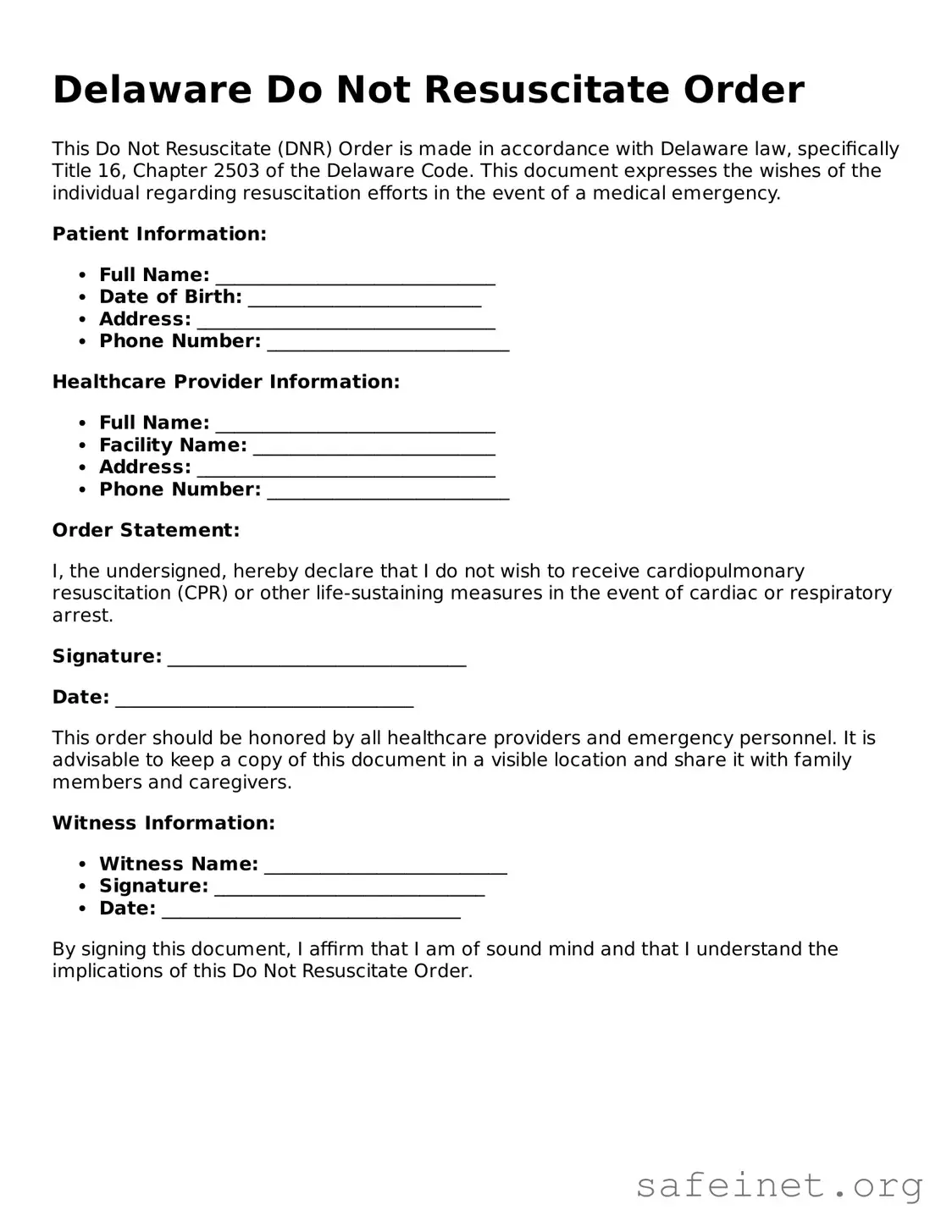
In Delaware, the Do Not Resuscitate (DNR) Order form serves as a critical tool for individuals who wish to express their preferences regarding life-sustaining treatment in emergency situations. This form allows patients to communicate their desire not to receive cardiopulmonary resuscitation (CPR) in the event of cardiac arrest or respiratory failure. It is essential for ensuring that healthcare providers respect a patient's wishes, particularly when the individual may not be able to voice them at a crucial moment. The DNR Order must be completed and signed by a physician, and it requires the patient’s or their legal representative's consent. Importantly, the form is designed to be easily accessible and recognizable, featuring a bright yellow color that alerts emergency personnel. Understanding the nuances of the DNR Order can empower individuals to make informed decisions about their healthcare, fostering peace of mind for both patients and their loved ones.
Delaware Do Not Resuscitate Order
This Do Not Resuscitate (DNR) Order is made in accordance with Delaware law, specifically Title 16, Chapter 2503 of the Delaware Code. This document expresses the wishes of the individual regarding resuscitation efforts in the event of a medical emergency.
Patient Information:
Healthcare Provider Information:
Order Statement:
I, the undersigned, hereby declare that I do not wish to receive cardiopulmonary resuscitation (CPR) or other life-sustaining measures in the event of cardiac or respiratory arrest.
Signature: ________________________________
Date: ________________________________
This order should be honored by all healthcare providers and emergency personnel. It is advisable to keep a copy of this document in a visible location and share it with family members and caregivers.
Witness Information:
By signing this document, I affirm that I am of sound mind and that I understand the implications of this Do Not Resuscitate Order.
| Fact Name | Description |
|---|---|
| Definition | A Do Not Resuscitate (DNR) order is a legal document that instructs medical personnel not to perform CPR if a patient's heart stops or they stop breathing. |
| Governing Law | The Delaware Do Not Resuscitate Order is governed by 16 Delaware Code, Chapter 2502. |
| Eligibility | Any adult can complete a DNR order, provided they are of sound mind and understand the implications of the document. |
| Signature Requirement | The DNR order must be signed by the patient or their legally authorized representative. |
| Witnesses | The signature on the DNR form must be witnessed by two individuals who are not related to the patient. |
| Form Availability | The Delaware DNR order form is available through healthcare providers and online resources. |
| Revocation | A patient can revoke a DNR order at any time, and this can be done verbally or in writing. |
| Emergency Medical Services | Emergency medical personnel must honor a valid DNR order when responding to a medical emergency. |
| Transferability | A DNR order is valid across healthcare settings in Delaware, including hospitals and nursing homes. |
| Education and Awareness | Healthcare providers are encouraged to educate patients about DNR orders and their implications for end-of-life care. |
Filling out the Delaware Do Not Resuscitate Order form is an important step in expressing your medical preferences. After completing the form, it will need to be signed and dated. Make sure to keep a copy for your records and share it with your healthcare provider and family members.
What is a Do Not Resuscitate (DNR) Order in Delaware?
A Do Not Resuscitate Order (DNR) in Delaware is a legal document that allows a person to express their wish not to receive cardiopulmonary resuscitation (CPR) or other life-saving measures in the event of a medical emergency. This order is typically used by individuals with terminal illnesses or those who wish to avoid aggressive medical interventions at the end of life. It is important to have a clear understanding of this document, as it guides healthcare providers in respecting the patient's wishes during critical moments.
How do I obtain a DNR Order in Delaware?
To obtain a DNR Order in Delaware, you must first have a conversation with your healthcare provider. This discussion should cover your health status, prognosis, and personal values regarding end-of-life care. If you and your provider agree that a DNR is appropriate, they will help you complete the necessary form. After filling it out, the form must be signed by both you and your physician. It is crucial to keep copies of the signed DNR Order in accessible locations, such as with your medical records and at home, to ensure that it can be easily found in an emergency.
Can I change or revoke my DNR Order once it is established?
Yes, you can change or revoke your DNR Order at any time. If you decide to make changes, it is essential to inform your healthcare provider and update the DNR form accordingly. To revoke a DNR Order, you can simply destroy the existing document and inform your medical team of your decision. It is advisable to provide them with a new form if you choose to establish a different set of wishes regarding resuscitation.
What should I do if I have a DNR Order and am admitted to a hospital?
If you have a DNR Order and are admitted to a hospital, make sure to inform the hospital staff about your wishes as soon as possible. Bring a copy of your DNR Order with you, as this will help ensure that your preferences are respected. Hospitals typically have protocols for handling DNR Orders, and they will work with you and your family to ensure that your healthcare decisions are honored. It’s also a good idea to discuss your DNR Order with the healthcare team during your stay to clarify any questions or concerns.
Failing to ensure that the form is properly signed by both the patient and the physician. Both signatures are essential for the order to be valid and recognized by medical personnel.
Not providing clear and specific instructions regarding the patient's wishes. Ambiguities can lead to confusion during critical moments. Clarity is crucial to ensure that the patient's preferences are honored.
Neglecting to update the form when a patient's health status changes. As medical conditions evolve, so too may a patient's wishes regarding resuscitation. Regular reviews of the order are important to reflect current desires.
Overlooking the need to communicate the existence of the Do Not Resuscitate Order to family members and healthcare providers. Awareness is key to ensuring that everyone involved in the patient's care understands and respects the order.
A Delaware Do Not Resuscitate (DNR) Order is an important document that communicates a person's wishes regarding resuscitation efforts in the event of a medical emergency. However, several other forms and documents often accompany a DNR to ensure comprehensive healthcare planning and decision-making. Below is a list of these related documents.
Having these documents in place alongside a Delaware Do Not Resuscitate Order can provide clarity and ensure that healthcare decisions align with an individual’s values and wishes. Properly organizing these forms can help facilitate communication among family members and healthcare providers during critical moments.
The Delaware Do Not Resuscitate (DNR) Order form is similar to a living will. A living will allows individuals to express their wishes regarding medical treatment in situations where they cannot communicate. Both documents ensure that a person's preferences regarding life-sustaining measures are respected, especially in critical health scenarios. They provide clarity to healthcare providers and family members about the individual's choices, aiming to prevent unwanted medical interventions.
Another document comparable to the DNR Order is a healthcare power of attorney. This legal document designates an agent to make medical decisions on behalf of an individual if they become incapacitated. While the DNR specifically addresses resuscitation efforts, the healthcare power of attorney covers a broader range of medical decisions. Both documents empower individuals to control their medical care and ensure their preferences are honored when they are unable to voice them.
The advance healthcare directive shares similarities with the DNR Order as well. This comprehensive document combines elements of both a living will and a healthcare power of attorney. It outlines an individual’s wishes for medical treatment and appoints someone to make decisions on their behalf. Like the DNR, it serves to guide healthcare providers and loved ones, ensuring that the individual's values and preferences are upheld during critical moments.
A physician’s order for life-sustaining treatment (POLST) is another document that parallels the DNR Order. POLST forms provide specific medical orders regarding the types of treatment a patient wishes to receive or avoid in emergencies. Unlike a DNR, which focuses solely on resuscitation, POLST can address various aspects of care, including hospitalization and intubation. Both documents aim to communicate a patient’s wishes clearly to healthcare providers, ensuring that their desires are respected in urgent situations.
The medical order for life-sustaining treatment (MOLST) is also akin to the DNR Order. This document, similar to POLST, is designed for individuals with serious health conditions. It details the patient’s preferences for emergency care and treatment options. The MOLST emphasizes honoring patient autonomy and ensures that healthcare providers follow the specified medical orders. Both MOLST and DNR forms play crucial roles in guiding treatment decisions during emergencies.
Another related document is the do-not-hospitalize (DNH) order. This order specifically instructs healthcare providers not to transfer a patient to a hospital for treatment. While a DNR focuses on resuscitation efforts, a DNH addresses the patient's preference for remaining in a specific care setting, such as a nursing home or hospice. Both documents reflect the individual’s wishes regarding end-of-life care and aim to provide comfort and dignity during serious health challenges.
Lastly, the comfort care order is similar to the DNR Order. This document outlines a patient’s desire to receive only comfort-focused treatments rather than aggressive medical interventions. It emphasizes pain management and quality of life rather than curative measures. Both comfort care orders and DNRs prioritize the individual's preferences, ensuring that their end-of-life experience aligns with their values and wishes.
When completing the Delaware Do Not Resuscitate Order form, it is essential to approach the process with care and attention. Here is a list of things to consider:
Taking these steps can help ensure that your Do Not Resuscitate Order accurately reflects your wishes and is respected in medical situations.
Understanding the Delaware Do Not Resuscitate (DNR) Order form is essential for individuals and families making end-of-life decisions. However, several misconceptions can lead to confusion. Here are six common misconceptions:
This is not true. A DNR order specifically instructs medical personnel not to perform cardiopulmonary resuscitation (CPR) in the event of cardiac arrest. Other medical treatments and care can still be provided based on the patient's wishes and medical needs.
Anyone can request a DNR order, regardless of their health status. It is a personal decision that reflects an individual's wishes regarding resuscitation efforts.
This is a misconception. A DNR order can be revoked or modified at any time by the patient or their legal representative. It’s important to communicate any changes to healthcare providers.
This is not the case. A DNR order is about choosing not to undergo CPR in specific situations. It does not mean that other treatments, such as pain management or comfort care, will not be provided.
A DNR order can be valid in various settings, including at home or in long-term care facilities, as long as it is properly documented and recognized by the healthcare providers involved.
This is misleading. DNR orders can vary by state and may have different requirements or forms. It’s important to ensure that the DNR order used complies with Delaware laws and regulations.
By understanding these misconceptions, individuals can make informed decisions about their healthcare preferences and communicate them effectively with their loved ones and healthcare providers.
When considering a Do Not Resuscitate (DNR) Order in Delaware, it’s important to understand the process and implications. Here are five key takeaways to keep in mind:
Understanding these key points can help individuals make informed decisions about their end-of-life care preferences.