When navigating the emotional and often complex landscape of divorce, having a clear and comprehensive Divorce Settlement Agreement is essential for both parties involved. This document serves as a crucial tool for outlining the terms of the divorce, ensuring that all aspects of the separation are addressed in a structured manner. Key elements typically included in the agreement encompass the division of assets and debts, child custody arrangements, visitation rights, and child support obligations. Additionally, spousal support may also be negotiated and documented. The clarity provided by this agreement not only helps to minimize future disputes but also facilitates a smoother transition for both parties as they move forward with their lives. Understanding the importance of this form and its implications can significantly impact the outcome of a divorce, making it imperative to approach the process with care and attention to detail.
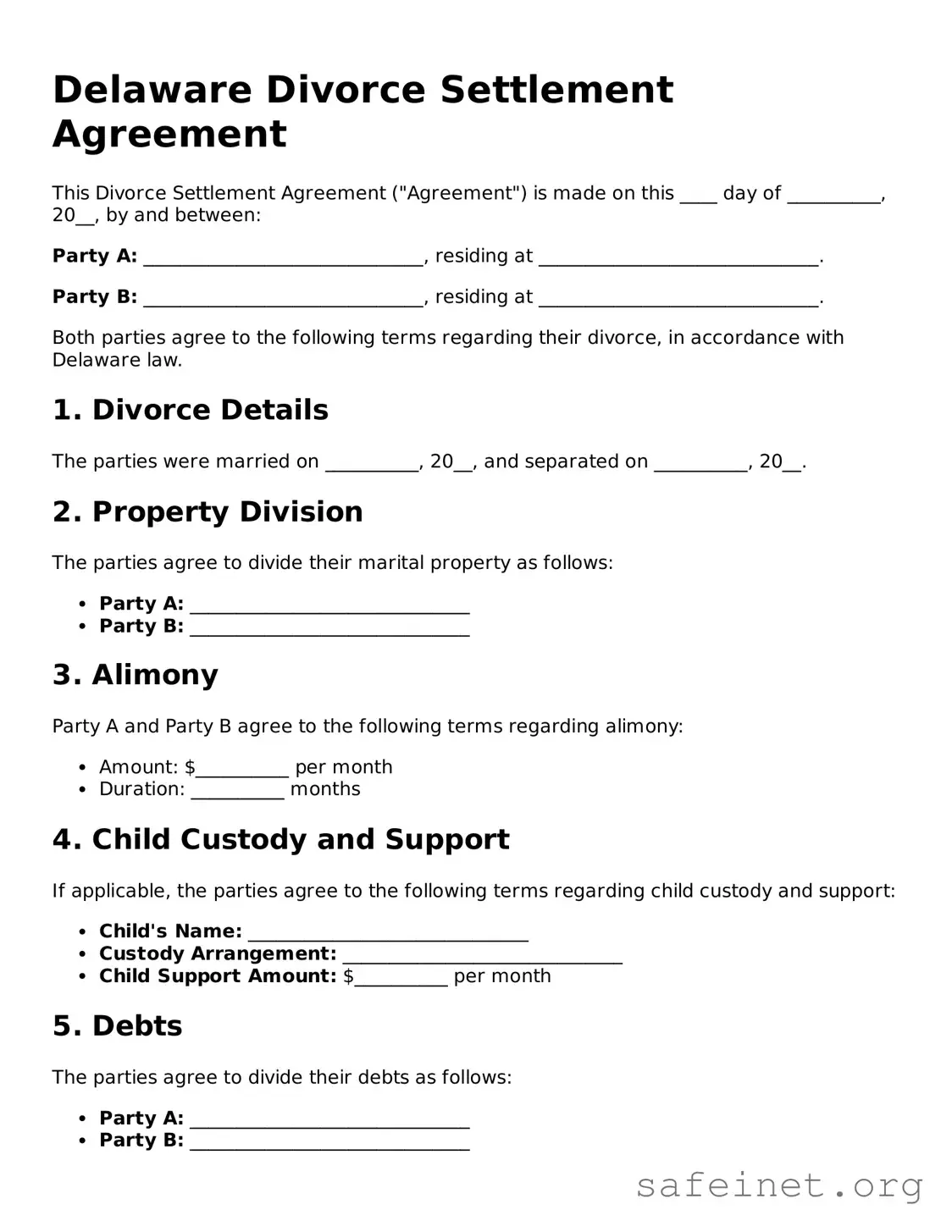
Delaware Divorce Settlement Agreement
This Divorce Settlement Agreement ("Agreement") is made on this ____ day of __________, 20__, by and between:
Party A: ______________________________, residing at ______________________________.
Party B: ______________________________, residing at ______________________________.
Both parties agree to the following terms regarding their divorce, in accordance with Delaware law.
1. Divorce Details
The parties were married on __________, 20__, and separated on __________, 20__.
2. Property Division
The parties agree to divide their marital property as follows:
3. Alimony
Party A and Party B agree to the following terms regarding alimony:
4. Child Custody and Support
If applicable, the parties agree to the following terms regarding child custody and support:
5. Debts
The parties agree to divide their debts as follows:
6. Miscellaneous
This Agreement constitutes the entire understanding between the parties. It may be modified only in writing, signed by both parties.
7. Governing Law
This Agreement shall be governed by the laws of the State of Delaware.
IN WITNESS WHEREOF, the parties have executed this Divorce Settlement Agreement as of the date first above written.
Party A Signature: ______________________________
Date: ______________________________
Party B Signature: ______________________________
Date: ______________________________
| Fact Name | Description |
|---|---|
| Governing Law | The Delaware Divorce Settlement Agreement is governed by Title 13 of the Delaware Code, specifically regarding family law. |
| Purpose | This form outlines the terms of a divorce settlement, including asset division, child custody, and support obligations. |
| Mandatory Use | In Delaware, couples seeking a divorce must complete this agreement if they have settled their differences amicably. |
| Filing Requirement | The completed agreement must be filed with the court as part of the divorce proceedings. |
| Signature Requirement | Both parties must sign the agreement, indicating their acceptance of the terms outlined within. |
| Modification | Once filed, the agreement can only be modified by mutual consent of both parties and approval by the court. |
Once you have gathered all necessary information and documents, you can begin filling out the Delaware Divorce Settlement Agreement form. This form is crucial for outlining the terms of your divorce, including asset division, child custody, and support arrangements. Completing this form accurately will help facilitate a smoother divorce process.
After completing the form, it is important to file it with the appropriate court. This will initiate the legal process for your divorce settlement. Make sure to keep copies for your records and consider consulting with a legal professional if you have any questions or concerns about the next steps.
What is a Delaware Divorce Settlement Agreement?
A Delaware Divorce Settlement Agreement is a legally binding document that outlines the terms of a divorce between two parties. It typically includes details about asset division, child custody arrangements, child support, and spousal support. This agreement serves as a comprehensive plan that both parties must adhere to following the divorce proceedings.
Why is a Divorce Settlement Agreement important?
This agreement is crucial because it helps to avoid future disputes by clearly defining each party's rights and responsibilities. By having a formalized settlement, both parties can ensure that their interests are protected and that there is a mutual understanding of the terms agreed upon. It also provides the court with a clear framework to finalize the divorce.
How do I create a Divorce Settlement Agreement in Delaware?
To create a Divorce Settlement Agreement in Delaware, both parties should first discuss and negotiate the terms of the settlement. It is advisable to consult with legal professionals to ensure that the agreement complies with Delaware law. Once the terms are finalized, the agreement should be drafted in writing, signed by both parties, and then submitted to the court for approval.
Can I modify a Divorce Settlement Agreement after it is finalized?
Yes, it is possible to modify a Divorce Settlement Agreement after it has been finalized, but it requires the consent of both parties. If circumstances change significantly, such as a change in income or living situation, one party may petition the court for a modification. The court will review the request and determine if the modification is warranted.
What happens if one party does not comply with the agreement?
If one party fails to comply with the terms of the Divorce Settlement Agreement, the other party has the right to take legal action. This may involve filing a motion with the court to enforce the agreement. The court can impose penalties or compel the non-compliant party to fulfill their obligations under the agreement.
Is a Divorce Settlement Agreement the same as a divorce decree?
No, a Divorce Settlement Agreement is not the same as a divorce decree. The settlement agreement outlines the specific terms agreed upon by both parties, while the divorce decree is the official court order that finalizes the divorce. The court will typically incorporate the settlement agreement into the divorce decree, making it enforceable by law.
Do I need a lawyer to draft my Divorce Settlement Agreement?
While it is not legally required to have a lawyer draft your Divorce Settlement Agreement, it is highly recommended. A lawyer can provide valuable guidance, ensure that your rights are protected, and help you navigate the complexities of divorce law. Having professional assistance can also reduce the likelihood of future disputes.
Where can I find a template for a Delaware Divorce Settlement Agreement?
Templates for a Delaware Divorce Settlement Agreement can be found through various legal websites, local court websites, or family law resources. However, it is essential to ensure that any template used complies with Delaware law and is tailored to your specific situation. Consulting with a legal professional is advisable to ensure accuracy and completeness.
Incomplete Information: One common mistake is failing to provide all necessary details. Each section of the form must be filled out completely. Missing information can lead to delays or complications in the divorce process.
Incorrect Financial Disclosure: Some individuals do not accurately report their income or assets. This can result in unfair settlements. It is essential to be honest and thorough when disclosing financial information.
Not Understanding Legal Terms: People often overlook the importance of understanding the terms used in the agreement. Misinterpretations can lead to confusion later on. Seeking clarification on any unclear terms is advisable.
Failure to Review the Agreement: Before submitting the form, it is crucial to review the entire agreement. Some individuals may rush through this step, missing errors or inconsistencies. A careful review can help prevent future disputes.
When navigating a divorce in Delaware, several documents may accompany the Divorce Settlement Agreement. Each of these forms plays a crucial role in ensuring that all aspects of the divorce are addressed and legally recognized. Below is a list of commonly used forms and documents that may be relevant.
Understanding these documents can help streamline the divorce process and ensure that all necessary legal requirements are met. Each form serves a specific purpose and contributes to a comprehensive resolution of the divorce matters at hand.
The Separation Agreement is a document that outlines the terms of a couple's separation before a divorce is finalized. Similar to the Divorce Settlement Agreement, it addresses issues such as property division, child custody, and support. Both documents aim to provide a clear framework for the couple's responsibilities and rights, ensuring that both parties understand their obligations during the separation period.
The Child Custody Agreement is another important document that focuses specifically on the arrangements for children following a divorce. Like the Divorce Settlement Agreement, it details custody arrangements, visitation schedules, and child support obligations. This document is crucial for ensuring that the best interests of the children are prioritized and that both parents are on the same page regarding their roles and responsibilities.
The Marital Settlement Agreement serves a similar purpose to the Divorce Settlement Agreement but is often used in cases where the couple is not yet ready to file for divorce. It outlines how assets and debts will be divided and addresses other relevant issues, such as spousal support. Both agreements aim to facilitate a fair resolution of marital issues, whether during separation or after the divorce is finalized.
The Property Settlement Agreement is focused specifically on the division of marital property. This document is akin to the Divorce Settlement Agreement in that it delineates how assets and debts will be split between the spouses. It ensures clarity and fairness in the distribution of property, helping to prevent disputes that may arise after the divorce is complete.
The Parenting Plan is a comprehensive document that details how parents will raise their children after separation or divorce. Similar to the Child Custody Agreement, it includes provisions for custody, visitation, and decision-making responsibilities. Both documents are designed to promote the welfare of the children and to establish a cooperative co-parenting relationship.
The Spousal Support Agreement outlines the financial support one spouse may provide to the other following a divorce. This document shares similarities with the Divorce Settlement Agreement, as it addresses financial obligations and aims to ensure that both parties can maintain a reasonable standard of living post-divorce. Clarity in this area helps prevent future conflicts regarding financial support.
The Final Judgment of Divorce is the official court document that finalizes the divorce process. While it serves a different function than the Divorce Settlement Agreement, it often incorporates the terms agreed upon in that document. Both documents work together to ensure that the divorce is legally recognized and that all agreed-upon arrangements are enforceable by the court.
When filling out the Delaware Divorce Settlement Agreement form, it is important to approach the task with care. Below are ten guidelines that can help ensure the process goes smoothly.
By following these guidelines, individuals can help facilitate a smoother process during what can be a challenging time.
Misconception 1: The Divorce Settlement Agreement is only for couples with children.
This is not true. While the agreement often addresses child custody and support, it is also essential for couples without children. It outlines the division of assets, debts, and other important matters, regardless of whether children are involved.
Misconception 2: A Divorce Settlement Agreement is not legally binding.
In fact, once both parties sign the agreement and it is approved by the court, it becomes legally binding. This means that both parties must adhere to the terms set forth in the document.
Misconception 3: You cannot change a Divorce Settlement Agreement after it is signed.
While it is true that changes are not easy, they are possible. If both parties agree, they can modify the agreement. Additionally, if circumstances change significantly, one party may petition the court for a modification.
Misconception 4: The Divorce Settlement Agreement must be complicated and lengthy.
Many people believe that a complex agreement is necessary for it to be valid. However, the agreement should be clear and straightforward. It should cover all essential aspects of the divorce without unnecessary complexity.
Misconception 5: Only lawyers can draft a Divorce Settlement Agreement.
While having legal assistance is beneficial, it is not mandatory. Individuals can draft their own agreement, provided it meets the legal requirements. However, consulting a lawyer can help ensure that all important issues are addressed properly.
When navigating the Delaware Divorce Settlement Agreement form, it’s essential to understand its importance and how to fill it out correctly. Here are some key takeaways:
By keeping these takeaways in mind, individuals can navigate the complexities of the Delaware Divorce Settlement Agreement more effectively, ensuring a smoother transition during a challenging time.