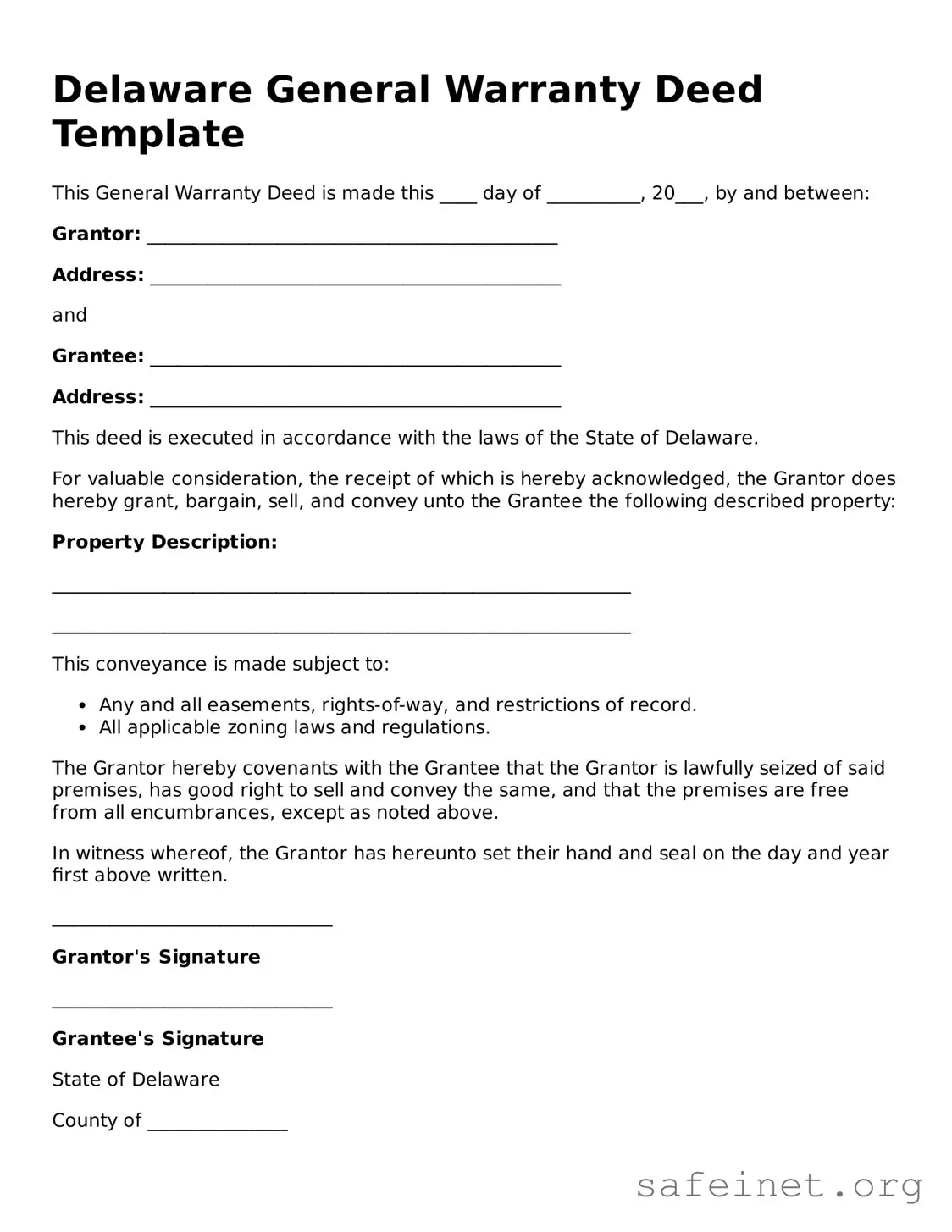
The Delaware Deed form serves as a vital legal document in real estate transactions within the state, facilitating the transfer of property ownership from one party to another. This form includes essential information such as the names of the grantor (the seller) and the grantee (the buyer), a clear description of the property being conveyed, and the terms of the transfer. Additionally, the form may specify any conditions or restrictions associated with the property, ensuring that both parties understand their rights and obligations. The Delaware Deed also requires the signature of the grantor, and in some cases, the presence of a notary public to validate the transaction. By adhering to the state's specific requirements, the Delaware Deed form not only protects the interests of both the buyer and seller but also provides a public record of the property transfer, which is crucial for future legal clarity and ownership verification.
Delaware General Warranty Deed Template
This General Warranty Deed is made this ____ day of __________, 20___, by and between:
Grantor: ____________________________________________
Address: ____________________________________________
and
Grantee: ____________________________________________
Address: ____________________________________________
This deed is executed in accordance with the laws of the State of Delaware.
For valuable consideration, the receipt of which is hereby acknowledged, the Grantor does hereby grant, bargain, sell, and convey unto the Grantee the following described property:
Property Description:
______________________________________________________________
______________________________________________________________
This conveyance is made subject to:
The Grantor hereby covenants with the Grantee that the Grantor is lawfully seized of said premises, has good right to sell and convey the same, and that the premises are free from all encumbrances, except as noted above.
In witness whereof, the Grantor has hereunto set their hand and seal on the day and year first above written.
______________________________
Grantor's Signature
______________________________
Grantee's Signature
State of Delaware
County of _______________
On this ____ day of __________, 20___, before me, a Notary Public in and for said State and County, personally appeared ______________________, known to me to be the person(s) whose name(s) is/are subscribed to the within instrument, and acknowledged that they executed the same.
Witness my hand and official seal.
______________________________
Notary Public
My Commission Expires: ________________
| Fact Name | Description |
|---|---|
| Governing Law | The Delaware Deed form is governed by the Delaware Code, Title 25, Chapter 501. |
| Purpose | This form is used to transfer ownership of real property from one party to another. |
| Types of Deeds | Delaware recognizes several types of deeds, including warranty deeds, quitclaim deeds, and special warranty deeds. |
| Signature Requirements | The deed must be signed by the grantor (the person transferring the property). |
| Notarization | A notary public must witness the signing of the deed for it to be valid. |
| Recording | To protect the interests of the new owner, the deed should be recorded in the county where the property is located. |
| Consideration | The deed should state the consideration, which is the value exchanged for the property. |
| Legal Description | A complete legal description of the property must be included in the deed to identify it accurately. |
Once you have gathered all necessary information, you will be ready to fill out the Delaware Deed form. This process involves providing accurate details about the property and the parties involved. After completing the form, it will need to be signed and submitted to the appropriate authorities for recording.
What is a Delaware Deed form?
A Delaware Deed form is a legal document used to transfer ownership of real property in the state of Delaware. It serves as proof of the transfer and outlines the details of the transaction, including the parties involved and the property description.
What types of deeds are available in Delaware?
Delaware offers several types of deeds, including warranty deeds, quitclaim deeds, and special warranty deeds. Each type serves different purposes. For example, a warranty deed guarantees that the seller has clear title to the property, while a quitclaim deed transfers whatever interest the seller has without any guarantees.
Do I need to have the deed notarized?
Yes, in Delaware, a deed must be signed in the presence of a notary public. The notary verifies the identities of the parties involved and ensures that the signing is done voluntarily.
How do I fill out a Delaware Deed form?
To fill out a Delaware Deed form, you will need to provide information such as the names of the grantor (seller) and grantee (buyer), the legal description of the property, and the consideration (purchase price). Ensure all details are accurate to avoid future disputes.
Is there a fee for recording a Delaware Deed?
Yes, there is a fee for recording a deed in Delaware. The fee varies by county and is typically based on the number of pages in the document. It is essential to check with the local recorder of deeds for the exact amount.
How long does it take to record a deed in Delaware?
The recording process in Delaware can usually be completed within a few days. However, it may take longer during busy periods or if there are issues with the paperwork. Always check with the local office for the most current processing times.
What happens after I record the deed?
After recording the deed, it becomes a public record. You will receive a copy of the recorded deed, which serves as proof of ownership. It is important to keep this document in a safe place, as it may be needed for future transactions or legal matters.
Can I change a deed after it has been recorded?
Once a deed is recorded, it cannot be changed. If you need to make changes, you will have to create a new deed to correct any errors or to update the information. This new deed must also be recorded to be legally effective.
What should I do if I lose my deed?
If you lose your deed, you can obtain a copy from the county recorder's office where it was originally recorded. It is advisable to keep multiple copies of important documents like your deed in secure locations to prevent loss.
Incorrect Names: People often misspell names or use nicknames instead of legal names. Ensure that the names match exactly with those on identification documents.
Wrong Property Description: A common mistake is providing an inaccurate or incomplete description of the property. Always verify the legal description from previous deeds or property records.
Omitting Signatures: Some forget to sign the deed. All parties involved must sign the document for it to be valid.
Not Notarizing: A deed must be notarized in Delaware. Failing to have a notary public witness the signatures can lead to issues.
Incorrect Date: Entering the wrong date can cause confusion. Make sure the date reflects when the deed is being executed.
Missing Additional Information: Some deeds require additional information, such as tax parcel numbers. Check local requirements to ensure nothing is left out.
Improper Filing: After completing the deed, it must be filed with the appropriate county office. Failing to do so means the deed is not legally recognized.
When preparing a Delaware Deed form, there are several other documents that may be necessary to ensure a smooth transaction. Each of these documents serves a specific purpose and helps clarify the details of the property transfer. Below is a list of commonly used forms that accompany the Delaware Deed.
Understanding these documents can help facilitate a successful property transaction. Each plays a critical role in protecting the interests of both the buyer and seller, ensuring that all necessary information is disclosed and that the transfer of ownership is executed smoothly.
The Delaware Deed form is similar to the Quitclaim Deed, which is often used to transfer property without guaranteeing that the title is clear. In both documents, the grantor conveys their interest in the property to the grantee. However, the Quitclaim Deed does not provide any warranties or assurances regarding the title, making it a more straightforward but riskier option for the grantee.
Another similar document is the Warranty Deed. This deed provides a guarantee from the grantor that they hold clear title to the property and have the right to transfer it. Like the Delaware Deed form, the Warranty Deed includes details about the property and the parties involved. However, the Warranty Deed offers additional protection for the grantee, ensuring that if any title issues arise, the grantor will be liable.
The Bargain and Sale Deed is also comparable. This document implies that the grantor has title to the property but does not guarantee it. Similar to the Delaware Deed form, it facilitates the transfer of property ownership, but it may not protect the grantee against claims or liens. It is often used in real estate transactions where the seller may not want to provide full warranties.
The Special Purpose Deed is another document that shares similarities with the Delaware Deed form. This type of deed is used for specific situations, such as transferring property from a government entity or a corporation. Like the Delaware Deed, it serves to transfer property ownership but may include unique provisions relevant to the specific context of the transfer.
A Statutory Warranty Deed is also akin to the Delaware Deed form. This document provides a warranty of title and is executed according to state statutes. Both forms serve to transfer property, but the Statutory Warranty Deed ensures that the title is free from defects, thus offering greater protection to the grantee.
The Grant Deed is another document that is similar in purpose to the Delaware Deed form. It conveys property ownership and includes implied warranties that the grantor has not transferred the title to anyone else. While both documents facilitate property transfers, the Grant Deed provides some level of assurance regarding the title, making it a safer option for the grantee.
The Trustee's Deed is also comparable, especially in situations involving trusts. This deed is used when a property is transferred by a trustee to a beneficiary. Like the Delaware Deed form, it outlines the details of the transfer, but it operates within the framework of trust law, ensuring that the trustee acts in the best interest of the beneficiaries.
Lastly, the Personal Representative's Deed is similar as well. This document is used to transfer property from an estate to heirs or beneficiaries after someone has passed away. It serves the same purpose as the Delaware Deed form in that it facilitates the transfer of ownership, but it is specifically designed for situations involving probate and estate administration.
When filling out the Delaware Deed form, it is essential to follow specific guidelines to ensure accuracy and compliance. Below is a list of things to do and avoid during this process.
Things You Should Do:
Things You Shouldn't Do:
There are several misconceptions about the Delaware Deed form that can lead to confusion. Understanding these myths can help individuals navigate the process more effectively. Here are eight common misconceptions:
By clarifying these misconceptions, individuals can approach the Delaware Deed form with a better understanding and confidence in their property transactions.
When filling out and using the Delaware Deed form, there are several important points to keep in mind. Understanding these key takeaways can help ensure that the process goes smoothly and that the deed is legally valid.