Homepage > Blank Declaration Canada E311 Template
Article Structure

The Declaration Canada E311 form plays a crucial role in the travel experience for individuals entering Canada. Designed by the Canada Border Services Agency (CBSA), this form allows travelers to declare their goods and any accompanying individuals, streamlining the customs process. Each traveler is responsible for their own declaration, even if they are traveling with family or friends. The form accommodates up to four individuals living at the same address, ensuring that everyone can be included in a single declaration card. It is essential for travelers to report any currency or monetary instruments totaling CAN$10,000 or more, as failing to do so could lead to serious consequences, including penalties or criminal charges. The information collected on this form helps facilitate compliance with Canadian customs laws and enables the collection of applicable duties and taxes. Additionally, personal information provided may be shared with other government entities to enforce Canadian legislation. For visitors, the form outlines duty-free allowances, while residents returning to Canada can benefit from specific personal exemptions based on their duration of absence from the country. Understanding the nuances of the E311 form is vital for a smooth entry into Canada, making it a key document for all travelers.
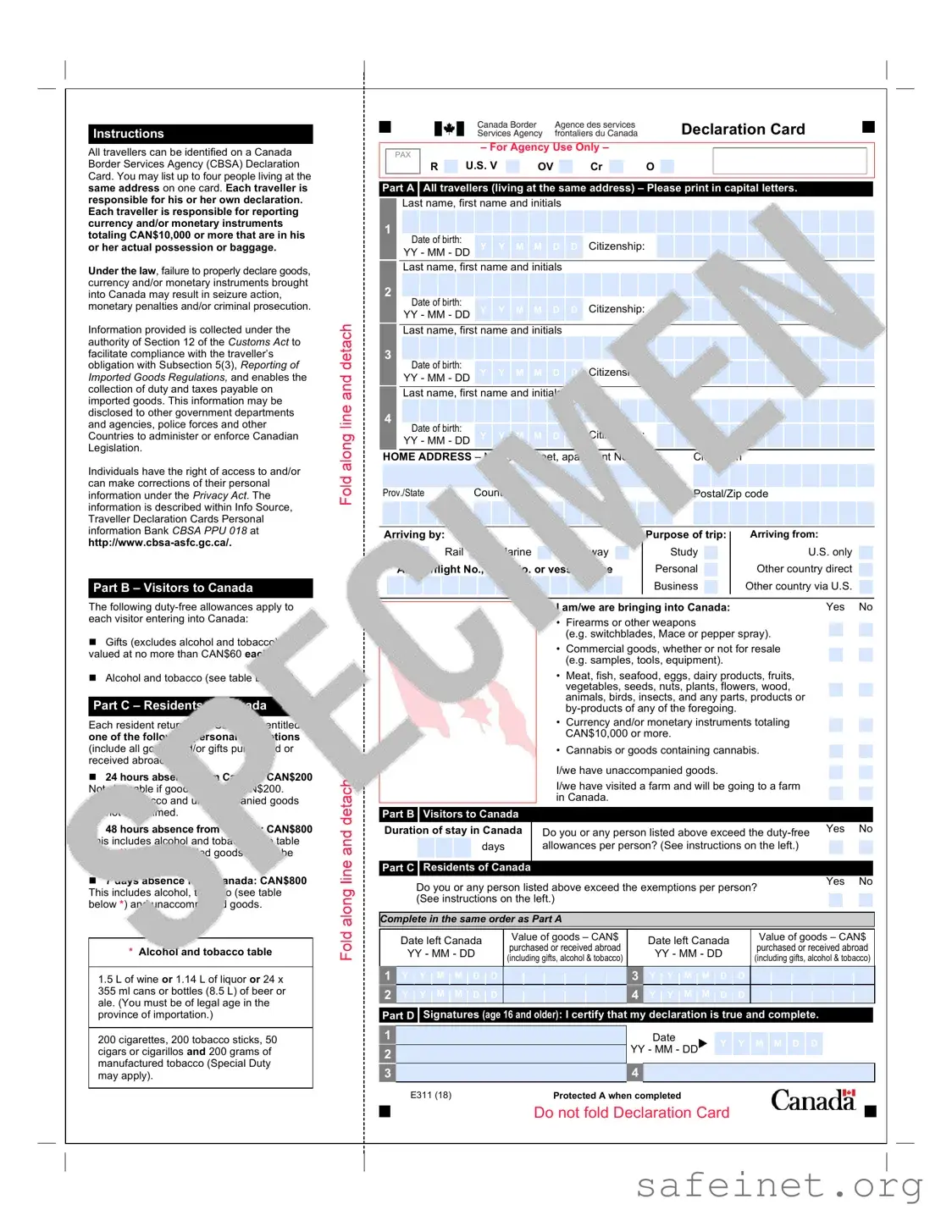
Form Sample

Duration of stay in Canada
All travellers can be identified on a Canada
Border Services Agency (CBSA) Declaration
Card. You may list up to four people living at the
same address on one card. Each traveller is
responsible for his or her own declaration.
Each traveller is responsible for reporting
currency and/or monetary instruments
totaling CAN$10,000 or more that are in his
or her actual possession or baggage.
Under the law, failure to properly declare goods,
currency and/or monetary instruments brought
into Canada may result in seizure action,
monetary penalties and/or criminal prosecution.
Information provided is collected under the
authority of Section 12 of the Customs Act to
facilitate compliance with the travellers
obligation with Subsection 5(3), Reporting of
Imported Goods Regulations, and enables the
collection of duty and taxes payable on
imported goods. This information may be
disclosed to other government departments
and agencies, police forces and other
Countries to administer or enforce Canadian
Legislation.
Individuals have the right of access to and/or
can make corrections of their personal
information under the Privacy Act. The
information is described within Info Source,
Traveller Declaration Cards Personal
information Bank CBSA PPU 018 at
http://www.cbsa-asfc.gc.ca/.
Instructions
1.5 L of wine or 1.14 L of liquor or 24 x
355 ml cans or bottles (8.5 L) of beer or
ale. (You must be of legal age in the
province of importation.)
200 cigarettes, 200 tobacco sticks, 50
cigars or cigarillos and 200 grams of
manufactured tobacco (Special Duty
may apply).
* Alcohol and tobacco table
Part C Residents of Canada
Part B Visitors to Canada
The following duty-free allowances apply to
each visitor entering into Canada:
Gifts (excludes alcohol and tobacco)
valued at no more than CAN$60 each.
Alcohol and tobacco (see table below *).
Each resident returning to Canada is entitled to
one of the following personal exemptions
(include all goods and/or gifts purchased or
received abroad):
24 hours absence from Canada: CAN$200
Not claimable if goods exceed CAN$200.
Alcohol, tobacco and unaccompanied goods
cannot be claimed.
48 hours absence from Canada: CAN$800
This includes alcohol and tobacco (see table
below *). Unaccompanied goods cannot be
claimed.
7 days absence from Canada: CAN$800
This includes alcohol, tobacco (see table
below *) and unaccompanied goods.
Y Y DD
MM
Date left Canada
YY - MM - DD
Value of goods CAN$
purchased or received abroad
(including gifts, alcohol & tobacco)
2
1
Y Y DD
MM
Y Y DD
MM
4
3
Y Y DD
MM
Date left Canada
YY - MM - DD
Value of goods CAN$
purchased or received abroad
(including gifts, alcohol & tobacco)
Y Y M M D D
Complete in the same order as Part A
Yes No
Do you or any person listed above exceed the duty-free
allowances per person? (See instructions on the left.)
days
Part B
Visitors to Canada
Residents of Canada
Part C
Yes No
Do you or any person listed above exceed the exemptions per person?
(See instructions on the left.)
Signatures (age 16 and older): I certify that my declaration is true and complete.
Part D
1
2
3
Protected A when completed
Date
YY - MM - DD
Do not fold Declaration Card
E311 (18)
4
– For Agency Use Only –
M
Y Y M M D D
Y Y M M D D
Y Y M M D D
Y Y M D D
Postal/Zip code
City/Town
RailAir HighwayMarine
PAX
1
4
3
2
All travellers (living at the same address) – Please print in capital letters.Part A
Last name, first name and initials
Citizenship:
Last name, first name and initials
Citizenship:
Last name, first name and initials
Citizenship:
HOME ADDRESS Number, street, apartment No.
Business
Airline/flight No., train No. or vessel name
Arriving from:
Arriving by: Purpose of trip:
Study
Personal Other country direct
Other country via U.S.
U.S. only
Prov./State
Country
Yes No
Citizenship:
I am/we are bringing into Canada:
Firearms or other weapons
(e.g. switchblades, Mace or pepper spray).
Commercial goods, whether or not for resale
(e.g. samples, tools, equipment).
Meat, fish, seafood, eggs, dairy products, fruits,
vegetables, seeds, nuts, plants, flowers, wood,
animals, birds, insects, and any parts, products or
by-products of any of the foregoing.
Currency and/or monetary instruments totaling
CAN$10,000 or more.
Cannabis or goods containing cannabis.
I/we have unaccompanied goods.
I/we have visited a farm and will be going to a farm
in Canada.
Declaration Card
R
U.S. V
Cr OOV
Date of birth:
YY - MM - DD
Date of birth:
YY - MM - DD
Date of birth:
YY - MM - DD
Date of birth:
YY - MM - DD

Document Specifications

Fact Name Description
Declaration Responsibility Each traveler is responsible for their own declaration, ensuring accuracy and honesty when reporting goods and currency.
Currency Reporting If a traveler carries currency or monetary instruments totaling CAN$10,000 or more, they must declare it. This applies to both personal possession and baggage.
Duty-Free Allowances Visitors to Canada can bring in gifts valued up to CAN$60 each without duty. Specific allowances exist for alcohol and tobacco.
Exemptions for Residents Residents returning to Canada have specific personal exemptions based on their time away. For example, a 24-hour absence allows for goods valued up to CAN$200.
Legal Authority The information collected is under the authority of Section 12 of the Customs Act and supports compliance with the Reporting of Imported Goods Regulations.

Steps to Filling Out Declaration Canada E311

Filling out the Declaration Canada E311 form is a straightforward process that requires attention to detail. Ensure that all information is accurate to avoid complications upon your arrival in Canada. This form must be completed by each traveler, even if you are part of a group. Here’s how to fill it out step by step.

  1. Start with Part A. Print your last name, first name, and initials in capital letters for each traveler living at the same address.
  2. For each traveler, provide the date of birth in the format YY-MM-DD and indicate citizenship.
  3. Next, fill in the home address, including number, street, apartment number, city/town, province/state, country, and postal/zip code.
  4. Indicate how you are arriving in Canada by selecting from the options: Air, Rail, Marine, Highway, etc.
  5. State the purpose of your trip and where you are arriving from, specifying if it is from the U.S. or another country.
  6. Answer the questions regarding items you are bringing into Canada. Mark 'Yes' or 'No' for firearms, commercial goods, food products, currency over CAN$10,000, unaccompanied goods, and farm visits.
  7. Move to Part B. Indicate the duration of your stay in Canada.
  8. Answer whether anyone listed exceeds the duty-free allowances per person.
  9. In Part C, indicate if you or anyone listed exceeds the personal exemptions allowed for residents of Canada.
  10. Complete the section for the date you left Canada and the value of goods purchased or received abroad for each traveler, ensuring you include gifts, alcohol, and tobacco.
  11. Finally, in Part D, each traveler aged 16 and older must sign and date the form, certifying that the declaration is true and complete.

More About Declaration Canada E311

What is the Declaration Canada E311 form?

The Declaration Canada E311 form is a declaration card used by travelers entering Canada. It is issued by the Canada Border Services Agency (CBSA) and allows individuals to report goods, currency, and other items they are bringing into the country. Each traveler is responsible for their own declaration, and up to four people living at the same address can be listed on a single card.

Who needs to fill out the E311 form?

All travelers entering Canada must fill out the E311 form. This includes Canadian residents returning home and visitors arriving from abroad. Each traveler must declare their own items, and it is essential to accurately report any goods, currency, or monetary instruments in their possession.

What are the consequences of failing to declare items?

Failing to declare goods, currency, or monetary instruments can lead to serious consequences. This may include the seizure of items, monetary penalties, or even criminal prosecution. It is crucial for travelers to comply with the declaration requirements to avoid these potential issues.

What are the duty-free allowances for visitors to Canada?

Visitors to Canada have specific duty-free allowances. Each visitor can bring gifts valued at up to CAN$60, excluding alcohol and tobacco. For alcohol and tobacco, there are specific limits based on the type and quantity, which must be adhered to in order to qualify for duty-free exemptions.

What personal exemptions are available for residents returning to Canada?

Residents returning to Canada are entitled to personal exemptions based on their absence from the country. After 24 hours, they can claim up to CAN$200 worth of goods. After 48 hours, this allowance increases to CAN$800, which includes alcohol and tobacco. If residents have been away for 7 days or more, they can also claim up to CAN$800, including unaccompanied goods.

What should travelers do if they are bringing currency totaling CAN$10,000 or more?

Travelers bringing currency and/or monetary instruments totaling CAN$10,000 or more must declare this amount on the E311 form. This requirement applies to both cash and other monetary instruments, and it is crucial to report accurately to comply with Canadian law.

How is personal information collected on the E311 form handled?

Personal information collected on the E311 form is governed by the Privacy Act. It is collected to ensure compliance with customs regulations and may be disclosed to other government departments and agencies. Individuals have the right to access and correct their personal information as necessary.

Common mistakes

  1. Incomplete Information: Failing to fill out all required fields can lead to complications. Each traveller must provide their full name, date of birth, and citizenship. Omitting any of this information can delay processing.

  2. Incorrect Currency Declaration: Misreporting currency amounts can result in severe penalties. If carrying CAN$10,000 or more, ensure this is accurately declared. Neglecting this requirement can lead to seizure of funds.

  3. Misunderstanding Duty-Free Allowances: Each visitor has specific duty-free limits. Not knowing these limits can result in unexpected duties. Familiarize yourself with the rules for gifts, alcohol, and tobacco.

  4. Failure to Sign: All travellers aged 16 and older must sign the declaration. Forgetting to do so renders the form invalid. Ensure each person listed has signed before submission.

  5. Using Incorrect Format: The form requires capital letters for names and addresses. Using lowercase letters can lead to misinterpretation. Always follow the formatting instructions provided.

  6. Not Detaching the Card: The card must be folded and detached as instructed. Failure to do so may cause confusion at the border. Ensure the card is properly prepared for submission.

Documents used along the form

The Declaration Canada E311 form is essential for travelers entering Canada, but it often accompanies other important documents. These documents help ensure compliance with Canadian customs regulations and facilitate the declaration process. Here’s a list of commonly used forms and documents that may be needed alongside the E311 form.

  • Passport: This is the primary identification document required for international travel. It proves your identity and citizenship.
  • Visa: Depending on your nationality, you may need a visa to enter Canada. This document grants you permission to enter the country for a specified duration and purpose.
  • Customs Declaration Form (B4): This form is used to declare goods you are bringing into Canada. It provides details about items exceeding your duty-free allowance.
  • Currency Declaration Form (E677): If you are carrying more than CAN$10,000, this form is necessary to report the amount and source of the funds.
  • Travel Itinerary: This document outlines your travel plans, including flight details and accommodation information. It may be requested by customs officials.
  • Proof of Purchase Receipts: Keep receipts for items purchased abroad. They may be needed to verify the value of goods you are declaring.
  • Health Insurance Documentation: If traveling from outside Canada, proof of health insurance can be essential in case of medical emergencies.
  • COVID-19 Vaccination Proof: Depending on current regulations, proof of vaccination may be required for entry into Canada.
  • Travel Authorization (eTA): For visa-exempt travelers arriving by air, an eTA is required. It allows you to board your flight to Canada.

Having these documents ready can streamline your entry process into Canada. It’s advisable to check the latest requirements before traveling, as regulations can change. Being prepared will help you avoid delays and ensure a smoother experience at the border.

Similar forms

The Canada Border Services Agency (CBSA) Declaration Card is similar to the U.S. Customs Declaration Form 6059B. Both documents serve the purpose of collecting information from travelers entering a country. The U.S. Customs Declaration Form requires travelers to disclose personal details, including their name, address, and citizenship, as well as information about goods they are bringing into the country. Like the E311 form, it emphasizes the importance of declaring items accurately to avoid penalties. Each traveler must complete their own form, reflecting the individual responsibility for compliance with customs regulations.

Another document comparable to the Declaration Canada E311 form is the U.S. Department of Agriculture (USDA) Animal and Plant Health Inspection Service (APHIS) Declaration Form. This form is designed for travelers bringing agricultural products into the U.S. Similar to the E311, it requires travelers to declare specific items, ensuring that they comply with regulations aimed at protecting public health and the environment. Both forms highlight the necessity of transparency in declaring items that may pose risks to local ecosystems or economies.

The Customs Declaration for International Mail is another document that shares similarities with the E311 form. This declaration is used for packages sent to the U.S. from abroad. It requires senders to list the contents of their packages, including their value and purpose. Like the E311, this form is essential for customs clearance and helps prevent the importation of prohibited items. Both documents emphasize the importance of accurate reporting to facilitate compliance with customs laws.

Lastly, the U.S. Visa Waiver Program (VWP) ESTA application form is akin to the Declaration Canada E311 form in that it collects vital information from travelers prior to their arrival. While the ESTA form is primarily for visa exemption, it requires travelers to provide personal information, travel plans, and potential security risks. Both forms aim to ensure that travelers meet specific entry requirements and that authorities can maintain security and compliance with national laws. Each traveler bears the responsibility for providing truthful and complete information.

Dos and Don'ts

When filling out the Declaration Canada E311 form, it is essential to follow specific guidelines to ensure accuracy and compliance. Below is a list of things to do and avoid.

  • Do print clearly in capital letters to ensure legibility.
  • Do list all travellers living at the same address on one card, up to four individuals.
  • Do declare any currency or monetary instruments totaling CAN$10,000 or more.
  • Do check the appropriate boxes regarding goods you are bringing into Canada.
  • Do ensure all information provided is accurate and complete.
  • Don't fold the Declaration Card before submission.
  • Don't forget to sign the form if you are 16 years or older.

Following these guidelines will help facilitate a smooth entry into Canada and avoid potential penalties.

Misconceptions

Misconceptions about the Declaration Canada E311 form can lead to confusion among travelers. Understanding the facts can help ensure compliance and a smoother travel experience. Here are five common misconceptions:

  • Only one person can fill out the form. Many believe that each traveler must fill out a separate form. In reality, up to four people living at the same address can be listed on a single Declaration Card.
  • All goods can be brought into Canada duty-free. Some travelers think that they can bring any amount of goods without incurring duties. However, specific exemptions apply based on the duration of absence from Canada, and exceeding these limits can result in penalties.
  • It is not necessary to declare currency under CAN$10,000. A common belief is that travelers do not need to declare amounts below this threshold. However, every traveler is still responsible for reporting any currency or monetary instruments totaling CAN$10,000 or more.
  • Alcohol and tobacco allowances are the same for all travelers. Many assume that the duty-free allowances for alcohol and tobacco are uniform. In fact, these allowances vary based on the length of time a traveler has been outside Canada.
  • Failure to declare goods is a minor issue. Some individuals think that not declaring goods is inconsequential. In truth, failing to properly declare items can lead to serious consequences, including seizure of goods, monetary penalties, or even criminal prosecution.

Addressing these misconceptions can help travelers navigate the regulations more effectively and avoid potential issues at the border.

Key takeaways

When filling out and using the Declaration Canada E311 form, consider the following key takeaways:

  • Each traveller must fill out their own declaration, even if travelling together.
  • Up to four individuals living at the same address can be listed on one Declaration Card.
  • Report any currency or monetary instruments of CAN$10,000 or more in your possession.
  • Failure to declare goods or currency can lead to serious penalties, including seizure and prosecution.
  • Information collected is governed by the Customs Act and may be shared with other agencies.
  • Each visitor to Canada has specific duty-free allowances, including gifts valued at CAN$60 or less.
  • Residents returning from abroad have personal exemptions based on the duration of their absence.
  • Alcohol and tobacco allowances vary based on how long you have been outside Canada.
  • Complete the form accurately and in the order specified, ensuring all details are correct.
  • Sign and date the declaration to certify its accuracy, which is required for those aged 16 and older.