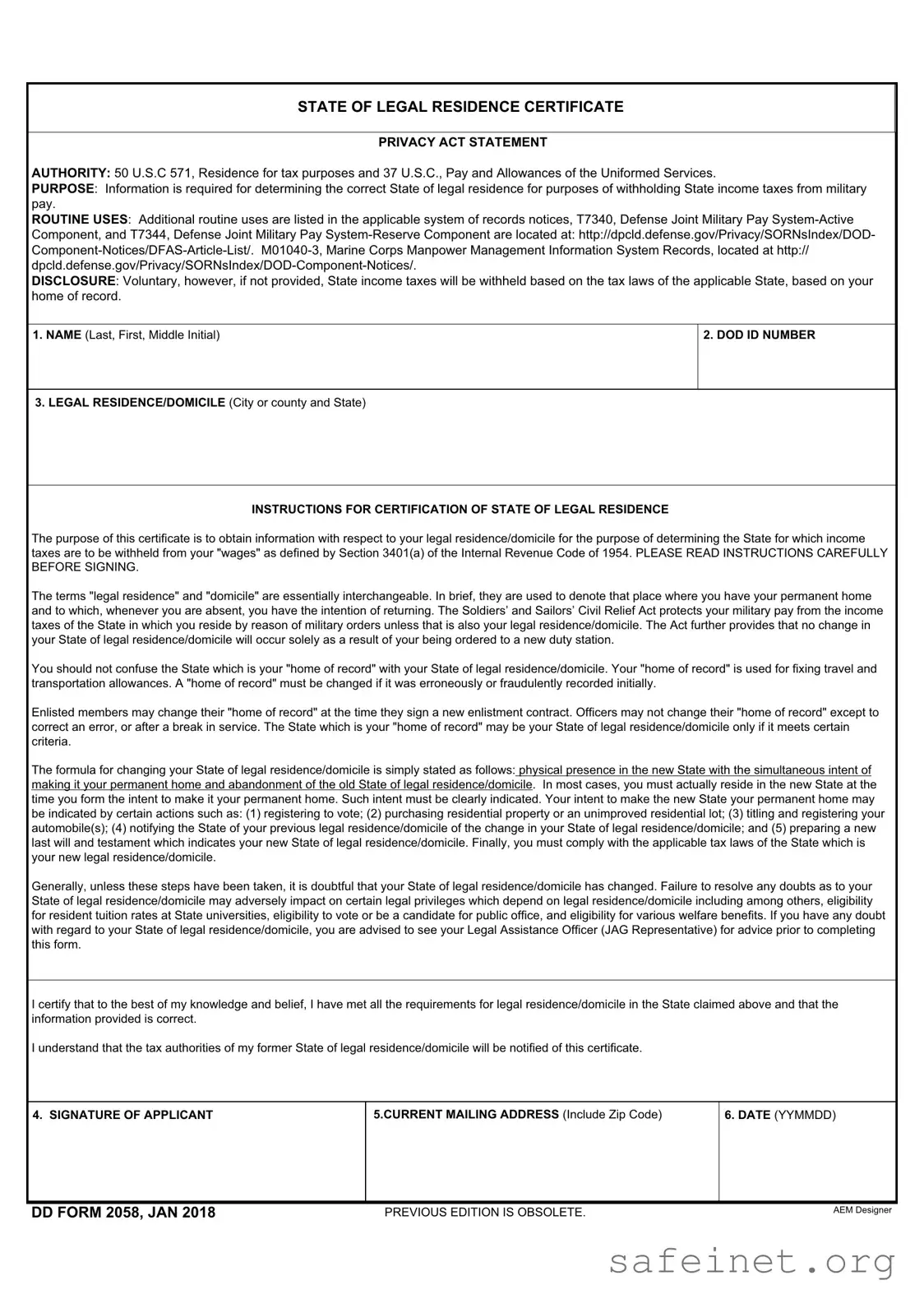
The DD Form 2058, known as the State of Legal Residence Certificate, plays a crucial role for military personnel in determining their correct state for income tax withholding purposes. This form is governed by specific legal statutes, including 50 U.S.C. 571 and 37 U.S.C., which outline the responsibilities related to residence for tax purposes and pay allowances within the Uniformed Services. The information collected on this form is essential, as it directly impacts the amount of state income tax withheld from military pay. Individuals must provide their name, DOD ID number, and legal residence or domicile, which is defined as the place they consider their permanent home. It is important to note that the terms "legal residence" and "domicile" are often used interchangeably, both indicating a person's permanent home. The Soldiers’ and Sailors’ Civil Relief Act offers protections against state income taxes for military members stationed away from their legal residence, ensuring that a change in duty station does not automatically alter their state of legal residence. However, the distinction between a service member's "home of record" and their legal residence is significant; the former is primarily used for travel and transportation allowances and may require correction if recorded inaccurately. To change their state of legal residence, service members must demonstrate physical presence in the new state and an intent to make it their permanent home, which can be evidenced through various actions such as registering to vote or purchasing property. Failure to clarify one's legal residence can lead to complications regarding eligibility for benefits, voting rights, and tuition rates. Therefore, service members are encouraged to seek guidance from a Legal Assistance Officer if they have any uncertainties before submitting the form.

| Fact Name | Description |
|---|---|
| Authority | 50 U.S.C. 571 and 37 U.S.C. govern the DD Form for determining legal residence for tax purposes. |
| Purpose | The form is used to establish the correct State of legal residence for withholding State income taxes from military pay. |
| Voluntary Disclosure | Providing information on the form is voluntary. However, if not completed, State income taxes will be withheld based on your home of record. |
| Legal Residence Definition | Legal residence and domicile refer to the permanent home where an individual intends to return. |
| Protection Under Law | The Soldiers’ and Sailors’ Civil Relief Act protects military pay from State income taxes based on military orders. |
| Home of Record vs. Legal Residence | Your home of record is different from your State of legal residence/domicile and is used for travel and transportation allowances. |
| Change of Residence | To change your State of legal residence, you must physically reside in the new State and intend to make it your permanent home. |
| Actions Indicating Intent | Actions such as registering to vote or purchasing property can indicate your intent to establish a new legal residence. |
| Legal Assistance | If there is uncertainty regarding your legal residence, consulting a Legal Assistance Officer is recommended before completing the form. |
Completing the DD Form 2058 is an important step in establishing your state of legal residence for tax purposes. This form helps ensure that the correct state income taxes are withheld from your military pay. Follow these steps carefully to fill out the form accurately.
After completing the form, review all the information for accuracy. Once confirmed, submit it according to the provided instructions. This will help ensure that your state income tax withholding aligns with your legal residence.
What is the purpose of the DD Form 2058?
The DD Form 2058, or State of Legal Residence Certificate, is designed to determine your correct state of legal residence for tax purposes. When you fill out this form, it helps ensure that the appropriate state income taxes are withheld from your military pay. This is particularly important for military personnel, as their tax obligations can differ significantly from civilian standards.
Who is required to complete the DD Form 2058?
All active duty members of the military, as well as certain reserve members, are required to complete the DD Form 2058. If you are a service member and want to establish or change your state of legal residence for tax withholding purposes, this form is necessary. It’s crucial to provide accurate information to avoid any issues with tax withholding.
What information do I need to provide on the form?
You will need to provide several key pieces of information on the DD Form 2058. This includes your name, DOD ID number, legal residence or domicile (which includes your city or county and state), current mailing address, and your signature. Additionally, you must indicate the date you are signing the form. Each piece of information plays a vital role in establishing your legal residence for tax purposes.
What happens if I do not complete the DD Form 2058?
If you choose not to complete the DD Form 2058, state income taxes will be withheld based on the tax laws of your home of record. This may not reflect your actual legal residence, potentially leading to higher tax liabilities. It’s in your best interest to complete the form to ensure that the correct amount of taxes is withheld.
How can I change my state of legal residence?
Changing your state of legal residence involves two main components: physical presence in the new state and the intent to make it your permanent home. This means you must actually live in the new state and take actions that demonstrate your intent, such as registering to vote, purchasing property, or updating your vehicle registration. Simply moving does not automatically change your legal residence; you must also abandon your old state of legal residence.
What should I do if I am unsure about my state of legal residence?
If you have any doubts regarding your state of legal residence or domicile, it’s wise to consult with a Legal Assistance Officer or a JAG representative. They can provide guidance tailored to your specific situation and help you understand the implications of your residency status. This step is especially important, as legal residence can affect various benefits and privileges.
What protections does the Soldiers’ and Sailors’ Civil Relief Act provide?
The Soldiers’ and Sailors’ Civil Relief Act offers protections for military members regarding state income taxes. It ensures that your military pay is not taxed by the state where you are stationed due to military orders, unless that state is also your legal residence. This act helps prevent service members from being taxed in multiple states and provides clarity on where tax obligations lie.
Failing to provide complete name information. Ensure that you include your last name, first name, and middle initial as required.
Not including the DOD ID number. This number is crucial for identification and processing your form.
Incorrectly stating your legal residence/domicile. Make sure to accurately reflect your city or county and state.
Overlooking the importance of intent. Your intent to make a new state your permanent home must be clearly demonstrated.
Confusing home of record with legal residence. Remember, these terms are not interchangeable.
Neglecting to sign the form. Your signature is necessary to validate the information provided.
Providing an incomplete mailing address. Ensure you include your full address, including the zip code.
Failing to date the form accurately. Use the correct format (YYMMDD) to avoid processing delays.
Not seeking assistance when in doubt. If you're unsure about your legal residence, consult a Legal Assistance Officer.
Ignoring state tax laws. Familiarize yourself with the tax laws of your new legal residence to avoid penalties.
The DD Form is an important document for military personnel as it establishes their legal residence for tax purposes. However, it is often accompanied by several other forms and documents that help clarify and support the information provided. Below is a list of these commonly used forms and documents.
Understanding these forms and documents is crucial for military personnel and their families. Each one plays a specific role in ensuring that the service member's legal and financial matters are properly managed. By being aware of these documents, individuals can better navigate their responsibilities and rights while serving in the military.
The DD Form 2058, State of Legal Residence Certificate, shares similarities with the IRS Form W-4. Both documents serve to determine tax withholding. While the DD Form 2058 focuses on military personnel's state of legal residence for state tax purposes, the W-4 is used by employees in various sectors to inform employers of their tax withholding preferences. Completing either form accurately ensures that the correct amount of taxes is withheld from paychecks, preventing underpayment or overpayment of taxes.
Another document akin to the DD Form 2058 is the IRS Form 1040. The Form 1040 is the standard individual income tax return form used in the United States. Like the DD Form 2058, it requires individuals to provide information about their residency. However, the 1040 is submitted annually to report income and calculate tax liabilities, while the DD Form 2058 is specifically for military personnel to establish their legal residence for withholding purposes.
The DD Form 2058 is also similar to the State Tax Residency Certificate. This certificate is often required by states to confirm an individual's residency status for tax purposes. Both documents aim to clarify an individual's legal residence, but the State Tax Residency Certificate is typically issued by state tax agencies, while the DD Form 2058 is specific to military members and their unique circumstances.
Furthermore, the DD Form 2058 resembles the VA Form 21-526EZ, which is used to apply for disability compensation. Both forms require personal information and documentation to establish eligibility. However, while the DD Form 2058 addresses tax residency, the VA Form 21-526EZ focuses on determining veterans' benefits based on service-related disabilities.
Another related document is the IRS Form 8862, which is used to claim the Earned Income Tax Credit after it has been disallowed in previous years. Similar to the DD Form 2058, this form requires individuals to provide detailed information about their residency and income. Both documents emphasize the importance of accurate residency information for tax-related benefits.
The DD Form 2058 is also comparable to the Certificate of Residency issued by some states. This document confirms an individual's residency status for state tax purposes. Like the DD Form 2058, it aims to clarify where an individual is legally domiciled, but the Certificate of Residency is usually issued by state governments rather than the Department of Defense.
Additionally, the DD Form 2058 can be compared to the IRS Form 8332, which allows custodial parents to release their claim to a child's tax exemption. Both forms require signatures and affirmations of accuracy, but while the DD Form 2058 pertains to residency for military personnel, Form 8332 deals with tax exemptions related to dependents.
Another document with similarities is the IRS Form 4506-T, which is used to request a transcript of tax returns. Both forms require personal information and can impact tax obligations. However, the DD Form 2058 focuses on establishing residency for withholding purposes, while Form 4506-T is used to obtain past tax information for various reasons, including loan applications.
Lastly, the DD Form 2058 is akin to the IRS Form 8822, which is used to change an address with the IRS. Both forms emphasize the importance of accurate residency information. The DD Form 2058 determines state tax withholding, while Form 8822 ensures that the IRS has the correct address for sending tax-related correspondence.
When filling out the DD Form, there are important things to keep in mind. Here’s a list of what to do and what to avoid:
Misconceptions about the DD Form can lead to confusion regarding its purpose and requirements. Below is a list of ten common misconceptions along with clarifications.
Filling out the DD Form 2058, the State of Legal Residence Certificate, is an important process for military personnel. Understanding its purpose and the implications of the information provided can significantly affect tax withholding and legal residence status. Here are some key takeaways to consider:
Understanding these key points will help ensure that the DD Form 2058 is completed accurately and that the implications of legal residence are clear. This knowledge is essential for navigating the complexities of military pay and tax obligations.