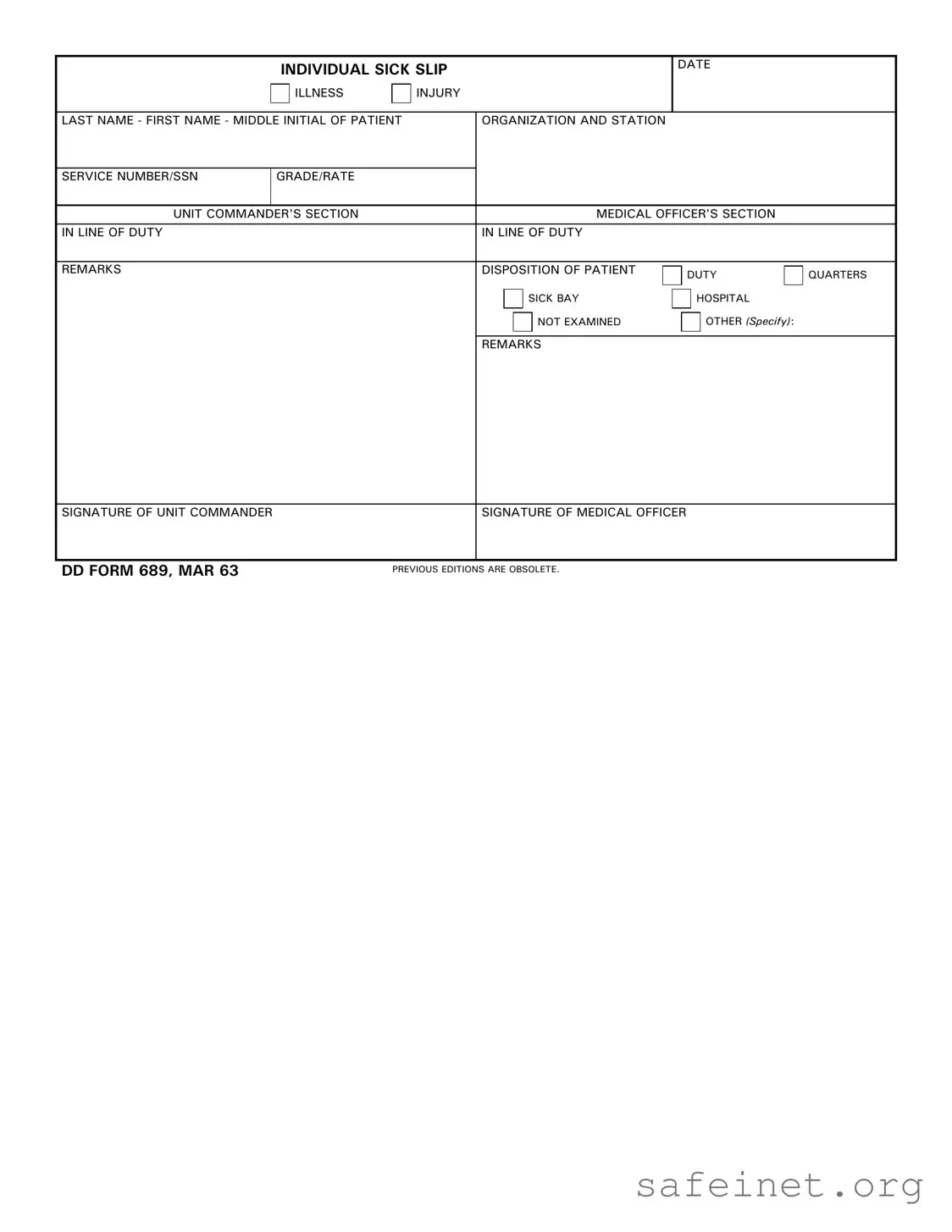
The DD Form 689, commonly referred to as the Individual Sick Slip, plays a crucial role in the military healthcare system by documenting the medical status of service members. This form is essential for tracking illnesses and injuries that may affect a soldier's ability to perform their duties. It captures vital information, including the patient's last name, first name, and middle initial, alongside their organization, service number or Social Security Number, and grade or rate. The form also includes sections for both the unit commander and the medical officer to provide their assessments, ensuring that all relevant parties are informed about the patient's condition. Notably, it allows for the classification of the patient's status, indicating whether they are in line of duty or not, and offers space for remarks that can clarify the situation further. Whether the individual is to remain in duty quarters, visit a sick bay, or requires hospitalization, the DD Form 689 ensures that appropriate care is coordinated efficiently. The signatures of both the unit commander and the medical officer at the bottom serve as a formal acknowledgment of the information provided, emphasizing the collaborative nature of military healthcare.
| Fact Name | Details |
|---|---|
| Purpose | The DD Form 689 is used to document an individual's illness or injury, ensuring proper medical and administrative processing. |
| Components | This form includes sections for patient information, illness or injury details, and signatures from both the unit commander and medical officer. |
| Submission | It must be submitted to the appropriate medical facility or command as part of the medical treatment process. |
| Governing Law | The use of this form is governed by military regulations and instructions, specifically those related to medical care and duty status. |
| In Line of Duty | The form includes a section to indicate whether the illness or injury occurred in the line of duty, which can affect benefits and compensation. |
| Signature Requirement | Both the unit commander and the medical officer must sign the form, verifying the accuracy of the information provided. |
| Obsolescence Notice | The form states that previous editions are obsolete, emphasizing the importance of using the current version for official documentation. |
Filling out the DD 689 form is straightforward. This form is essential for documenting a patient's illness or injury in a military context. Once completed, it will be submitted to the appropriate medical and command personnel for processing.
What is the DD Form 689?
The DD Form 689, also known as the Individual Sick Slip, is a document used primarily by military personnel to report an illness or injury. It serves as a formal notification to commanders and medical officers regarding a service member's health status. This form helps ensure that proper care is provided and that the member's absence from duty is documented correctly.
Who needs to fill out the DD Form 689?
The form must be filled out by service members who are unable to perform their duties due to illness or injury. It is typically completed by the individual affected, but it may also involve input from medical personnel or unit commanders, depending on the situation.
What information is required on the DD Form 689?
Essential details include the date of the illness or injury, the patient's full name, service number or Social Security Number, organization and station, and the grade or rate of the service member. Additionally, the form requires information about whether the condition is in line of duty, along with remarks from both the unit commander and the medical officer.
How does the DD Form 689 affect a service member's duty status?
The completion of the DD Form 689 can directly impact a service member's duty status. It provides official documentation of their inability to perform duties, which can affect pay, leave, and medical care. Commanders use this form to make informed decisions regarding the member's fitness for duty.
What should I do if I need to submit a DD Form 689?
If you need to submit a DD Form 689, start by filling out the required sections accurately. Ensure that all relevant information is included, such as the nature of the illness or injury and any remarks from your unit commander or medical officer. Once completed, submit the form to your chain of command or designated medical personnel for processing.
Can the DD Form 689 be used for any type of illness or injury?
Yes, the DD Form 689 can be used for any illness or injury that prevents a service member from performing their duties. This includes minor ailments, like the flu, as well as more serious conditions. However, it is essential to ensure that the form is used appropriately and in accordance with military regulations.
What happens if I do not submit a DD Form 689?
Failing to submit a DD Form 689 when required can lead to complications in your medical care and duty status. It may result in unauthorized absences, which can affect your pay and could lead to disciplinary action. It is crucial to follow the proper procedures to avoid any negative consequences.
Is there a specific format for filling out the DD Form 689?
While the DD Form 689 has designated fields for information, it is important to fill it out clearly and legibly. Use black or blue ink for handwritten entries, and ensure that all required sections are completed. If using a digital version, follow the prompts to ensure all necessary information is provided accurately.
Incomplete Patient Information: Failing to provide the full name, including the last name, first name, and middle initial of the patient can lead to delays in processing.
Missing Service Number or SSN: Omitting the service number or Social Security Number (SSN) can result in difficulties in identifying the patient within military records.
Incorrect Illness or Injury Details: Providing vague or inaccurate descriptions of the illness or injury may hinder appropriate medical responses.
Neglecting to Specify Disposition: Not indicating whether the patient is in duty quarters, sick bay, hospital, or other can create confusion about the patient's status.
Omitting Signatures: Failing to obtain the required signatures from both the unit commander and the medical officer can render the form invalid.
Forgetting Remarks Section: Not utilizing the remarks section to provide additional context or details can limit the understanding of the situation.
Using Previous Editions: Submitting an outdated version of the DD Form 689 can lead to rejection or delays in processing.
Not Following Submission Guidelines: Ignoring specific submission procedures for the form can complicate the processing and tracking of the patient's case.
The DD Form 689 is a critical document used to report an individual's illness or injury within military settings. Along with this form, several other documents may be required to ensure comprehensive medical and administrative processing. Below are four commonly used forms that complement the DD Form 689.
These documents work in tandem with the DD Form 689 to provide a complete picture of a service member's medical status and history. Proper completion and submission of these forms are essential for maintaining accurate medical records and ensuring that service members receive the appropriate care and support.
The DD Form 689, known as the Individual Sick Slip, serves as an essential document for military personnel reporting illness or injury. A similar document is the DD Form 214, Certificate of Release or Discharge from Active Duty. While the DD Form 689 focuses on an individual's current health status, the DD Form 214 provides a comprehensive summary of a service member's military career, including dates of service and the nature of discharge. Both forms are vital for maintaining accurate records within military healthcare and personnel systems, ensuring that service members receive the appropriate care and benefits.
Another document akin to the DD Form 689 is the DA Form 3349, Physical Profile. This form details a soldier's physical limitations and is used to communicate specific medical conditions that may affect their ability to perform duties. While the DD Form 689 is primarily a notification of illness or injury, the DA Form 3349 serves as a more permanent record that outlines ongoing medical issues and restrictions. Both documents play critical roles in safeguarding the health of service members and ensuring that medical information is effectively communicated within military units.
The SF 600, Chronological Record of Medical Care, is also comparable to the DD Form 689. This form provides a detailed history of medical care received by a patient, including visits, treatments, and diagnoses. In contrast, the DD Form 689 is a more immediate report of a specific illness or injury. Both documents are essential for tracking a service member's health over time, ensuring that medical professionals have access to relevant information when providing care.
Similarly, the AF Form 422, Notification of Air Force Member's Qualification Status, serves a related purpose. This form assesses a service member's physical and mental fitness for duty, which may stem from a recent illness or injury reported on the DD Form 689. While the DD Form 689 documents an individual sick day, the AF Form 422 determines whether a member can continue performing their assigned duties. Both forms are integral to maintaining operational readiness within the Air Force.
The VA Form 21-526EZ, Application for Disability Compensation and Related Compensation Benefits, can also be likened to the DD Form 689. While the DD Form 689 is used for short-term illness or injury, the VA Form 21-526EZ is part of a process for long-term disability claims. It requires documentation of medical conditions that impact a veteran's ability to work and live normally. Both forms are crucial for ensuring that service members receive the medical attention and benefits they deserve.
Another related document is the DD Form 2807-1, Report of Medical History. This form collects comprehensive information about a service member's medical history, including past illnesses and injuries. In contrast, the DD Form 689 is focused on a specific incident of illness or injury. Both documents are vital for understanding a service member's overall health and ensuring that appropriate medical care is provided.
The DD Form 2766, Adult Preventive and Chronic Care Flowsheet, is also similar to the DD Form 689. This form tracks ongoing health issues and preventive care measures for service members. While the DD Form 689 documents a current health issue, the DD Form 2766 provides a broader view of an individual's health management over time. Both forms work together to ensure that service members receive comprehensive care tailored to their needs.
Lastly, the MEB (Medical Evaluation Board) documentation is another document that shares similarities with the DD Form 689. The MEB process evaluates a service member's medical condition to determine fitness for duty. The DD Form 689 may initiate this process by reporting an illness or injury. Both documents are essential in ensuring that service members receive the appropriate evaluations and decisions regarding their medical readiness and career in the military.
When filling out the DD 689 form, it's important to follow certain guidelines to ensure accuracy and completeness. Here are some dos and don'ts to keep in mind:
Following these guidelines will help ensure that the form is processed smoothly and efficiently.
Misconceptions about the DD Form 689 can lead to confusion and errors in its use. Here are nine common misunderstandings:
Understanding these misconceptions can help service members use the DD Form 689 effectively and ensure their health concerns are properly documented.
When filling out and using the DD Form 689, also known as the Individual Sick Slip, it is essential to follow specific guidelines to ensure accurate and effective communication regarding a patient's health status. Here are some key takeaways: