Homepage > Blank Dd 2860 Template
Article Structure

The DD Form 2860, known as the Claim for Combat-Related Special Compensation (CRSC), serves a critical function for military retirees seeking benefits related to disabilities incurred during combat. This form is utilized to submit claims through the appropriate uniformed service, allowing retirees to establish their eligibility for CRSC and determine the amount and effective dates of any payments. It is essential to provide accurate personal information, including name, Social Security number, and contact details, as well as to complete all sections of the form without leaving any items blank. The form requires detailed documentation of the claimed disabilities, including supporting evidence from personal or government records. Retirees must also indicate their service history and any combat operations they participated in, which is vital for the claim's review process. Additionally, the form includes sections for required documentation and a certification statement, emphasizing the importance of truthfulness in the information provided. Failure to complete the form correctly or to include necessary documentation may result in delays or denial of the claim. Timely submission of the DD Form 2860 is crucial for retirees seeking to secure their rightful benefits.
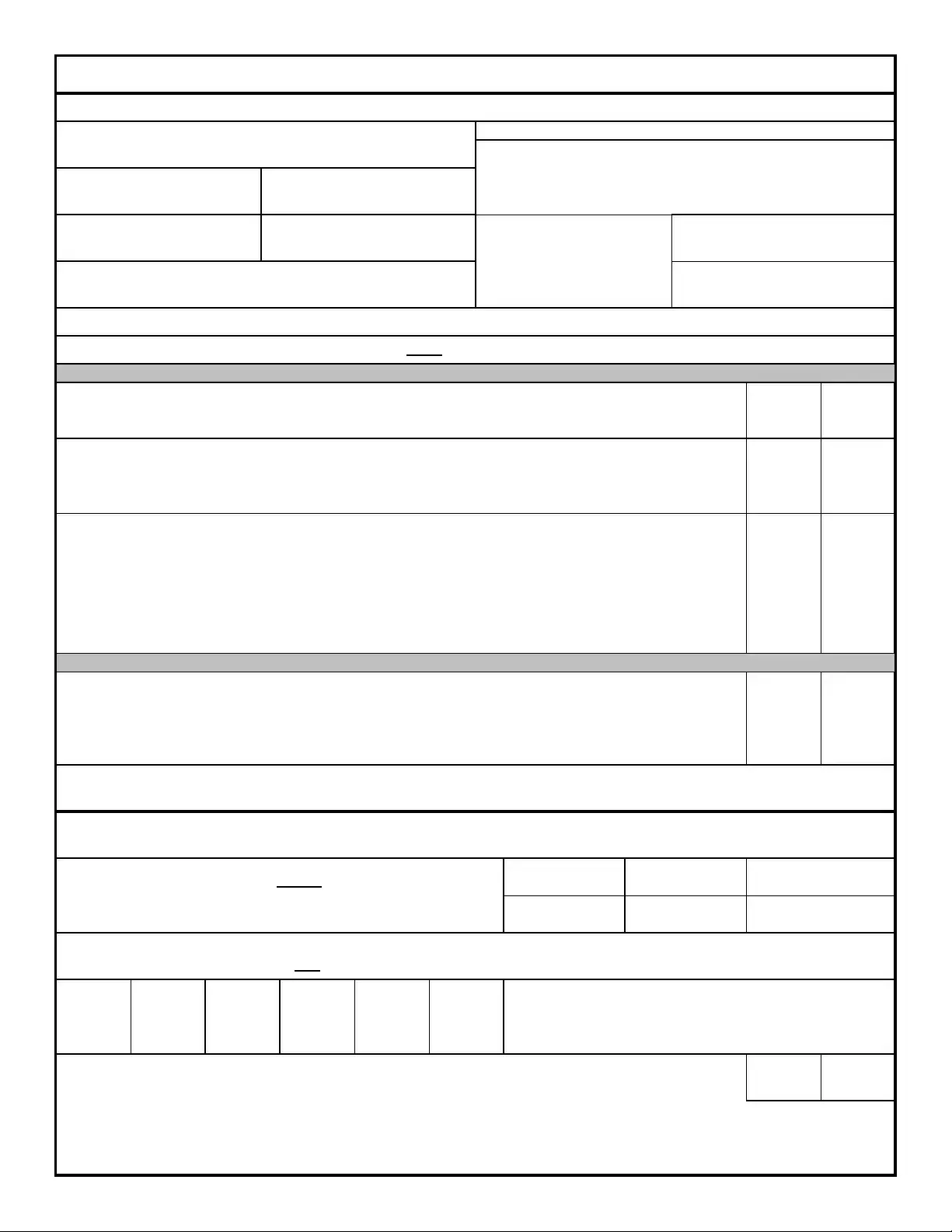
Form Sample

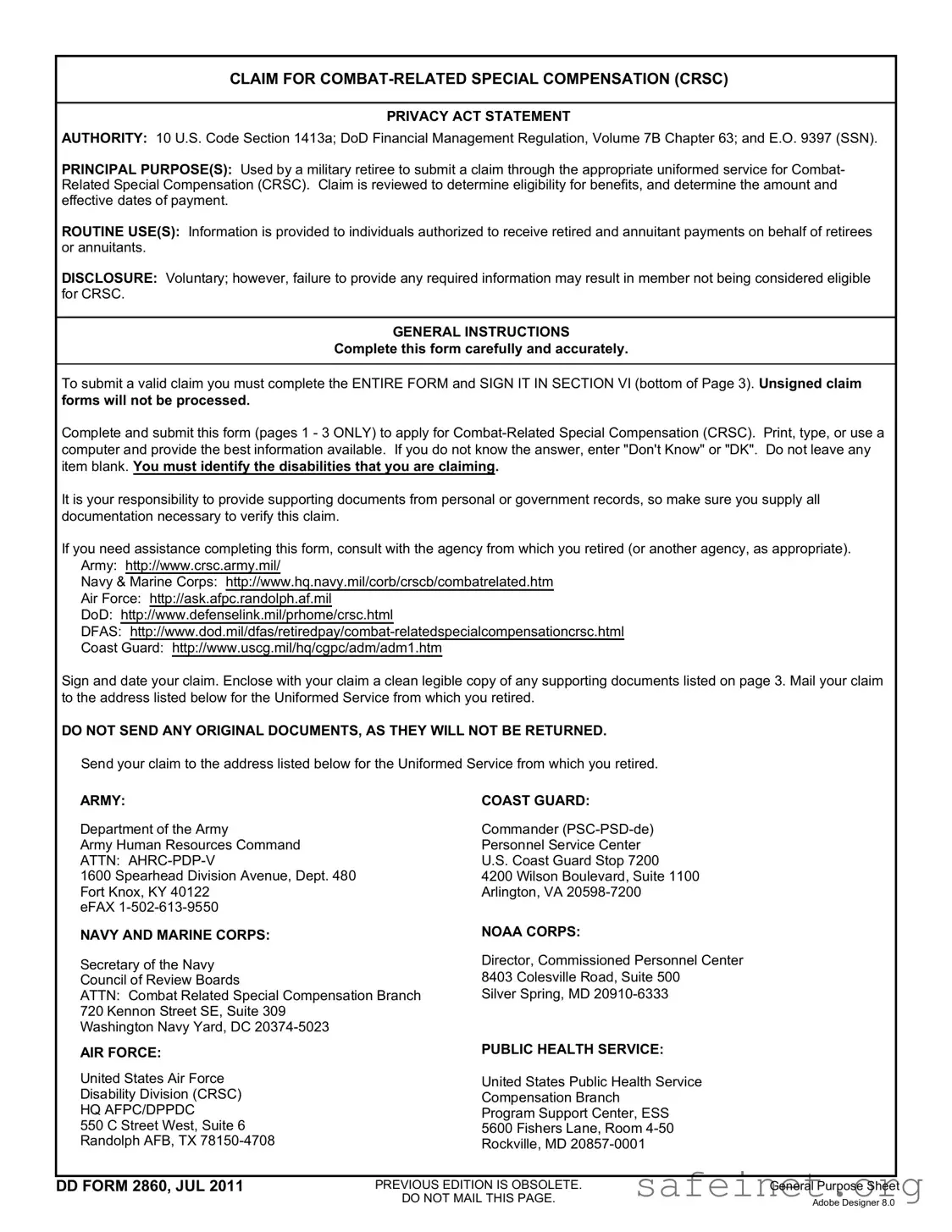
CLAIM FOR COMBAT-RELATED SPECIAL COMPENSATION (CRSC)
PRIVACY ACT STATEMENT
AUTHORITY: 10 U.S. Code Section 1413a; DoD Financial Management Regulation, Volume 7B Chapter 63; and E.O. 9397 (SSN).
PRINCIPAL PURPOSE(S): Used by a military retiree to submit a claim through the appropriate uniformed service for Combat-
Related Special Compensation (CRSC). Claim is reviewed to determine eligibility for benefits, and determine the amount and
effective dates of payment.
ROUTINE USE(S): Information is provided to individuals authorized to receive retired and annuitant payments on behalf of retirees
or annuitants.
DISCLOSURE: Voluntary; however, failure to provide any required information may result in member not being considered eligible
for CRSC.
GENERAL INSTRUCTIONS
Complete this form carefully and accurately.
To submit a valid claim you must complete the ENTIRE FORM and SIGN IT IN SECTION VI (bottom of Page 3). Unsigned claim
forms will not be processed.
Complete and submit this form (pages 1 - 3 ONLY) to apply for Combat-Related Special Compensation (CRSC). Print, type, or use a
computer and provide the best information available. If you do not know the answer, enter "Don't Know" or "DK". Do not leave any
item blank. You must identify the disabilities that you are claiming.
It is your responsibility to provide supporting documents from personal or government records, so make sure you supply all
documentation necessary to verify this claim.
If you need assistance completing this form, consult with the agency from which you retired (or another agency, as appropriate).
Army: http://www.crsc.army.mil/
Navy & Marine Corps: http://www.hq.navy.mil/corb/crscb/combatrelated.htm
Air Force: http://ask.afpc.randolph.af.mil
DoD: http://www.defenselink.mil/prhome/crsc.html
DFAS: http://www.dod.mil/dfas/retiredpay/combat-relatedspecialcompensationcrsc.html
Coast Guard: http://www.uscg.mil/hq/cgpc/adm/adm1.htm
Sign and date your claim. Enclose with your claim a clean legible copy of any supporting documents listed on page 3. Mail your claim
to the address listed below for the Uniformed Service from which you retired.
DO NOT SEND ANY ORIGINAL DOCUMENTS, AS THEY WILL NOT BE RETURNED.
Send your claim to the address listed below for the Uniformed Service from which you retired.
ARMY:
Department of the Army
Army Human Resources Command
ATTN: AHRC-PDP-V
1600 Spearhead Division Avenue, Dept. 480
Fort Knox, KY 40122
eFAX 1-502-613-9550
COAST GUARD:
Commander (PSC-PSD-de)
Personnel Service Center
U.S. Coast Guard Stop 7200
4200 Wilson Boulevard, Suite 1100
Arlington, VA 20598-7200
NAVY AND MARINE CORPS:
Secretary of the Navy
Council of Review Boards
ATTN: Combat Related Special Compensation Branch
720 Kennon Street SE, Suite 309
Washington Navy Yard, DC 20374-5023
NOAA CORPS:
Director, Commissioned Personnel Center
8403 Colesville Road, Suite 500
Silver Spring, MD 20910-6333
AIR FORCE:
United States Air Force
Disability Division (CRSC)
HQ AFPC/DPPDC
550 C Street West, Suite 6
Randolph AFB, TX 78150-4708
PUBLIC HEALTH SERVICE:
United States Public Health Service
Compensation Branch
Program Support Center, ESS
5600 Fishers Lane, Room 4-50
Rockville, MD 20857-0001
DD FORM 2860, JUL 2011
General Purpose Sheet
PREVIOUS EDITION IS OBSOLETE.
DO NOT MAIL THIS PAGE.
Adobe Designer 8.0
NOTE: If you answered NO to all questions a through d above, you are not eligible for CRSC.
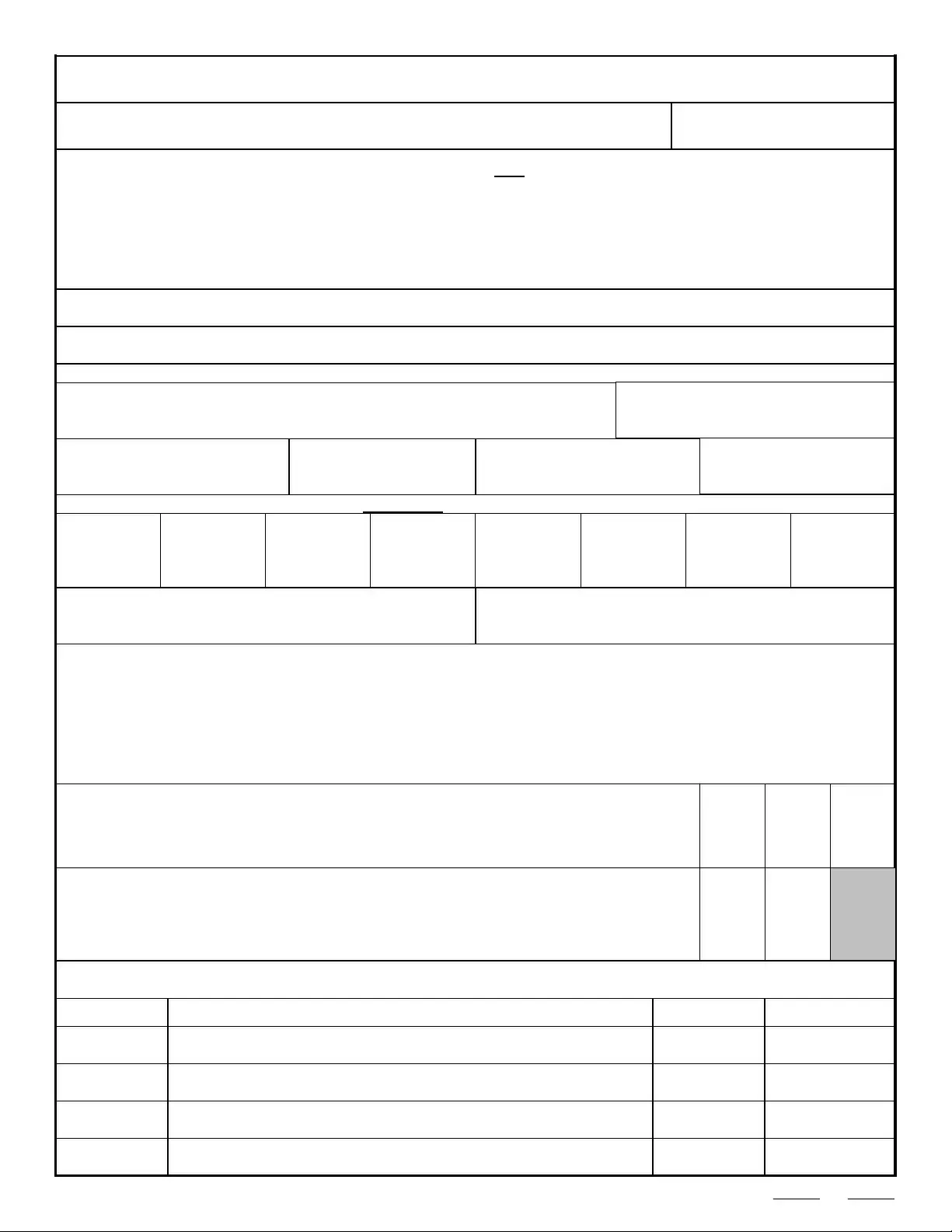
CLAIM FOR COMBAT-RELATED SPECIAL COMPENSATION (CRSC)
SECTION I - PERSONAL INFORMATION
1. NAME
(Last, First, Middle Initial)
2. SOCIAL SECURITY OR
EMPLOYEE ID NUMBER
3. RETIRED RANK/RATE
5. TELEPHONE
(Include area code)
4. DATE OF BIRTH
(YYYYMMDD)
6. E-MAIL ADDRESS
7. MAILING ADDRESS
a. STREET
(Include apartment number or P.O. Box)
b. CITY c. STATE
d. ZIP CODE
SECTION II - PRELIMINARY REQUIREMENTS
8. MARK (X) NEXT TO THE APPROPRIATE ANSWER FOR EACH QUESTION.
QUALIFICATION BEFORE JANUARY 1, 2008
YES NO
a. Were you entitled to retired pay for regular service, having completed at least 20 years of service prior to
January 1, 2008?
OR
b. Were you entitled to retired pay for reserve service, having completed at least 20 years of combined active
and reserve service and having reached age 60 prior to January 1, 2008?
YES
NO
QUALIFICATION ON OR AFTER JANUARY 1, 2008
YES NO
c. Were you entitled to retired pay for reserve service under the Reserve TERA program having completed at
least 15 but less than 20 years of combined active and reserve service and having reached age 60 prior to
January 1, 2008?
NOTE: You must provide proof of the retirement authority by attaching a copy of your Retirement Orders and/
or a copy of your 15 year letter. Evidence must clearly state that you were a reservist and you retired under
Section 12731a of title 10, United States Code.
d. Are you currently entitled to military retired pay for any reason, other than early reserve retirement for
physical disabilities not incurred in line of duty (i.e., other than section 12731b of title 10, United States
Code?
YES NO
OR
DD FORM 2860, JUL 2011
Page 1
SECTION III - SERVICE HISTORY
You must provide copies of evidence needed to verify this information (i.e., DD214's, awards, evaluations, etc.).
9. FROM WHICH SERVICE DID YOU RETIRE?
Provide a copy of your
retirement orders or "retirement" DD214. To expedite this claim it
is important that you mail your claim to the service you retired from.
ARMY NAVY/USMC AIR FORCE
NOAA CORPS
PUBLIC HEALTHCOAST GUARD
10. DID YOU SERVE IN ANY OF THE FOLLOWING WARS OR COMBAT OPERATIONS? (X all that apply) (Provide a copy of a DD214/award
citation or any other evidence that verifies ANY combat service.)
WWI WWII VIETNAM
KOREAN
WAR
GULF
WAR
OTHER
(e.g., a SF Ops mission - explain where and when and
provide evidence.)
11. WERE YOU EVER A PRISONER OF WAR (POW)?
If YES, indicate Where/When/How long
(Provide any official evidence available)
:
YES
NO
OIF/OEF
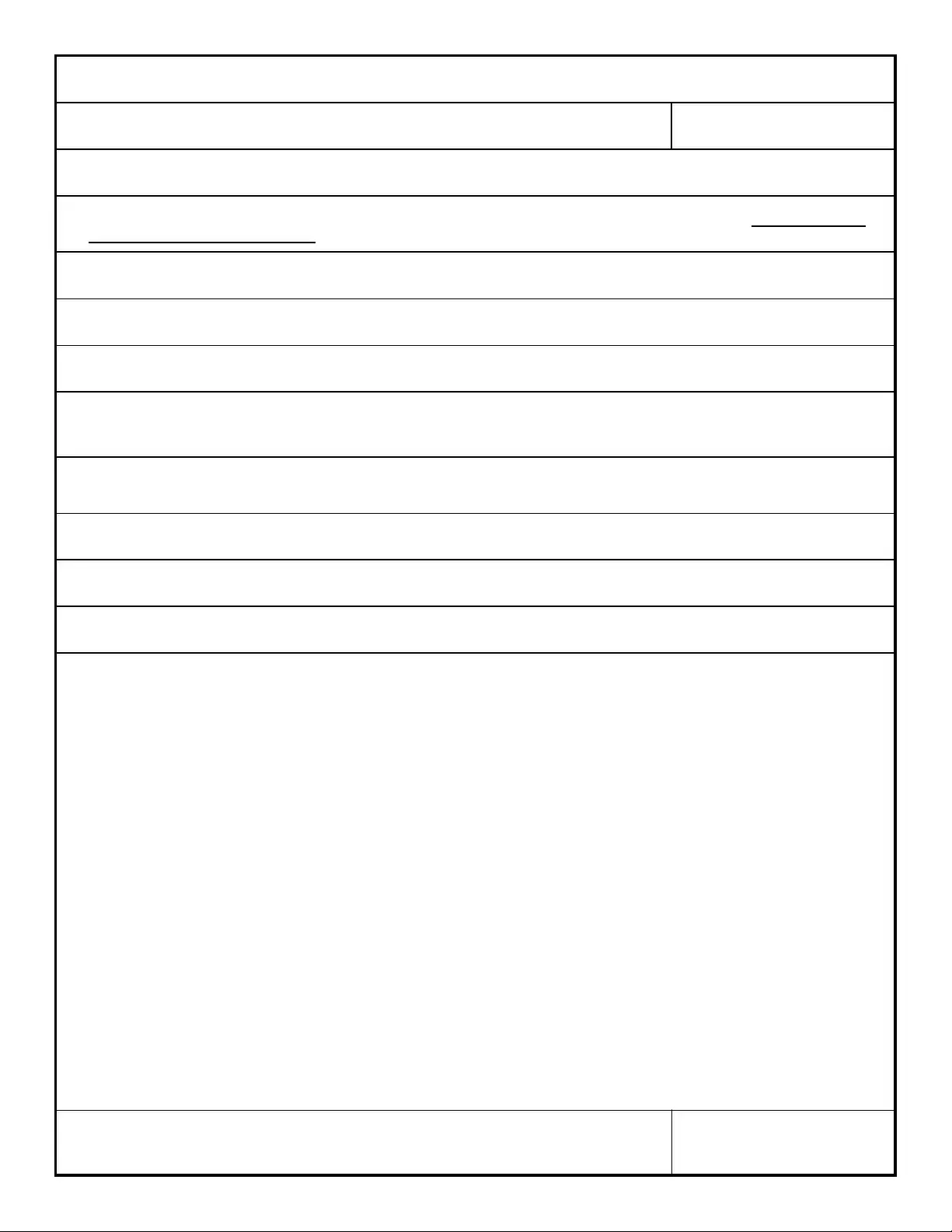
CLAIM FOR COMBAT-RELATED SPECIAL COMPENSATION (CRSC)
NAME
(Last, First, Middle Initial)
SOCIAL SECURITY OR EMPLOYEE
ID NUMBER
NOTE: To ensure the review of all of your requested disabilities, limit ONE disability for each page. You are authorized to make
additional copies of this page for any additional disabilities. You may list any secondary conditions that are connected to a disability
on the bottom of the sheet that it has been connected to. In order to award any disability as secondary we must have a copy of the
evidence from VA or from your medical records which clearly states that the condition is the result of the primary condition you are
requesting. Good evidence could include a VA rating decision that clearly states (for example), "hypertension is secondary to
diabetes."
It is your responsibility to supply any evidence necessary to verify this disability is combat-related.
12. VA FILE NUMBER (If known)
SECTION IV - REQUEST FOR COMBAT-RELATEDNESS DETERMINATION
13. DISABILITY DESCRIPTION
g. COMBAT-RELATED CODE (Mark (X) the code that best describes what caused the disability.) (See Appendix A for code descriptions.)
PH
PURPLE
HEART
AC
ARMED
CONFLICT
HS
HAZARDOUS
SERVICE
SW
SIMULATING
WAR
IN
INSTRUMENT
OF WAR
AO
AGENT
ORANGE
RE
RADIATION
GW or MG
GULF WAR or
MUSTARD GAS
a. TITLE OF DISABILITY (As written on the VA rating decision.) b. BODY PART AFFECTED. (e.g., right knee)
c. VA DISABILITY CODE (If known) d. DATE AWARDED BY VA
(YYYYMMDD)
e. INITIAL RATING % BY THE VA
f. CURRENT RATING % BY
THE VA
h. UNIT OF ASSIGNMENT WHEN INJURED
j. IN YOUR OWN WORDS, DESCRIBE THE EVENTS SURROUNDING THE DISABILITY AND HOW IT MEETS THE GUIDELINES OF COMBAT-
RELATED.
YES
NO N/A
k. DID YOU RECEIVE A PURPLE HEART (PH) FOR THIS INJURY? If YES, attach documentation to verify that
you were awarded a PH and any evidence that proves what occurred or what body part was injured.
NOTE: Proof of being awarded a PH does not always allow us to award a disability as PH. We need to know
what the PH was awarded for. For example, send the medevac report and DD214.
YES NO
l. DID VA EVER DOCUMENT THAT THIS CONDITION CAUSED SECONDARY DISABILITIES? If YES, you
must provide evidence from VA or your medical records which state that the conditions listed in item 13.m.,
below, are indeed caused by the primary condition listed above. We cannot award any condition as secondary
without evidence to support the claim. Attach the VA rating decision for all secondary conditions.
NOTE: If YES, list all secondary conditions in item 13.m., below.
m. VA DETERMINED THAT THE FOLLOWING CONDITIONS ARE SECONDARY CONDITIONS TO THE PRIMARY DISABILITY (Listed in item
13.a., above).
(1) DISABILITY
CODE
(2) DESCRIPTION
(3) % AWARDED
BY VA
(4) DATE AWARDED
(YYYYMMDD)
DD FORM 2860, JUL 2011 Page 2 - Sheet
of
i. LOCATION/AREA OF ASSIGNMENT WHEN INJURED
SECTION V - REQUIRED DOCUMENTATION
14. In order to process your claim the following records
(if applicable)
must be submitted with this claim. Do not send ANY
original documents - COPIES only!
a. All DD214's and DD215's (especially if for retirement or showing combat ribbons).
b. Retirement orders and supporting documents.
d. Copies of ALL VA Rating Decisions, letters, and code sheets (current and prior). Do NOT remove any pages. All VA
documents discussing changes in benefits including Special Monthly Compensation (SCM) and/or Individual Unemployability
(IU).
c. Reserve Retirement point computation including any 15-year or 20-year letter (if applicable).
SECTION VI - CERTIFICATION AND WAIVER OF CONCURRENT RETIREMENT AND DISABILITY PAYMENTS (CRDP)
15. Complete this section to enable the Defense Finance and Accounting Service (DFAS) or the applicable pay center for
non-DoD retirees to make any CRSC payments you qualify to receive.
a. I understand that if I am eligible for both Concurrent Retirement and Disability Payments (CRDP) under 10 U.S.C., section
1414 and Special Compensation for Certain Combat-Related Disabled Uniformed Service Retirees under 10 U.S.C., section
1413a (CRSC), I may not receive both, but must elect which to receive.
b. I understand that if my election results in any retroactive payments, any previously paid amounts of CRDP, SCSD, or CRSC for
that period of time will be deducted from any amount due for that period.
c. Under penalties of perjury, the information provided above is true to the best of my knowledge and belief and provided with the
full knowledge of the penalties for making false statements (18 U.S.C. 287 and 1001 provide for a penalty of not more than
$10,000 fine, or 5 years in prison, or both; 31 U.S.C. 3279 provides civil penalties; and 31 U.S.C. 3802 provides administrative
penalties).
d. I hereby understand that payments will be deposited to my account of record for Uniformed Services retired pay if I am currently
receiving such payments. Otherwise, they will be made to the account of record for my VA disability compensation. After
payments begin, I must advise DFAS or the applicable non-DoD pay center of any changes to my account.
e. SIGNATURE f. DATE SIGNED (YYYYMMDD)
DD FORM 2860, JUL 2011
Page 3
e. Medical records or notes that verify how the injury/disability occurred. (Do NOT send EKGs, lab slips, CDs, diskettes or
other
electronic media.)
f. Physical Evaluation Board (MEB-PEB) results and/or summaries.
NAME
(Last, First, Middle Initial)
SOCIAL SECURITY OR EMPLOYEE
ID NUMBER
g. Any evidence which can be used to verify the events or circumstances.
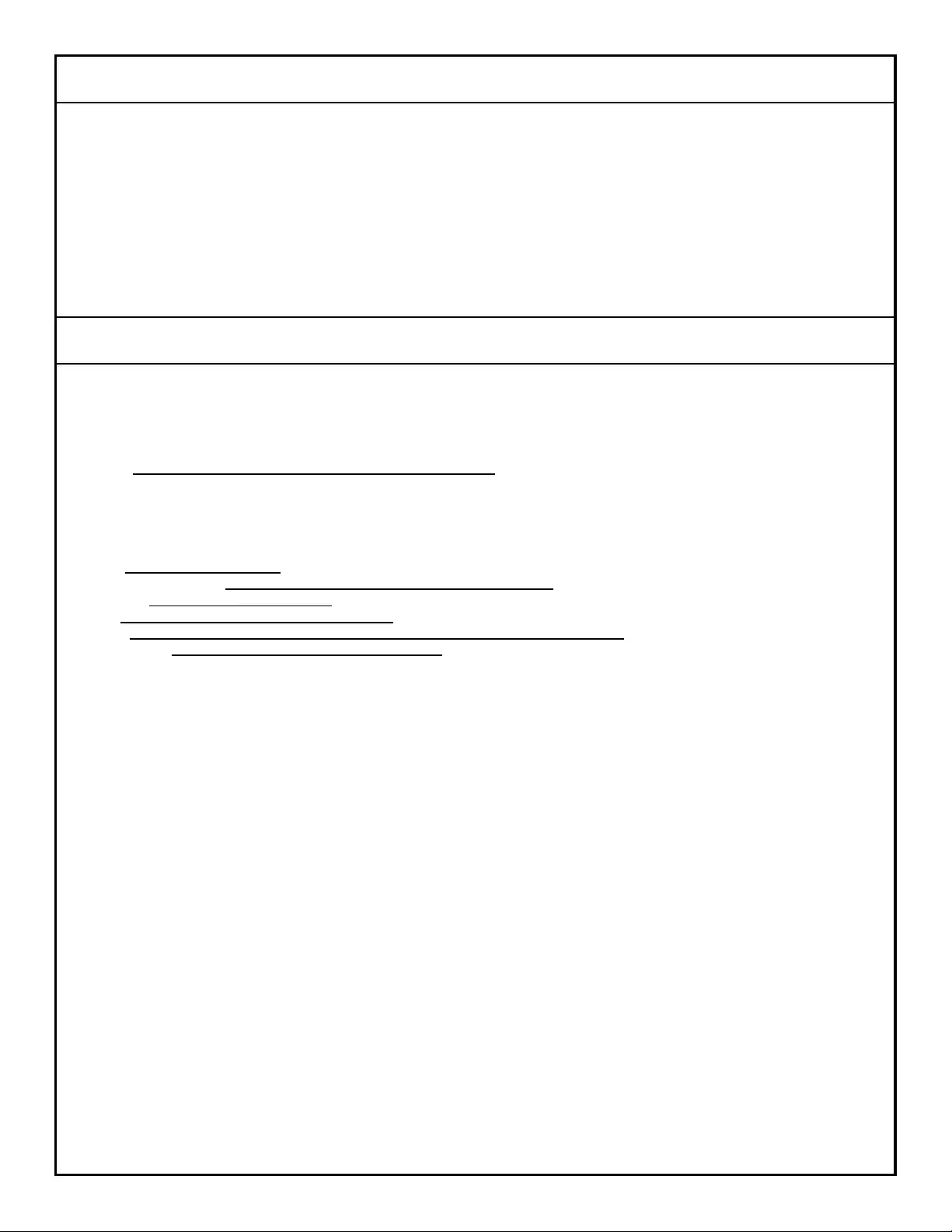
CLAIM FOR COMBAT-RELATED SPECIAL COMPENSATION (CRSC)
APPENDIX A - COMBAT-RELATED CODES
DD FORM 2860, JUL 2011
Appendix A
PURPLE HEART (PH) - The disability resulted from an injury for which you were awarded the Purple Heart. Evidence should clearly show
that the injury was associated with an incident involving armed conflict, such as shrapnel wounds due to a mortar attack. Documentation
must include a copy of the Purple Heart citation and DD Form 214 reflecting the award and injury, or the Purple Heart citation, and excerpts
from the Service Medical Record that correspond to the date and document the treatment of the Purple Heart injury.
DIRECT RESULT OF ARMED CONFLICT (AC) - The disability was incurred in the line of duty as a direct result of armed conflict. The fact
that a member incurred the disability during a period of war or an area of armed conflict or while participating in combat operations is not
sufficient by itself to support a combat-related determination. There must be a definite, documented, causal relationship between the armed
conflict and the resulting disability. Armed conflict includes a war, expedition, occupation of an area or territory, battle, skirmish, raid, invasion,
rebellion, insurrection, guerrilla action, riot, or any other action in which Service members are engaged with a hostile or belligerent nation,
faction, force, or terrorists. Armed conflict may also include such situations as incidents involving a member while interned as a prisoner of
war or while detained against his or her will in custody of a hostile or belligerent force or while escaping or attempting to escape from such
confinement, prisoner of war, or detained status.
IN THE PERFORMANCE OF DUTY UNDER CONDITIONS SIMULATING WAR (SW). - The disability was incurred in the line of duty as a
result of simulating armed conflict. The fact that a member incurred the disability during a period of simulating war or in an area of simulated
armed conflict or while participating in simulated combat operations is not sufficient by itself to support a combat-related determination. There
must be a definite, documented, causal relationship between the simulated armed conflict and the resulting disability. In general, this covers
disabilities resulting from simulated combat activity during military training, such as war games, practice alerts, tactical exercises, airborne
operations, grenade and live fire weapons practice, bayonet training, hand-to-hand combat training, rappelling, and negotiation of combat
confidence and obstacle courses while in full combat gear. Physical training activities such as calisthenics and jogging or formation running
and supervised sports activities are not included.
WHILE ENGAGED IN HAZARDOUS SERVICE (HS) - The disability was incurred during performance of duties that present a higher degree of
danger to Service personnel due to the level of exposure to actual or simulated armed conflict. The fact that a member incurred the disability
during a period of hazardous service is not sufficient by itself to support a combat-related determination. There must be a definite,
documented, causal relationship between the hazardous service and the resulting disability. Such service includes, but is not limited to, aerial
flight, parachute duty, demolition duty, experimental stress duty, diving duty, and rescue missions.
INSTRUMENTALITY OF WAR (IN) - The disability was incurred in the line of duty as a result of an instrumentality of war. An instrumentality of
war is a vehicle, vessel, or device designed primarily for Military Service and intended for use in such Service at the time of the occurrence or
injury. Incurrence during an actual period of war is not required; however, there must be a direct, documented, causal relationship between the
instrumentality of war and the resulting disability. The disability must be incurred incident to a hazard or risk of service and be caused by the
device itself. Instrumentalities not designed primarily for Military Service if use of, or occurrence involving, such instrumentality subjects the
individual to a hazard peculiar to Military Service, are included. Such use or occurrence differs from the use or occurrence under similar
circumstances in civilian pursuits. An example of this would be injuries sustained while engaging in pugil stick training using a broomstick,
where the broomstick replaces the weapon and causes the injury. A determination that a disability is the result of an instrumentality of war may
be made if the disability was incurred in any period of service as a result of such diverse causes as wounds caused by a military weapon,
accidents involving a military combat vehicle, injury or sickness caused by fumes, gases, or explosion of military ordnance, vehicles, or
material. For example, if a member is on a field exercise and is engaged in sporting activity and falls and strikes an armored vehicle, the injury
will not be considered to result from the instrumentality of war (armored vehicle) because it was the sporting activity that was the cause of the
injury, not the vehicle. On the other hand, if the individual was engaged in the same sporting activity and the armored vehicle struck the
member, the injury would be considered the result of an instrumentality of war.
AGENT ORANGE (AO) - The disability was incurred as a result of Agent Orange exposure (herbicides). For these disabilities to be
considered combat related, they must be specifically granted by the Department of Veterans Affairs (VA) as presumptive to Agent Orange
exposure (herbicides). For consideration, the initial VA Rating Decision for the claimed disability must show not just Service connection, but
the specific causes of the condition; such as, member has Diabetes due to Agent Orange exposure (herbicides). In addition, for secondary
conditions to be granted as combat related, they must be specifically granted by the VA as secondary to the Agent Orange condition; such as,
member's Hypertension is secondary to Agent Orange Diabetes. If the conditions were diagnosed after Vietnam service and prior to
retirement, evidence must show the date of diagnosis and proof of Vietnam service. Proof of Vietnam service can include but is not limited to
service medical records, evaluations, decoration citations, travel vouchers or PCS orders.
RADIATION EXPOSURE (RE) - The disability was incurred as a result of combat-related radiation exposure. Combat-related radiation
exposure includes documented, onsite participation in a test involving the atmospheric detonation of a nuclear device; the occupation of
Hiroshima or Nagasaki, Japan, by the United States forces during the period beginning on August 6, 1945, and ending on July 1, 1946;
internment as a prisoner of war in Japan during World War II; or service in Paducah, Kentucky, Portsmouth, Ohio; or the area identified as
K25 at Oak Ridge, Tennessee for at least 250 days before February 1, 1992.
GULF WAR (GW), MUSTARD GAS OR LEWISITE (MG) - These codes relate to disabilities awarded by the VA on the basis of presumption
relating to service in the Persian Gulf War or exposure to Mustard Gas or Lewisite, even though there is no direct connection and the disability
did not occur immediately. For consideration, the initial VA Rating Decision for the claimed disability must show not just Service connection,
but the specific cause of the condition, such as, member has developed Fibromyalgia from service in the Persian Gulf War. Documentation
should also describe the place, period, and conditions of exposure. In addition, for secondary conditions to be granted as combat-related, they
must be specifically granted by the VA as secondary to the condition developed from service in the Persian Gulf War or exposure to Mustard
Gas or Lewisite; such as, member's Scars are secondary to Chronic Obstructive Pulmonary Disorder from exposure to Mustard Gas.
DO NOT MAIL THIS PAGE.

Document Specifications

Fact Name Fact Description
Form Purpose The DD 2860 form is used by military retirees to submit claims for Combat-Related Special Compensation (CRSC).
Governing Laws This form is governed by 10 U.S. Code Section 1413a, the DoD Financial Management Regulation, Volume 7B Chapter 63, and E.O. 9397 (SSN).
Voluntary Disclosure Providing information on the form is voluntary; however, not supplying required information may lead to ineligibility for CRSC.
Signature Requirement The form must be signed in Section VI for the claim to be processed. Unsigned forms will not be accepted.
Documentation Needed Applicants must submit copies of all relevant documents, including DD214s, retirement orders, and VA rating decisions.
Eligibility Criteria Eligibility for CRSC includes having retired pay for regular or reserve service, with specific conditions related to service dates.
Submission Instructions Claims should be mailed to the appropriate address based on the retiree's branch of service, and original documents should not be sent.
Combat-Related Codes The form includes specific codes to categorize disabilities as combat-related, such as Purple Heart, Agent Orange, and Gulf War exposures.

Steps to Filling Out Dd 2860

Completing the DD 2860 form requires careful attention to detail and accuracy. This form serves as a claim for Combat-Related Special Compensation (CRSC). It is essential to ensure that all sections are filled out completely and that all necessary documentation is included. Once the form is completed, it should be signed and mailed to the appropriate address for the uniformed service from which the individual retired.

  1. Begin by filling out your personal information in Section I. This includes your name, social security number, retired rank/rate, date of birth, telephone number, email address, and mailing address.
  2. In Section II, answer the preliminary requirements questions by marking "YES" or "NO" next to each question regarding your eligibility for CRSC.
  3. Proceed to Section III to provide your service history. Indicate from which service you retired and list any wars or combat operations you served in. Ensure to attach copies of your retirement orders or DD214.
  4. In Section IV, describe your disabilities. Include the title of the disability, the body part affected, the VA disability code (if known), the date awarded by the VA, and the current rating percentage. Provide details on how the disability is combat-related.
  5. Section V requires you to list the required documentation. Make sure to include copies of all necessary documents, such as DD214s, retirement orders, VA rating decisions, and medical records.
  6. Finally, complete Section VI by signing and dating the form. This section confirms your understanding of the information provided and any potential consequences for false statements.
  7. Before mailing, ensure that you have enclosed copies of all supporting documents and have not included any original documents.
  8. Mail the completed form and documentation to the appropriate address for your service branch, as indicated in the instructions.

More About Dd 2860

What is the purpose of the DD Form 2860?

The DD Form 2860 is designed for military retirees to submit a claim for Combat-Related Special Compensation (CRSC). This form allows the appropriate uniformed service to review the claim and determine the retiree's eligibility for benefits, as well as the amount and effective dates of payment.

Who should use the DD Form 2860?

This form should be used by military retirees who believe they are eligible for Combat-Related Special Compensation. Eligibility typically requires that the retiree has a service-related disability that is combat-related. Retirees from all branches of the military can use this form to apply for benefits.

What information is required to complete the DD Form 2860?

To complete the DD Form 2860, you must provide personal information such as your name, Social Security number, retired rank, date of birth, and contact information. Additionally, you need to detail your service history, including any combat operations you participated in and the disabilities you are claiming. Supporting documentation, such as DD214s and VA rating decisions, must also be included.

How do I submit the DD Form 2860?

Once you have completed the form, you should mail it to the appropriate address for the uniformed service from which you retired. Ensure that you include copies of all required supporting documents and do not send original documents, as they will not be returned. Each service branch has a specific address for claims submission.

What happens if I don’t complete the entire form?

Failure to complete the entire DD Form 2860 may result in your claim not being processed. It is crucial to fill out every section accurately and to sign the form in Section VI. Unsigned forms will not be considered valid.

What types of disabilities can be claimed on the DD Form 2860?

You can claim disabilities that are directly related to combat or that occurred during military service under specific conditions. This includes injuries sustained in combat, as well as conditions that are secondary to primary disabilities. You must provide evidence to support your claims, including medical records or VA documentation.

Is there a deadline for submitting the DD Form 2860?

While there is no specific deadline mentioned for submitting the DD Form 2860, it is advisable to submit your claim as soon as possible after you believe you qualify for CRSC. Delays in submission can impact the effective date of your benefits.

What if I need help filling out the DD Form 2860?

If you need assistance with the DD Form 2860, you should consult with the agency from which you retired. Each branch of the military has resources available to help retirees navigate the claims process. You can also seek help from veterans' service organizations that specialize in assisting with claims.

Common mistakes

  1. Leaving Sections Blank: Failing to fill out any section can lead to processing delays or outright rejection of the claim. Every item must be completed, even if the answer is "Don't Know" or "DK."

  2. Not Signing the Form: The form must be signed in Section VI. Unsigned forms will not be processed, which can significantly delay your claim.

  3. Submitting Original Documents: Original documents should never be sent. Only copies of supporting documents are accepted, as originals will not be returned.

  4. Inadequate Supporting Documentation: Failing to provide necessary documentation, such as retirement orders or VA rating decisions, can hinder the verification of the claim.

  5. Incorrectly Identifying Disabilities: Each disability claimed must be clearly identified and documented. Not following the guidelines can lead to the denial of the claim.

  6. Missing the Deadline: Submitting the claim after the established deadlines can result in ineligibility for benefits. Timeliness is crucial.

  7. Not Consulting Resources: Many individuals do not seek assistance when filling out the form. Consulting with the appropriate agency can provide clarity and ensure accuracy.

  8. Ignoring Specific Instructions: Each section has detailed instructions that must be followed. Ignoring these can result in incomplete or incorrect submissions.

Documents used along the form

The DD Form 2860 is essential for military retirees seeking Combat-Related Special Compensation (CRSC). To support a claim effectively, several other forms and documents may be required. Each of these documents plays a crucial role in verifying eligibility and ensuring a smooth claims process.

  • DD Form 214: This form is a certificate of release or discharge from active duty. It provides vital information about a service member's military service, including dates of service, awards, and any combat experience.
  • DD Form 215: This is a correction to the DD Form 214. It is used to amend errors or add missing information regarding a service member's military record, ensuring that all details are accurate for claims processing.
  • Retirement Orders: These documents formally indicate a service member's retirement from military service. They are essential for proving eligibility for retirement benefits and can include details on the member's rank and service history.
  • VA Rating Decisions: These letters from the Department of Veterans Affairs outline the disability ratings assigned to a veteran. They are crucial for establishing the extent of a service-related disability and its impact on the veteran's life.
  • Medical Records: These documents provide evidence of the injuries or disabilities claimed. They should detail the nature of the injury, treatment received, and any ongoing medical issues related to military service.
  • Physical Evaluation Board (PEB) Results: This documentation summarizes the findings of a Physical Evaluation Board, which assesses a service member's fitness for duty. It can provide insight into the severity of disabilities and their connection to military service.
  • Reserve Retirement Point Computation: This document outlines the points earned towards retirement for reservists. It is essential for verifying eligibility for benefits based on service in the reserves.
  • Evidence of Combat Service: Any documentation that verifies participation in combat operations, such as deployment orders or award citations, is critical for establishing the combat-related nature of the claimed disabilities.

Gathering these documents can significantly enhance the likelihood of a successful claim for Combat-Related Special Compensation. Each piece of information helps paint a complete picture of the service member's military history and the disabilities they are facing.

Similar forms

The DD Form 214 is a critical document for military personnel, serving as a record of service. It provides details about a service member's time in the military, including dates of service, discharge status, and any awards or commendations received. Like the DD 2860, it is essential for claiming benefits, including Combat-Related Special Compensation. The DD 214 is often required as supporting documentation when submitting a claim, ensuring that all relevant service history is accurately represented.

The VA Form 21-526EZ is another important document for veterans seeking disability compensation from the Department of Veterans Affairs. This form simplifies the application process for disability benefits, allowing veterans to claim compensation for service-connected disabilities. Similar to the DD 2860, the VA Form 21-526EZ requires detailed information about the disabilities being claimed and supporting evidence. Both forms aim to establish eligibility for benefits based on military service and related injuries.

The VA Form 21-4138, also known as a Statement in Support of Claim, is used by veterans to provide additional information or evidence to support their claims. This form is often used alongside the DD 2860 to clarify or expand upon the details of a claim for Combat-Related Special Compensation. Both forms emphasize the importance of comprehensive documentation and clear communication when applying for benefits.

The VA Form 21-4142 allows veterans to authorize the release of medical records from private healthcare providers. This form is crucial for gathering necessary medical evidence to support a claim for disability benefits. Similar to the DD 2860, it emphasizes the importance of providing thorough and accurate documentation to substantiate claims related to combat-related disabilities.

The VA Form 21-526 is a standard application for veterans seeking disability compensation. While the VA Form 21-526EZ is a streamlined version, the original form requires more detailed information about the veteran's service and disabilities. Both forms serve the same purpose of establishing eligibility for benefits, highlighting the need for accurate and comprehensive information regarding a veteran's service-related injuries.

The SF 180, Request Pertaining to Military Records, is utilized by veterans to request copies of their military records. This document is essential for obtaining necessary documentation to support claims for benefits. Similar to the DD 2860, it underscores the importance of having complete and accurate records when applying for compensation related to combat-related injuries.

The VA Form 21-22 is used to designate a representative to assist a veteran in filing a claim for benefits. This form is important for veterans who may need guidance through the claims process, similar to the assistance provided when completing the DD 2860. Both forms facilitate access to benefits and ensure that veterans receive the support they need in navigating the complexities of their claims.

The VA Form 21-0779, Request for Nursing Home Information, is relevant for veterans seeking long-term care benefits. This form collects information about the veteran's medical condition and care needs. Like the DD 2860, it requires detailed information to determine eligibility for benefits, emphasizing the importance of accurate documentation in the claims process.

The VA Form 21-8940, Application for Increased Compensation Based on Unemployability, is used by veterans who are unable to secure employment due to service-connected disabilities. This form is similar to the DD 2860 in that it focuses on establishing eligibility for benefits based on the impact of military service on a veteran's life. Both forms require a comprehensive understanding of the veteran's service-related conditions.

The VA Form 21-526EZ (Fully Developed Claim) is designed to expedite the claims process for veterans who have gathered all necessary documentation before submitting their claim. This form encourages veterans to provide complete information upfront, similar to the requirements of the DD 2860. Both forms aim to streamline the process of obtaining benefits for service-related disabilities, ensuring that veterans receive timely assistance.

Dos and Don'ts

When filling out the DD 2860 form, it's important to follow certain guidelines to ensure your claim for Combat-Related Special Compensation (CRSC) is processed smoothly. Here are some key do's and don'ts to keep in mind:

  • Do complete the entire form without leaving any items blank.
  • Do sign and date your claim in Section VI.
  • Do provide clear and accurate information, using "Don't Know" if you are unsure about an answer.
  • Do attach all required supporting documents, ensuring they are copies and not originals.
  • Don't leave any section incomplete, as this may delay your application.
  • Don't send original documents, as they will not be returned.
  • Don't forget to mail your claim to the correct address based on your branch of service.
  • Don't hesitate to seek assistance from the agency from which you retired if you need help filling out the form.

Misconceptions

  • Misconception 1: The DD 2860 form is only for active duty service members.
  • This form is specifically designed for military retirees who are submitting claims for Combat-Related Special Compensation (CRSC). Active duty members do not use this form.

  • Misconception 2: Completing the DD 2860 form guarantees approval for benefits.
  • Submitting the form does not guarantee that a claim will be approved. The claim will be reviewed to determine eligibility and the amount of compensation.

  • Misconception 3: All disabilities are automatically considered combat-related.
  • Not all disabilities qualify as combat-related. There must be a documented causal relationship between the disability and combat service.

  • Misconception 4: You do not need to provide supporting documents with the DD 2860.
  • It is essential to provide supporting documents to verify the claim. Missing documentation may result in denial of the claim.

  • Misconception 5: You can leave sections of the form blank if you do not know the answer.
  • Every section of the form must be completed. If you do not know an answer, you should write "Don't Know" or "DK" instead of leaving it blank.

  • Misconception 6: Only the Purple Heart award is considered for combat-related claims.
  • While the Purple Heart is one form of evidence, there are various codes and criteria that can establish a disability as combat-related.

  • Misconception 7: You can submit original documents with your claim.
  • Only copies of documents should be submitted. Original documents will not be returned, which could jeopardize your ability to provide necessary evidence in the future.

  • Misconception 8: The DD 2860 form can be submitted electronically.
  • The form must be printed, completed, and mailed to the appropriate address. Electronic submissions are not accepted.

  • Misconception 9: You can submit the form without a signature.
  • Failure to sign the form will result in the claim not being processed. A signature is mandatory for validation.

  • Misconception 10: There is no deadline for submitting the DD 2860 form.
  • There are specific timeframes within which claims must be submitted. Delays may affect eligibility for benefits.

Key takeaways

  • Complete the entire form: Ensure that every section of the DD 2860 form is filled out completely. An incomplete form may lead to delays or denial of your claim.
  • Sign and date your claim: Remember to sign the form in Section VI. Unsigned claims will not be processed, which could hinder your eligibility for benefits.
  • Provide supporting documentation: Attach all necessary documents that verify your claim. This includes DD214s, retirement orders, and any relevant medical records. Do not send original documents, as they will not be returned.
  • Consult for assistance: If you find yourself unsure about how to complete the form or what documents to include, reach out to the agency from which you retired or seek help from a veterans' service organization.