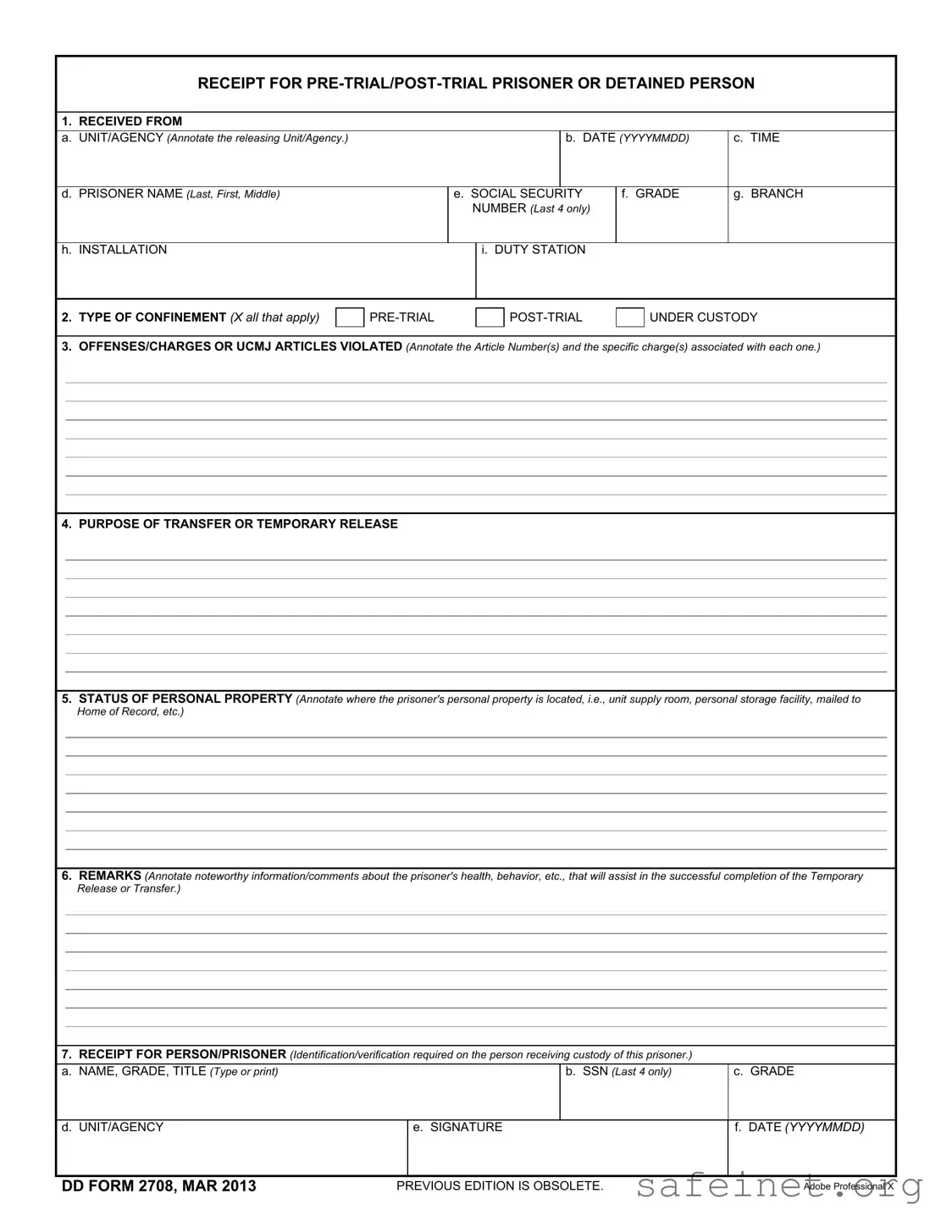
The DD Form 2708 serves a critical role in the management of pre-trial and post-trial prisoners or detained individuals within the military justice system. This form is primarily used to document the receipt of a prisoner during their transfer or temporary release, ensuring that all necessary information is accurately recorded. Key sections of the form include details about the releasing unit or agency, the date and time of transfer, and the personal information of the prisoner, such as their name, Social Security number, and military branch. Additionally, the form requires an indication of the type of confinement—whether pre-trial, post-trial, or under custody—along with a comprehensive list of offenses or charges under the Uniform Code of Military Justice (UCMJ). It also captures essential details regarding the purpose of the transfer, the status of the prisoner’s personal property, and any remarks that may provide insight into the individual's health or behavior. Finally, the form mandates identification verification for the person receiving custody of the prisoner, ensuring accountability and security throughout the process. This structured approach not only aids in maintaining accurate records but also enhances the overall management of detainees within the military framework.
| Fact Name | Fact Description |
|---|---|
| Form Purpose | The DD 2708 form is a receipt used for the transfer or temporary release of a pre-trial or post-trial prisoner. |
| Receiving Agency | The form requires information about the unit or agency that is releasing the prisoner. |
| Personal Information | It collects personal details of the prisoner, including name, social security number, and duty station. |
| Confinement Type | The form allows the user to indicate whether the confinement is pre-trial, post-trial, or under custody. |
| Offenses | Users must list the specific charges or UCMJ articles violated by the prisoner. |
| Property Status | The form documents the status of the prisoner's personal property during the transfer. |
| Remarks Section | A section is provided for remarks about the prisoner's health and behavior to aid in their transfer. |
| Custody Receipt | Identification and verification are required for the person receiving custody of the prisoner. |
Filling out the DD 2708 form is a crucial step in the process of documenting the transfer or temporary release of a prisoner or detained person. After completing this form, it will be used to ensure that all necessary information is accurately recorded and that the transfer process is conducted smoothly. Here are the steps to fill out the form:
What is the purpose of the DD 2708 form?
The DD 2708 form serves as a receipt for the transfer or temporary release of a prisoner or detained person. It documents essential information about the individual being transferred, including their name, social security number, and the circumstances of their confinement. This form helps ensure accountability during the transfer process and provides a record for both the releasing and receiving agencies.
What information is required on the DD 2708 form?
The form requires detailed information about the prisoner, including their name, social security number, and military branch. Additionally, it asks for the type of confinement (pre-trial, post-trial, or under custody), the offenses or charges, and the purpose of the transfer. Personal property status and any remarks regarding the prisoner's health or behavior are also included to assist in the transfer process.
Who is responsible for completing the DD 2708 form?
How is the DD 2708 form used after completion?
Failing to provide complete information in the RECEIVED FROM section. Each field must be filled out accurately, including the unit or agency name, date, time, and the prisoner's full name.
Neglecting to check all applicable boxes in the TYPE OF CONFINEMENT section. It's essential to mark all relevant categories, whether pre-trial, post-trial, or under custody.
Overlooking the OFFENSES/CHARGES OR UCMJ ARTICLES VIOLATED section. This part requires specific article numbers and charges; incomplete information can lead to confusion or delays.
Not specifying the PURPOSE OF TRANSFER OR TEMPORARY RELEASE. Clearly stating the reason for the transfer helps ensure that the process runs smoothly.
Failing to document the STATUS OF PERSONAL PROPERTY. Indicate where the prisoner's belongings are located, as this is important for their transition and security.
Omitting crucial details in the REMARKS section. Providing information about the prisoner's health and behavior can significantly aid in their successful transfer or temporary release.
The DD Form 2708 is essential for documenting the transfer or temporary release of a prisoner or detained person within the military justice system. Alongside this form, several other documents may also be necessary to ensure a smooth process. Below is a list of commonly used forms and documents that often accompany the DD Form 2708.
These forms and documents are integral to the military's administrative processes. Each serves a unique purpose and helps maintain accurate records, ensuring that the rights and responsibilities of service members are upheld throughout their interactions with the military justice system.
The DD Form 2708 serves as a receipt for the transfer of a prisoner or detained person and is similar to the DD Form 2707, which is the "Receipt for Inmate Transfer." Both documents are used to document the transfer of individuals in custody, ensuring that the receiving agency acknowledges the transfer. The DD Form 2707, like the 2708, includes details such as the prisoner's name, the reason for transfer, and the custody status, providing a clear record for both parties involved.
Another comparable document is the DD Form 2706, known as the "Prisoner Transfer Order." This form is utilized to officially authorize the movement of a prisoner from one location to another. While the DD Form 2708 focuses on the receipt aspect, the 2706 serves as the directive for the transfer, outlining the specifics of the move and ensuring all legal protocols are followed. Both forms emphasize the importance of documenting the transfer process to maintain accountability.
The DD Form 268, or the "Report of Investigation," also shares similarities with the DD Form 2708. This form is used to document incidents involving military personnel, including those in custody. While the DD Form 2708 focuses on the details of the prisoner’s transfer, the DD Form 268 captures the circumstances surrounding the detention. Both forms aim to maintain clear records that can be referenced in future proceedings or investigations.
In addition, the DD Form 2875, titled "System Authorization Access Request," can be considered similar in that it requires detailed information about individuals. While primarily focused on access to information systems, it requires personal identification details, much like the DD Form 2708. Both documents necessitate accurate information to ensure the correct handling of sensitive situations involving individuals under custody or surveillance.
The DD Form 149, which is an "Application for Correction of Military Records," also parallels the DD Form 2708 in its focus on personal records. Although it is used for correcting military records rather than transferring prisoners, both forms require detailed personal information and are crucial for maintaining accurate military documentation. They reflect the importance of having correct and accessible records in military operations.
Lastly, the DD Form 214, known as the "Certificate of Release or Discharge from Active Duty," shares some characteristics with the DD Form 2708. This form provides a summary of a service member’s time in the military, including reasons for discharge. While the DD Form 2708 is specific to prisoners, both documents serve to formalize the status of individuals within the military system, ensuring that proper records are kept regarding their status and transitions.
When filling out the DD 2708 form, it's important to ensure accuracy and completeness. Here are some key points to consider:
Understanding the DD Form 2708, which serves as a receipt for pre-trial or post-trial prisoners, is crucial for anyone involved in the military justice system. However, several misconceptions exist about this form. Here are seven common misunderstandings:
Clarifying these misconceptions can help ensure that all parties involved understand the importance and proper use of the DD Form 2708 in the military justice process.
The DD 2708 form serves as a critical document for the transfer or temporary release of prisoners or detained persons. Here are seven key takeaways regarding its completion and use: