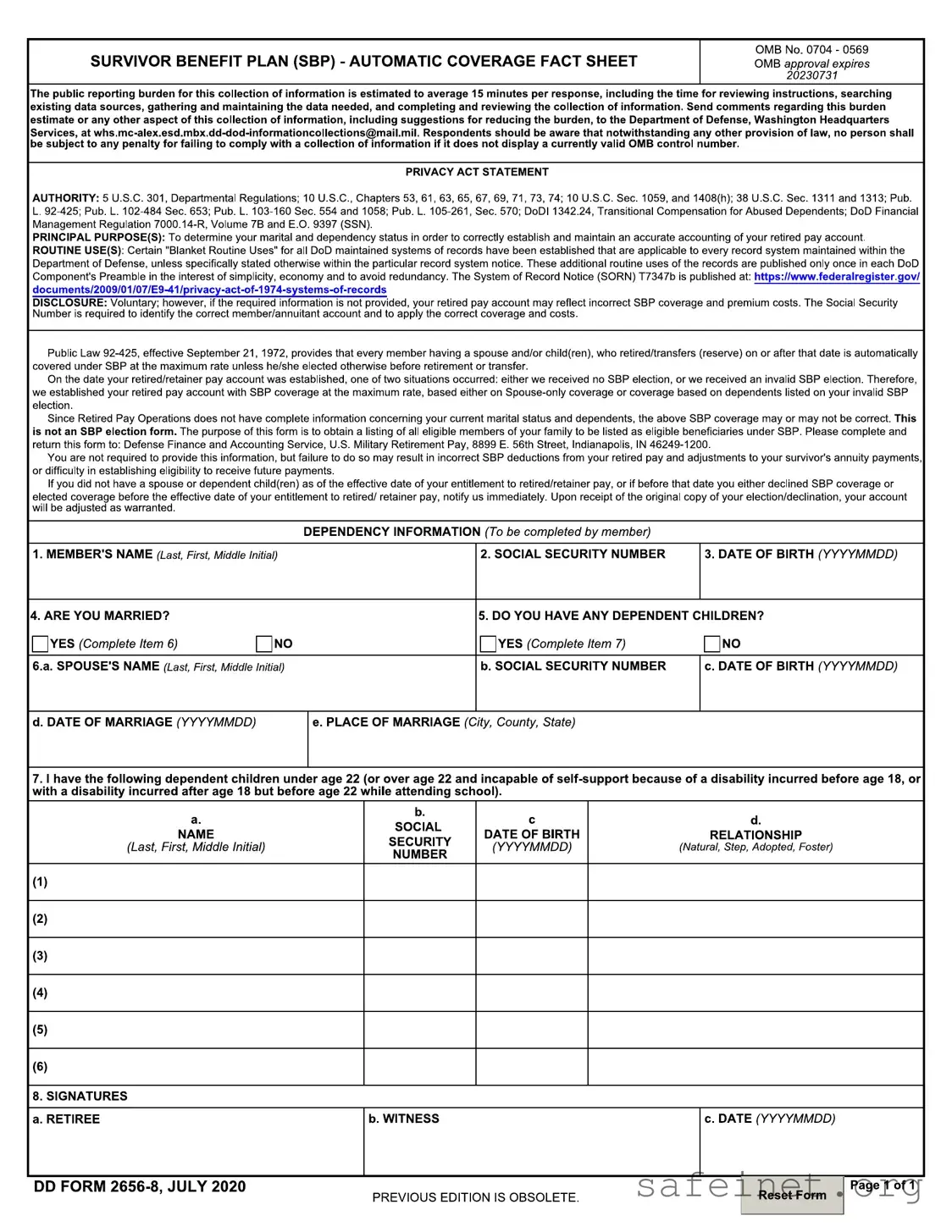
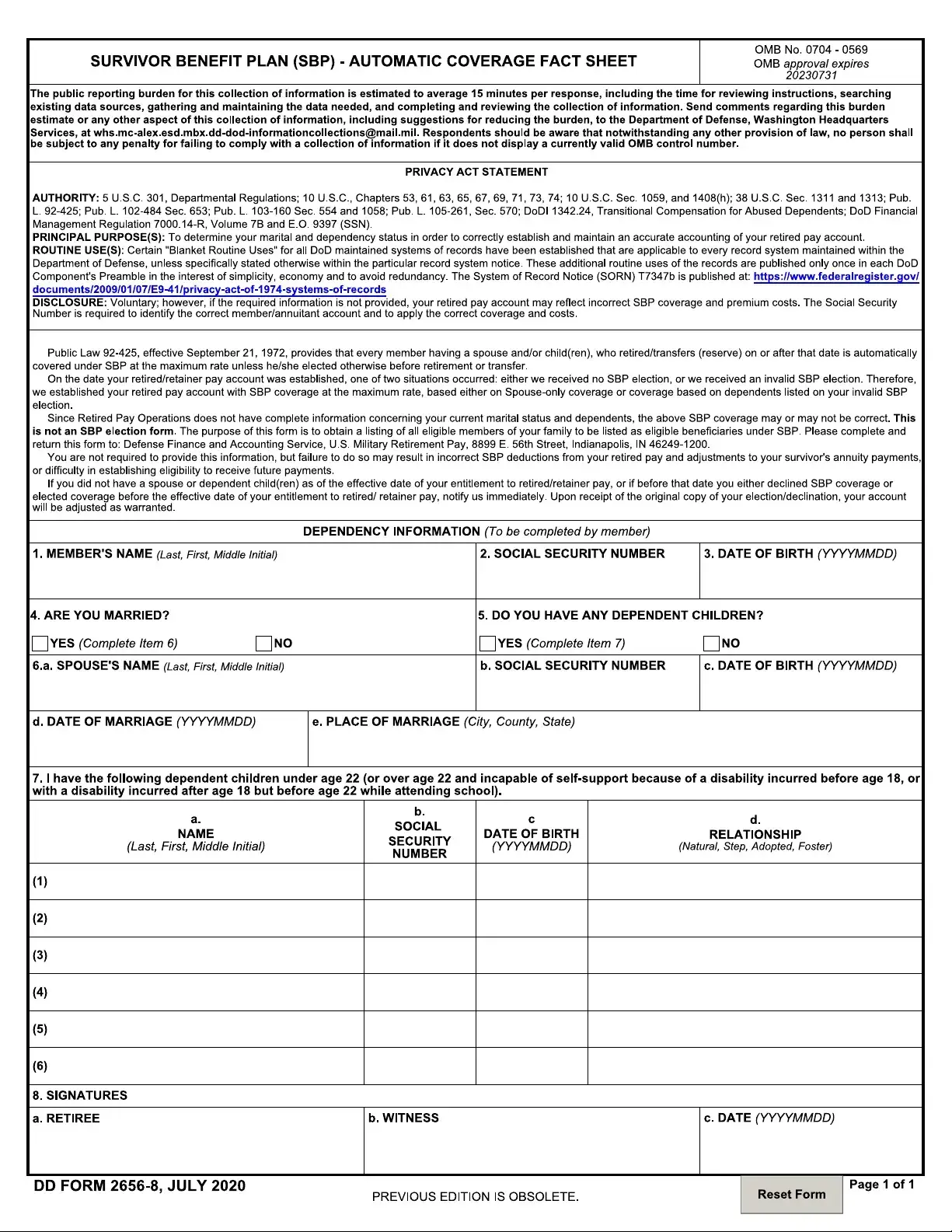
The DD Form 2656-8 is a crucial document for military retirees, specifically designed to ensure accurate management of the Survivor Benefit Plan (SBP). This form plays a vital role in establishing and maintaining your retired pay account by capturing essential information about your marital status and dependents. It is important to complete this form accurately to avoid potential discrepancies in SBP coverage and premium costs. The form is not an election form but rather a means to gather information about eligible beneficiaries who may receive benefits under the SBP. By providing details such as your spouse's name, Social Security number, and the names of dependent children, you help ensure that your account reflects the correct coverage. Failing to submit this information may lead to incorrect deductions from your retired pay or complications in future survivor annuity payments. The urgency of this matter cannot be overstated; it is essential to act promptly to secure your benefits and those of your loved ones.
| Fact Name | Details |
|---|---|
| Purpose | This form collects information to determine marital and dependency status for accurate retired pay account management. |
| Privacy Act Statement | The information collected is governed by several laws, including 5 U.S.C. 301 and 10 U.S.C. Chapters 53, 61, and others. |
| Disclosure | Providing information is voluntary. However, not completing the form may lead to incorrect SBP coverage and premium costs. |
| Automatic Coverage | Members with a spouse or children are automatically covered under SBP unless they elect otherwise before retirement. |
Completing the DD Form 2656-8 is essential for ensuring accurate records regarding your Survivor Benefit Plan (SBP) coverage. This process involves providing detailed information about your marital status and any dependent children. Follow the steps outlined below to fill out the form correctly.
After completing the form, it is crucial to return it to the appropriate address. Send the form to the Defense Finance and Accounting Service, U.S. Military Retirement Pay, at 8899 E. 56th Street, Indianapolis, IN 46249-1200. Ensuring that this information is accurate will help maintain correct SBP deductions and facilitate future payments.
What is the purpose of the DD Form 2656-8?
The DD Form 2656-8 is used to gather information about your marital and dependency status. This information is crucial for establishing and maintaining an accurate accounting of your retired pay account. It ensures that the Survivor Benefit Plan (SBP) coverage is correctly set up based on your current family situation.
Who needs to complete the DD Form 2656-8?
This form must be completed by military retirees who have a spouse or dependent children. If you have not provided your current marital status or details about your dependents, it is essential to fill out this form. Failure to do so may lead to incorrect deductions from your retired pay and complications with survivor benefits.
What happens if I do not submit the DD Form 2656-8?
If you choose not to submit the DD Form 2656-8, your retired pay account may reflect incorrect SBP coverage and premium costs. This could result in adjustments to your survivor's annuity payments or difficulties in establishing eligibility for future payments. Therefore, it is in your best interest to provide the necessary information.
Is the information provided on the DD Form 2656-8 confidential?
Yes, the information collected on this form is treated with confidentiality. The Privacy Act protects your data, and it will only be used for the purpose of establishing your retired pay account and ensuring accurate SBP coverage. You can trust that your information will be handled responsibly.
What should I do if my marital status or dependents change?
If your marital status changes or if you gain or lose dependents, it is important to notify the appropriate authorities immediately. You may need to submit a new DD Form 2656-8 or other relevant documentation to ensure that your retired pay account is updated accordingly. This will help maintain accurate SBP coverage and prevent any issues with your benefits.
Incomplete Personal Information: Failing to provide all required personal details, such as the member's full name, Social Security number, and date of birth, can lead to delays in processing. Ensure every field is filled out accurately.
Incorrect Marital Status: Misreporting marital status can cause significant issues. If you are married, you must complete the spouse's information. Omitting this can result in incorrect SBP coverage.
Neglecting Dependent Information: If you have dependent children, be sure to list them correctly. Providing their names, Social Security numbers, and dates of birth is essential for determining eligibility for benefits.
Missing Signatures: The form requires the retiree's signature. Without it, the submission is incomplete. Make sure to double-check that all necessary signatures are present before sending the form.
Failure to Review Before Submission: Rushing through the form can lead to errors. Take the time to review all entries for accuracy. This step can prevent complications and ensure that benefits are correctly established.
The DD Form 2656-8 is a crucial document for military retirees, specifically concerning the Survivor Benefit Plan (SBP). However, it often accompanies several other forms and documents that help ensure the proper management of benefits and entitlements. Below is a list of these related documents, each serving a unique purpose in the process.
Each of these documents plays a significant role in ensuring that military retirees and their families receive the benefits to which they are entitled. Understanding these forms can help streamline the process and avoid potential pitfalls in managing retirement and survivor benefits.
The DD Form 214, often referred to as the Certificate of Release or Discharge from Active Duty, serves as a crucial document for military personnel transitioning to civilian life. Like the DD 2656-8, it contains essential information about a service member's time in the military, including their discharge status and any awards received. This form is vital for veterans seeking benefits, as it verifies their service and can influence eligibility for programs such as the GI Bill or VA home loans. Both documents are foundational in establishing a service member’s rights and benefits upon retirement or separation from active duty.
The DD Form 1172-2, also known as the Application for Uniformed Services Identification Card, is another document similar to the DD 2656-8. This form is used to obtain ID cards for military dependents, which grant access to various benefits and services. Just as the DD 2656-8 collects information about dependents for the Survivor Benefit Plan, the DD 1172-2 ensures that eligible family members receive the identification necessary for accessing military healthcare and other resources. Both forms emphasize the importance of accurately reporting family status to secure benefits.
The SF 2809, or Health Benefits Election Form, is used by federal employees, including military personnel, to enroll in health insurance plans. Similar to the DD 2656-8, this form requires individuals to provide information about their dependents to determine eligibility for coverage. Both documents play a significant role in managing benefits, ensuring that the right individuals are covered under the respective plans. Accurate completion of the SF 2809 is critical, just as it is for the DD 2656-8, to avoid potential gaps in coverage.
The VA Form 21-526EZ, known as the Application for Disability Compensation and Related Compensation Benefits, is another important document for veterans. Like the DD 2656-8, it requires detailed information about the veteran’s status and dependents to process claims effectively. This form is essential for veterans seeking compensation for service-related disabilities, and it highlights the need for accurate information regarding family members, as benefits can extend to dependents in certain situations. Both forms serve to protect the rights and benefits of military families.
The DD Form 2656, which is the basic Survivor Benefit Plan Election form, directly relates to the DD 2656-8. While the latter focuses on automatic coverage and dependency information, the former is used to make specific elections regarding SBP coverage. Both forms are critical in ensuring that service members and their families receive the appropriate benefits after retirement. They underscore the importance of making informed decisions about coverage options and maintaining accurate records of family status.
The Form W-4, Employee’s Withholding Certificate, is used by employees to determine the amount of federal income tax withheld from their paychecks. While not specifically military-focused, it shares similarities with the DD 2656-8 in that it requires personal and dependent information to calculate withholding accurately. Both forms emphasize the importance of providing correct information to ensure proper financial management, whether it be for tax purposes or for determining benefits under military retirement plans.
The Form 1099-R, which reports distributions from pensions, annuities, retirement plans, and other similar sources, is relevant for retirees. It relates to the DD 2656-8 as both involve financial aspects of retirement benefits. The 1099-R provides crucial information for tax reporting, while the DD 2656-8 ensures that survivors receive the correct benefits. Both documents highlight the importance of accurate reporting and record-keeping in the context of retirement finances.
The Form 4856, Developmental Counseling Form, is used for documenting counseling sessions within military environments. While its primary purpose is different, it shares a commonality with the DD 2656-8 in that both involve maintaining accurate records of service members’ statuses and experiences. The 4856 form can impact a service member's career progression, just as the DD 2656-8 can influence their financial security after retirement. Both documents underscore the importance of clear communication and documentation in military life.
Finally, the Form DD 1300, Report of Casualty, is used to report the death of a service member. This form is similar to the DD 2656-8 in that it deals with the consequences of military service on families. While the DD 2656-8 focuses on ensuring that survivors are accounted for in benefit plans, the DD 1300 serves to officially document a loss, triggering the necessary processes for survivor benefits. Both forms are vital in supporting military families during significant life events.
When filling out the DD 2656-8 form, it's important to follow certain guidelines to ensure accuracy and completeness. Here’s a list of things you should and shouldn’t do:
Here are seven common misconceptions about the DD Form 2656-8:
Filling out the DD Form 2656-8 is essential for ensuring that your Survivor Benefit Plan (SBP) coverage is accurate. Here are some key takeaways to keep in mind:
By following these guidelines, you can help ensure that your SBP coverage is set up correctly, providing peace of mind for you and your beneficiaries.