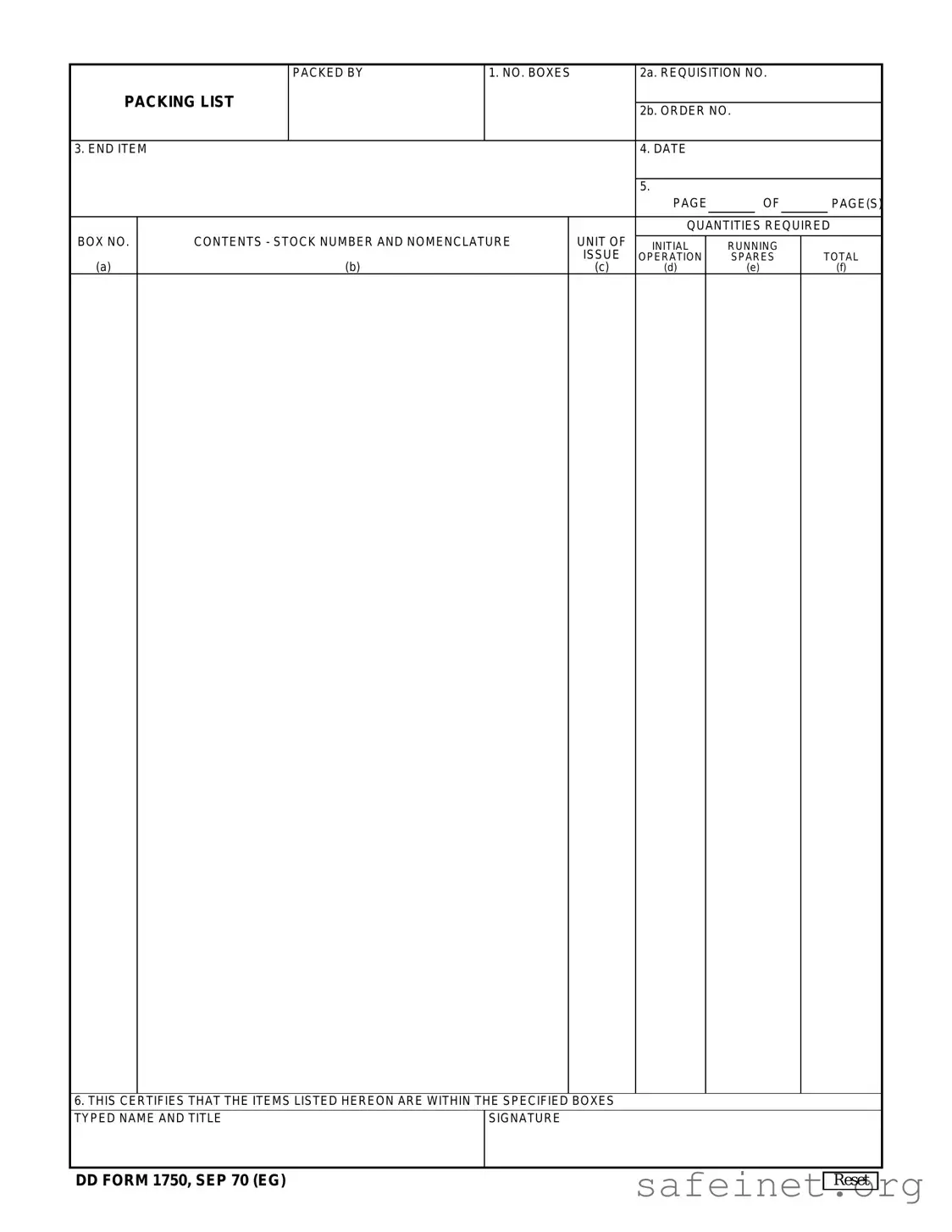
The DD Form 1750, often referred to as a packing list, serves a crucial role in the logistics and supply chain management of the U.S. Department of Defense. This form is designed to document the contents of shipments, ensuring that all items are accurately accounted for and properly organized. Key elements of the form include the number of boxes in a shipment, requisition and order numbers, and detailed descriptions of the end items being shipped. Each entry is meticulously categorized, allowing for easy reference and verification. For instance, it specifies stock numbers, nomenclature, and the quantities of items required for both initial operations and running spares. The form also includes a certification section, where the preparer attests to the accuracy of the listed items. Additionally, the reverse side of the form provides important notes to the consignee, guiding them on how to utilize the packing list effectively. This structured approach not only aids in inventory management but also facilitates communication regarding the shipment, making the DD Form 1750 an indispensable tool in military logistics.

|
|
PACKED BY |
1. NO. BOXES |
|
2a. REQUISITION NO. |
|
|
||
PACKING LIST |
|
|
|
|
|
|
|
|
|
|
|
|
2b. ORDER NO. |
|
|
||||
|
|
|
|
|
|
|
|||
|
|
|
|
|
|
|
|
|
|
3. END ITEM |
|
|
|
|
4. DATE |
|
|
|
|
|
|
|
|
|
|
|
|
|
|
|
|
|
|
|
5. |
|
|
|
|
|
|
|
|
|
PAGE |
|
OF |
|
PAGE(S) |
|
|
|
|
|
|
|
|
|
|
BOX NO. |
CONTENTS - STOCK NUMBER AND NOMENCLATURE |
UNIT OF |
QUANTITIES REQUIRED |
||||||
INITIAL |
RUNNING |
TOTAL |
|||||||
(a) |
|
(b) |
|
ISSUE |
OPERATION |
SPARES |
|||
|
|
(c) |
(d) |
(e) |
|
(f) |
|||
6. THIS CERTIFIES THAT THE ITEMS LISTED HEREON ARE WITHIN THE SPECIFIED BOXES
TYPED NAME AND TITLE |
SIGNATURE |
DD FORM 1750, SEP 70 (EG)
Reset

NOTES TO CONSIGNEE
The listing shown on the reverse side, together with pertinent notations relative to each item included, is furnished for your information and guidance only. In the case of lists covering equipment sets, one copy may be retained for reference and used as a supporting document to property books and the other copy retained with the equipment as a component parts listing. For the purpose of clarification, explanations of the various entries on this Packing List are furnished.
ITEM 1. The number of boxes in a set.
ITEMS 2a. & b. The requisition number appearing on the DD Form
ITEM 3. The stock number, nomenclature, type number (when available), and the directive under which the end item was assembled. Not applicable to shipments consisting only of miscellaneous repair parts and accessories for the assembly, set or unit in which case this entry will contain such a notation in lieu of the information cited above (See 5.3.1.1).
ITEM 4. Date of preparation.
ITEM 5.
Column a. This column will be used when two or more boxes are required for the equipment. It will indicate the number of the container in which the items are packed.
Column b. This space contains a listing of items contained within the box, which are identified by stock number and nomenclature. When an FSN is not
applicable, the manufacturer's code (See 5.2.2.10) and part number shall be used.
NOTE: As required, due to out of stock position within the DOD supply system, a component parts shortage which will not hinder operational functions may be waived by higher authority and will be so indicated to the right of the nomenclature. Waivers noted thereon should be requisitioned through normal supply channels.
Column c.
Column d. "Initial Operation" - Items which are required for operation of the equipment.
Column e. "Running Spares" - Those items shipped concurrently with the equipment as spare parts and accessories.
NOTE: Columns d and e will be used on an optional basis.
"Total" -
ITEM 6.
DD FORM 1750 Reverse, SEP 70
| Fact Name | Fact Description |
|---|---|
| Form Purpose | The DD Form 1750 serves as a packing list for military shipments, detailing the contents of boxes and related information. |
| Number of Boxes | Item 1 specifies the total number of boxes included in a shipment. |
| Requisition and Order Numbers | Items 2a and 2b require the requisition number and order number, which are essential for tracking the shipment. |
| End Item Information | Item 3 includes details about the end item, such as stock number and nomenclature, unless the shipment consists only of miscellaneous parts. |
| Date of Preparation | Item 4 indicates the date when the packing list was prepared, ensuring that the information is current. |
| Box Contents | Item 5 provides a breakdown of the contents in each box, including stock numbers and nomenclature. |
| Operational Items | Columns d and e categorize items as either initial operation requirements or running spares, which are optional to include. |
| Certification | Item 6 certifies that the items listed are contained within the specified boxes, requiring a signature from an authorized individual. |
| Governing Laws | The use of the DD Form 1750 is governed by Department of Defense regulations and policies, which may vary by state. |
Filling out the DD 1750 form is an important task that requires attention to detail. This form is used to create a packing list for items being shipped, ensuring that all necessary information is accurately recorded. Once the form is completed, it will serve as a reference for both the sender and the recipient regarding the contents of the shipment.
After completing the DD 1750 form, review it for any errors or omissions. Ensure that all necessary fields are filled out correctly. This will help facilitate a smooth shipping process and ensure that the recipient receives all expected items without confusion.
What is the purpose of the DD Form 1750?
The DD Form 1750 serves as a packing list for shipments of military equipment and supplies. It provides detailed information about the items being shipped, including their stock numbers, quantities, and packaging details. This form helps ensure that all items are accounted for and assists in the proper handling and tracking of military shipments.
What information is required on the DD Form 1750?
Several key pieces of information are needed on the DD Form 1750. This includes the number of boxes in a set, requisition and order numbers, the stock number and nomenclature of items, and the date of preparation. Additionally, the form requires details about the contents of each box, including quantities and any necessary notes about the items.
How do I fill out the packing list section of the DD Form 1750?
To fill out the packing list section, start by indicating the number of boxes in the set. Next, list the requisition and order numbers. For each item, provide the stock number and nomenclature, along with the quantities required. You will also need to specify if the items are for initial operation or running spares. Ensure that all information is accurate and clear to avoid any confusion during the shipment process.
What should I do if an item is out of stock?
If an item is out of stock, a waiver may be granted by higher authority. This waiver should be noted on the DD Form 1750 next to the nomenclature of the item. It is essential to follow normal supply channels to requisition the waived items, ensuring that operational functions are not hindered.
Who is responsible for signing the DD Form 1750?
The individual who prepares the DD Form 1750 must sign it, certifying that the items listed are accurate and within the specified boxes. This signature confirms that the packing list is complete and that the information provided is correct, which is crucial for accountability.
Can I keep a copy of the DD Form 1750 for my records?
Yes, it is advisable to keep a copy of the DD Form 1750 for your records. One copy can be retained for reference and used as a supporting document for property books, while another copy should remain with the equipment as a component parts listing. This practice helps maintain accurate records and aids in future inventory management.
What happens if I need to make changes to the DD Form 1750 after it has been completed?
If changes are necessary after the DD Form 1750 has been completed, it is important to document those changes clearly. You may need to issue an updated form or make notations directly on the existing form, depending on the nature of the changes. Always ensure that any modifications are communicated to all relevant parties involved in the shipment.
Is there a specific format for the DD Form 1750?
The DD Form 1750 has a specific format that must be followed. It includes designated sections for listing items, quantities, and other relevant information. Adhering to this format is crucial for clarity and compliance with military logistics requirements. Ensure that you use the most current version of the form to avoid any discrepancies.
Omitting Required Information: Many individuals fail to fill out all necessary fields, such as the requisition number or order number. This omission can lead to delays in processing the shipment.
Incorrect Stock Numbers: Providing inaccurate stock numbers or nomenclature is a common mistake. This can result in the wrong items being shipped or difficulties in tracking the shipment.
Improper Date Entry: Some people forget to include the date of preparation or enter an incorrect date. This can create confusion regarding when the items were packed and shipped.
Misunderstanding Box Numbering: Failing to correctly indicate the box numbers can lead to complications. Each box should be numbered sequentially to ensure clarity in the packing list.
Neglecting to Sign: A signature is required to certify that the information provided is accurate. Skipping this step can invalidate the form and cause issues with the shipment.
Ignoring Notes to Consignee: Some individuals overlook the notes provided on the reverse side of the form. These notes contain important information and guidance that can help prevent mistakes.
The DD Form 1750 is a packing list used primarily by the Department of Defense to document the contents of boxes being shipped. Several other forms and documents are often utilized alongside this form to ensure accurate tracking, accountability, and compliance during the shipping process. Below is a list of commonly associated documents.
Each of these forms plays a critical role in the logistics and supply chain processes within the Department of Defense. Using them in conjunction with the DD Form 1750 helps maintain clarity and accountability throughout the shipping and receiving phases.
The DD Form 1348-1 is a key document used in the military supply chain, similar to the DD 1750. It serves as a requisition and receipt document for items being ordered or shipped. Just like the DD 1750, it includes essential details such as the stock number, quantity, and description of items. The DD 1348-1 is often the initial point of reference for tracking orders, making it crucial for ensuring that the correct items are received and accounted for, just as the DD 1750 does for packing lists.
The DD Form 1149 is another document that shares similarities with the DD 1750. This form is used for requisitioning and shipping supplies and equipment. It provides a comprehensive list of items being shipped, including quantities and descriptions. Both forms require attention to detail to ensure accuracy in the items listed. The DD 1149, however, is more focused on the requisition process, while the DD 1750 emphasizes packing and shipping logistics.
Another related document is the SF 364, also known as the Report of Discrepancy. This form is utilized when there are discrepancies in the shipment, such as missing or damaged items. Like the DD 1750, it requires specific information about the items in question. Both documents aim to maintain accountability and traceability within the supply chain, ensuring that any issues can be promptly addressed.
The DD Form 250, or Material Inspection and Receiving Report, is also comparable to the DD 1750. This form is used to document the acceptance of goods and services. It includes details about the items received, similar to the packing list format of the DD 1750. Both forms are critical for verifying that shipments meet the required specifications and for facilitating the acceptance process in military logistics.
Lastly, the DA Form 2062, also known as the Hand Receipt, is similar in that it tracks the issuance and accountability of property. It lists items being issued to personnel, including descriptions and quantities. While the DD 1750 focuses on packing and shipping, the DA Form 2062 emphasizes the transfer of responsibility for items. Both documents play a vital role in ensuring that military supplies are properly managed and accounted for throughout their lifecycle.
When filling out the DD 1750 form, attention to detail is crucial. Here are ten important dos and don'ts to consider:
Here are some common misconceptions about the DD 1750 form:
Here are some key takeaways about filling out and using the DD Form 1750: